
Understanding California Employee Leave Rights, Benefits, and Job Protections
By Matthew J. Ruggles
Introduction: California Leave Law Is a System, Not a Single Rule
A California employee who says, “I need a leave of absence,” is usually asking at least four different legal questions: May I take time off? Must my employer keep my job open? Will I receive pay or benefits? What happens when I return? Those questions may be governed by different statutes, and the answers often overlap without being identical.
I have litigated, advised on, or otherwise dealt with thousands of leave-of-absence issues during more than three decades of employment-law practice. The recurring lesson is simple: the word leave sounds singular, but California law treats it more like a crowded freeway interchange. CFRA, FMLA, FEHA, the ADA, pregnancy-disability rules, paid sick leave, wage-replacement programs, workers’ compensation, and several special-purpose statutes may all point in different directions. The good news is that the signs are readable once you know what to look for.
This guide is written for California employees. It explains the most important state and federal protections, the limits of those protections, the notice and medical-certification rules, the right to reinstatement, what happens to bonuses and commissions, when termination may still be lawful, and how to preserve evidence if something goes wrong. It also links to focused articles on this site so this page functions as a cornerstone hub, not a substitute that competes with every narrower topic.
Important distinction: paid benefits and job protection are not the same thing. California Paid Family Leave or State Disability Insurance may replace part of your wages, while CFRA, FMLA, FEHA, PDL, the ADA, the PWFA, a collective-bargaining agreement, or an employer policy may protect your job. Sometimes both apply. Sometimes only one applies. Sometimes neither applies — and that is usually where the trouble starts.
I have litigated, advised on, or otherwise dealt with thousands of leave-of-absence issues during more than three decades of employment-law practice. That experience informs the practical warnings, examples, and case studies throughout this guide.
Ten Key Takeaways
- A leave can be approved by Human Resources but still lack statutory job protection; conversely, a legally protected leave can exist even if HR never uses the correct acronym.
- CFRA generally applies to employers with five or more employees; FMLA generally requires a covered employer and an employee who works at a location with at least 50 employees within 75 miles.
- An employee ordinarily needs 12 months of service and 1,250 hours in the preceding 12 months for CFRA or FMLA, but pregnancy-disability leave and disability accommodation have different eligibility rules.
- Employees do not need to say “CFRA,” “FMLA,” “FEHA,” or “ADA,” but they must provide enough information to put the employer on notice that leave may be legally protected.
- A fixed leave can be a reasonable accommodation even after CFRA/FMLA ends; an open-ended leave with no reasonably certain return date is much harder to protect.
- Protected leave is not immunity from a genuine reduction in force, preexisting discipline, misconduct, or a position elimination that would have occurred anyway.
- An employer ordinarily may not count protected leave as an attendance point, a negative performance factor, or a reason to deny an otherwise-earned benefit.
- Whether a bonus or commission is due turns on when it was earned, the written plan, objective conditions, equal treatment of comparable leave, and whether the employer is using leave as a pretext for forfeiture.
- The employee’s best evidence is usually created before the dispute: written requests, medical certifications, HR notices, return-to-work restrictions, policy versions, pay plans, calendars, and contemporaneous emails.
- Deadlines can be short and overlapping. An employee who suspects retaliation or interference should obtain legal advice promptly rather than waiting for an internal appeal to run its course.
The Four Questions That Determine Whether Leave Is Protected
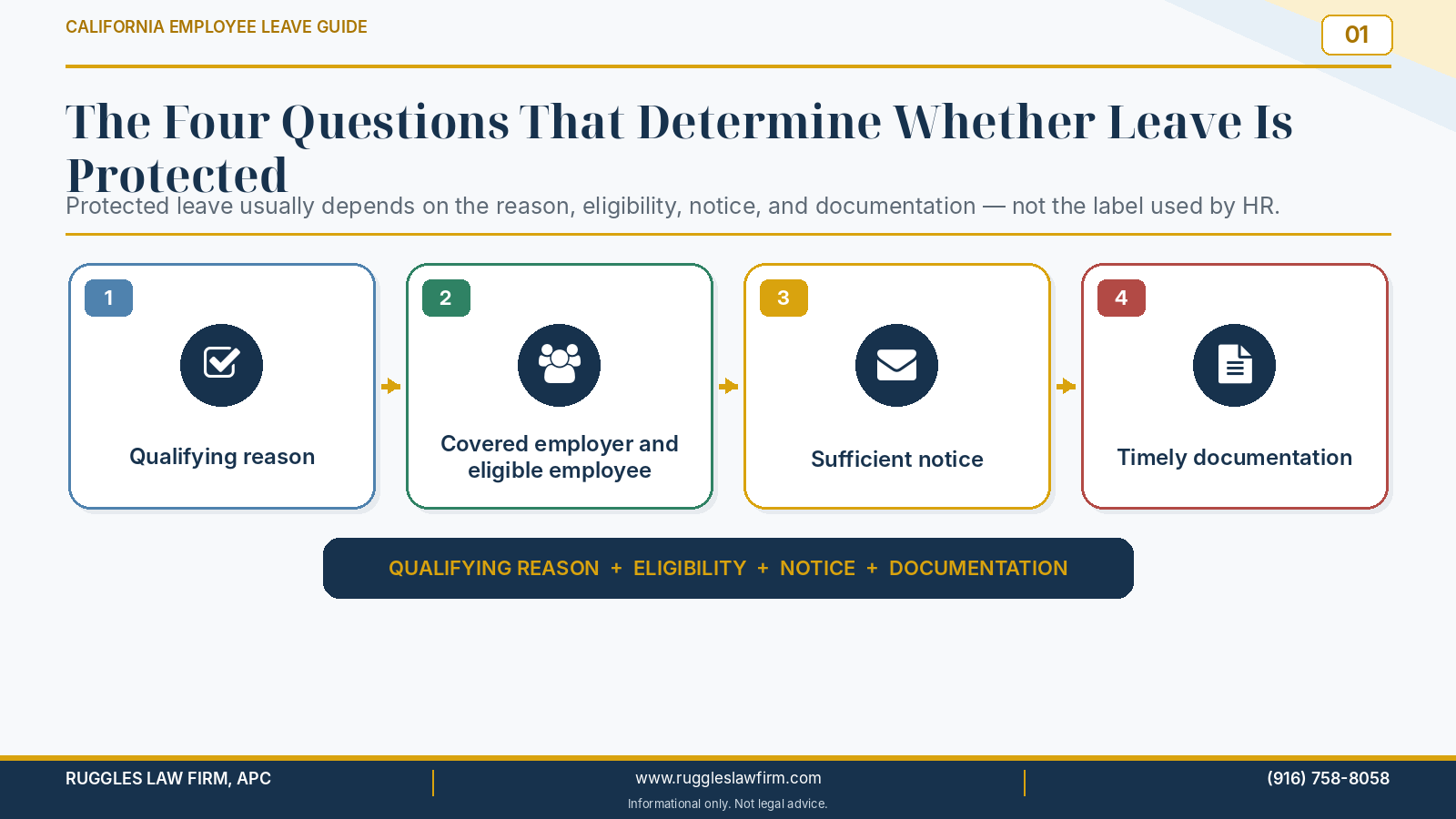
The phrase protected leave is often used too casually. A leave may be protected by statute, protected as a disability accommodation, protected by a contract or policy, or merely approved as a discretionary personal leave. The source of protection determines how long the leave lasts, what benefits continue, what information the employer may request, and what reinstatement rights apply.
Question 1: Why is the employee taking leave?
The reason for leave is the starting point. A serious health condition, care for a covered family member, pregnancy disability, bonding with a new child, jury service, military service, bereavement, reproductive loss, victim-related safety needs, organ donation, school activities, and several other reasons may trigger specific statutes. A vacation, a move, a sabbatical, ordinary childcare problems, or a desire to “reset” may be approved, but they are not automatically protected.
Question 2: Is the employer covered, and is the employee eligible?
Different laws use different thresholds. CFRA and FEHA generally reach employers with five or more employees. The ADA and PWFA generally reach employers with 15 or more. FMLA generally applies to employers with at least 50 employees and has a worksite-distance eligibility rule. Some special-purpose leaves apply at 15, 25, or 50 employees; some apply regardless of size. Eligibility can also depend on months of service, hours worked, or advance notice.
Question 3: Did the employee provide enough notice?
Employees do not have to diagnose themselves or deliver a law-school outline to HR. They do have to communicate facts that reasonably suggest a potentially protected need for time off. “I will not be at work for a while” may be too vague. “My doctor is taking me off work for six weeks for treatment” is usually enough to trigger follow-up duties. When the need is foreseeable, advance notice matters; when it is an emergency, notice should be given as soon as practicable.
Question 4: Was required documentation supplied?
A doctor’s note is not a magic wand, but a timely and adequate certification can be critical. CFRA, FMLA, PDL, FEHA, ADA, workers’ compensation, paid sick leave, and employer policies do not all permit the same inquiries. An employer may request information tied to the need, duration, and functional restrictions, but it generally does not receive unrestricted access to an employee’s medical history.
“plainly prohibits the use of FMLA-protected leave as a negative factor in an employment decision”
Bachelder v. America West Airlines, Inc., 259 F.3d 1112, 1125 (9th Cir. 2001).
Protected leave cannot lawfully be converted into an attendance strike, a poor-review factor, or a hidden reason for termination.
Protected leave is a shield, not a force field
A protected leave prevents an employer from punishing the employee because of the leave and usually creates restoration rights. It does not erase misconduct, guarantee a bonus that was never earned, stop a legitimate layoff, or require the employer to hold a job forever. The practical legal question is often causation: Did the adverse action occur because of protected leave, or would the same action have occurred for a lawful reason anyway?
Professional reality check
HR software loves acronyms. Courts care more about facts. A request can be protected even when no one clicked the correct dropdown menu — although employees should still make the record as clear as possible.
What Is Protected — and What Is Not
| Protected | Not Automatically Protected |
|---|---|
|
• Time off for a qualifying reason under an applicable statute or reasonable-accommodation duty. |
• A discretionary leave for vacation, travel, relocation, or a personal project with no qualifying legal basis. |
|
• Good-faith notice that gives the employer enough information to recognize a potentially protected need. |
• An employee’s unexplained absence or refusal to communicate when communication is practicable. |
|
• Compliance with reasonable call-in, certification, and update requirements when the employee can comply. |
• Fraudulent documentation, material misrepresentation, or abuse of leave. |
|
• Freedom from retaliation, attendance points, or negative treatment because the employee exercised protected rights. |
• Immunity from a genuine layoff, preexisting misconduct investigation, or termination that would have occurred anyway. |
|
Protected Example
A five-employee company is told that an employee’s physician requires six weeks off for cancer treatment. The employee follows the certification process. Even if CFRA eligibility is missing, FEHA accommodation duties may protect the finite leave.
|
Not-Protected Example
An employee asks for six weeks to travel abroad, receives a denial, and stops reporting to work without any medical or statutory reason. Approval would have been discretionary, not legally required.
|
Unsure whether your leave is legally protected?
The answer may depend on more than the label HR used. A focused review of your reason for leave, eligibility, notices, medical documentation, and timing can identify protections before an absence becomes a termination dispute.
Request an initial case consultation | (916) 758-8058
CFRA: California’s Core Family and Medical Leave Protection
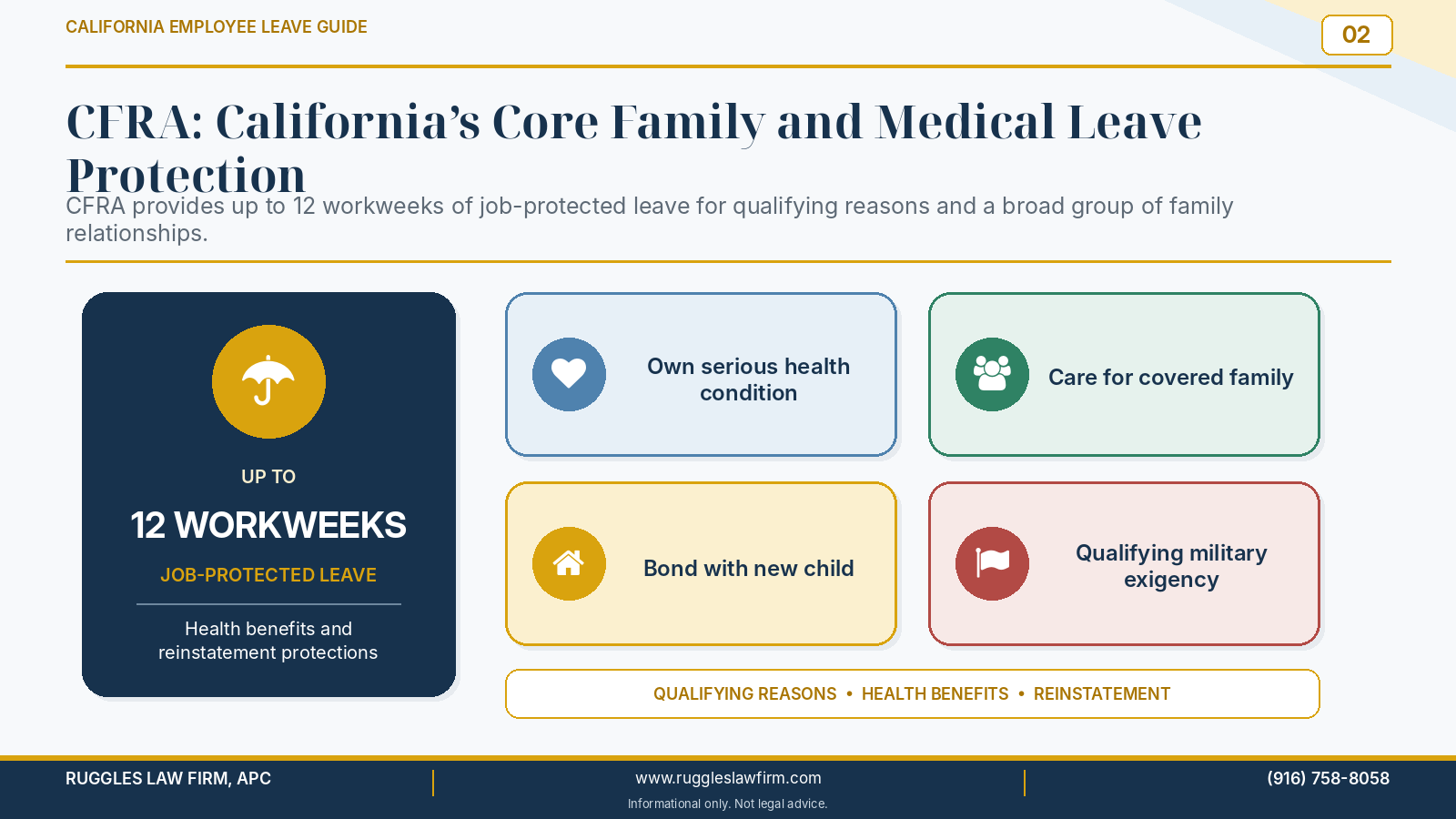
The California Family Rights Act — commonly called CFRA — is the primary state job-protection statute for family and medical leave. California Government Code section 12945.2 and the CFRA regulations generally apply to employers with five or more employees.
Who is eligible for CFRA?
An employee generally must have worked for the employer for at least 12 months and performed at least 1,250 hours of service during the 12 months immediately preceding leave. The 12 months need not be consecutive, subject to regulatory limits on very old service gaps. Unlike FMLA, CFRA does not impose a 50-employees-within-75-miles requirement.
What reasons qualify?
- The employee’s own serious health condition, excluding disability due to pregnancy, childbirth, or related medical conditions that are ordinarily covered by PDL.
- Care for a spouse, registered domestic partner, child of any age, parent, parent-in-law, grandparent, grandchild, sibling, or a designated person related by blood or whose association is the equivalent of a family relationship.
- Bonding with a child after birth, adoption, or foster placement within one year of the event.
- A qualifying exigency related to covered active duty of a spouse, domestic partner, child, or parent in the Armed Forces.
A serious health condition generally involves inpatient care or continuing treatment by a health-care provider. Ordinary short illnesses may not qualify, but chronic conditions, pregnancy-related conditions, inpatient procedures, periods of incapacity plus treatment, and restorative surgery may. The analysis is medical and regulatory, not based on whether a supervisor thinks the condition “sounds serious.”
How much leave is available?
CFRA generally provides up to 12 workweeks in the employer’s designated 12-month period. For an employee with a variable schedule, the calculation is based on the employee’s usual hours. Intermittent or reduced-schedule leave is available when medically necessary. Bonding leave is generally taken in blocks of at least two weeks, but an employer must grant at least two requests for shorter increments.
Benefits and reinstatement
During CFRA leave, the employer generally must maintain group health coverage on the same terms as if the employee remained actively at work. At the end of leave, the employee generally must be returned to the same or a comparable position. A comparable job must be virtually identical in pay, benefits, status, duties, schedule, and location — not a consolation prize with a new title and a much worse future.
CASE STUDY: A hospital form can be enough notice
What happened: In Avila, an employee was hospitalized and submitted a hospital form saying he had been hospitalized for several days. The employer applied its attendance policy and terminated him.
Legal analysis: The Court of Appeal held that the form could provide sufficient information to trigger CFRA duties, even though it did not use the words “CFRA leave.” Avila v. Continental Airlines, Inc., 165 Cal.App.4th 1237, 1258-1259 (2008).
Employee takeaway: Give clear notice whenever possible, but do not assume the law disappears because the employee did not recite a statute. Employers must respond to facts that reasonably suggest protected leave.
CASE LAW IN ONE SENTENCE
“notice on a hospital’s preprinted form … may be sufficient”
Avila v. Continental Airlines, Inc., 165 Cal.App.4th 1237, 1258 (2008).
CFRA notice is functional. The employee must provide enough information to trigger inquiry; legal terminology is not required.
CFRA does not authorize leave abuse
An employer may require reasonable notice, medical certification, periodic status updates, and compliance with lawful call-in procedures. CFRA does not protect dishonesty about the need for leave or activities that materially contradict the certified restrictions. Richey v. AutoNation, Inc., 60 Cal.4th 909 (2015), confirms that an employer may discipline genuine misuse, although the employer still needs reliable evidence and a fair, nonretaliatory process.
A designated person is not an unlimited category
CFRA allows an employee to identify one designated person in a 12-month period. The relationship must be by blood or the equivalent of a family relationship. An employer may ask the employee to identify the person when leave is requested, but it should not demand intrusive proof beyond what the statute and regulations permit.
What Is Protected — and What Is Not
| Protected | Not Automatically Protected |
|---|---|
|
• Up to 12 workweeks for the employee’s serious health condition, qualifying family care, bonding, or military exigency when eligibility is met. |
• Routine family errands or companionship that do not amount to care for a serious health condition. |
|
• Intermittent or reduced-schedule leave when medically necessary, and qualifying bonding leave in permitted increments. |
• More than 12 workweeks solely under CFRA, unless another law or policy supplies additional protection. |
|
• Continuation of group health benefits and restoration to the same or a comparable position, subject to lawful exceptions. |
• Failure to provide requested certification after a fair opportunity to comply, absent unusual circumstances. |
|
• Care that includes physical assistance, psychological comfort, arranging treatment, or providing essential support to a covered family member. |
• A demand to return to a position that was genuinely eliminated for reasons unrelated to leave. |
|
Protected Example
An employee with 18 months of service and 1,600 hours requests eight weeks to care for her adult son during chemotherapy. Her employer has 12 employees. CFRA can protect the leave even though FMLA may not apply.
|
Not-Protected Example
An employee asks for three weeks to help a healthy sibling move and settle into a new apartment. The sibling is covered family, but the reason is not care for a serious health condition.
|
Was your CFRA request delayed, denied, or counted against you?
CFRA disputes often turn on eligibility, the adequacy of notice, medical certification, the employer’s leave-year method, and the reason given for denying reinstatement. Preserve every notice and policy version.
Request an initial case consultation | (916) 758-8058
FMLA and CFRA: Similar Rights, Important Differences
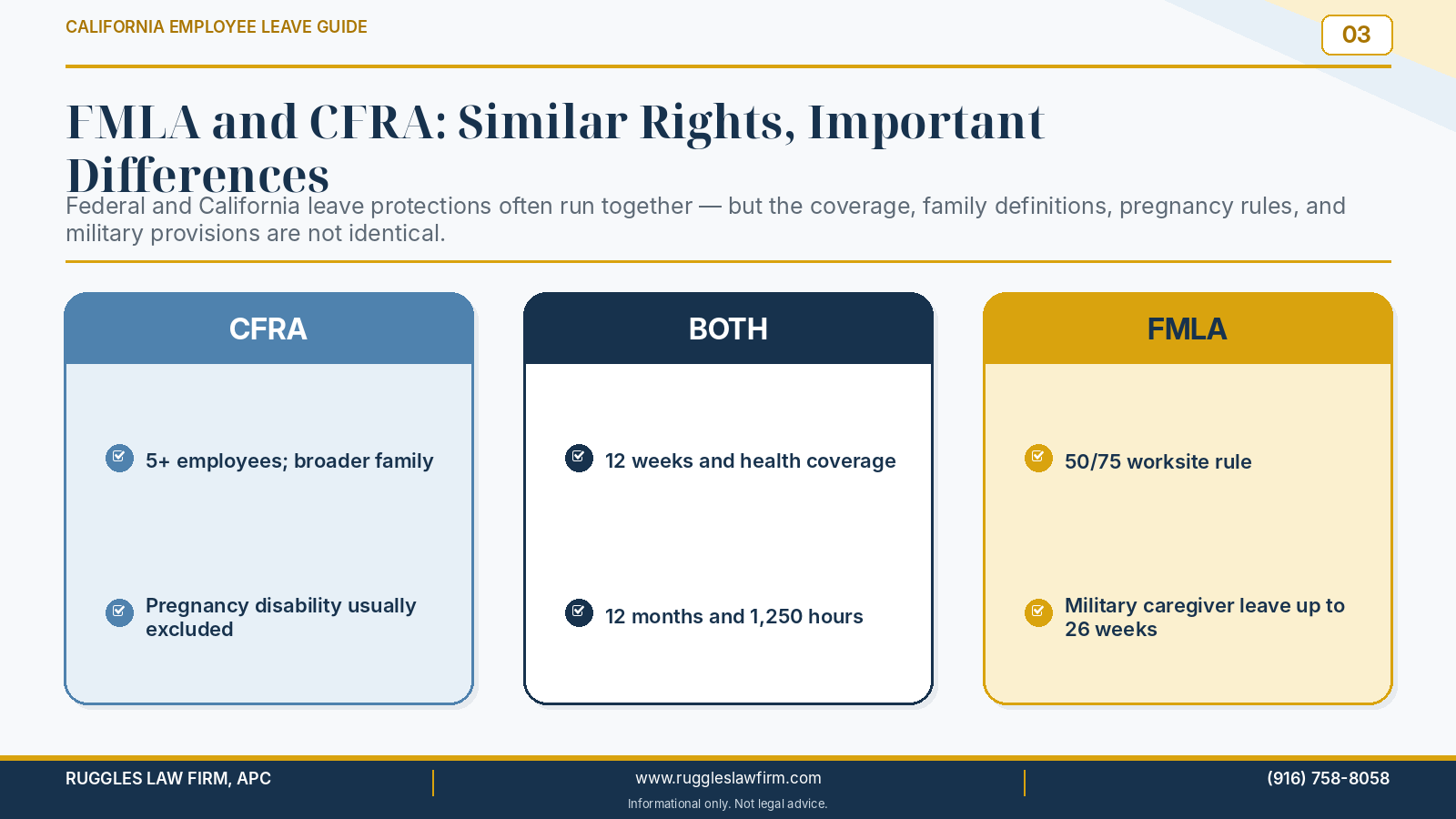
The federal Family and Medical Leave Act and CFRA are close relatives, not identical twins. Where both apply to the same absence, the employer ordinarily runs them concurrently. Where only one applies, the employee may have rights that HR overlooks by treating the laws as interchangeable.
| Issue | CFRA | FMLA |
|---|---|---|
| Employer coverage | Generally 5+ employees. | Generally 50+ employees; public agencies and schools have special coverage rules. |
| Employee worksite rule | No 50-within-75-miles rule. | Employee generally must work where employer has 50 employees within 75 miles. |
| Service requirement | 12 months and 1,250 hours in prior 12 months. | 12 months and 1,250 hours in prior 12 months. |
| Family | Spouse, domestic partner, child any age, parent, parent-in-law, grandparent, grandchild, sibling, designated person. | Spouse, parent, and child under 18 or adult child incapable of self-care due to disability; military provisions add categories. |
| Pregnancy disability | Ordinarily covered by PDL, not CFRA medical leave; CFRA bonding may follow. | May be FMLA leave if eligible and usually runs with PDL. |
| Military caregiver | No separate 26-week entitlement. | Up to 26 workweeks in a single 12-month period for a covered servicemember. |
When the laws run concurrently
If an eligible employee takes leave for a reason covered by both statutes — for example, the employee’s own surgery at a large employer — the employer may designate the absence under both. The employee normally receives one 12-week bank, not 12 weeks under each law. The employer must give required designation and rights notices; it should not wait until the employee returns and announce that ordinary sick days were retroactively charged without proper notice.
When the laws do not run concurrently
Differences can create additional protection. Pregnancy disability may run under PDL and FMLA, followed by CFRA bonding leave. Care for an adult child who is not disabled may be covered by CFRA but not FMLA. Care for a designated person may be CFRA-protected but outside FMLA. Federal military-caregiver leave may provide more than CFRA.
Interference and retaliation are different theories
FMLA interference asks whether the employer denied, restrained, or interfered with substantive rights. Retaliation asks whether the employer took adverse action because the employee exercised rights. A single event can support both theories — for example, denying reinstatement and then giving a false explanation for the denial.
CASE LAW IN ONE SENTENCE
“plainly prohibits the use of FMLA-protected leave as a negative factor in an employment decision”
Bachelder v. America West Airlines, Inc., 259 F.3d 1112, 1125 (9th Cir. 2001).
Under Ninth Circuit law, an employee can prove interference by showing protected leave was used as a negative factor; the case need not fit only a traditional retaliation framework.
Can an employee decline FMLA designation?
The Ninth Circuit held in Escriba v. Foster Poultry Farms, Inc., 743 F.3d 1236 (9th Cir. 2014), that an employee may affirmatively decline FMLA leave in particular circumstances. Later U.S. Department of Labor guidance has emphasized that employers generally must designate qualifying leave and may not delay designation by agreement. Employees should not casually attempt to “save” FMLA time without obtaining advice; the facts, notices, and jurisdiction matter.
Key employees and public-sector complications
FMLA has a narrow “key employee” provision that may allow denial of restoration to certain highly compensated salaried employees if reinstatement would cause substantial and grievous economic injury and strict notices are given. Public employees, school employees, union employees, and employees covered by civil-service rules may have additional protections, procedures, or return-to-work rights beyond the statutes discussed here.
Acronym warning
If HR says “you are not FMLA eligible,” that does not answer whether CFRA, PDL, FEHA, the ADA, the PWFA, paid sick leave, workers’ compensation, or a policy protects the absence. One acronym is not the whole alphabet.
What Is Protected — and What Is Not
| Protected | Not Automatically Protected |
|---|---|
|
• Concurrent designation when the same absence qualifies under both CFRA and FMLA, with the strongest applicable protection honored. |
• Double-counting the same absence as 12 weeks under CFRA plus another 12 weeks under FMLA when both cover the same reason. |
|
• CFRA-only leave for broader California family relationships or employers below the federal size threshold. |
• Assuming federal ineligibility eliminates California rights. |
|
• FMLA military-family leave, including qualifying exigency and military-caregiver provisions. |
• Trying to reserve FMLA by using a different label after providing facts that clearly show a qualifying reason, without legal advice. |
|
• Freedom from interference, discouragement, negative attendance treatment, or retaliation under either law. |
• A claim to reinstatement if the employer proves the employee would have lost the position for an independent reason. |
|
Protected Example
A California employee works for a 20-person employer and needs leave to care for a grandparent. CFRA may apply; FMLA does not because of employer size and family definition.
|
Not-Protected Example
An employee takes 12 weeks for surgery at a large employer and argues that FMLA should begin only after the 12 CFRA weeks. Because both covered the same leave, the entitlements ordinarily ran together.
|
Did HR stop its analysis after saying “FMLA does not apply”?
California employees often have state-law or disability-accommodation rights even when federal FMLA eligibility is missing. The complete leave record should be reviewed under every potentially applicable law.
Request an initial case consultation | (916) 758-8058
Notice, Medical Certification, Intermittent Leave, and Privacy
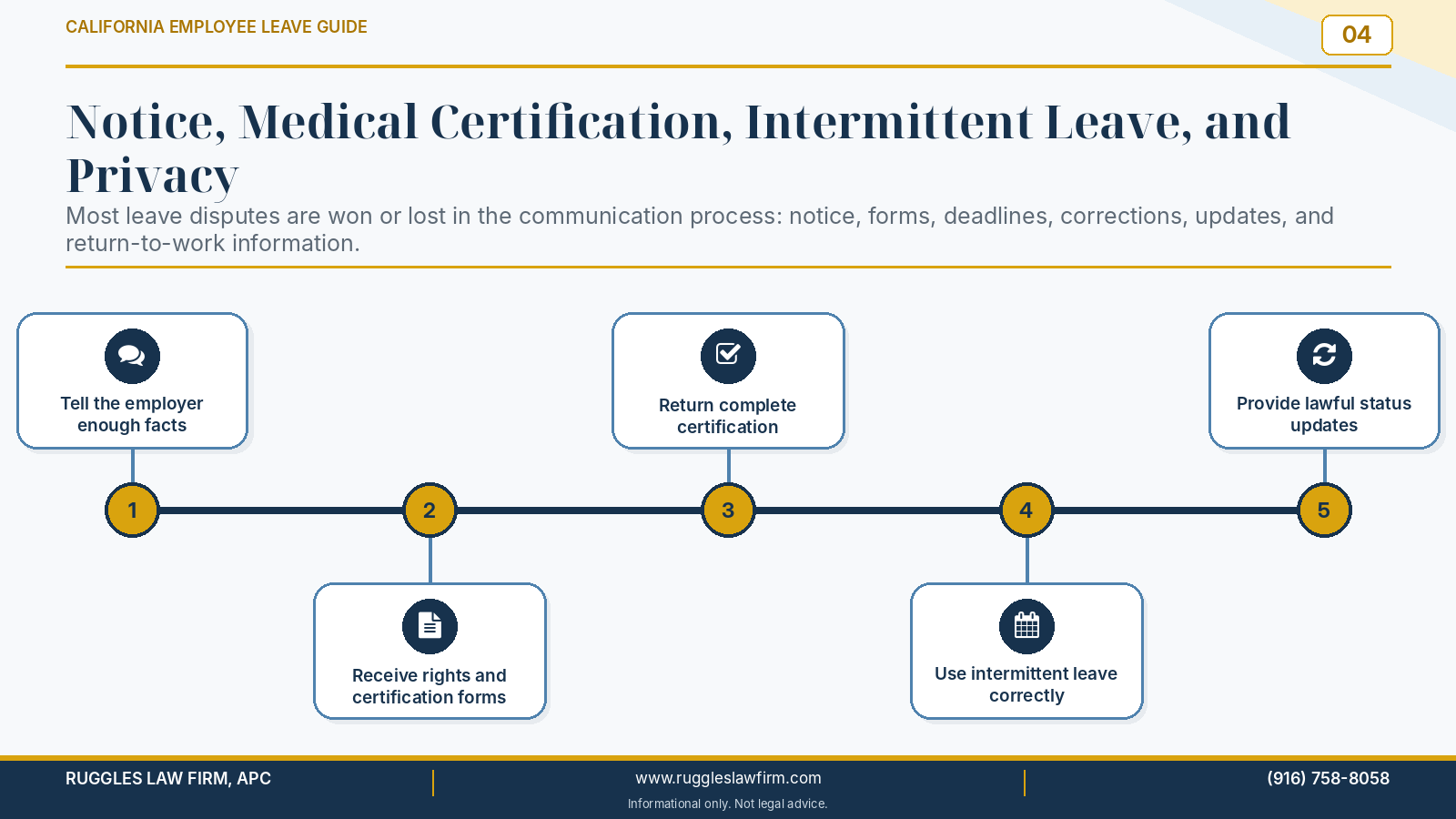
A legally qualifying medical condition does not help much if the employer never receives enough information to recognize a leave request. At the same time, an employer cannot avoid the law by demanding magic words or ignoring obvious facts. California and federal law create a back-and-forth process.
The employee’s initial notice
For foreseeable leave, an employee generally should give at least 30 days’ notice. If 30 days is not possible — an accident, hospitalization, sudden flare, premature delivery, or emergency — notice should be given as soon as practicable. The notice should explain the expected timing and duration, whether intermittent time is needed, and enough facts to show a potentially qualifying reason. A diagnosis is not always required.
The employer’s response
Once the employer has enough information, it should provide required eligibility, rights-and-responsibilities, designation, and certification notices. If the information is incomplete, the employer ordinarily must explain what is missing and provide a reasonable opportunity to cure. Silence followed by an attendance termination is a dangerous way to administer leave.
Medical certification
For CFRA and FMLA, an employer may request certification from an appropriate health-care provider. Federal certification generally may address the medical facts, duration, incapacity, need for care, and intermittent schedule. California certification rules are more protective of diagnosis information. For FEHA or ADA accommodation, the employer may seek information showing disability-related restrictions, expected duration, and the need for accommodation, but not unrelated medical history.
- Return forms by the stated deadline — under FMLA, usually at least 15 calendar days — or explain in writing why that is not practicable despite diligent efforts.
- Ask the provider to identify functional restrictions and an expected duration, not merely “unable to work until further notice.”
- Keep copies of every form and every version. Do not rely on a portal that the employee cannot access after termination.
- If HR says a form is deficient, ask for the deficiency in writing and respond within the cure period.
- Do not authorize unrestricted access to complete medical records unless there is a considered reason to do so.
CASE LAW IN ONE SENTENCE
“notice on a hospital’s preprinted form … may be sufficient”
Avila v. Continental Airlines, Inc., 165 Cal.App.4th 1237, 1258 (2008).
A short document can trigger duties if it communicates hospitalization or another qualifying event. The employer must read what it receives, not just look for a preferred form.
Intermittent and reduced-schedule leave
Intermittent leave means separate periods of absence for one qualifying reason. Reduced-schedule leave means a temporary change from full-time to fewer hours. Both can be required when medically necessary. Common examples include migraine flares, periodic infusions, physical therapy, episodic mental-health conditions, dialysis, prenatal appointments, and a gradual return after surgery.
The employee should follow normal call-in procedures unless unusual circumstances make that impossible, identify the absence as related to the certified condition without oversharing, and track the time used. Employers may use the shortest increment they use for other leave, subject to FMLA limits. They may temporarily transfer the employee to an available equivalent position that better accommodates foreseeable intermittent treatment, but the transfer cannot be punitive.
Medical privacy and direct contact with the provider
Medical documents must be maintained confidentially and separately from ordinary personnel files. Under FMLA, a designated HR professional, leave administrator, management official, or health-care provider — not the direct supervisor — may contact the provider for authentication or clarification after giving the employee a chance to cure. The employer may not demand genetic information or unrelated records.
Suspected misuse
Employers may investigate objective evidence of misuse, but surveillance, social-media review, or discipline must be handled consistently and without jumping to conclusions. A person may be unable to perform a job and still be able to attend a family event, travel with medical approval, or perform limited activities. The real question is whether the conduct contradicts the certification or involves dishonesty.
CASE STUDY: The certification trap
What happened: An employee with recurring migraines timely submits a certification estimating one or two episodes each month, each lasting one or two days. The employer begins counting the third monthly episode as unexcused without asking for recertification or clarifying whether the frequency was an estimate.
Legal analysis: Estimated frequency is not always a hard cap. The employer may seek lawful recertification when circumstances change, but automatically treating an extra episode as misconduct may interfere with protected leave. Bareno v. San Diego Community College District, 7 Cal.App.5th 546 (2017), emphasizes that communications must be viewed in context rather than through an artificially rigid lens.
Employee takeaway: When frequency changes, notify the leave administrator and obtain an updated certification promptly. Do not let a predictable paperwork issue become a credibility dispute.
What Is Protected — and What Is Not
| Protected | Not Automatically Protected |
|---|---|
|
• Good-faith notice that identifies a potentially qualifying reason, even without statutory labels. |
• Ignoring normal call-in procedures when compliance was possible and no unusual circumstances existed. |
|
• Reasonable time to obtain certification and cure identified deficiencies. |
• Refusing all certification or status information after clear, lawful requests and adequate time. |
|
• Medically necessary intermittent leave or a reduced schedule supported by certification. |
• Using intermittent leave for nonqualifying reasons or falsifying the timing or need. |
|
• Confidential handling of medical information and inquiries limited to the need, duration, and restrictions. |
• An expectation that a supervisor must remain completely uninformed about scheduling limitations; managers may receive necessary work restrictions and timing information. |
|
Protected Example
An employee is rushed to surgery and cannot give 30 days’ notice. Her spouse emails HR the next morning, explains the hospitalization, and provides an estimated three-week absence. The emergency timing does not defeat protection.
|
Not-Protected Example
An employee with approved intermittent leave repeatedly misses shifts without using the call-in line, despite being able to call, and later labels every absence as FMLA. The law does not automatically excuse avoidable noncompliance.
|
Are leave forms, deadlines, or intermittent absences becoming a disciplinary issue?
Certification disputes are easier to fix before termination. Keep the forms, deficiency notices, attendance records, call logs, and every message showing when the employer learned of the need for leave.
Request an initial case consultation | (916) 758-8058
Medical Leave as a Reasonable Accommodation Under FEHA and the ADA
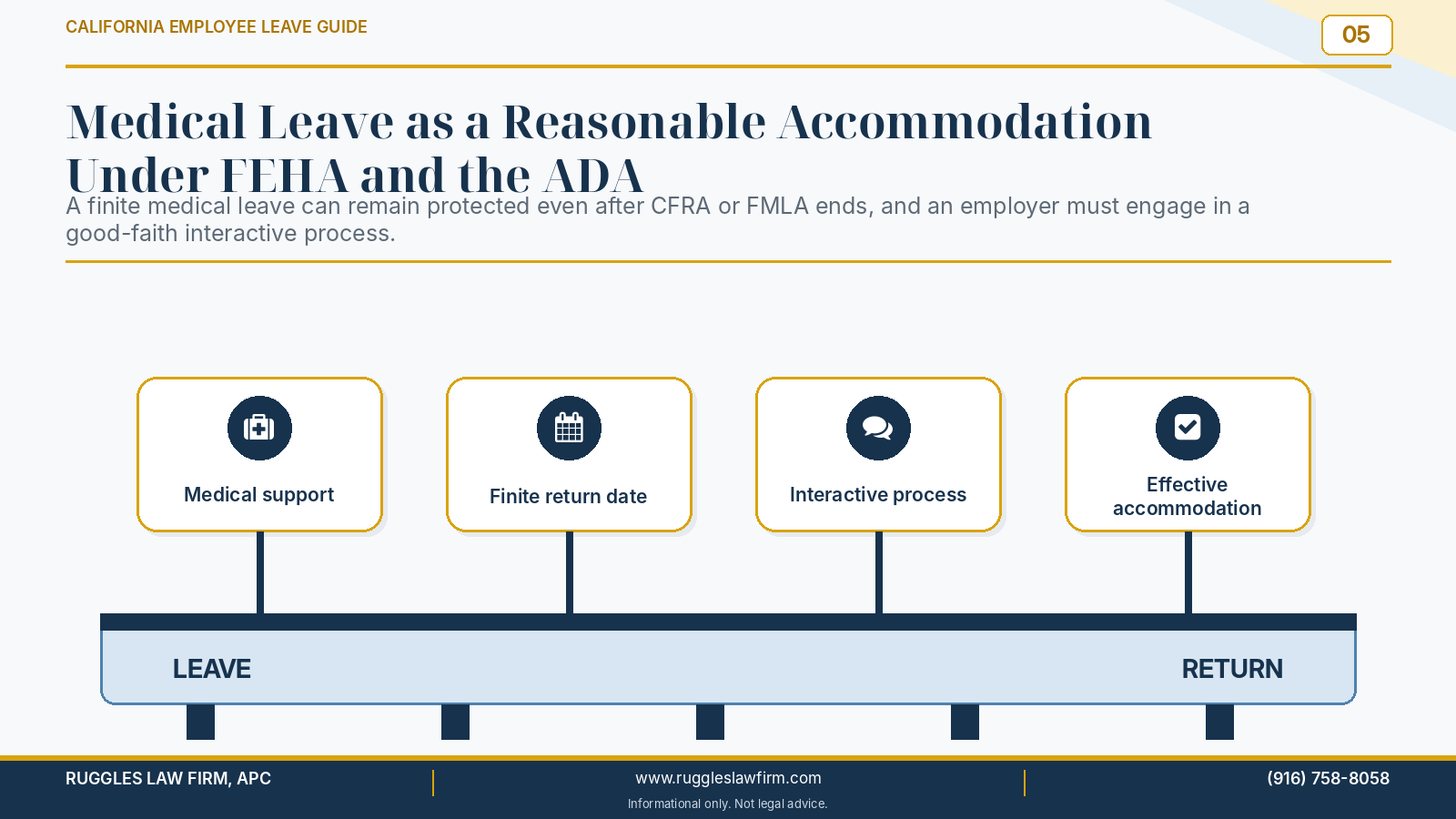
Many employees — and too many employers — treat week twelve as a trapdoor. It is not. The expiration of CFRA or FMLA may end one statutory entitlement, but California’s Fair Employment and Housing Act and the federal ADA can require additional leave or another accommodation for an employee with a disability.
Who is covered?
FEHA generally applies to employers with five or more employees. The ADA generally applies at 15 employees. Unlike CFRA and FMLA, disability accommodation does not require 12 months of service or 1,250 hours worked. A newly hired employee may therefore have accommodation rights even when family-and-medical leave statutes do not apply.
A finite leave can be reasonable
Leave may be a reasonable accommodation when it is likely to enable the employee to return and perform essential functions. The employee does not have to prove recovery is guaranteed; medicine rarely comes with that warranty. The employee and provider should give the best available estimate, explain restrictions, and update the employer when circumstances materially change.
CASE LAW IN ONE SENTENCE
“Even an extended medical leave … may be a reasonable accommodation”
Nunes v. Wal-Mart Stores, Inc., 164 F.3d 1243, 1247 (9th Cir. 1999).
The employer bears the burden of showing that a requested accommodation would create undue hardship; a fixed extension cannot be rejected merely because it follows an earlier leave.
CASE LAW IN ONE SENTENCE
“A finite leave can be a reasonable accommodation under FEHA”
Zamora v. Security Industry Specialists, Inc., 71 Cal.App.5th 1, 35 (2021).
A short, medically supported extension may remain protected even when the employee cannot return on the first expected date.
The interactive process is a continuing duty
The employer and employee must communicate in good faith about restrictions, duration, and possible accommodations. The employee should respond to reasonable requests and identify what may work. The employer should analyze alternatives rather than demand a “100 percent healed” release or send a single form and close the file. Humphrey v. Memorial Hospitals Association, 239 F.3d 1128, 1138 (9th Cir. 2001), explained that the duty is continuing and is not exhausted by one unsuccessful effort.
CASE LAW IN ONE SENTENCE
“the duty to accommodate is a continuing duty that is not exhausted by one effort”
Humphrey v. Memorial Hospitals Association, 239 F.3d 1128, 1138 (9th Cir. 2001).
When a first accommodation fails, both sides may need to revisit leave, schedule changes, remote work, reassignment, equipment, or modified procedures.
Leave should not be forced when another accommodation works
An employer should not push an employee onto unpaid leave merely because leave is administratively convenient. If the employee can perform essential functions with a modified schedule, remote work, equipment, restructuring of marginal duties, or another effective accommodation, forced leave may be discriminatory. Ravel v. Hewlett-Packard Enterprise, Inc., 228 F.Supp.3d 1086 (E.D. Cal. 2017), and Civil Rights Department v. Grimmway Enterprises, Inc., 800 F.Supp.3d 1084 (E.D. Cal. 2025), illustrate that inflexible leave and return-to-work practices can create FEHA exposure.
Indefinite leave and essential attendance
FEHA and the ADA do not ordinarily require an employer to hold a position open indefinitely when the employee cannot provide a reasonably certain return window. Dark v. Curry County, 451 F.3d 1078, 1090 (9th Cir. 2006), cautioned that recovery time of unspecified duration may be unreasonable. The line is fact-specific: a provider’s best estimate of “four to six more weeks” is different from “unknown, check back someday.”
Attendance can be an essential function in some jobs, particularly positions requiring on-site response or face-to-face coordination. Samper v. Providence St. Vincent Medical Center, 675 F.3d 1233 (9th Cir. 2012), found regular attendance essential for a neonatal intensive-care nurse. But an employer cannot simply paste “attendance is essential” into every job description and avoid analyzing actual duties, past remote work, coverage options, and the requested duration.
Caregiver and associational issues
The ADA prohibits discrimination because of association with a disabled person, but it generally does not require accommodation so an employee can care for that person. CFRA or FMLA may provide the leave instead. California associational-accommodation law is unsettled. Head v. Costco Wholesale Corp., No. 24-cv-01203-EMC, 2025 WL 1592737 (N.D. Cal. June 5, 2025), is an unpublished district-court order allowing an employee’s FEHA theory to proceed on unusual facts; it is persuasive, not binding, and employees should not assume it creates a broad caregiver-leave right.
CASE STUDY: Week twelve is not an automatic termination date
What happened: An employee exhausts 12 weeks of CFRA/FMLA after major surgery. Two weeks before expiration, the surgeon says the employee should be able to return in four additional weeks with a temporary lifting restriction.
Legal analysis: The employer should evaluate the four-week extension and the restriction under FEHA and the ADA. Nunes v. Wal-Mart Stores, Inc., 164 F.3d 1243 (9th Cir. 1999), Hanson v. Lucky Stores, Inc., 74 Cal.App.4th 215 (1999), and Zamora v. Security Industry Specialists, Inc., 71 Cal.App.5th 1 (2021), support individualized analysis of finite leave.
Employee takeaway: Before CFRA/FMLA expires, submit a written accommodation request with the expected return date and restrictions. Do not wait for an automated termination letter.
What Is Protected — and What Is Not
| Protected | Not Automatically Protected |
|---|---|
|
• A finite, medically supported leave that is reasonably likely to enable return to essential job functions. |
• Truly indefinite leave with no reasonably reliable return estimate and no other effective accommodation. |
|
• A good-faith interactive process concerning leave, reduced schedules, remote work, reassignment, or other effective accommodations. |
• Removal of essential job functions for an unlimited period when no reassignment is available. |
|
• Additional disability leave after CFRA/FMLA exhaustion when it does not create undue hardship. |
• Failure to engage, provide medical support, or respond to reasonable accommodation inquiries. |
|
• Return with reasonable restrictions instead of an unlawful “full duty only” or “100 percent healed” requirement. |
• A general right to accommodation solely to care for someone else under the ADA; family-leave statutes must be analyzed separately. |
|
Protected Example
A new employee at a seven-person company needs six weeks off for treatment and has a firm return estimate. She is not CFRA eligible, but FEHA may require the leave as a reasonable accommodation.
|
Not-Protected Example
After a year of absence, an employee says only that he might return if his condition eventually improves, provides no estimate after repeated requests, and cannot perform the job remotely or in a vacant role. Indefinite leave may not be required.
|
RELATED RUGGLES LAW FIRM RESOURCES
Pregnancy, Childbirth, Bonding, the PWFA, and Reproductive Loss
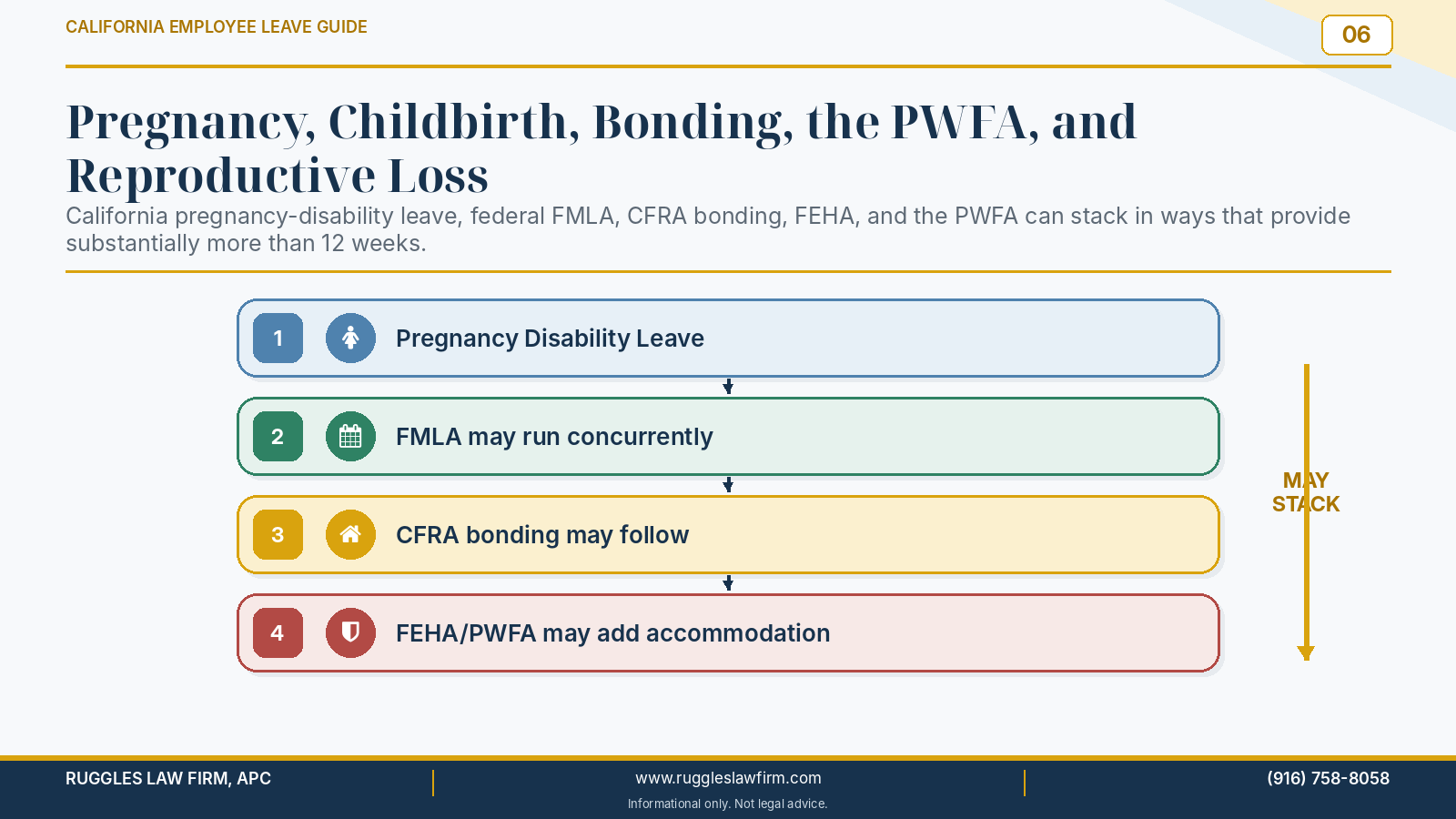
Pregnancy leave is one of the clearest examples of why employees should not accept “you get twelve weeks” as a complete answer. California’s Pregnancy Disability Leave law, FMLA, CFRA, FEHA, and the federal Pregnant Workers Fairness Act can overlap and sometimes stack.
Pregnancy Disability Leave (PDL)
An employee disabled by pregnancy, childbirth, or a related medical condition may receive up to four months per pregnancy from an employer with five or more employees. Four months means the number of days or hours the employee would normally work in 17 1/3 weeks; a part-time employee receives the part-time equivalent. There is no 12-month or 1,250-hour eligibility requirement.
PDL can be taken continuously, intermittently, or on a reduced schedule when medically advisable. It can cover severe morning sickness, prenatal or postnatal care, medically required bed rest, childbirth, recovery, postpartum depression, pregnancy loss, and related conditions. The employer may also have to transfer the employee temporarily to a less strenuous or hazardous position if medically advisable and reasonably available.
FMLA may run with PDL; CFRA bonding may follow
If the employee is FMLA eligible, FMLA generally runs concurrently with PDL for pregnancy disability. CFRA ordinarily does not run for pregnancy disability, so an eligible employee may then receive up to 12 additional weeks of CFRA bonding leave after the child is born. A full PDL period plus CFRA bonding can total roughly 29 1/3 workweeks, and additional FEHA or PWFA accommodation may sometimes be required.
CASE LAW IN ONE SENTENCE
“its remedies augment, rather than supplant, those set forth elsewhere in the FEHA”
Sanchez v. Swissport, Inc., 213 Cal.App.4th 1331, 1338 (2013).
The four-month PDL entitlement is not a ceiling on all disability accommodation. An employee may still be entitled to more leave under FEHA.
The Pregnant Workers Fairness Act
The PWFA generally applies to employers with 15 or more employees and requires reasonable accommodation for known limitations related to pregnancy, childbirth, or related medical conditions unless the accommodation causes undue hardship. Possible accommodations include breaks, schedule changes, seating, water, light duty, temporary suspension of an essential function in qualifying circumstances, and leave. An employer generally may not force leave if another reasonable accommodation allows the employee to keep working.
Bonding leave
CFRA and FMLA bonding leave applies after birth, adoption, or foster placement and must be completed within one year. Both parents may have rights, regardless of gender or marital status. CFRA generally permits bonding in two-week blocks, with at least two occasions of shorter duration. An employer may not insist that a parent prove a medical need to bond; bonding is its own qualifying reason.
Reproductive-loss leave
Government Code section 12945.6 generally provides up to five days of leave after a reproductive-loss event, including miscarriage, stillbirth, failed adoption, failed surrogacy, or unsuccessful assisted reproduction. The employee generally must have worked at least 30 days. Leave must usually be taken within three months and need not be consecutive. Multiple events may create up to 20 days in a 12-month period. The leave is generally unpaid, but available paid leave may be used.
Lactation accommodation after return
California Labor Code sections 1030-1034 generally require reasonable break time and a compliant private space, other than a bathroom, for expressing breast milk. Lactation rights are not a substitute for leave, but they are an important part of a lawful return-to-work plan.
CASE STUDY: How leave can stack after childbirth
What happened: A CFRA/FMLA-eligible employee becomes medically disabled 10 weeks before delivery, remains disabled for seven weeks after delivery, and then wants bonding time.
Legal analysis: PDL can cover the entire 17-week disability period. FMLA can run concurrently for the first 12 qualifying weeks. Because CFRA generally did not run during pregnancy disability, the employee may then take up to 12 weeks of CFRA bonding. Sanchez v. Swissport, Inc., 213 Cal.App.4th 1331 (2013), also requires consideration of additional FEHA accommodation if disability continues.
Employee takeaway: Ask HR to state in writing which leave bank is being charged and on what dates. A generic “12 weeks exhausted” notice may incorrectly collapse separate rights.
District-court guidance
Salgado v. IQVIA, Inc., 459 F.Supp.3d 1318 (S.D. Cal. 2020), is a useful federal district-court discussion of the interaction among PDL, CFRA, and FMLA. District-court decisions are persuasive rather than binding on California courts, but they can show how overlapping statutes are being applied in current litigation.
What Is Protected — and What Is Not
| Protected | Not Automatically Protected |
|---|---|
|
• Up to four months of pregnancy-disability leave for an employee disabled by pregnancy, childbirth, or a related condition at a covered employer. |
• A universal rule limiting every pregnancy-related absence to 12 weeks. |
|
• CFRA bonding leave after PDL for an eligible employee, with FMLA concurrency analyzed separately. |
• Forcing an employee onto leave when another reasonable pregnancy accommodation would permit work. |
|
• Pregnancy accommodations under FEHA and the PWFA, including leave when appropriate and alternatives that permit continued work. |
• Automatic extension of bonding leave beyond one year after birth or placement. |
|
• Reproductive-loss leave and lactation accommodation under their separate statutory rules. |
• An unlimited leave with no reasonable return estimate after all applicable entitlements and accommodations have been assessed. |
|
Protected Example
A new employee at a six-person company is placed off work for eight weeks because of pregnancy complications. She lacks CFRA/FMLA tenure but may qualify immediately for PDL and FEHA accommodation.
|
Not-Protected Example
A parent requests bonding leave 18 months after the child’s birth, with no disability or other qualifying reason. Statutory bonding leave generally had to be completed within the first year.
|
Did your employer combine pregnancy disability and bonding into one 12-week bank?
PDL, FMLA, CFRA, FEHA, and the PWFA have different triggers and timelines. A leave calendar should be reconstructed day by day before accepting an exhaustion decision.
Request an initial case consultation | (916) 758-8058
California Paid Sick Leave and Kin Care
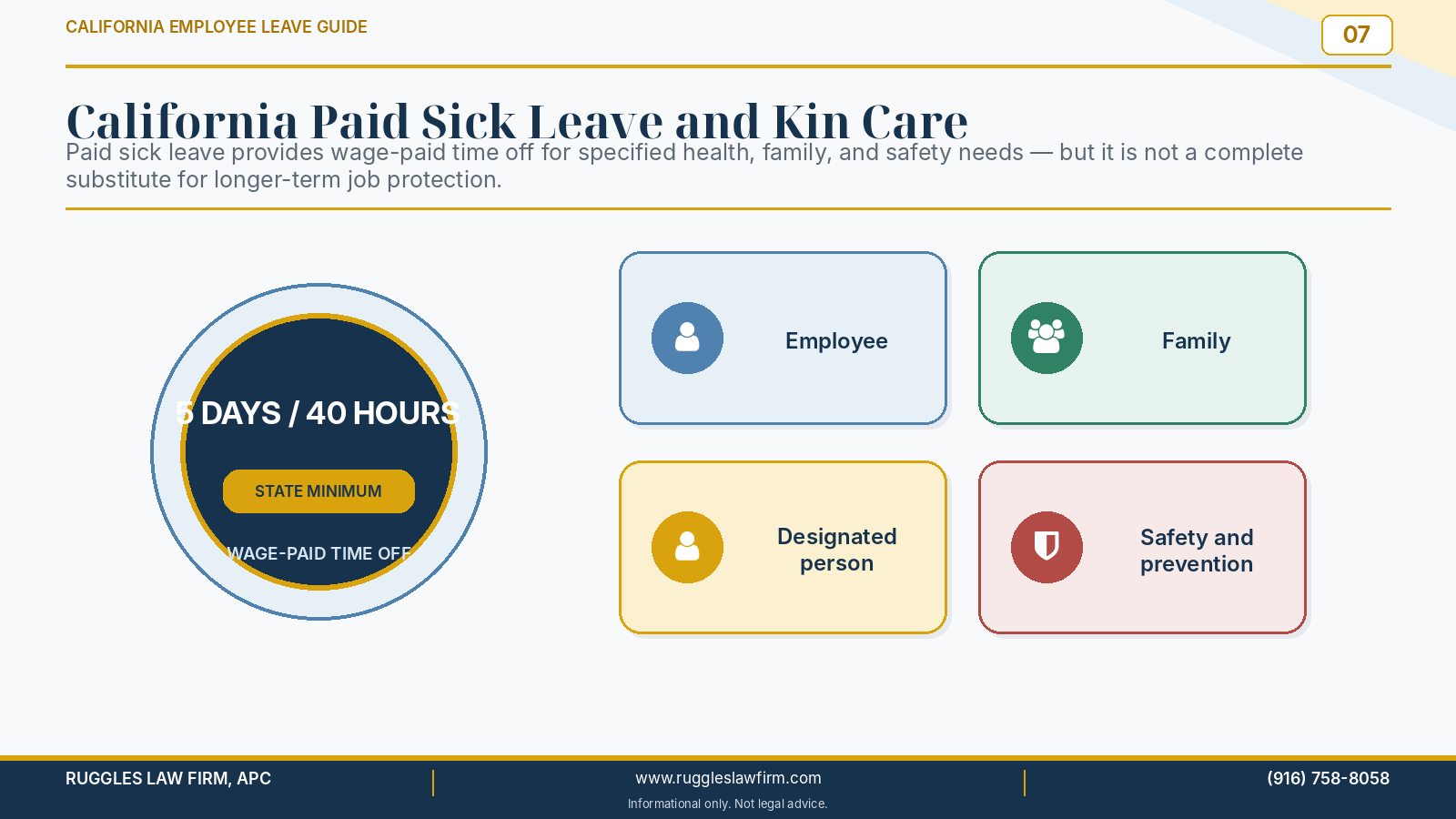
California’s Healthy Workplaces, Healthy Families Act gives most employees a statewide minimum amount of paid sick leave. The current statewide floor is generally five days or 40 hours per year, whichever is more, although local ordinances and employer policies may be more generous. The Labor Commissioner’s paid-sick-leave guidance is an important current source.
Eligibility, accrual, and use
An employee generally qualifies after working in California for the same employer for at least 30 days within a year and may begin using accrued leave after 90 days of employment. An employer may use statutory accrual, another compliant accrual method, or frontload the full amount. Under an accrual plan, carryover is generally required, although the employer may cap accrual at 80 hours or 10 days and annual use at 40 hours or five days. A compliant frontload plan may avoid carryover.
Permitted reasons
- Diagnosis, care, treatment, or preventive care for the employee.
- Diagnosis, care, treatment, or preventive care for a covered family member.
- Care for a designated person identified by the employee, subject to statutory limits.
- Specified needs related to being a victim, including medical attention, counseling, services, safety planning, relocation, and certain court proceedings under current law.
- Other uses added by statute, including certain jury, witness, and agricultural-emergency circumstances, depending on the facts and effective date.
Kin care
Labor Code sections 233 and 234 — often called the kin-care law — generally allow an employee to use at least one-half of the employee’s annual accrued and available sick leave to care for covered family members or a designated person. Kin care does not create a separate new bank. It protects use of an existing employer sick-leave plan.
Notice and documentation
An employee may request paid sick leave orally or in writing. When the need is foreseeable, reasonable advance notice may be required; otherwise notice should be provided as soon as practicable. The statute does not make a doctor’s note a universal precondition to every sick day. Employers should be cautious about policies that effectively deny statutory use, demand unnecessary medical details, or require the employee to find a replacement worker.
No attendance points and no replacement requirement
An employer may not count lawful paid-sick-leave use as an attendance occurrence or require the employee to find a replacement. The employer also may not retaliate for requesting or using leave. Labor Code section 246.5 creates a rebuttable presumption of retaliation for certain adverse actions within 30 days of protected conduct.
Paid sick leave is not unlimited job protection
Paid sick leave guarantees paid time for covered uses within the available bank. Once the bank is exhausted, the employee may still have CFRA, FMLA, PDL, FEHA, ADA, PWFA, workers’ compensation, local ordinance, or policy rights. Conversely, receiving State Disability Insurance does not replenish paid sick leave. Each program answers a different question.
Payout at termination
Unused statutory sick leave generally does not have to be paid out at termination unless the employer combines it with vacation or PTO in a vested plan. If an employee is rehired within one year, previously accrued and unused statutory sick leave generally must be restored, subject to exceptions when a combined PTO balance was paid out.
Local-law caution
San Francisco, Los Angeles, San Diego, Oakland, Berkeley, Emeryville, Santa Monica, and other local jurisdictions may impose more generous or different requirements. The statewide floor is only the starting point.
What Is Protected — and What Is Not
| Protected | Not Automatically Protected |
|---|---|
|
• Use of accrued paid sick leave for the employee, covered family, designated person, preventive care, and qualifying safety-related reasons. |
• Paid sick leave beyond the employee’s available statutory or policy bank, unless another leave law applies. |
|
• Oral or written requests, reasonable emergency notice, and freedom from replacement-worker requirements. |
• A right to cash out unused statutory sick leave at termination when it is not part of vested PTO. |
|
• Use without attendance points, discipline, retaliation, or loss of another statutory right. |
• Dishonest use for a nonqualifying reason. |
|
• More generous rights under local law or employer policy. |
• An assumption that five paid days resolve a long-term disability or family-care absence; longer-leave laws must be evaluated separately. |
|
Protected Example
An employee uses two paid sick days for therapy and medication management for anxiety, gives notice under policy, and has available hours. Mental-health treatment is health care; the employer may not count the days as attendance points.
|
Not-Protected Example
An employee with no sick balance claims a paid sick day to attend a recreational event and lies about illness. The statute does not protect fraud or create an unlimited paid bank.
|
Were you given attendance points or disciplined for using paid sick leave?
Save the pay stubs, leave-balance records, attendance policy, request, manager response, and disciplinary notice. A short paid absence can still support a significant retaliation claim.
Request an initial case consultation | (916) 758-8058
Job Protection Versus Wage Replacement: PFL, DI, and Workers’ Compensation
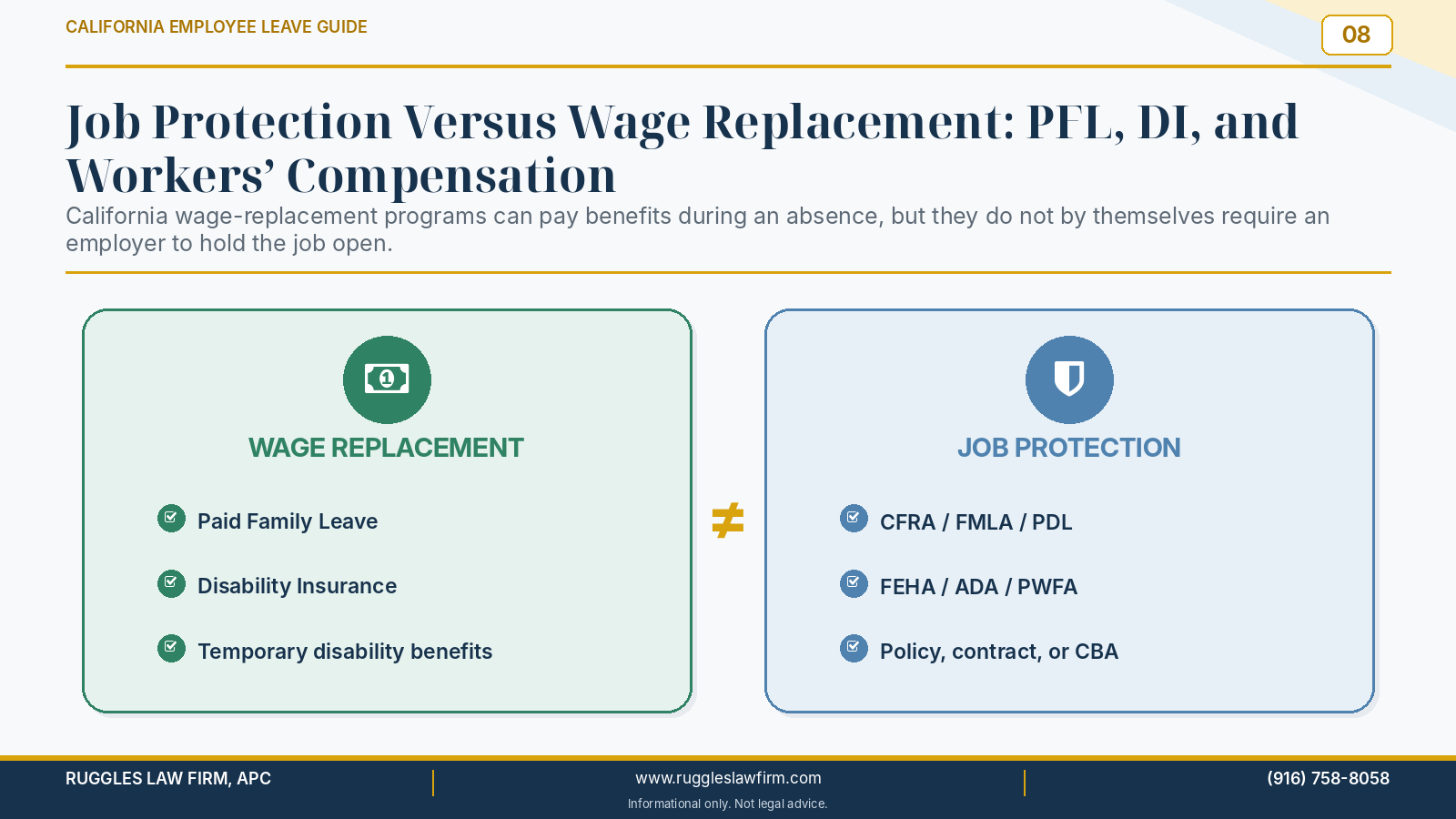
Employees commonly receive a benefit approval from the Employment Development Department and assume their job is protected. That is understandable — and often wrong. Paid Family Leave and Disability Insurance replace part of wages. They do not independently create reinstatement rights.
California Paid Family Leave (PFL)
PFL generally provides up to eight weeks of partial wage replacement to bond with a new child, care for a seriously ill family member, or participate in qualifying military events. For claims beginning in 2026, benefits generally replace approximately 70 to 90 percent of wages, subject to the state minimum and maximum. PFL is funded through employee payroll contributions and is administered by EDD.
State Disability Insurance (DI)
DI generally provides short-term wage replacement when an employee cannot perform regular work because of a non-work-related illness, injury, pregnancy, or childbirth. Benefits may last up to 52 weeks when medical eligibility continues. DI approval is evidence of disability for benefit purposes, but the employer may still require lawful certification for leave and accommodation.
Workers’ compensation temporary disability
For a work-related injury or illness, temporary-disability benefits may replace part of lost wages. Workers’ compensation also provides medical treatment and other benefits. Labor Code section 132a prohibits discrimination because an employee filed or made known an intent to file a workers’ compensation claim, but workers’ compensation alone does not guarantee indefinite job restoration. FEHA, CFRA, FMLA, employer policy, and return-to-work accommodation must be analyzed separately.
How the programs coordinate
An employee may receive DI or PFL while also being on protected CFRA, FMLA, PDL, or accommodation leave. The employer may coordinate accrued paid leave under applicable rules, and a voluntary paid-leave program may supplement state benefits. The employee should ask for a written explanation of which job-protection bank, wage-replacement benefit, and employer-paid balance is being used for each date.
| Program or law | Primary function | Typical duration | Does it independently protect the job? |
|---|---|---|---|
| Paid Family Leave | Partial wage replacement for bonding, family care, and qualifying military events. | Up to 8 weeks. | No. Pair with CFRA/FMLA or another protection. |
| Disability Insurance | Partial wage replacement for non-work disability, pregnancy, or childbirth. | Up to 52 weeks if eligible. | No. Pair with PDL, CFRA/FMLA, FEHA/ADA/PWFA, or policy. |
| Workers’ comp temporary disability | Partial wage replacement for industrial injury or illness. | Depends on disability and statutory limits. | Not by itself; anti-retaliation and accommodation rights may apply. |
| CFRA / FMLA / PDL | Job-protected leave and benefit continuation. | Usually 12 weeks; PDL up to 4 months. | Yes, subject to eligibility and lawful exceptions. |
| FEHA / ADA / PWFA | Reasonable accommodation, potentially including leave. | No fixed statutory number; reasonableness controls. | Potentially, subject to essential functions and undue hardship. |
Benefit approval does not excuse communication with the employer
EDD and the employer are separate systems. Sending a claim to EDD does not necessarily notify HR, and telling HR does not file an EDD claim. Employees should complete both tracks and keep copies. A benefits portal is not a substitute for a job-protection request.
Benefit denial does not always defeat leave protection
A DI or PFL claim may be denied for contribution, timing, or documentation reasons unrelated to whether the employee has CFRA, FMLA, PDL, FEHA, or ADA rights. The reverse is also true: EDD may pay a benefit even when the employee lacks statutory reinstatement rights. The systems use different standards.
CASE STUDY: The approved-benefit misconception
What happened: An employee receives DI payments for six months after a non-work injury. The employer’s leave policy provides 12 weeks, and HR never discusses FEHA accommodation before ending employment.
Legal analysis: DI established wage-replacement eligibility, not job protection. But the employer still had to evaluate CFRA/FMLA eligibility and a finite FEHA/ADA accommodation before termination. Nunes v. Wal-Mart Stores, Inc., 164 F.3d 1243 (9th Cir. 1999), and California accommodation law may be central.
Employee takeaway: Do not rely on EDD approval alone. Send a separate written leave or accommodation request to the employer with duration and restrictions.
What Is Protected — and What Is Not
| Protected | Not Automatically Protected |
|---|---|
|
• Receipt of PFL, DI, or workers’ compensation benefits when program eligibility is met. |
• An assumption that EDD benefit approval alone requires the employer to restore the job. |
|
• Concurrent job protection under CFRA, FMLA, PDL, FEHA, ADA, PWFA, USERRA, policy, or contract when separately established. |
• Double recovery or benefit coordination contrary to program rules. |
|
• Freedom from retaliation for filing a workers’ compensation claim or exercising protected leave rights. |
• Failure to notify the employer because a doctor or EDD already received paperwork. |
|
• Coordination of employer pay and state benefits under applicable plan and statutory rules. |
• Indefinite job protection for the entire period that DI or workers’ compensation benefits remain payable. |
|
Protected Example
An employee takes eight weeks to care for a parent, receives PFL wage replacement, and is CFRA eligible. PFL supplies pay; CFRA supplies job protection and benefit continuation.
|
Not-Protected Example
An ineligible new employee receives DI for a year but never requests accommodation and provides no return estimate. DI payments alone do not obligate the employer to keep the position open for the full year.
|
Are you receiving state benefits but unsure whether your job is protected?
Build a date-by-date map of benefits, leave designations, medical restrictions, and employer communications. The payment decision and the job-protection decision are separate and should be reviewed separately.
Request an initial case consultation | (916) 758-8058
Personal and Discretionary Leaves of Absence
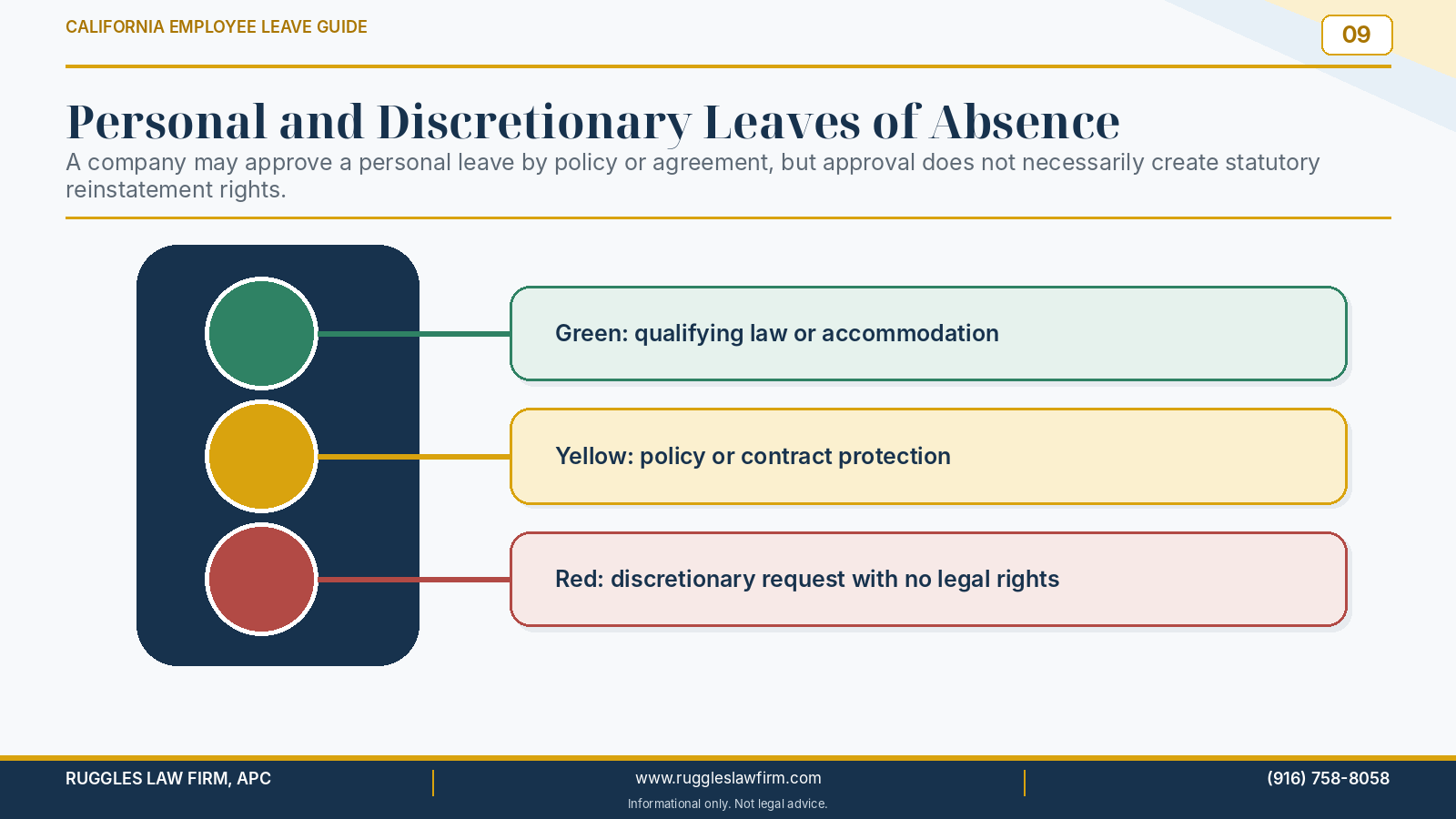
California does not have a general statute giving every employee a personal leave for travel, education, relocation, a sabbatical, family errands, or “time to think.” Employers may voluntarily offer personal leave, and a written policy, contract, collective-bargaining agreement, handbook promise, or consistent past practice may create enforceable rights. But the details matter.
Approved is not the same as protected
A leave administrator may approve a personal leave while stating that reinstatement is not guaranteed. That language does not necessarily eliminate another statute, but it matters if no statute applies. Employees should read the approval letter, handbook, plan document, and any union agreement before assuming the job must remain open.
A personal request may reveal a protected reason
The employer must look beyond the form label. An employee may select “personal leave” in a portal because there is no disability option, then explain that chemotherapy is the reason. The facts can trigger CFRA, FMLA, FEHA, or ADA duties. Likewise, a request to help a family member may be protected care even if the employee initially calls it personal time.
What policies and promises can add
- A handbook may promise a defined personal-leave period, status, benefit treatment, or reapplication right.
- A collective-bargaining agreement may create seniority, recall, bidding, or reinstatement protections beyond statute.
- An individual employment agreement may address sabbaticals, executive leave, or benefit continuation.
- A consistent practice of returning similarly situated employees can be relevant to discrimination, retaliation, or contract theories.
- An employer may be estopped from changing position after making a clear promise on which the employee reasonably relied, although the elements are demanding and fact-specific.
Personal leave can be ended according to the policy
If no statute, accommodation duty, or contract applies, an at-will employer may often deny or end a discretionary leave, fill the position, or require reapplication. The employer still may not act for a discriminatory or retaliatory reason. A policy applied generously to favored employees but rigidly to an employee who recently complained about harassment can become evidence of pretext.
Caregiving that does not qualify
Family affection is broad; statutory definitions are narrower. Pang v. Beverly Hospital, Inc., 79 Cal.App.4th 986 (2000), held that helping a parent relocate did not necessarily qualify as care under the circumstances. Marchisheck v. County of San Mateo, 199 F.3d 1068 (9th Cir. 1999), likewise illustrates that a parent’s serious concern for a child does not automatically satisfy FMLA’s treatment-and-care requirements.
Personal leave after protected leave
Some employers transition employees from CFRA/FMLA to personal leave. That can be helpful, but it must not replace FEHA/ADA analysis. Canupp v. Children’s Receiving Home of Sacramento, 181 F.Supp.3d 767 (E.D. Cal. 2016), demonstrates that the legal treatment of overlapping statutory and employer-provided leave depends on the employer’s notices, policies, and actual administration.
CASE STUDY: The dropdown-menu problem
What happened: An employee requests six weeks for depression treatment using the portal’s “personal leave” category because no medical option appears. The employee uploads a provider note identifying treatment and a return date.
Legal analysis: The employer has facts suggesting disability and a potentially serious health condition. Calling the request personal does not permit the employer to ignore CFRA, FMLA, FEHA, or ADA duties. The employer should clarify and designate the applicable protection.
Employee takeaway: Describe the reason and expected duration in writing, even when a portal uses an inaccurate label. Save screenshots and uploaded documents.
A little professional humor
A leave portal is a filing cabinet, not a court. The law does not disappear because the employee clicked the wrong folder.
What Is Protected — and What Is Not
| Protected | Not Automatically Protected |
|---|---|
|
• Rights created by a written policy, contract, collective-bargaining agreement, or clear enforceable promise. |
• A general statutory right to vacation, travel, education, relocation, a sabbatical, or ordinary personal convenience. |
|
• A supposedly personal request that actually communicates facts triggering CFRA, FMLA, PDL, FEHA, ADA, or another law. |
• Guaranteed reinstatement when the approval letter and policy reserve discretion and no other law applies. |
|
• Consistent, nondiscriminatory application of discretionary-leave rules. |
• A demand that the employer ignore legitimate staffing needs for an open-ended personal absence. |
|
• Reliance on an express return or benefit promise when the legal elements of contract or estoppel are satisfied. |
• Mislabeling a nonqualifying reason as medical or family leave. |
|
Protected Example
A handbook promises up to 30 days of personal leave and reinstatement if the position remains open. The employer returns every comparable employee except one who recently reported discrimination. The policy and inconsistent treatment may matter.
|
Not-Protected Example
An employee requests a three-month world tour, has no contractual leave right, and is told the company cannot hold the job. California law does not generally require approval or reinstatement.
|
RELATED RUGGLES LAW FIRM RESOURCES
Did the company call your medical or family leave “personal” and deny protection?
The employer’s label is not controlling. Review the underlying reason, documents, policy promises, and treatment of comparable employees before accepting that the leave was purely discretionary.
Request an initial case consultation | (916) 758-8058
Other California and Federal Leaves Employees Should Know
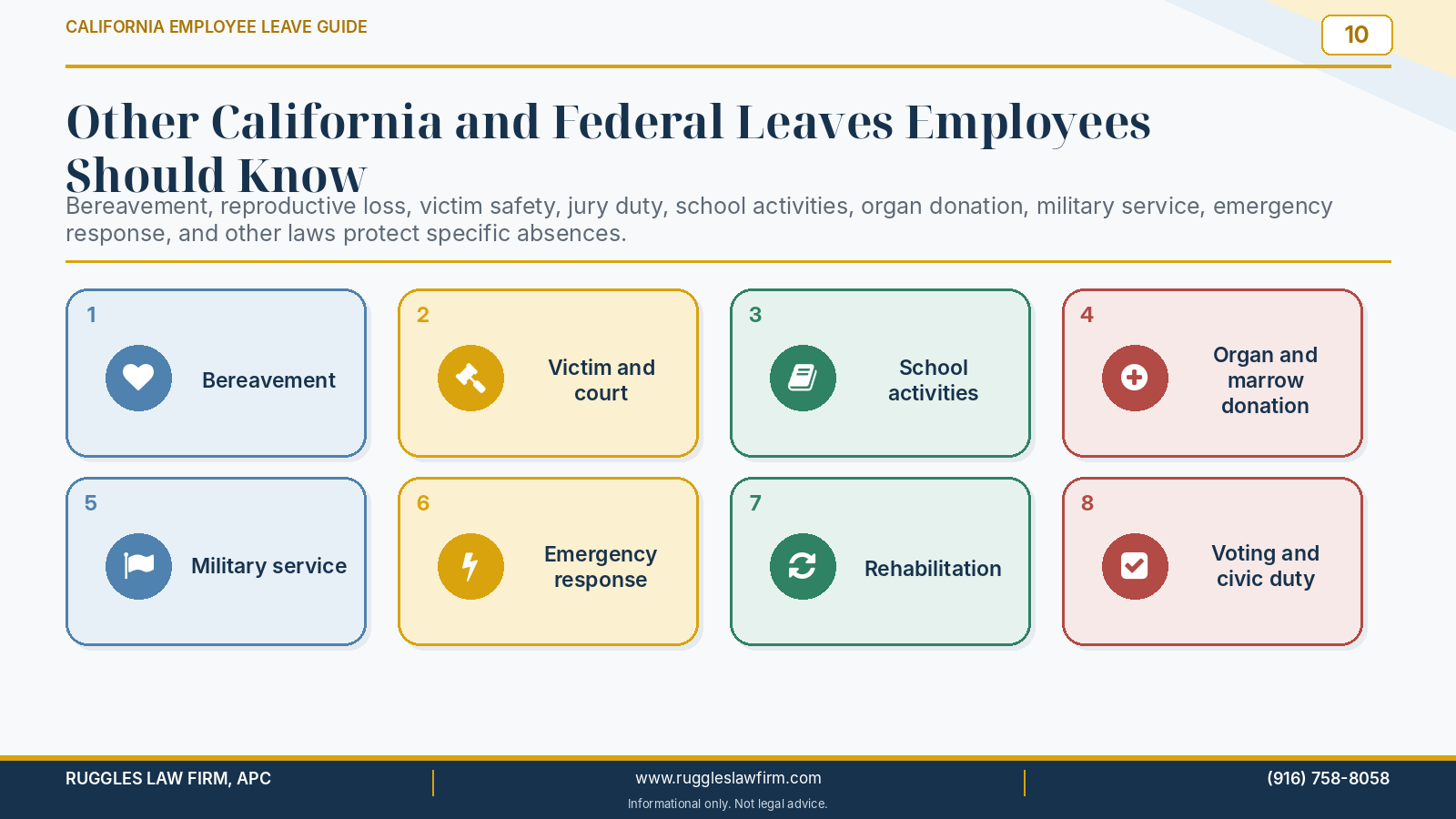
The major medical-leave statutes receive most of the attention, but California has a collection of targeted leave laws. These rights differ sharply in employer threshold, length, pay, notice, documentation, and reinstatement. The chart below is a practical starting point, not a substitute for reading the current statute.
| Leave type | Basic protection | Pay | Key limits and source |
|---|---|---|---|
| Bereavement | Up to 5 days after death of covered family member; days need not be consecutive. | Generally unpaid; accrued paid leave may be used. | Employers 5+; employee usually 30 days; complete within 3 months. Gov. Code §12945.7. |
| Reproductive loss | Up to 5 days per event, generally up to 20 days in 12 months. | Generally unpaid; accrued paid leave may be used. | Employers 5+; employee usually 30 days; complete within 3 months. Gov. Code §12945.6. |
| Victim, jury, witness, safety | Time for jury service, subpoena, protective relief, treatment, counseling, services, safety planning, relocation, and specified family-related needs. | Varies; paid sick or other accrued leave may apply. | Gov. Code §12945.8 and related provisions; additional rights at employers 25+. |
| School and childcare activities | Up to 40 hours annually for qualifying activities; emergency and suspension rules also apply. | Generally unpaid; paid leave may be used. | Labor Code §§230.7-230.8, generally employers 25+ for scheduled activities. |
| Voting | Up to 2 paid hours if insufficient time outside work hours. | First 2 hours paid. | Elections Code §14000; usually at beginning or end of shift with notice. |
| Organ donation | Paid leave for donation; additional unpaid leave may apply. | Up to 30 paid business days plus up to 30 unpaid business days. | Labor Code §§1508-1513; generally employers 15+ and 90 days service. |
| Bone-marrow donation | Protected donation leave. | Up to 5 paid business days. | Labor Code §§1508-1513; generally employers 15+ and 90 days service. |
| Military / USERRA | Leave and reemployment rights; discrimination prohibited. | Federal law does not universally require pay, but comparable paid leave rules may. | 38 U.S.C. §§4301-4335; California Military & Veterans Code. |
| Military spouse | Up to 10 days when a deployed spouse is on leave. | Generally unpaid. | Military & Veterans Code §395.10; generally employers 25+ and employees working 20+ hours weekly. |
| Emergency responder | Protection for emergency duty; training leave in qualifying workplaces. | Generally unpaid. | Labor Code §§230.3-230.4. |
| Civil Air Patrol | Mission-related leave and reinstatement. | Generally unpaid. | Labor Code §§1500-1507; generally employers 15+ and service requirements. |
| Alcohol or drug rehabilitation | Reasonable accommodation to participate in rehabilitation. | Use of paid leave depends on policy. | Labor Code §§1025-1028; generally employers 25+; no requirement to tolerate impairment or misconduct. |
| Literacy education | Reasonable accommodation to enroll in literacy education. | Generally unpaid. | Labor Code §§1040-1044; generally employers 25+. |
Bereavement leave
Government Code section 12945.7 generally covers the death of a spouse, child, parent, sibling, grandparent, grandchild, domestic partner, or parent-in-law. The employer may request reasonable documentation within statutory limits. The leave need not be consecutive, and the employee may use available vacation, personal leave, sick leave, or compensatory time if the policy permits.
Victim, family-member victim, jury, and witness rights
Current Government Code section 12945.8 consolidates and expands protections involving jury service, subpoenas, qualifying acts of violence, medical attention, counseling, services, safety planning, relocation, and specified needs involving a family member who is a victim. Employer size affects the available categories and limits. Confidentiality and reasonable advance notice or certification rules apply, with emergency exceptions.
Military service and paid comparable leave
USERRA protects leave, reemployment, seniority, benefits, and freedom from discrimination for qualifying uniformed service. It also applies to employers of all sizes. Whether short military leave must be paid may depend on how the employer pays comparable nonmilitary leaves. Clarkson v. Alaska Airlines, Inc., 59 F.4th 424 (9th Cir. 2023), held that USERRA’s comparable-leave rules can require pay when the employer pays comparable absences.
School activities and emergencies
Eligible parents, guardians, and grandparents may take time for school or licensed-childcare activities. Scheduled activities are generally subject to the annual and monthly limits; emergencies and suspension appearances have separate rules. Employees should give notice as soon as practicable and may be asked for proof of participation.
Rehabilitation and workplace safety
An employer covered by Labor Code sections 1025-1028 must reasonably accommodate an employee who voluntarily enters alcohol or drug rehabilitation, absent undue hardship, and must protect confidentiality. The law does not require the employer to tolerate on-duty intoxication, possession, policy violations, or inability to perform safely.
Why this section matters
A supervisor may have never heard of a special-purpose leave. That does not make the statute optional. The employee should identify the reason, cite the law if known, and retain the request and response.
What Is Protected — and What Is Not
| Protected | Not Automatically Protected |
|---|---|
|
• Time off that fits a special-purpose statute and satisfies the applicable employer-size, service, notice, and documentation rules. |
• Assuming every special-purpose leave is paid or has the same duration. |
|
• Use of accrued paid leave where the statute permits substitution. |
• Exceeding statutory limits without another source of protection. |
|
• Reinstatement, confidentiality, benefit treatment, or anti-retaliation rights provided by the specific law. |
• Failure to provide notice or documentation when reasonably possible and lawfully requested. |
|
• Additional rights under a union agreement, public-sector rule, local ordinance, or employer policy. |
• Using civic, victim, rehabilitation, or military leave as a pretext for unrelated absence or misconduct. |
|
Protected Example
An employee at a 30-person company needs two days to attend a protective-order hearing after domestic violence and gives notice as soon as safely possible. Current victim-leave protections may apply even though the absence is not medical leave.
|
Not-Protected Example
An employee takes ten paid days for bereavement without checking the employer policy. State law generally guarantees five protected days, not ten paid days; additional time and pay depend on other rights.
|
Was a special-purpose leave denied because HR treated it as ordinary time off?
Identify the exact statute, employer threshold, duration, notice, pay, and reinstatement rules. Special-purpose leaves are technical, but a technical violation can still produce real damages.
Request an initial case consultation | (916) 758-8058
Health Insurance, Benefits, PTO, Seniority, and Work During Leave
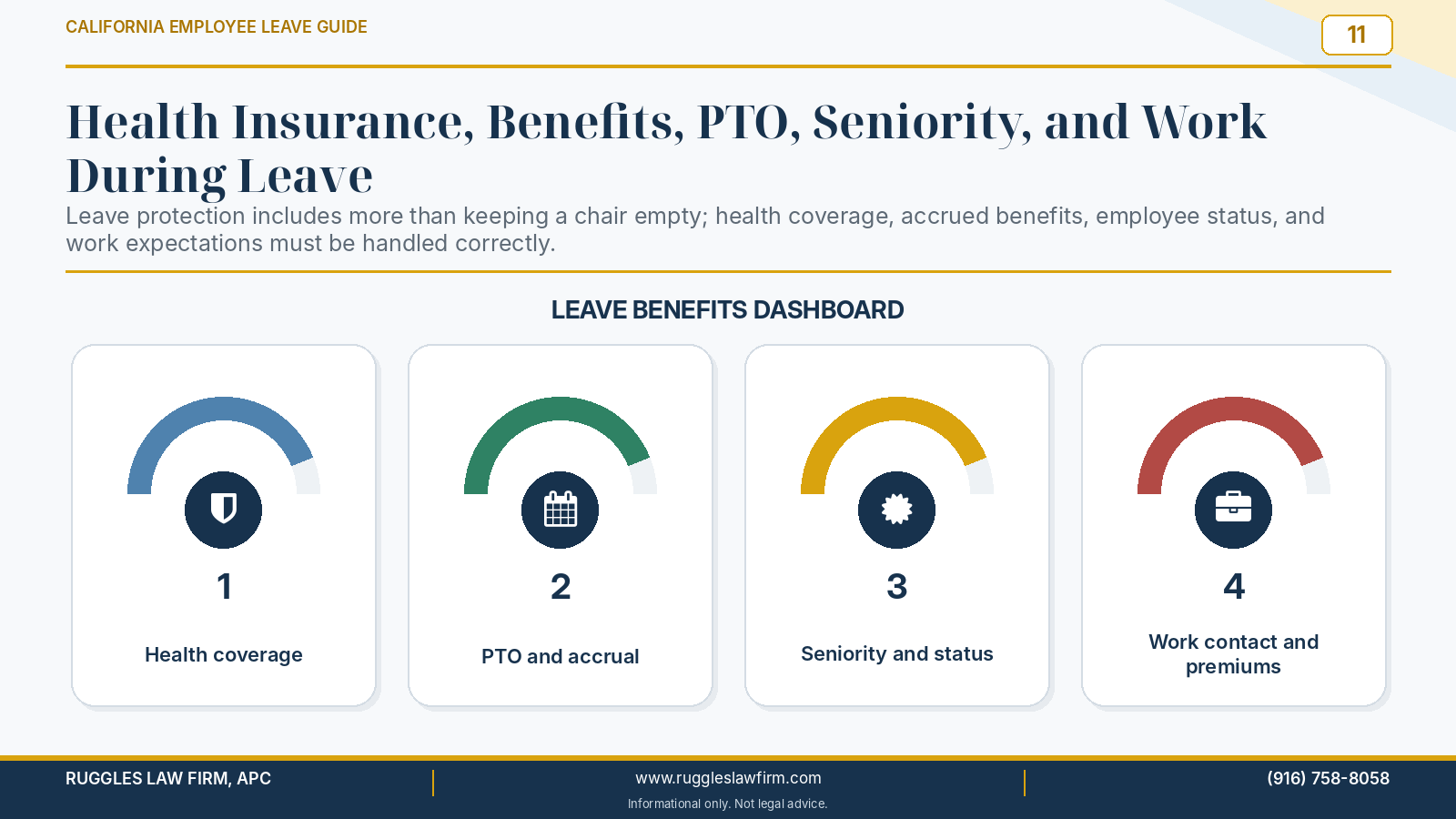
A leave dispute often begins with the job but quickly reaches insurance premiums, PTO, holidays, retirement contributions, life insurance, equity vesting, and demands to keep working. The governing rule depends on the leave statute and how the employer treats comparable unpaid leave.
Group health coverage
During CFRA and FMLA leave, the employer generally must maintain group health coverage on the same terms as active employment for up to the protected period. During PDL, California requires continuation for the duration of pregnancy-disability leave, up to four months, and that coverage entitlement is separate from CFRA bonding coverage. The employee must continue paying the regular employee share of premiums.
If protected coverage ends, COBRA or Cal-COBRA may allow continuation at the employee’s expense. An employer should provide timely election notices. Coverage termination before the legal entitlement ends can support interference and damages, especially if treatment is disrupted.
Vacation, PTO, and sick leave substitution
An employer may require or permit use of accrued paid leave during otherwise unpaid CFRA/FMLA leave, subject to the statutes and policy. California rules distinguish vacation/PTO from sick leave in some family-care situations. Employees should ask whether paid balances are running concurrently with job-protected leave or being used before the protected leave begins. Usually they run concurrently; using PTO does not automatically extend CFRA/FMLA.
Vested vacation or PTO generally cannot be forfeited under California law and must be paid at termination. Statutory sick leave generally need not be cashed out unless combined into a vested PTO plan. Accrual during unpaid leave depends on the policy and treatment of comparable leave; leave laws generally preserve accrued benefits but do not always require new accrual.
Seniority, retirement, and service credit
An employee ordinarily returns with the seniority and benefits earned before leave and must not suffer a break in service prohibited by law. FMLA and CFRA generally do not require accrual of seniority or pension credit during unpaid leave if employees on comparable leave do not accrue it. USERRA is different: the “escalator” principle and seniority-based benefits can require the employee to return as though continuously employed.
Holidays and bonuses during leave
Holiday pay and incentive treatment depend on plan terms and equal treatment. Under 29 C.F.R. §825.215(c)(2), an unconditional bonus or payment generally remains due, while a goal-based bonus tied to hours, production, or perfect attendance may be reduced if the employee did not meet the goal because of FMLA leave and employees on comparable non-FMLA leave are treated the same. Section 12 addresses this in detail.
Can the employer require work during leave?
An employer may request reasonable status updates and may occasionally ask a brief, nonburdensome question needed to transition work. It should not require the employee to perform normal duties, attend recurring meetings, answer a steady stream of client calls, or “volunteer” substantial work while charging the time to leave. Requiring work can interfere with leave and create wage issues.
Premium recovery when the employee does not return
Under FMLA and CFRA rules, an employer may sometimes recover the employer share of health premiums if the employee does not return for reasons other than a continuing serious health condition or circumstances beyond the employee’s control. Strict conditions apply. An employer should not reflexively invoice every employee who resigns after leave.
Communication boundaries
Employees should identify one contact method, provide agreed status updates, and use an out-of-office message if appropriate. Supervisors should not demand medical details or pressure an employee to accelerate return. A polite written boundary — “I am on approved medical leave and will provide the next update on August 15” — is usually more effective than disappearing or engaging in daily argument.
Practical point
Leave is not supposed to become remote work without remote pay. If you are doing material work, document the time and ask HR to clarify your status.
| Protected | Not Automatically Protected |
|---|---|
|
• Continuation of group health coverage during CFRA, FMLA, and PDL on statutory terms. |
• Automatic accrual of every benefit during unpaid leave regardless of policy or comparable treatment. |
|
• Preservation of benefits already earned before leave and equal treatment with comparable leave. |
• An assumption that PTO used during leave adds extra weeks after CFRA/FMLA ends. |
|
• Use or substitution of accrued paid leave according to statute and policy without extending the statutory bank unless the policy says so. |
• Refusal to pay the employee share of health premiums after clear notice. |
|
• Reasonable status communications without being required to perform substantial work while on leave. |
• A complete ban on all employer contact; reasonable updates and limited transition questions may be permissible. |
|
Protected Example
An employee on CFRA leave continues paying her normal premium share, but the employer cancels coverage after six weeks because she is not receiving wages. That can violate benefit-continuation rules.
|
Not-Protected Example
An employee on unpaid leave expects new vacation accrual even though the written policy provides no accrual for any unpaid leave. Equal application may be lawful.
|
Did your insurance end, PTO disappear, or work continue while you were on leave?
Benefit and wage losses can be significant even when the job remains open. Save premium notices, plan summaries, pay stubs, PTO balances, work messages, and coverage-denial records.
Request an initial case consultation | (916) 758-8058
Bonuses, Commissions, RSUs, and Other Compensation During Leave
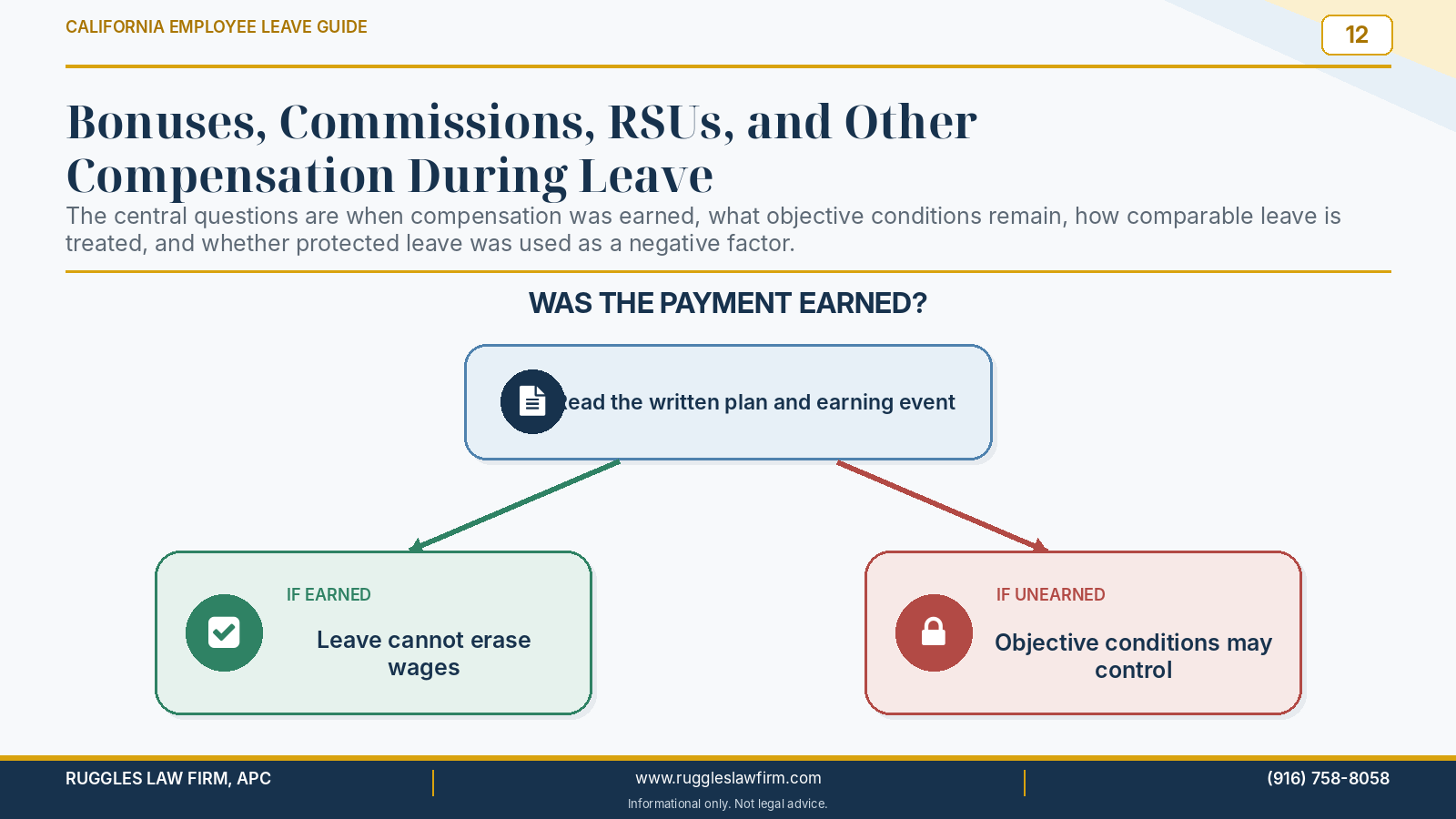
Compensation disputes during leave are unusually fact-specific because the word earned does most of the legal work. An employer may postpone a payment date without changing when wages were earned. It may also establish lawful, clearly disclosed conditions that must occur before a bonus, commission, or equity award is earned. Protected leave cannot be used as a convenient excuse to rewrite those conditions after the fact.
Step 1: Identify the governing documents
- The commission agreement required by Labor Code section 2751.
- The bonus plan, quota letter, compensation policy, and any amendments in effect during the performance period.
- The offer letter, equity plan, grant notice, vesting schedule, and leave-of-absence policy.
- Past payout practices and how employees on vacation, military leave, disability leave, or other comparable absences were treated.
- The date the employer says the payment was earned, the date it became calculable, and the date it was payable.
Earned commissions are wages
California treats earned commissions as wages. The written agreement should state the method by which commissions are computed and paid. Once the employee has satisfied the contract’s earning conditions, the employer generally cannot forfeit the commission merely because the employee later takes leave, is terminated, or is absent on the payment date. Labor Code sections 200, 201-203, 221, and 2751 may apply.
Koehl v. Verio, Inc., 142 Cal.App.4th 1313 (2006), and Steinhebel v. Los Angeles Times Communications, LLC, 126 Cal.App.4th 696 (2005), recognize that the agreement can define when a commission is earned and permit lawful adjustments before that event. Sciborski v. Pacific Bell Directory, 205 Cal.App.4th 1152 (2012), explains that an employer cannot simply recapture wages after they are earned by calling the deduction an adjustment.
Sales completed before leave
Suppose an employee secures a signed contract before leave, but installation, payment, or a cancellation period occurs during leave. If the plan says the commission is earned only after installation or customer payment, that condition may control if it is lawful, clear, and consistently applied. If the employee already satisfied all conditions and payment was merely delayed for accounting, the employer cannot erase the commission because the employee is on leave.
Accounts reassigned during leave
An employer may need to reassign active accounts so customers are served. The compensation plan should explain how credit is divided when one employee originated the sale and another performs post-sale work. Retroactively assigning all credit away from an employee because she took protected leave can support wage and retaliation claims, especially if comparable vacation or nonprotected absences are treated differently.
Bonuses: unconditional versus goal-based
Under 29 C.F.R. §825.215(c)(2), an unconditional bonus — for example, a companywide payment to all employees — generally must be paid to an employee on FMLA leave. A bonus tied to a specific goal such as hours worked, products sold, or perfect attendance may be reduced if the employee fails the goal because of FMLA leave, but only if employees on equivalent non-FMLA leave are treated the same. The employer may not characterize protected leave itself as poor performance.
Active-employment and payout-date clauses
California courts examine the plan’s terms and whether the payment was earned. Neisendorf v. Levi Strauss & Co., 143 Cal.App.4th 509, 523-524 (2006), enforced a bonus plan’s eligibility terms where the employee did not satisfy them. Schachter v. Citigroup, Inc., 47 Cal.4th 610, 619-622 (2009), likewise enforced clear conditions on a voluntary incentive plan before the compensation vested. These decisions do not authorize forfeiture of wages already earned or termination designed to prevent vesting.
CASE LAW IN ONE SENTENCE
“eligibility for bonus payments is properly determined by the bonus plans’ specific terms”
Neisendorf v. Levi Strauss & Co., 143 Cal.App.4th 509, 523 (2006).
The written plan matters — but so do wage law, anti-retaliation rules, the timing of the earning event, and whether the plan is applied consistently.
Discretionary bonuses
A truly discretionary bonus may give the employer latitude, but “discretionary” is not a magic eraser. If the employer uses objective metrics, has a regular formula, or promises payment for completed work, the payment may be nondiscretionary for wage-law purposes. Selectively exercising discretion against employees who took protected leave can also prove retaliation or discrimination.
RSUs, stock options, and equity
Unvested equity usually depends on the plan and grant documents. A protected leave does not automatically accelerate vesting, and many plans pause or continue service credit according to a leave policy. The employer must follow the governing documents and cannot single out protected leave for worse treatment than comparable leave. USERRA’s seniority rules may require different treatment for military service. If employment ends, severance negotiation may address forfeited vesting, exercise periods, or acceleration.
Other payments
- Expense reimbursements: business expenses incurred before leave remain reimbursable under Labor Code section 2802; leave does not erase them.
- Vacation/PTO: vested vacation is generally payable at termination; statutory sick leave ordinarily is not unless combined into PTO.
- Holiday pay: plan terms and equivalent-leave treatment control.
- Draws and advances: lawful recovery depends on whether the payment was a true advance and the written plan clearly permits reconciliation.
- Severance: not ordinarily required by leave law, but retaliation, wage, disability, or reinstatement claims can create negotiation leverage.
CASE STUDY: The commission that closed while the salesperson was on leave
What happened: A salesperson negotiates a deal for six months and obtains the customer’s signed order one day before beginning CFRA leave. The plan says the commission is earned when the customer pays. Payment arrives during leave, and management assigns the entire commission to a substitute who only monitored installation.
Legal analysis: The written earning condition, the originator’s work, the substitute’s role, prior split-credit practice, and treatment of comparable leave must be examined. If customer payment completed the final condition, the original salesperson may have earned some or all of the commission. Reassignment because of protected leave may also be a negative factor under CFRA/FMLA.
Employee takeaway: Preserve the signed plan, CRM history, emails, order date, payment date, account-credit changes, payout statements, and examples involving employees on vacation or other leave.
CASE STUDY: The annual bonus and a leave-related termination
What happened: An annual bonus plan requires active employment on the payout date. An employee meets all performance metrics, takes protected leave, and is terminated two days before payout based on a newly invented reason.
Legal analysis: Neisendorf v. Levi Strauss & Co., 143 Cal.App.4th 509 (2006), and Schachter v. Citigroup, Inc., 47 Cal.4th 610 (2009), show that clear plan conditions can matter. But an unlawful termination timed to avoid payment can support retaliation, wrongful termination, and wage theories. The condition is not insulated from causation analysis.
Employee takeaway: The employer cannot manufacture ineligibility through retaliation. Compare the stated reason, decision date, bonus approval history, and treatment of employees who took other leave.
The practical rule
Ask two separate questions: Was the payment earned? And was protected leave used to deny or reduce it? A “no” to the first may end a wage claim; a “yes” to the second can create a leave or discrimination claim.
What Is Protected — and What Is Not
| Protected | Not Automatically Protected |
|---|---|
|
• Payment of commissions and bonuses that were earned under the written plan before or during leave. |
• A commission before the employee satisfies a clear, lawful earning condition such as customer payment or completed installation. |
|
• Unconditional bonuses and equal treatment of goal-based bonuses under FMLA and comparable-leave rules. |
• A goal-based bonus when the employee objectively did not meet the goal and comparable non-FMLA leave is treated the same. |
|
• Accurate sales credit, lawful account reassignment, and nondiscriminatory application of plan conditions. |
• Automatic acceleration of unvested RSUs or stock options solely because leave occurred. |
|
• Contractual equity treatment, vested benefits, expense reimbursement, and freedom from leave-related forfeiture or retaliatory timing. |
• A guarantee of severance or discretionary compensation absent a plan, promise, unlawful motive, or other legal basis. |
|
Protected Example
A commission was fully earned upon customer payment, which occurred during CFRA leave. The employer cannot forfeit it merely because the employee was absent when payroll processed the commission.
|
Not-Protected Example
A quarterly production bonus requires 500 completed units, and employees on all unpaid leaves receive a proportionate reduction. An employee completes 350 because of leave. The neutral objective formula may be lawful under FMLA rules.
|
RELATED RUGGLES LAW FIRM RESOURCES
- Closed the Deal, Lost the Commission: Post-Sale Commission Theft
- California Commission Clawback Lawyer — Windfall Provisions
- RSU Acceleration in California: When Employers Will Agree and Why
- Laid Off With RSUs in California: When Lost Equity Creates Severance Leverage
- California Tech Layoff: Severance, RSUs, and Executive Compensation
Did leave cause a commission, bonus, or equity loss?
Compensation claims require the exact plan language and transaction history. Preserve every version of the plan, quota, CRM data, payout calculation, leave notice, vesting schedule, and termination document before access disappears.
Request an initial case consultation | (916) 758-8058
Return to Work, Reinstatement, Restrictions, and Fitness-for-Duty
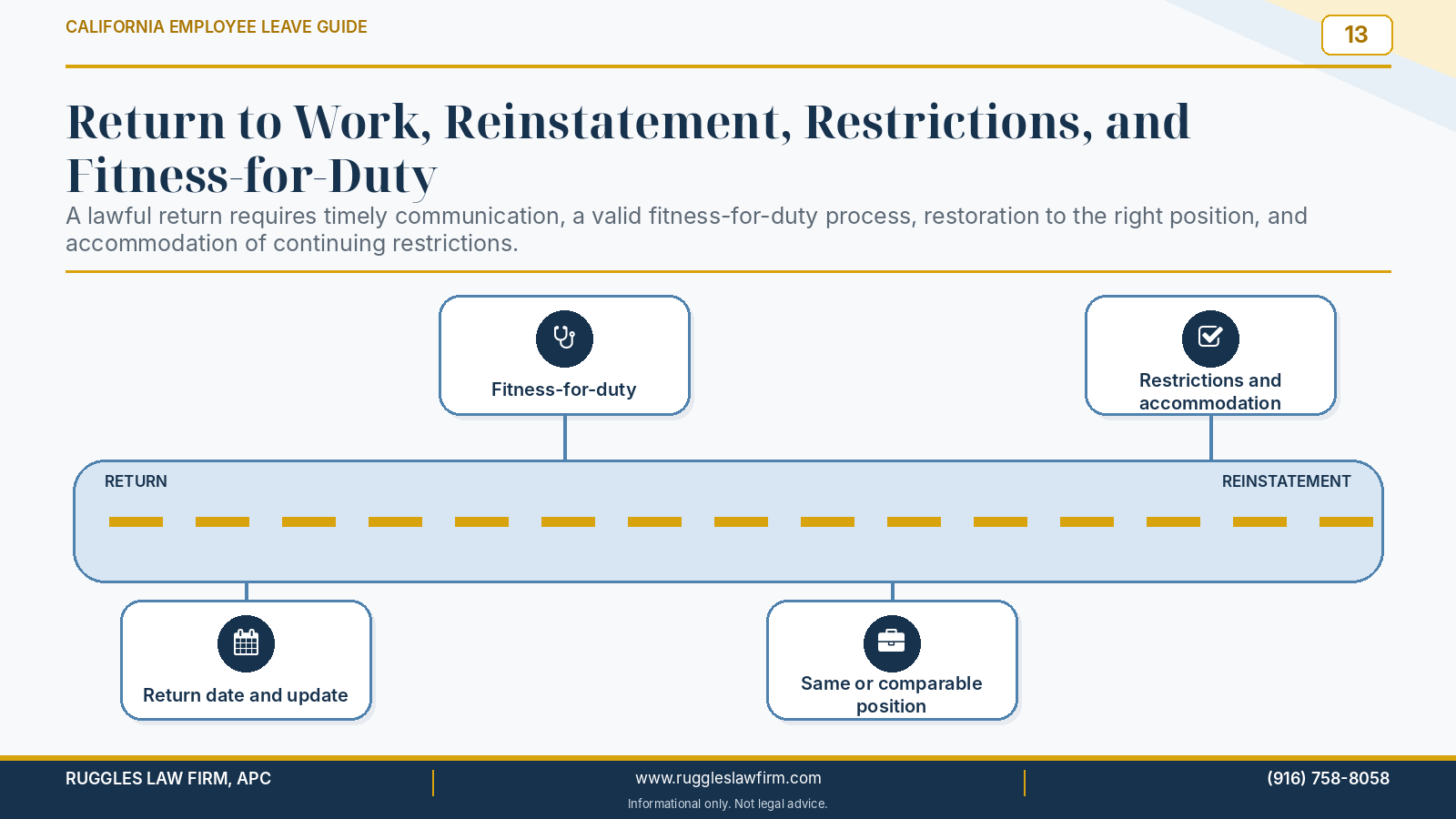
Returning from leave is not merely the reverse of leaving. The employer must identify the correct reinstatement standard, the employee must provide required return information, and both sides may need to address restrictions through the interactive process. Many otherwise manageable leaves become disputes during the last two weeks.
CFRA and FMLA restoration
An employee returning on time from CFRA or FMLA leave is generally entitled to the same position or an equivalent/comparable position. The job should have substantially similar pay, benefits, schedule, location, status, duties, skill, effort, responsibility, and promotional opportunity. An employer cannot satisfy restoration by offering a nominally similar job that is materially worse.
PDL restoration
PDL generally carries a right to return to the same position, subject to narrow exceptions when the position would not have existed for legitimate reasons unrelated to leave. If the same position is unavailable, the employer may have to offer a comparable position. FEHA accommodation duties can add further obligations.
Fitness-for-duty certifications
An employer may require a fitness-for-duty certification under FMLA or CFRA if it provided proper advance notice and applies the policy uniformly to similarly situated employees. The request should relate to the condition that caused leave. Under FMLA, an employer that wants the provider to address the employee’s ability to perform essential functions generally must provide the essential-functions list with the designation notice.
A certification can state that the employee may return with restrictions. “Fit” does not have to mean “no restriction whatsoever.” A blanket 100-percent-healed policy can violate FEHA and the ADA because it bypasses individualized accommodation analysis.
Returning with restrictions
Common temporary restrictions include reduced hours, lifting limits, remote work, extra breaks, no overtime, limited travel, or intermittent treatment. The employer should analyze whether the employee can perform essential functions with accommodation, whether marginal duties can be reassigned, and whether a temporary change creates undue hardship. If no accommodation works in the current job, reassignment to a vacant position may be required under FEHA or the ADA.
Delayed release and short extensions
If a provider changes the return date, the employee should notify the employer promptly and provide an updated estimate. A short extension can be reasonable under Nunes v. Wal-Mart Stores, Inc., 164 F.3d 1243 (9th Cir. 1999), and Zamora v. Security Industry Specialists, Inc., 71 Cal.App.5th 1 (2021). The employer should not treat one changed date as automatic abandonment, but repeated vague delays without medical support can undermine protection.
The job changed while the employee was away
Business changes can occur during leave. If the employer reorganized the department, it must place the employee in the role the employee would have held absent leave. That may be a changed or successor role, not necessarily a frozen snapshot. The employer should be able to explain the reorganization, comparators, decision timing, and why leave played no role.
Failure to return or communicate
An employer may enforce a reasonable return deadline and treat an unexplained failure to return as job abandonment after providing clear notice and considering known disability issues. The employee should never assume a provider’s office sent a release. Confirm receipt and keep a copy. If the employee cannot return, submit a written accommodation request before the deadline.
CASE LAW IN ONE SENTENCE
“the duty to accommodate is a continuing duty that is not exhausted by one effort”
Humphrey v. Memorial Hospitals Association, 239 F.3d 1128, 1138 (9th Cir. 2001).
Return-to-work restrictions should restart the interactive process; an earlier leave approval does not exhaust accommodation duties.
CASE STUDY: The “full duty only” return
What happened: An employee is released after shoulder surgery with a 20-pound lifting limit for six weeks. The job occasionally requires lifting 40 pounds, but coworkers routinely share the task. HR refuses return until the employee has no restrictions.
Legal analysis: The employer should determine whether heavy lifting is essential, whether temporary assistance is effective, whether another accommodation works, and whether hardship is real. A blanket full-duty rule can violate FEHA and the ADA.
Employee takeaway: Ask the provider to identify precise restrictions and duration. Ask HR in writing to engage in the interactive process rather than simply saying “come back when you are 100 percent.”
Return-to-work checklist
Confirm the date, delivery method, recipient, restrictions, essential functions, accommodation request, schedule, benefit status, and position. A five-minute confirmation email can prevent a five-month dispute.
What Is Protected — and What Is Not
| Protected | Not Automatically Protected |
|---|---|
|
• Restoration to the same or a genuinely equivalent/comparable position after timely return from protected leave. |
• A right to demand a preferred position that is not the same, comparable, or a reasonable reassignment. |
|
• A fitness-for-duty process that was properly noticed, uniformly applied, and limited to the relevant condition and essential functions. |
• Refusal to provide a properly requested fitness-for-duty certification after adequate notice. |
|
• Return with reasonable restrictions and a renewed interactive process. |
• An unexplained failure to return or respond after leave expires and no disability issue is known. |
|
• A short medically supported extension or reassignment to a vacant position when required as an accommodation. |
• Elimination of essential functions indefinitely when no accommodation or vacant reassignment exists. |
|
Protected Example
An employee returns from CFRA on the certified date with a temporary no-overtime restriction. Overtime is not essential, and the employer can cover it for one month. Refusing return solely because the employee is not “full duty” may violate FEHA.
|
Not-Protected Example
An employee’s leave expires, HR sends three written requests for an updated status, and the employee does not respond for a month despite being able to do so. The employer may have a lawful abandonment argument.
|
Were you cleared with restrictions but told not to return until you were “100 percent”?
A restricted release should trigger individualized accommodation analysis. Preserve the release, job description, actual duty evidence, communications, and any comparable employees who returned with restrictions.
Request an initial case consultation | (916) 758-8058
When an Employer May Lawfully Terminate an Employee on Leave
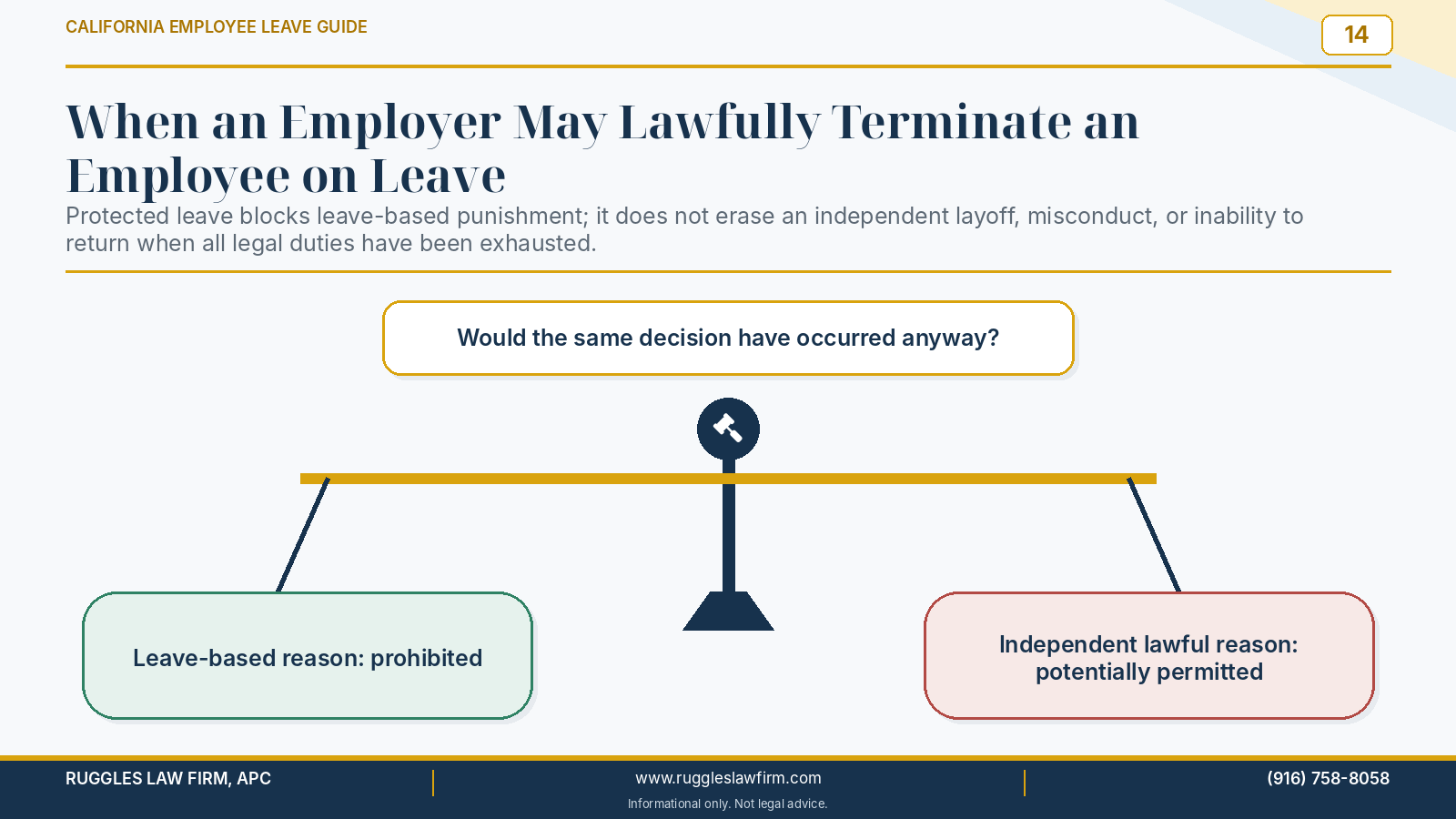
The sentence “you cannot be fired while on leave” is comforting and incomplete. An employer cannot terminate an employee because the employee took protected leave. It can sometimes terminate an employee during leave for a reason that is genuinely independent of leave. The dispute usually turns on whether that explanation is real, supported, consistently applied, and timed independently.
Legitimate reasons that may support termination
- A genuine reduction in force or position elimination that would have affected the employee even if actively working.
- Serious misconduct discovered during leave, including fraud, theft, violence, harassment, or material falsification.
- A termination decision completed before the employer learned of the need for leave, if supported by contemporaneous evidence.
- Exhaustion of protected leave followed by a good-faith accommodation process showing no finite return, no effective accommodation, and no vacant reassignment.
- Failure to provide required certification, updates, or return information after clear notice and a fair opportunity to comply.
- Closure of the business, expiration of a truly temporary position, or another objective event unrelated to leave.
CASE LAW IN ONE SENTENCE
“Persons on CFRA leave are not immunized from layoff during the leave”
Tomlinson v. Qualcomm, Inc., 97 Cal.App.4th 934, 940 (2002).
The employer must still prove the layoff was genuine and that the employee would have been selected even if not on leave.
The “would have happened anyway” defense
Under FMLA, an employer may avoid restoration if it proves the employee would not have remained employed when leave ended. Sanders v. City of Newport, 657 F.3d 772 (9th Cir. 2011), discusses the employer’s burden in an interference case. California CFRA decisions similarly recognize that protected leave does not create greater rights than continued employment would have provided.
Preexisting performance and discipline
An employee’s poor performance does not disappear during leave. But timing matters. A documented final warning issued months earlier is different from a negative review created after the employee requests surgery. The employer should be able to identify when the decision was proposed, who decided it, what comparators were treated similarly, and whether leave affected the score or recommendation.
Misconduct and leave abuse
Richey v. AutoNation, Inc., 60 Cal.4th 909 (2015), recognizes that an employer may terminate genuine abuse of CFRA leave. Hardin v. Wal-Mart Stores, Inc., 604 Fed.Appx. 545 (9th Cir. 2015) (unpublished), likewise illustrates that protected leave does not shield independently actionable conduct. The employer should have reliable evidence and should distinguish activity inconsistent with restrictions from ordinary life activities that are not inconsistent.
Leave exhaustion and disability accommodation
An automated termination at the end of CFRA/FMLA is risky if the employer knows the employee has a disability. Before termination, the employer should consider a finite extension, modified schedule, remote work, reassignment, and other accommodations. Rogers v. County of Los Angeles, 198 Cal.App.4th 480 (2011), and Zamora v. Security Industry Specialists, Inc., 71 Cal.App.5th 1 (2021), illustrate the importance of separating leave exhaustion from FEHA analysis.
Unpublished district-court examples
Unpublished federal district-court orders are not binding, but they show how judges evaluate particular records. Romo v. Costco Wholesale Corp., No. 3:19-cv-01120-JAH-MSB, ECF No. 87 (S.D. Cal. Sept. 20, 2021), addressed prolonged absence and attendance as an essential function. Kilgore v. Tulare County Health & Human Services Agency, No. 1:10-cv-00031-AWI-BAM, ECF No. 30 (E.D. Cal. Feb. 13, 2012), addressed the limits of open-ended leave. Employees and employers should treat such orders as persuasive illustrations, not statewide rules.
Signs the reason may be pretext
- The stated reason changes between HR, the termination letter, unemployment proceedings, and litigation.
- The employer cannot produce contemporaneous selection criteria or decision documents.
- Protected leave was counted in attendance, productivity, utilization, quota, or ranking data.
- A decisionmaker complained about the burden of leave or asked when the employee would “finally be reliable.”
- Comparable employees outside protected leave were retained despite worse performance or discipline.
- The position was advertised or refilled soon after the employer claimed it was eliminated.
CASE STUDY: A real layoff versus a leave-based selection
What happened: Two employees perform the same role. During one employee’s medical leave, the company eliminates one position. The leave-taking employee is selected because her current-quarter utilization is lowest, and the calculation includes weeks of protected leave as zero production.
Legal analysis: A reduction in force can be legitimate, but using protected leave to depress the selection metric makes leave a negative factor. Bachelder v. America West Airlines, Inc., 259 F.3d 1112 (9th Cir. 2001), and Xin Liu v. Amway Corp., 347 F.3d 1125 (9th Cir. 2003), support close scrutiny of timing, comments, and leave-related metrics.
Employee takeaway: Obtain the selection matrix, metric definitions, data period, comparator records, and all versions. The label “RIF” does not answer whether the selection was lawful.
The cleanest question
Ask: What would have happened on the same date if the employee had not taken leave? The evidence supporting that counterfactual is usually the heart of the case.
What Is Protected — and What Is Not
| Protected | Not Automatically Protected |
|---|---|
|
• Freedom from termination, layoff selection, discipline, or nonrenewal because of protected leave or accommodation. |
• Immunity from a genuine RIF, business closure, or position elimination that would have occurred anyway. |
|
• Removal of protected absences from attendance, productivity, quota, and ranking metrics where counting them would make leave a negative factor. |
• Protection for fraud, misconduct, or material leave abuse established by reliable evidence. |
|
• A disability-accommodation analysis before termination at the end of statutory leave. |
• Automatic restoration after the employee has no finite return, cannot perform essential functions with accommodation, and no vacant role exists. |
|
• Accurate, consistent reasons supported by contemporaneous evidence and comparable treatment. |
• Erasure of preexisting documented performance or discipline unrelated to leave. |
|
Protected Example
An employer chooses an employee for layoff because the employee’s utilization was zero during eight weeks of FMLA leave. Leave was used as a negative factor, even if the overall RIF was real.
|
Not-Protected Example
A facility permanently closes while an employee is on leave, and every position at the facility ends. The employee ordinarily is not entitled to a job that would not have existed absent leave.
|
Interference, Retaliation, Evidence, Deadlines, and Remedies
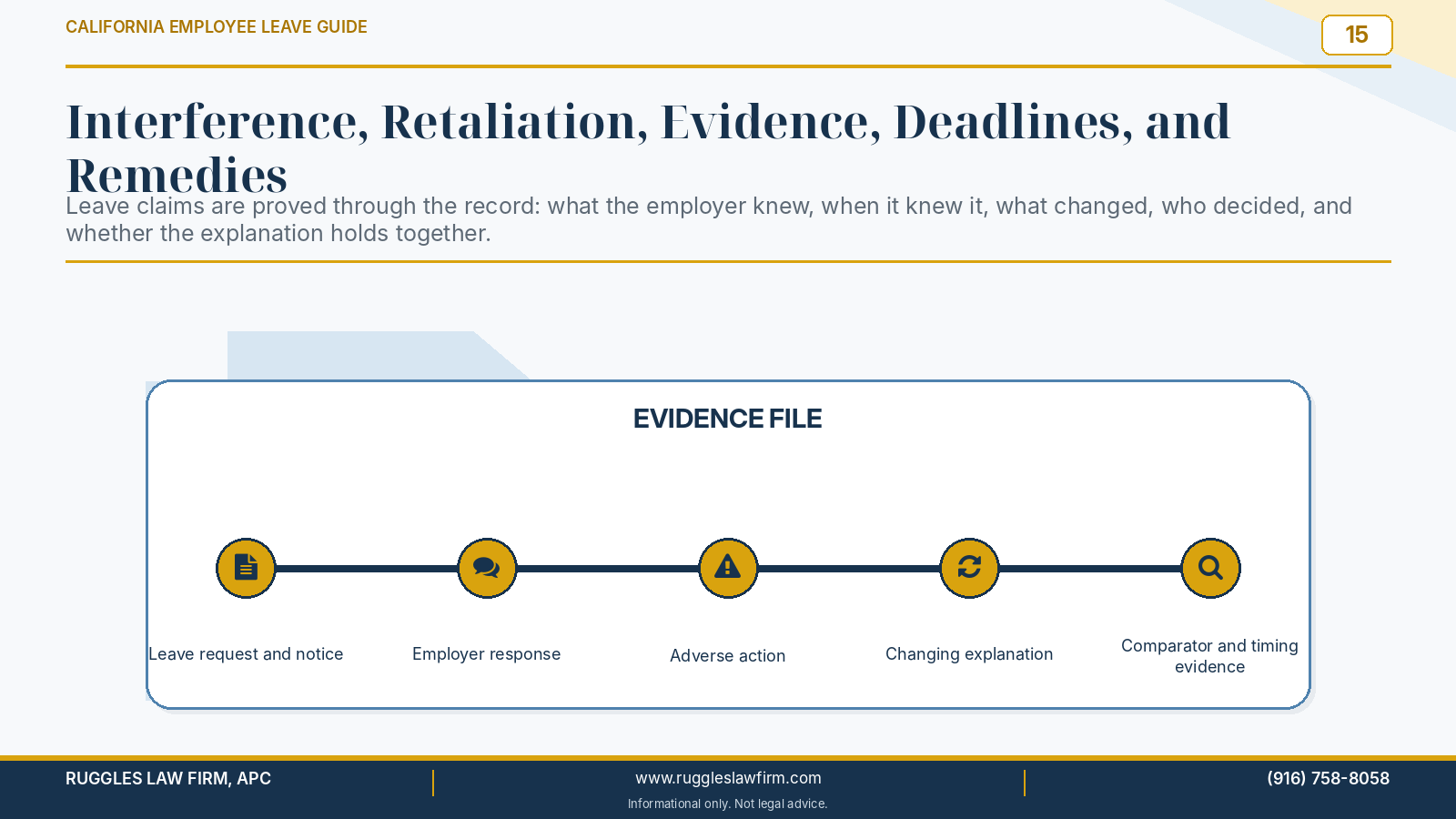
A strong leave claim is not built from the employee’s suspicion alone. It is built from a chronology showing protected activity, employer knowledge, interference or adverse action, causation, damages, and an explanation that does not withstand comparison to the documents.
Interference
Interference includes denying leave, discouraging use, failing to designate qualifying leave, counting protected time as an attendance occurrence, requiring substantive work, terminating benefits early, refusing lawful intermittent leave, or denying reinstatement. Under Bachelder v. America West Airlines, Inc., 259 F.3d 1112 (9th Cir. 2001), using FMLA leave as a negative factor can establish interference.
Retaliation and discrimination
Retaliation occurs when an employer takes adverse action because the employee requested or used protected leave, sought accommodation, opposed an unlawful practice, or participated in a protected process. Adverse actions can include termination, demotion, reduced hours, worse assignments, denial of bonus, exclusion from opportunities, threats, discipline, hostile scrutiny, or a materially disadvantageous transfer.
Xin Liu v. Amway Corp., 347 F.3d 1125 (9th Cir. 2003), found that timing, negative comments about leave, and changed performance treatment could support a jury’s inference. California law likewise permits circumstantial proof through temporal proximity, shifting reasons, policy deviations, comparative evidence, and implausibilities.
The evidence to preserve
- Every leave request, certification, approval, denial, designation, deficiency notice, extension request, and return-to-work release.
- Attendance records, point totals, performance reviews, quotas, utilization reports, bonus and commission calculations, and RIF matrices.
- Handbooks and leave policies in effect at the relevant time, including screenshots of portals and FAQs.
- Emails, texts, chat messages, calendar invitations, call logs, and contemporaneous notes of conversations.
- Names of comparators, replacements, witnesses, and employees who received different leave treatment.
- Pay stubs, insurance records, medical bills, unemployment records, job-search logs, and evidence of emotional or financial harm.
Preserve lawfully
Do not take attorney-client communications, trade secrets, patient records, customer data, or documents you are not authorized to possess. Preserve your own communications and legitimately accessible records, and obtain legal advice about company information.
A practical chronology
Create a dated timeline beginning before the leave request. Include the employee’s performance history, prior discipline, the date the employer learned of the need, each certification, decisionmaker comments, position postings, replacement timing, and the first adverse action. A good chronology often reveals whether the employer’s explanation preceded the leave or was assembled afterward.
Administrative and court deadlines
| Claim type | General deadline | Important caution |
|---|---|---|
| CFRA / FEHA / PDL / state disability discrimination | Generally 3 years to file an administrative complaint with the California Civil Rights Department. | A civil action generally follows a right-to-sue notice and has a separate deadline; exceptions and accrual disputes exist. |
| FMLA | Generally 2 years; 3 years for a willful violation. | The clock may run from the denial, termination, or other violation; internal review ordinarily does not stop it. |
| ADA / PWFA / federal discrimination | Generally 300 days to file with EEOC in California. | A federal lawsuit usually has a short deadline after a right-to-sue notice. |
| Labor Code retaliation / paid sick leave | Deadlines vary; many Labor Commissioner retaliation claims have a 1-year filing period. | Some statutes and civil claims use different periods. Do not assume one deadline controls all theories. |
| USERRA | Federal law generally bars applying a limitations period to USERRA claims. | Prompt action still matters because evidence and remedies can be affected. |
Potential remedies
Available remedies depend on the claim. They may include reinstatement, back pay, front pay, lost benefits, unpaid commissions or bonuses, emotional-distress damages, statutory penalties, liquidated damages under FMLA, punitive damages under FEHA when standards are met, injunctions, interest, and attorney’s fees. Mitigation duties require a terminated employee to make a reasonable job search, document applications, and consider suitable work.
Internal complaints and investigations
An employee can complain internally about leave interference or disability discrimination. The complaint should identify facts, not just conclusions, and request a specific correction. If the employer opens an investigation, the employee should cooperate, preserve the interview record, and review California workplace-investigation rights. False accusations made during a leave dispute should be addressed calmly with documents rather than a stream of angry messages.
CASE STUDY: The performance review that changed after leave
What happened: An employee has strong reviews for three years, requests intermittent FMLA for cancer treatment, and receives the first “unreliable” rating because missed treatment days lowered availability. The employee is later denied a bonus and terminated.
Legal analysis: The review may show interference and retaliation because protected leave was used as a negative factor. Bachelder v. America West Airlines, Inc., 259 F.3d 1112 (9th Cir. 2001), and Xin Liu v. Amway Corp., 347 F.3d 1125 (9th Cir. 2003), make the timing, comments, and changed evaluation highly relevant.
Employee takeaway: Preserve the earlier reviews, metric definitions, leave dates, manager comments, bonus plan, calibration documents, and comparator scores.
Severance does not erase the need for analysis
An employer may offer severance after a leave-related termination. The agreement may release CFRA, FMLA, FEHA, ADA, wage, commission, and benefit claims. Before signing, the employee should evaluate deadlines, damages, tax treatment, unemployment language, confidentiality, nondisparagement, cooperation, no-rehire, equity, and payment terms. A severance offer is neither proof of liability nor proof that the employer did nothing wrong.
What Is Protected — and What Is Not
| Protected | Not Automatically Protected |
|---|---|
|
• Complaints, requests, leave use, accommodation participation, and truthful cooperation in investigations concerning protected rights. |
• Taking confidential or privileged company material without authorization. |
|
• Preservation of personal records and legally accessible evidence. |
• Defamation, threats, harassment, or disruption merely because the employee is asserting rights. |
|
• Freedom from retaliation, negative-factor treatment, benefit loss, or false explanations because of leave. |
• Waiting indefinitely for an internal process while external deadlines expire. |
|
• Timely pursuit of administrative, judicial, wage, or contractual remedies. |
• Assuming close timing alone guarantees success without evidence that the employer knew of and reacted to protected conduct. |
|
Protected Example
A manager says the employee’s approved intermittent leave makes her “unreliable,” lowers her rating for those absences, and denies a bonus. The comment and metric can be direct evidence that leave was a negative factor.
|
Not-Protected Example
An employee downloads thousands of confidential customer and attorney-client files to build a leave case. Protected activity does not authorize indiscriminate removal of protected information.
|
RELATED RUGGLES LAW FIRM RESOURCES
- Workplace Retaliation Rights in California
- What Counts as Protected Activity in California Retaliation Cases?
- Employer Gave a False Reason for Termination in California
- Workplace Investigations in California: Employee Rights
- My Coworker Lied About Me: False Workplace Accusations
- California Severance Agreements: What Employees Should Know Before Signing
Do you suspect leave interference or retaliation?
Do not rely on memory alone. Preserve a lawful chronology, compare the employer’s explanations, calculate compensation and benefit losses, and obtain advice before administrative deadlines or severance-review periods expire.
Request an initial case consultation | (916) 758-8058
The California Employee Leave Action Plan
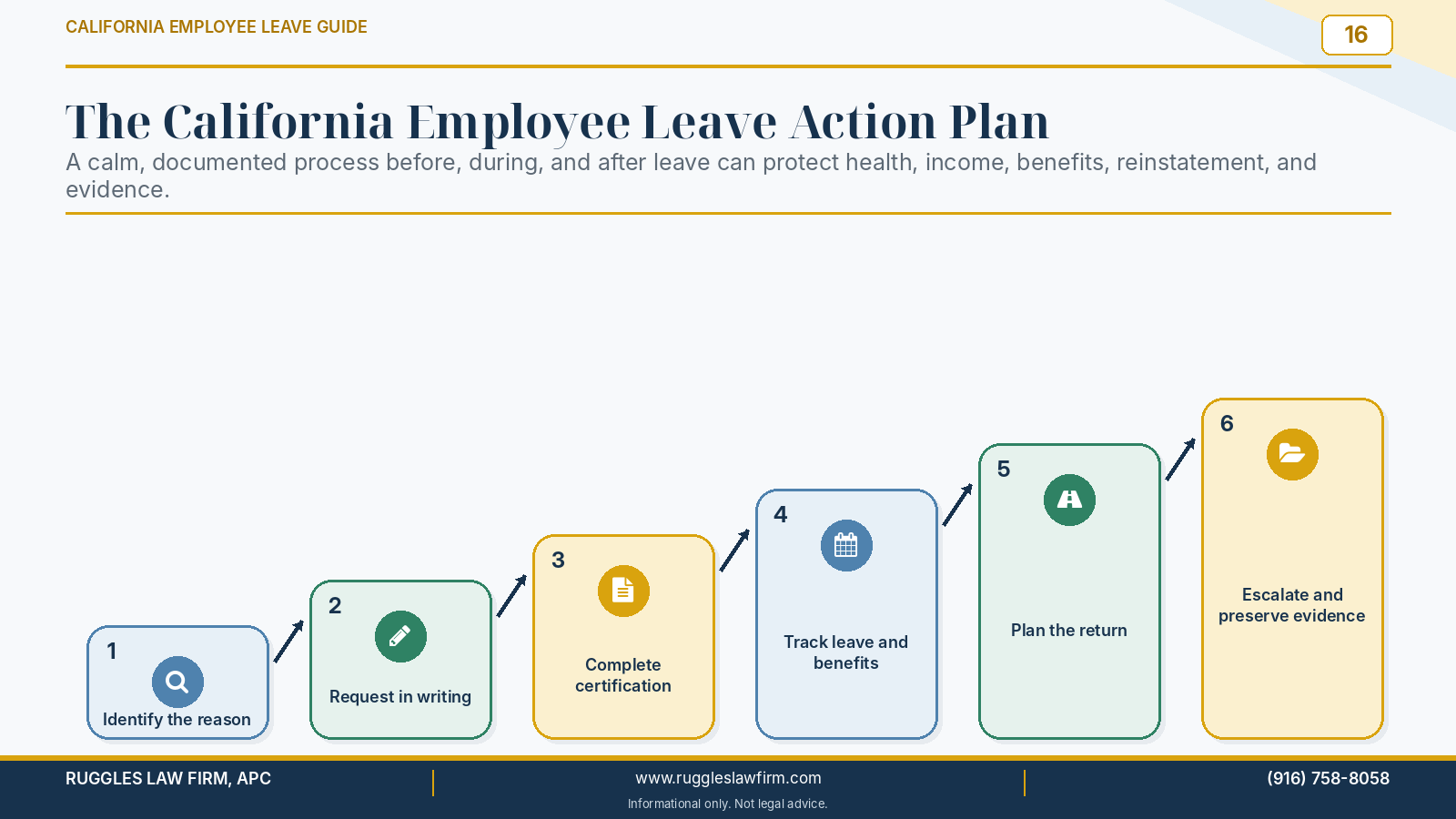
The legal rules are complicated, but the employee’s process can be straightforward. The objective is not to write a legal brief to HR. It is to communicate the qualifying facts, complete required forms, preserve the record, and address problems early enough to fix them.
Before leave begins
- Identify the real reason. Is this the employee’s health, family care, pregnancy disability, bonding, a workplace injury, military duty, victim safety, bereavement, reproductive loss, or another statutory category?
- Check coverage and eligibility. Count months and hours; identify employer size and worksite; review the handbook, union agreement, offer letter, and benefit plans.
- Make a written request. State the expected start, duration, continuous or intermittent schedule, and enough facts to trigger the correct process. Do not overshare diagnosis details.
- Ask HR to identify the law and leave year. Request written eligibility, designation, certification requirements, benefit treatment, and the calculation of available time.
- Give the provider a useful job description. The provider should address incapacity, duration, frequency, essential-function restrictions, and return estimate rather than writing only “off work until further notice.”
During leave
- Meet deadlines or explain obstacles. If a provider is delayed, document diligent efforts and ask for a short extension before the deadline.
- Follow call-in rules for intermittent leave. Identify the absence as related to the approved reason and track the time independently.
- Pay premium contributions and monitor coverage. Confirm deductions or payment instructions and save coverage records.
- Provide agreed status updates. Do not disappear, but do not allow leave to become unpaid remote work.
- Avoid contradictions and social-media drama. Activities should remain consistent with medical restrictions; context matters, but unexplained posts invite disputes.
- Preserve compensation records. Save commission plans, bonus metrics, vesting schedules, CRM history, quota adjustments, and pay statements.
Two to three weeks before expected return
- Confirm the return date and fitness-for-duty requirements. Ask exactly what the provider must address.
- Request accommodation for restrictions. Propose practical options and ask for the interactive process.
- If more time is needed, request a finite extension before leave expires. Include the best available return estimate.
- Confirm position, schedule, location, pay, benefits, and system access. A written return plan avoids first-day surprises.
If leave is denied or employment is threatened
- Ask for the reason in writing. Is the issue eligibility, certification, exhaustion, hardship, position elimination, or alleged misconduct?
- Correct factual mistakes promptly. Supply missing hours, service history, provider information, or documentation.
- State the alternative legal basis. For example: “If CFRA is exhausted, I am requesting a finite medical leave as a reasonable accommodation under FEHA.”
- Preserve lawful evidence. Keep the timeline, policies, notices, metrics, pay documents, and witness names.
- Do not resign impulsively. Resignation can affect reinstatement, damages, unemployment, and leverage. Obtain advice before deciding unless health or safety requires immediate action.
- Review severance carefully. A release may cover leave, disability, wage, bonus, commission, equity, and benefit claims.
Sample leave-request language
Sample email — initial request
Subject: Request for medical/family leave. I am requesting leave beginning [date] because [I am unable to work due to a medical condition / I need to care for my covered family member with a serious health condition / another qualifying reason]. My current expected return date is [date], and the leave is expected to be [continuous/intermittent]. Please provide all eligibility, rights, certification, benefit, and designation notices and identify any additional information required. I am available at [contact method] for leave-administration communications.
Sample email — additional accommodation
My CFRA/FMLA leave is expected to end on [date]. My provider currently estimates I can return on [date] with the attached restrictions. I am requesting this finite extension and/or the listed restrictions as a reasonable accommodation under FEHA and the ADA. Please engage in the interactive process and let me know if additional functional information is needed.
What not to write
Avoid threats, insults, legal conclusions unsupported by facts, promises that the provider has not made, or statements such as “I will never be able to return” when the medical outlook is still being evaluated. Professional, precise communication is more persuasive and more useful as evidence.
When to seek legal advice
- The employer denies leave, refuses forms, or tells the employee to resign.
- Leave is counted as attendance, poor performance, low utilization, or failure to meet quota.
- A return with restrictions is rejected without an interactive process.
- The position is eliminated, filled, or materially changed during leave.
- Benefits, bonuses, commissions, equity, or PTO are lost because of leave.
- The employee receives a PIP, investigation, severance agreement, or termination notice near the leave request or return.
- Administrative or contractual deadlines are approaching.
The final practical point
Most employees do not need to be aggressive. They need to be clear, timely, truthful, and organized. A calm paper trail usually protects better than a dramatic email marked “URGENT!!!” in three colors.
What Is Protected — and What Is Not
| Protected | Not Automatically Protected |
|---|---|
|
• A timely, good-faith request containing enough facts to trigger the correct leave or accommodation process. |
• False statements, altered forms, or material omission of facts requested lawfully. |
|
• Reasonable compliance with certification, updates, premium, call-in, and return requirements. |
• Threats, harassment, removal of confidential information, or intentional disruption. |
|
• A finite accommodation request before statutory leave expires and a documented interactive process. |
• Assuming the provider, insurer, EDD, workers’ compensation carrier, and employer automatically exchange all paperwork. |
|
• Lawful preservation of evidence, internal complaints, agency filings, and consultation with counsel. |
• Waiting until after an uncommunicated return deadline to request an extension that could have been requested earlier. |
|
Protected Example
Two weeks before CFRA ends, an employee submits a provider note requesting four more weeks and a temporary reduced schedule, expressly asks for FEHA accommodation, and responds to follow-up questions. The employer must analyze the request in good faith.
|
Not-Protected Example
An employee knows recertification is due, makes no effort to obtain it, ignores deficiency notices, and disappears for six weeks. The employee may lose statutory protection even if a medical issue existed.
|
RELATED RUGGLES LAW FIRM RESOURCES
Need a leave strategy before the situation becomes a termination?
Early advice can help frame the request, identify overlapping laws, protect compensation, plan a restricted return, and preserve leverage. The best time to solve a leave problem is usually before the final deadline or final paycheck.
Request an initial case consultation| (916) 758-8058
Frequently Asked Questions About California Employee Leave
These answers are intentionally concise. The full guide provides the broader rules, limitations, examples, case law, and source links. Because leave law is highly fact-specific, employees should not treat a short answer as a substitute for advice about a pending deadline, certification, termination, or severance agreement.
What is a leave of absence?
A leave of absence is an approved period away from work or a reduced work schedule. The phrase itself does not identify the legal source of the right. A leave may be protected by CFRA, FMLA, FEHA, the ADA, PDL, the PWFA, paid-sick-leave law, military law, another statute, a union agreement, or the employer’s own policy. Some leaves preserve the job but provide no pay; some wage-replacement programs provide money but no job protection; and some discretionary leaves do neither unless the employer promises otherwise. Start by identifying the reason, the employee’s eligibility, the employer’s coverage, and the requested duration.
Does California guarantee a leave of absence to every employee?
No. California has many leave laws, but there is no universal right to take any amount of time off for any reason. Protection depends on the qualifying reason, employer size, employee service and hours where applicable, notice, certification, and duration. A new employee at a five-person company may qualify immediately for pregnancy disability leave but not yet for CFRA. An employee needing a finite disability accommodation may be protected by FEHA even when CFRA and FMLA do not apply. A vacation, sabbatical, move, or nonqualifying caregiving request may be governed only by policy. The legal label follows the facts, not the heading on the employer’s form.
What makes a leave legally protected?
Usually four things must line up: coverage, eligibility, a qualifying reason, and procedural compliance. Coverage asks whether the employer is large enough and whether the law applies to that workplace. Eligibility may depend on months of service and hours worked. The reason must fit the statute, such as a serious health condition, pregnancy disability, bonding, military duty, or another protected category. Finally, the employee must provide sufficient notice and certification when lawfully required. A protected leave generally cannot be denied, counted as an attendance violation, or used as a negative factor, subject to legitimate limits and defenses.
Does protected leave have to be paid?
Usually not. CFRA, FMLA, PDL, FEHA accommodation leave, and many special leaves are primarily job-protection laws. Pay may come from accrued sick leave or PTO, California Disability Insurance, Paid Family Leave, workers’ compensation temporary disability, an employer salary-continuation plan, or a collective bargaining agreement. The employee may have several overlapping sources: for example, CFRA can protect the job while PFL replaces part of the wages. Because pay and job protection are separate, approval by EDD does not prove that the employer approved leave, and an employer’s leave approval does not automatically qualify the employee for state benefits.
Can I be fired while on protected leave?
An employee can be terminated during protected leave for a genuinely independent reason that would have produced the same result if the employee had been working, such as a documented companywide reduction, serious misconduct, or elimination of the position. The employer may not terminate because the employee requested or used leave, count protected absences against attendance, manufacture a reason, or refuse a required accommodation. Timing is evidence, not automatic proof. The central question is whether the same decision would have occurred without the leave. See Fired While on Medical Leave in California.
Is PTO the same thing as protected leave?
No. PTO is a pay bank or employer benefit; protected leave is a legal restriction on what the employer may do. PTO can run at the same time as CFRA or FMLA, but the PTO balance does not determine the statutory leave balance. Using vacation for a two-week trip does not create CFRA protection. Conversely, an employee with no PTO may still have unpaid protected leave. Employees should ask HR to state separately: the statutory leave designation, the paid-leave source, the remaining leave balance, and the effect on benefits.
Do independent contractors receive the same leave rights as employees?
Generally no. Most employment leave statutes protect employees, not genuine independent contractors. But California classification law looks at the actual relationship rather than the contract label. A worker called a contractor may still be an employee if the company controls the work or the statutory test is not met. Misclassification can affect leave, wage, tax, benefit, and discrimination rights. A contractor who is also employed by another entity may have rights through that employer. Classification is fact-intensive and should be addressed early because the wrong label can conceal every other issue.
Do remote employees working in California receive California leave protections?
Often yes, if the employee actually works in California and the statute applies, but the analysis can be complicated when the employer is outside California, the employee moves temporarily, or the worksite for FMLA purposes is another location. CFRA does not use FMLA’s 50-employees-within-75-miles test. FMLA worksite rules for remote workers generally focus on the office to which the employee reports or from which assignments are made. Choice-of-law, payroll, tax, and contract provisions can matter. A remote employee should identify the physical work location, reporting office, employer headcount, and where employment decisions were made.
Does at-will employment eliminate leave rights?
No. At-will employment permits termination for any lawful reason or no stated reason, but not for an unlawful reason. An employer may not use at-will status to defeat CFRA, FMLA, FEHA, PDL, the ADA, the PWFA, paid sick leave, USERRA, jury leave, or anti-retaliation laws. At-will status also does not permit nonpayment of earned wages, commissions, or vested vacation. The dispute usually concerns the real reason for the decision, not whether the offer letter contained an at-will clause.
What happens when more than one leave law applies?
The laws may run concurrently, consecutively, or provide different remedies. CFRA and FMLA commonly run together for the employee’s own nonpregnancy serious health condition. FMLA may run during pregnancy disability leave, while CFRA pregnancy-disability time generally does not, allowing CFRA bonding afterward. FEHA or the ADA may require additional finite leave after statutory family leave is exhausted. Paid sick leave may provide wages during the first part of another protected leave. The employer should designate each applicable law accurately; employees should keep separate calendars for job-protected leave, paid benefits, and accommodation time. CFRA and FMLA Eligibility, Reasons, and Rights
What is the California Family Rights Act?
CFRA is California’s principal family and medical leave law. It generally requires covered employers with five or more employees to provide up to 12 workweeks of unpaid, job-protected leave in a 12-month period to an eligible employee for the employee’s own serious health condition, care of specified family members or a designated person, bonding with a new child, or a qualifying military exigency. It also protects continued group health coverage and reinstatement, subject to statutory limits. The official CRD CFRA guide explains the framework.
Who is eligible for CFRA leave?
The employee generally must have worked for the employer for at least 12 months and performed at least 1,250 hours of work during the 12 months immediately preceding leave. The months need not be consecutive, subject to rules about long breaks in service. The employer generally must have five or more employees. Eligibility is measured when leave starts, so an employee who is initially ineligible may become eligible later. Pregnancy disability leave, paid sick leave, reproductive loss leave, and some other rights have different eligibility rules and should be analyzed separately.
How large must an employer be for CFRA to apply?
CFRA generally covers an employer with five or more employees. Unlike FMLA, CFRA does not require 50 employees within 75 miles of the employee’s worksite. This difference is important for small companies, satellite offices, remote employees, and distributed workforces. The five employees need not all work at the same location, although factual and statutory questions can arise regarding integrated entities, joint employment, staffing relationships, and affiliated companies.
How are the 1,250 hours for CFRA and FMLA counted?
The test generally counts hours actually worked during the 12 months immediately before leave begins. Paid vacation, holidays, sick time, and other nonworked paid hours ordinarily do not count as hours worked, although USERRA can require credit for hours that would have been worked during military service. Salaried exempt employees are not automatically disqualified; payroll, schedules, calendars, and workload records may establish hours. Employers must make a good-faith calculation and should not manipulate records to defeat eligibility.
Must the 12 months of employment be consecutive?
Not necessarily. Prior service can count even after a break, subject to statutory and regulatory rules. Under FMLA, a break of seven years or more is often disregarded unless the break involved USERRA service or a written agreement to rehire. CFRA has its own regulations and should be checked separately. Employees who previously worked for the employer, a predecessor, or an acquired entity should provide the dates and documents rather than accepting an immediate “not enough service” answer. Back to contents
What reasons qualify for CFRA leave?
The principal reasons are the employee’s own serious health condition; care of a child, parent, grandparent, grandchild, sibling, spouse, registered domestic partner, parent-in-law, or designated person with a serious health condition; bonding with a new child by birth, adoption, or foster placement; and a qualifying exigency related to covered military duty. Pregnancy disability itself is generally handled under PDL, though CFRA bonding may follow. Ordinary errands, routine child care without a serious health condition, and general family preference do not automatically qualify.
What is a serious health condition?
A serious health condition generally involves inpatient care or continuing treatment by a health care provider. It can include chronic conditions, pregnancy under FMLA, periods of incapacity with treatment, and conditions requiring multiple treatments. A common cold or routine appointment may not qualify unless the statutory criteria are met, while migraine, diabetes, depression, cancer treatment, surgery, and many other conditions can qualify depending on incapacity and treatment. The name of the diagnosis is less important than the treatment and functional effects.
Which family members are covered by CFRA?
CFRA covers a child of any age, parent, spouse, registered domestic partner, grandparent, grandchild, sibling, parent-in-law, and a designated person related by blood or whose association is equivalent to a family relationship. FMLA’s ordinary family-care categories are narrower, generally covering a spouse, parent, and son or daughter, with separate military provisions. The employee should identify the relationship accurately and provide only certification information lawfully required.
What is a designated person under CFRA?
A designated person is an individual related by blood or whose association with the employee is equivalent to a family relationship. The employee may identify the person when requesting leave, and the employer may limit the employee to one designated person in a 12-month period. The category is broader than a casual acquaintance but can include a close family-equivalent relationship not captured by traditional labels. Documentation should focus on the qualifying relationship and need for care without unnecessary personal detail.
Can I take CFRA leave to care for an adult child?
Yes. CFRA’s definition of child does not impose the same age or disability limitation that often matters under ordinary FMLA family-care rules. The adult child must have a serious health condition and the employee must be needed to provide qualifying care. Care can include physical assistance, transportation for treatment, psychological comfort, or arranging changes in care when connected to the condition. A purely social visit or general help unrelated to treatment may not qualify.
How does CFRA bonding leave work?
An eligible employee may take up to 12 workweeks to bond with a child after birth, adoption, or foster placement, generally within one year of the child’s arrival. Bonding leave ordinarily must be taken in blocks of at least two weeks, but the employer must grant requests for shorter periods on at least two occasions and may agree to more. Both parents can have rights even if they work for the same employer. Pregnancy disability leave may precede CFRA bonding leave, creating a longer protected period.
Can CFRA leave be taken intermittently?
Yes, when intermittent or reduced-schedule leave is medically necessary for a serious health condition or qualifying military exigency. Bonding leave has special minimum-increment rules. The employee should provide the estimated frequency and duration, follow call-in procedures, and identify each absence as related to the approved condition. The employer may temporarily transfer the employee to an equivalent position that better accommodates planned intermittent leave, but may not use the transfer as punishment or reduce equivalent pay and benefits.
Can an employer require me to use PTO during CFRA or FMLA leave?
Sometimes. Federal and California rules permit substitution of certain accrued paid leave for unpaid family or medical leave, but the details differ by reason and paid-leave category. An employer may require vacation or PTO in circumstances allowed by policy and law. Sick leave can have narrower permitted uses. State Disability Insurance or Paid Family Leave coordination can also affect substitution. The employee should request a written designation showing whether PTO runs concurrently and how much protected leave remains; using paid time ordinarily does not add extra weeks.
Does my health insurance continue during CFRA or FMLA leave?
Generally, group health coverage must continue on the same terms during protected CFRA and FMLA leave, with the employee paying the normal employee share. PDL also has continuation rules. Other benefits may follow the employer’s rules for comparable unpaid leaves. Failure to pay the employee contribution can jeopardize coverage after proper notice. If protected coverage ends, COBRA or Cal-COBRA may become available. Employees should obtain written premium instructions and verify that coverage remains active before treatment.
Must the employer return me to the same job after CFRA leave?
Generally, the employee is entitled to the same or a comparable position, subject to limited exceptions. A comparable position should be virtually identical in pay, benefits, schedule, location, status, duties, and working conditions. The employer need not reinstate an employee who would have been laid off or terminated for an independent reason, but it bears a significant factual burden when the decision occurs during leave. Returning an employee to a nominal title with materially worse territory, hours, compensation opportunity, or status may violate the statute.
How does FMLA differ from CFRA?
FMLA generally requires 50 employees within 75 miles of the worksite, while CFRA generally covers employers with five or more employees and lacks that radius test. CFRA covers additional family members and a designated person. FMLA includes pregnancy incapacity and military caregiver leave; CFRA treats pregnancy disability separately under PDL and has different family definitions. The laws often run concurrently but not always. Remedies, notices, regulations, and employer defenses also differ. Employees should not assume that an FMLA form describes the full California right.
What is FMLA’s 50-employees-within-75-miles rule?
A private-sector employee generally must work at a site where the employer employs at least 50 employees within 75 miles. For a remote employee, the worksite is usually the office to which the employee reports or from which assignments are made, not the home. Public agencies and certain schools are covered employers regardless of size, although employee eligibility rules still matter. CFRA has no comparable 50/75 requirement, so an employee may be CFRA-eligible even when FMLA does not apply.
Do public employees and school employees receive FMLA leave?
Public agencies are covered FMLA employers regardless of employee count, and public and private elementary and secondary schools have special coverage and scheduling rules. Individual eligibility still generally requires 12 months and 1,250 hours, unless another law, contract, civil-service rule, or collective bargaining agreement is more generous. Public employees may also have statutory appeal, Skelly, disability-retirement, Education Code, or union rights that private employees do not. Deadlines can be short, so the governing personnel system must be identified promptly.
What is the 26-week military caregiver leave?
FMLA can provide up to 26 workweeks in a single 12-month period to care for a covered servicemember with a serious injury or illness. Separate FMLA and CFRA provisions cover qualifying exigencies related to military deployment. USERRA protects military service itself and provides reinstatement and benefit rules. These laws use technical definitions for covered servicemember, next of kin, serious injury, deployment, and certification. Employees should use the military-specific forms rather than relying only on ordinary family-care paperwork.
Do CFRA and FMLA always run at the same time?
No. They run concurrently only when the absence qualifies under both laws and the employer properly designates it. They may diverge because of employer size, worksite headcount, family relationship, pregnancy disability, designated-person leave, or military caregiver leave. For example, pregnancy incapacity can use FMLA and PDL while leaving CFRA bonding time available. Employers should not delay designation to manufacture extra discipline or retroactively surprise the employee; employees should request a written calendar showing how each entitlement is being charged. Back to contents
Can I decline FMLA designation and save it for later?
The Ninth Circuit held in Escriba v. Foster Poultry Farms, Inc., 743 F.3d 1236 (9th Cir. 2014), that an employee could affirmatively decline FMLA protection in the circumstances presented. Later federal agency guidance has taken a more restrictive view of an employer allowing employees to defer FMLA designation. This is not a safe self-help strategy. An employee who says “do not treat this as FMLA” may lose protection, while an employer that fails to designate qualifying leave may face interference issues. Obtain advice before attempting to separate an absence from FMLA.
What if the employer fails to designate my leave as CFRA or FMLA?
The failure may violate notice or designation duties, but liability usually requires resulting harm or prejudice. If the employer nevertheless provided all the time, benefits, and reinstatement required, damages may be limited. If the failure caused the employee to postpone treatment, lose additional leave, incur benefits costs, or be disciplined, the omission can be significant. Employees should correct the record in writing while leave is ongoing and keep copies of eligibility, rights, designation, and certification notices.
What is the FMLA key-employee exception?
A covered employer may deny reinstatement to a salaried, eligible employee who is among the highest paid 10 percent of employees within 75 miles only if restoration would cause substantial and grievous economic injury and strict notice requirements are met. It is not a general “executive exception,” and it does not permit denial of leave or health coverage. The standard is demanding. An employer that first invokes the exception at the end of leave or relies only on inconvenience may not satisfy the statute. Notice, Certification, Intermittent Leave, and Privacy
How should I request leave?
Use a written request when practicable. State the qualifying facts, expected start date, estimated duration, whether leave is continuous or intermittent, and a reliable contact method. Ask the employer to provide eligibility, rights, certification, designation, benefit, and return-to-work requirements. The employee need not write a legal brief or disclose every diagnosis. If an emergency prevents advance writing, give oral notice as soon as possible and follow up. Keep the sent message, attachments, and confirmation of receipt.
Must I use the words CFRA or FMLA?
No magic words are required. The employee must provide enough information for the employer to understand that the absence may qualify. A hospitalization, surgery, pregnancy restriction, chronic flare, or need to care for a seriously ill parent can trigger inquiry duties even without a statute name. Once the employee has been approved for intermittent leave, later call-ins may need to identify the connection to the approved reason. Vague statements such as “I need time off” may be insufficient if the employer cannot reasonably connect them to a protected condition.
Must I give 30 days’ notice?
When the need is foreseeable at least 30 days in advance, the employee generally should provide 30 days’ notice. If 30 days is not practicable, notice should be given as soon as practicable. Planned treatment should be scheduled to minimize disruption when medically possible, but treatment should not be delayed dangerously. Failure to provide timely notice can permit delay in some circumstances, not automatic permanent forfeiture. The employer should consider what the employee knew, when the need became foreseeable, and whether an emergency or provider scheduling affected notice.
What if the need for leave is an emergency?
Give notice as soon as practicable under the circumstances. A family member can call if the employee is incapacitated. Provide basic facts—hospitalization, emergency treatment, expected absence—and complete forms after the crisis. An employer should not demand perfect paperwork while the employee is unconscious or arranging emergency care. The employee should nonetheless follow up promptly, identify the prior emergency notice, request the forms, and document diligent efforts to obtain certification.
Must I follow the employer’s normal call-in procedure?
Generally yes, absent unusual circumstances. Protected leave is not a license to ignore a reasonable call-in rule. For intermittent leave, the employee should use the required number or system, state that the absence relates to the approved condition, and keep a screenshot or call record. Unusual circumstances—such as emergency transport, hospitalization, or a nonfunctioning system—can excuse strict compliance. Selective enforcement against leave users may show interference or retaliation.
What may a medical certification ask?
A certification may generally request the date the condition began, probable duration, medical necessity, incapacity, needed care, and the expected frequency and duration of intermittent leave. For the employee’s own condition, it may address inability to perform essential functions. California limits can be more protective of diagnosis privacy than federal forms. The employer generally is not entitled to the employee’s complete medical record. A useful certification is specific about function and timing without unnecessary medical history.
Must I disclose my diagnosis to obtain leave?
Not always. CFRA certification generally focuses on the existence of a serious health condition, duration, and need for leave rather than the diagnosis. FMLA certification can seek sufficient medical facts but not unrestricted records. FEHA accommodation may require information establishing disability, restrictions, and duration, but often not a detailed diagnosis. The employer should keep medical information confidential and separate. Employees should not refuse all documentation; they should provide the functional information the law permits and ask HR to identify the legal basis for any broader demand.
How long do I have to return a certification?
Under FMLA, employers generally allow at least 15 calendar days after the request unless it is not practicable despite diligent, good-faith efforts. California rules have comparable timing concepts, and the employer should identify deficiencies and give an opportunity to cure. Employees should send the form to the provider immediately, follow up, document delays, and ask for an extension before the deadline. Silence is much riskier than a written explanation with proof of diligent efforts.
Can the employer demand a second medical opinion?
For FMLA leave based on the employee’s own serious health condition, the employer may in qualifying circumstances obtain a second and, if necessary, third opinion at its expense, using providers it does not regularly employ. Different rules apply to family-member certifications and recertifications. FEHA permits reasonable medical documentation but does not authorize fishing expeditions. A second opinion cannot be used as retaliation or to delay urgent leave indefinitely.
Can the employer require recertification?
Yes, within statutory limits. FMLA allows recertification at specified intervals, when circumstances change significantly, or when the employer receives information casting doubt on the reason or continuing validity. The employer should not demand a new certification for every absence covered by a stable intermittent certification. California accommodation processes can include reasonable status updates about duration and restrictions. Employees should respond timely and ask the employer to identify the changed circumstance or rule supporting an unusually frequent demand.
How is intermittent leave certified?
The provider should estimate the medical necessity, treatment schedule, flare frequency, and expected duration. Precision is not always possible, but ranges help: for example, one to two episodes per month lasting up to two days. The employee must track usage and follow call-in procedures. If actual usage materially exceeds the estimate, the employer may seek recertification rather than assume abuse. The employer may not convert approved intermittent absences into attendance points or require the employee to make up protected time as punishment.
Can migraines, depression, anxiety, or other episodic conditions support intermittent leave?
Yes, if the condition meets the serious-health-condition or disability standard and the leave is medically necessary. Chronic conditions can qualify even when episodes are intermittent and the employee is not treated on every absence day. Mental health conditions receive the same legal analysis as physical conditions. Certification should address incapacity and frequency without unnecessary detail. An employer may enforce call-in and certification rules but may not dismiss the condition as “not visible” or penalize approved episodes. Back to contents
Must I schedule appointments outside work?
The employee should make a reasonable effort to schedule planned treatment so it does not unduly disrupt operations, subject to the provider’s approval and availability. That does not require delaying necessary care or finding appointments that do not exist. The employer may discuss scheduling but cannot dictate treatment or force unsafe delay. Keep appointment confirmations if scheduling becomes disputed.
Can bonding leave be intermittent?
CFRA bonding leave is generally taken in increments of at least two weeks, but the employer must grant shorter requests on at least two occasions and may approve additional shorter periods. FMLA bonding leave ordinarily requires employer agreement for intermittent use. Employer policies may be more generous. Employees should propose a written schedule early because day-by-day bonding arrangements are treated differently from medically necessary intermittent leave.
Can the employer track my protected leave?
Yes. The employer may maintain accurate leave records, calculate increments, request lawful updates, and enforce notice procedures. It may not inflate usage, count nonworkdays improperly, use increments larger than allowed, or treat protected time as an attendance violation. Employees should keep an independent calendar showing each absence, hours charged, reason, call-in proof, PTO use, and remaining balance. Discrepancies are easier to correct monthly than after termination.
Can HR contact my doctor directly?
FMLA permits limited contact by an appropriate representative—not the direct supervisor—for authentication or clarification after the employee has an opportunity to cure, and it does not permit the employer to demand additional information beyond the certification rules. HIPAA authorization may be required for some communications. FEHA permits reasonable clarification of restrictions but not unrestricted medical access. Employees can ask that questions be provided in writing and routed through the provider’s designated process.
Can the employer investigate suspected leave abuse?
Yes, if the investigation is lawful, evenhanded, and based on legitimate facts. Fraudulent certification, working inconsistently with stated restrictions, or taking leave for an unapproved purpose may defeat protection. But an innocent photograph, travel, or outside activity does not automatically prove fraud; restrictions may permit many activities while barring job duties. Surveillance, social-media review, and interviews must comply with privacy and other laws. The employee should explain context truthfully and preserve medical restrictions rather than altering a story after the fact. Disability, Pregnancy, Paid Sick Leave, and Family Care
Can FEHA require leave after CFRA or FMLA is exhausted?
Yes. A finite additional leave may be a reasonable accommodation if it is likely to enable the employee to return and does not create undue hardship. CFRA and FMLA provide fixed entitlements; FEHA asks an individualized accommodation question. The employer should request updated functional information, explore alternatives, and assess hardship with evidence rather than a rigid maximum-leave policy. See Can My Employer Terminate Me if I Need an Indefinite Medical Leave?.
How long must an employer hold a job open as a disability accommodation?
There is no universal number of weeks under FEHA or the ADA. Relevant factors include the expected return date, prior leave, essential duties, operational impact, temporary coverage, employer size, cost, and alternative accommodations. A finite leave of several weeks may be reasonable; a request with no probable return can be unreasonable. The employer must engage in the interactive process rather than applying an automatic 12-week or six-month cutoff. See the firm’s Complete Guide to California Disability Discrimination and Failure to Accommodate.
Is indefinite leave a reasonable accommodation?
Usually not. Courts distinguish a finite leave with a reasonably reliable return estimate from an open-ended request that does not identify when the employee can perform essential functions. “Indefinite” should not be used casually: a provider who needs four more weeks but writes “until further notice” can create an avoidable problem. The employee should ask the provider for the best medically supported estimate, even if it may later need revision. A brief period to obtain updated information can itself be reasonable.
What is the FEHA interactive process?
It is a timely, good-faith dialogue about the employee’s limitations, essential duties, possible accommodations, duration, effectiveness, and hardship. Both sides must participate. The employer should not demand that the employee identify the perfect accommodation, and the employee should respond to reasonable questions and proposals. The process is continuing when restrictions change or an accommodation fails. Failure to engage can be a separate FEHA violation. See Did My Employer Follow the FEHA Interactive Process?.
Can an employer force me onto leave when I can work with accommodation?
Not automatically. Leave can be an accommodation, but it should not replace an effective accommodation that lets the employee work unless the alternative would create undue hardship or the employee cannot safely perform essential functions. A “100 percent healed” policy can violate FEHA or the ADA. The employer should evaluate remote work, schedule changes, equipment, restructuring of marginal tasks, transfer, and other options. Recent district decisions reinforce that forced leave can be discriminatory when work is possible with reasonable accommodation.
Can remote work be a reasonable accommodation instead of leave?
Sometimes. The analysis considers the job’s essential functions, prior remote performance, supervision, security, customer contact, equipment, and whether onsite presence is truly essential. Pandemic-era remote work can be evidence but does not permanently eliminate legitimate onsite requirements. A trial period may help. The employee should propose how duties will be performed and address operational concerns; the employer should not rely only on a blanket “everyone is back” rule.
What rights apply to a leave caused by a work injury?
Workers’ compensation may provide medical care and temporary disability pay, but it is not a complete job-protection statute. CFRA/FMLA may protect qualifying time; FEHA/ADA may require accommodation or finite leave; Labor Code section 132a prohibits certain discrimination because of a workers’ compensation claim or industrial injury. The employer, carrier, and provider often use different forms, and they do not automatically coordinate. Employees should send restrictions and leave requests to the employer, not assume the carrier did so. See Work Injury Discrimination and Retaliation in California.
Must an employer accommodate me so I can care for a disabled family member?
CFRA or FMLA may provide family-care leave if eligibility and relationship requirements are met. The ADA’s association provision generally prohibits adverse treatment because of a relative’s disability but does not ordinarily require accommodation for caregiving. California FEHA associational-accommodation theories remain developing and fact-dependent. Head v. Costco Wholesale Corp., No. 24-cv-01203-EMC, 2025 WL 1592737 (N.D. Cal. June 5, 2025), is a persuasive district order, not binding statewide authority. Employees should first analyze CFRA/FMLA and employer policy.
Who is eligible for pregnancy disability leave?
An employee disabled by pregnancy, childbirth, or a related medical condition may qualify if the employer has five or more employees. PDL does not require 12 months of service or 1,250 hours. The provider determines disability and may support leave, reduced schedule, transfer, or other accommodation. PDL is separate from CFRA bonding leave and may overlap with FMLA. See the official CRD Pregnancy Disability Leave and Bonding Guide.
How much pregnancy disability leave is available?
Up to four months per pregnancy, measured by the employee’s normal schedule—often described as 17 1/3 weeks for a full-time employee. It can be taken continuously or intermittently when medically necessary. The exact period depends on actual pregnancy disability, not an automatic four-month block. Group health coverage and reinstatement rules apply. FEHA and the PWFA may require additional accommodation beyond PDL when reasonable. Back to contents
How do PDL, FMLA, and CFRA stack?
For an eligible employee at a covered employer, FMLA may run concurrently with pregnancy disability leave. CFRA generally does not run during pregnancy disability itself, so up to 12 weeks of CFRA bonding can remain after PDL. That can produce up to approximately 29 1/3 weeks of combined PDL and CFRA protection for a full-time employee, plus possible FEHA/PWFA accommodation when justified. Actual dates depend on disability, eligibility, employer size, leave year, and designation.
What is the Pregnant Workers Fairness Act?
The PWFA is a federal law requiring employers with at least 15 employees to provide reasonable accommodations for known limitations related to pregnancy, childbirth, or related medical conditions unless undue hardship exists. Accommodations can include breaks, seating, schedule changes, temporary duty changes, remote work, or leave. An employer generally should not force leave when another effective accommodation permits continued work. The EEOC’s PWFA guidance explains the process.
What is California reproductive loss leave?
An employee who has worked at least 30 days for an employer with five or more employees may generally take up to five days after a reproductive loss event, including miscarriage, stillbirth, failed adoption, failed surrogacy, or unsuccessful assisted reproduction. Leave generally must be completed within three months of the event and may be nonconsecutive, with a typical maximum of 20 days in a 12-month period for multiple events. The leave is unpaid unless paid time is available, and retaliation is prohibited.
What lactation rights apply when I return?
California employers generally must provide reasonable break time and a compliant private space, other than a bathroom, for expressing milk, subject to limited hardship rules for very small employers. Federal law also provides protections. Lactation needs may overlap with pregnancy-related accommodation and anti-discrimination law. The employee should request the expected frequency, duration, and space needs before returning. Retaliation, humiliation, or forcing the employee to use an unsuitable location can create liability.
What is California’s statewide paid-sick-leave minimum?
Most covered employees must be able to use at least five days or 40 hours of paid sick leave per year, whichever provides more under the statutory calculation. Accrual plans generally require at least one hour for every 30 hours worked or an authorized alternative; frontloaded plans have different carryover rules. Employees generally become eligible after working 30 days in California and may use leave after 90 days. The DLSE paid sick leave page provides current guidance.
Can a local ordinance provide more paid sick leave?
Yes. San Francisco, Los Angeles, San Diego, Oakland, Berkeley, Emeryville, Santa Monica, and other jurisdictions may impose different accrual caps, coverage, documentation, or use rules. The more protective applicable rule can control. Remote and traveling employees may work in multiple jurisdictions, creating tracking issues. Employees should check the city or county where the work is physically performed rather than relying solely on the headquarters location.
What is Kin Care?
Labor Code section 233 generally allows an employee to use up to one-half of annual accrued and available sick leave for specified family-member care, preventive care, or covered victim-related purposes. It does not create a separate leave bank; it protects use of existing sick leave. The employee may designate the available category, and the employer may not apply a discriminatory absence-control policy. CFRA or FMLA may separately protect longer qualifying leave.
Must unused sick leave be paid at termination?
Usually not, unless the employer’s policy, contract, collective bargaining agreement, or combined PTO plan makes it payable. California vested vacation must generally be paid at termination, but a bona fide sick-leave bank ordinarily need not be cashed out. A combined PTO program is often treated as vacation. Employers may have to reinstate accrued sick leave if the employee is rehired within the statutory period, subject to exceptions.
Can I use paid sick leave for mental health?
Yes. Paid sick leave can be used for diagnosis, care, treatment, or preventive care of the employee or a covered family member, and mental health is not excluded. Longer mental-health absences may also qualify under CFRA, FMLA, FEHA, or the ADA. The employee should provide only the documentation lawfully required. An employer may not stigmatize mental-health leave or apply a harsher documentation rule than it applies to physical conditions.
Must I find someone to cover my shift before using paid sick leave?
No. California law prohibits requiring the employee to find a replacement as a condition of using accrued paid sick leave. The employee may still have to give reasonable notice and follow the call-in procedure. Voluntarily swapping shifts can be acceptable, but the employer cannot deny leave because no coworker agrees. Staffing is the employer’s responsibility. Pay, Benefits, Return to Work, Termination, and Enforcement
Does California Paid Family Leave protect my job?
No. PFL is an EDD wage-replacement program, not an independent reinstatement law. Job protection may come from CFRA, FMLA, PDL, FEHA, the ADA, a union agreement, or employer policy. An employee can be approved for PFL but ineligible for CFRA because of hours or service, and an employee can have CFRA protection but receive no PFL because the benefit claim does not qualify. File and communicate with both EDD and the employer.
How much and how long does PFL pay?
PFL generally provides up to eight weeks of partial wage replacement to bond with a new child, care for a seriously ill family member, or address a qualifying military event. For 2026 claims, weekly benefits generally replace approximately 70 to 90 percent of wages, subject to the state minimum and maximum. Benefit amounts are determined by EDD based on the base period and claim rules. The current EDD PFL page should be checked before relying on a number.
Does State Disability Insurance protect my job?
No. DI can provide partial wage replacement for the employee’s own nonwork-related disability, generally for up to 52 weeks if eligibility and medical certification continue. It does not itself require the employer to hold the position. CFRA, FMLA, PDL, FEHA, the ADA, or policy may provide job protection. An EDD certification may not satisfy the employer’s separate certification or fitness-for-duty form, so both processes must be completed.
Does workers’ compensation temporary disability protect my job?
Temporary disability payments replace part of wages during an industrial disability; they do not automatically require indefinite job retention. Labor Code section 132a prohibits certain discrimination for filing a claim or suffering an industrial injury, and FEHA/ADA accommodation duties often apply. CFRA/FMLA may run concurrently. The employee should provide work restrictions to the employer, request accommodation, and keep workers’ compensation and employment counsel informed because settlement language can affect reinstatement and resignation.
What happens to health insurance during leave?
During CFRA, FMLA, and PDL, group health coverage generally continues on the same terms for the protected period, with the employee paying the normal contribution. FEHA accommodation leave after statutory leave may be governed by the employer’s comparable-leave policy and benefit plan, though COBRA may be available if active coverage ends. The employee should obtain written premium dates, payment methods, grace periods, and confirmation of coverage. A missed premium can create a preventable gap. Back to contents
Do vacation, seniority, and benefits continue to accrue during leave?
Protected leave generally preserves accrued benefits and service status, but it does not always require new accrual of vacation, PTO, seniority, pension credit, or bonuses during unpaid time. The employer must usually treat protected leave consistently with comparable unpaid leave and comply with specific statutes and plans. Paid portions of leave may accrue differently from unpaid portions. USERRA has separate seniority and pension rules. Review the written plan and compare treatment of other leaves.
Is an annual bonus due while I am on leave?
It depends on what earns the bonus. Under 29 C.F.R. section 825.215(c)(2), an unconditional bonus generally must be paid, while an objective production, hours-worked, safety, or attendance bonus may be reduced if the employee misses the goal because of FMLA leave and employees on equivalent non-FMLA leave are treated the same. California law examines whether the bonus was already earned and whether a clear condition remained. A protected leave cannot be used as a disguised negative factor. Preserve every plan version and the employer’s comparator treatment.
Is a commission due if the sale closed before or during leave?
A commission that was earned under the written plan is a wage and generally cannot be forfeited merely because payment comes due during leave. The difficult question is when it was earned: booking, customer signature, delivery, installation, collection, expiration of a cancellation period, or another lawful condition. Labor Code section 2751 requires many commission agreements to be in writing. If the plan is ambiguous or changed after the sale, California wage law may favor the employee. See Closed the Deal, Lost the Commission.
Can the employer reassign my accounts or territory while I am on leave?
An employer may need temporary coverage and may reassign work, but it cannot use protected leave to strip earned commissions, permanently downgrade the employee, or return the employee to a materially inferior position. The analysis turns on the commission plan, booking and credit rules, reinstatement standards, business need, comparator treatment, and whether the change would have occurred anyway. Save CRM records, account lists, pipeline stages, territory maps, and communications before lawful access ends; do not take confidential customer data improperly.
Do RSUs continue vesting during leave?
There is no single California rule. The equity plan, grant notice, leave policy, board-approved terms, and type of leave control. Some plans continue vesting during approved leave; some pause after a period; some require active service; and USERRA or anti-discrimination rules can alter treatment. Unvested RSUs are often not treated as earned wages, but retaliation, inconsistent treatment, misrepresentation, or unlawful termination can support claims. See Unvested RSUs at Termination and RSU Acceleration in California.
Can the employer require a fitness-for-duty release?
Yes, when permitted by law and a uniformly applied policy, particularly for the condition that caused the employee’s own FMLA leave. The employer must generally give advance notice of the requirement and, if essential functions must be addressed, provide that information. A release cannot be a disguised “100 percent healed” demand. If the employee can return with restrictions, the employer should begin the FEHA/ADA interactive process rather than insist on no limitations.
What if I can return only with restrictions?
Provide the restrictions, expected duration, and proposed accommodations before the return date. The employer should evaluate whether the employee can perform essential functions with accommodation, including schedule changes, temporary task restructuring, remote work, equipment, transfer, or additional finite leave. The employer need not eliminate essential functions or create an undue hardship, but it cannot reject restrictions reflexively. The employee should remain available for the interactive process and respond to reasonable requests for clarification.
What if my position is eliminated while I am on leave?
Protected leave does not prevent a genuine elimination that would have occurred anyway, but the employer must separate the business decision from the absence. Relevant evidence includes planning dates, budgets, selection criteria, comparator employees, replacement hiring, distribution of duties, and changing explanations. A position that is “eliminated” while substantially the same work is given to a new hire may support pretext. Reinstatement rights can also require placement in a comparable open role. See Employer Gave a False Reason for Termination.
What evidence and deadlines matter in a leave dispute?
Preserve leave requests, certifications, notices, attendance records, schedules, benefit statements, job descriptions, reviews, PIPs, investigation materials, commission and bonus plans, equity grants, and a dated chronology. Keep lawful personal copies; do not remove privileged or confidential business files. Deadlines vary: FEHA/CFRA administrative complaints are generally due to CRD within three years; federal discrimination charges are often due within 300 days in California; FMLA claims generally have two years, or three for willful violations; other statutes differ. Obtain advice promptly.
When should I contact an employee-side lawyer?
Consider advice when leave is denied, certification is challenged, attendance points appear, a PIP or investigation begins near leave, the employer refuses a finite extension or restricted return, benefits lapse, compensation is withheld, the position is filled, or severance is offered. Early advice can sometimes prevent termination and preserve options. After termination, counsel can assess reinstatement, damages, deadlines, unemployment, wage claims, commissions, equity, severance, and evidence. Ruggles Law Firm offers employee-side evaluations through the firm website or at (916) 758-8058.