
When AI Layoff Decisions Violate California Employee Rights
By Matthew J. Ruggles
Most layoffs used to be blamed on budgets, reorganizations, or the familiar corporate phrase ‘changing business needs.’ Now the explanation may arrive wearing a lab coat and calling itself workforce analytics. The label does not matter. If an employer uses artificial intelligence, productivity scoring, workplace surveillance, or an algorithm to decide who stays and who goes, the ordinary rules against discrimination, retaliation, and interference with protected leave still apply.
That issue stopped being theoretical in July 2026. The Associated Press reported that 26 Meta employees filed a lawsuit alleging that internal AI tools, activity-monitoring data, AI-usage dashboards, and algorithmically assisted performance rankings disproportionately selected employees who had taken medical, parental, pregnancy, or family leave. Meta denied the allegations and stated that people, not AI, made the workforce decisions. The claims are allegations, not findings of liability. But the dispute provides a useful preview of the questions California employees are likely to confront as automated systems move from recruiting into performance management and layoffs. See Associated Press, “26 Meta employees sue, alleging AI-driven layoff picks hit workers on medical and parental leave”.
The short answer
A California employer may use AI or an automated decision system to assist with layoffs. It may not use technology to penalize protected leave, screen out employees because of disability, pregnancy, age, race, sex, or another protected characteristic, retaliate against protected activity, or avoid the obligation to provide reasonable accommodation. A human signature at the bottom of an algorithmic ranking does not automatically cure biased data or unlawful criteria.
Key Takeaways for California Employees
- AI is not an exemption from employment law. Existing California and federal civil-rights laws apply whether a decision is made by a manager, a spreadsheet, a vendor, or a machine-learning model.
- California now expressly regulates automated employment decision systems under the FEHA. The regulations took effect October 1, 2025 and cover systems that make or facilitate decisions affecting employment benefits.
- Protected leave cannot lawfully be converted into a performance defect. A system that treats approved medical, parental, pregnancy, caregiving, or disability-related leave as zero output may create serious legal risk.
- “A person made the final decision” is not the end of the analysis. California’s definition reaches systems that facilitate human decision-making, and the evidence may show that managers merely approved a ranking they did not independently examine.
- The evidence is usually in the inputs, not the marketing name. Evaluation windows, leave adjustments, productivity fields, comparator data, override logs, and changing explanations often matter more than whether the employer calls the tool AI.
- Do not sign a severance agreement before the selection process is evaluated. Review the firm’s California severance agreement guide and California tech layoff guide before releasing potential claims.
What Counts as an AI or Automated Layoff System in California?

California’s 2025 employment regulations define an automated-decision system broadly as a computational process that makes a decision—or facilitates human decision-making—regarding an employment benefit. The definition may include artificial intelligence, machine learning, algorithms, statistics, and other data-processing techniques. The regulations also recognize that a seemingly neutral factor may operate as a proxy, meaning a characteristic or category closely correlated with a basis protected by the Fair Employment and Housing Act. See Cal. Code Regs., tit. 2, §§ 11008 & 11008.1 (final automated-decision regulations).
That definition matters because employers often defend automated systems by saying the tool did not make the final decision. But a system does not need authority to press the termination button. If it ranked employees, assigned risk scores, flagged “low performers,” predicted attrition, identified “redundant” roles, or supplied a list that managers were expected to approve, it may have facilitated the decision.
Common systems that may influence a layoff
- Productivity dashboards measuring keystrokes, cursor movement, log-ins, code commits, calls, tickets, sales activity, or time in applications.
- AI-usage or “digital adoption” scores measuring how often an employee uses approved AI tools.
- Performance-ranking models that combine manager ratings with automated data.
- Workforce-planning software that predicts cost, flight risk, skills gaps, or role redundancy.
- Attendance and scheduling systems that score availability, responsiveness, or presence.
- Sentiment-analysis tools that evaluate messages, surveys, customer feedback, voice, or written communications.
- Vendor platforms that recommend employees for reassignment, promotion, discipline, or termination.
The EEOC has specifically warned workers that AI may be used for workplace surveillance, pay and promotion decisions, and layoffs or termination decisions, including systems that monitor email, keystrokes, cursor activity, location, task speed, facial expression, voice, or customer feedback. See EEOC, Employment Discrimination and AI for Workers.
How a “Neutral” Algorithm Can Penalize Protected Employees
Algorithms are excellent at finding patterns. They are less impressive at understanding why the pattern exists. That distinction can become decisive when the data reflects disability, pregnancy, medical restrictions, protected leave, care-giving responsibilities, or an accommodation.
| Metric or input | Why it may look neutral | Potential hidden legal risk | Evidence worth preserving |
|---|---|---|---|
| Output during a fixed quarter | Everyone is measured during the same dates | Employees on protected leave have fewer working days and may be scored as less productive | Leave dates, denominator used, output per active workday, review notes |
| Log-ins, keystrokes, or “active time” | The system counts observable activity | Disability accommodations, intermittent leave, field work, or non-computer work may appear as inactivity | Job duties, accommodation records, task records, manager instructions |
| AI-tool adoption | The employer wants modern work practices | Employees absent on leave or restricted from certain tools cannot accumulate usage | Training dates, access records, leave periods, adoption policy |
| Availability or response time | Responsiveness can matter to the job | Modified schedules, pumping breaks, treatment, or caregiving leave may be coded as lack of commitment | Approved schedule, response expectations, comparator schedules |
| Manager sentiment or “culture” score | The employer claims to measure teamwork | Protected complaints or accommodation requests may be treated as negativity or poor fit | Complaint timeline, comments, rating changes, written explanations |
| Cost or compensation data | Layoffs often seek savings | Salary can correlate with age or tenure, creating age-discrimination risk | Age distribution, tenure, role, salary bands, decisional-unit data |
A useful test
Ask whether the system measured actual job performance—or merely measured who was continuously present, easy to monitor, and least likely to need an accommodation. Those are not always the same thing.
Is It Legal for a California Employer to Use AI in a Layoff?
Usually, yes. California does not prohibit employers from using data, algorithms, or AI in workforce decisions. But California Government Code section 12940 prohibits discrimination in compensation, terms, conditions, privileges, and termination because of protected characteristics. It also requires reasonable accommodation and a timely, good-faith interactive process for known disabilities, and it prohibits retaliation for protected activity.
California’s Civil Rights Council adopted regulations to make clear that those duties apply to automated-decision systems. The regulations became effective October 1, 2025. They clarify that the use of an automated system may violate California law when it harms applicants or employees based on protected characteristics, and they require covered entities to retain relevant employment records—including automated-decision data—for at least four years. See California Civil Rights Department announcement and final regulatory text.
So the real question is not whether the employer used AI. The questions are what the system measured, how it handled protected circumstances, who designed and validated it, what managers were told, whether errors could be corrected, and whether the process produced or concealed unlawful treatment.
Two Main Legal Theories: Disparate Treatment and Disparate Impact
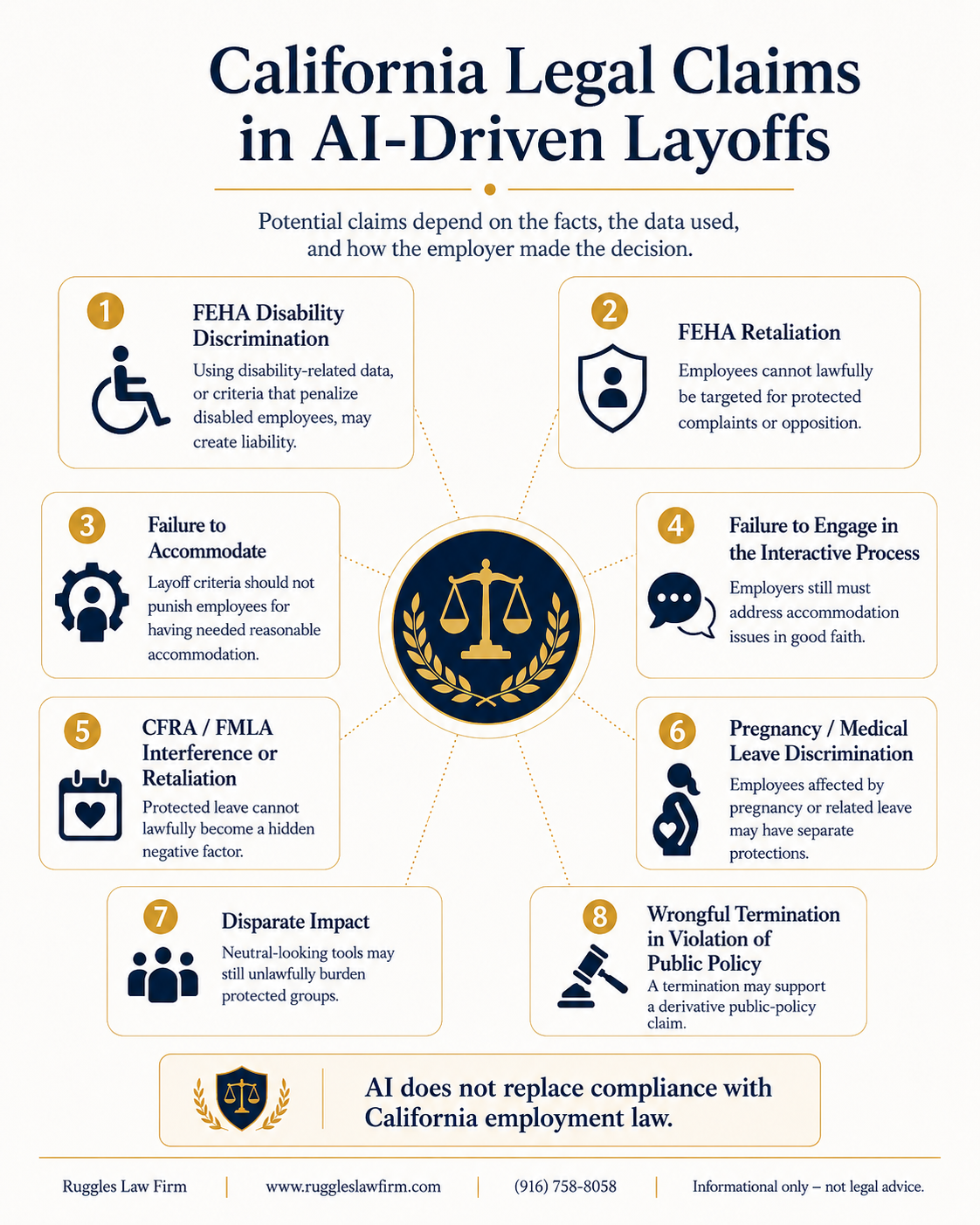
1. Disparate treatment: the system was used because of a protected characteristic
Disparate treatment is intentional discrimination. Examples might include telling a system to identify employees who took medical leave, lowering scores after an accommodation request, using age or pregnancy directly, or instructing managers to eliminate workers viewed as “less available” because of protected obligations.
California discrimination claims are often evaluated under the burden-shifting framework associated with McDonnell Douglas Corp. v. Green, 411 U.S. 792 (1973) and adopted in California cases such as Guz v. Bechtel National, Inc., 24 Cal. 4th 317 (2000). An employer may offer a legitimate reason such as cost reduction, role elimination, or performance. The employee may then show that the stated reason is untrue, inconsistent, selectively applied, or otherwise a pretext for discrimination. Evidence that an employer changed its explanation, ignored contrary performance evidence, or relied on questionable statistics may be important. See Reeves v. Sanderson Plumbing Products, Inc., 530 U.S. 133 (2000) and Reid v. Google, Inc., 50 Cal. 4th 512 (2010).
2. Disparate impact: a neutral rule disproportionately harms a protected group
Disparate impact focuses on results rather than an express discriminatory command. A facially neutral practice may be unlawful when it disproportionately excludes a protected group and cannot be justified under the governing legal standards. The doctrine began with Griggs v. Duke Power Co., 401 U.S. 424 (1971), was applied to subjective and data-driven selection practices in Watson v. Fort Worth Bank & Trust, 487 U.S. 977 (1988), and is codified in 42 U.S.C. § 2000e-2(k) for Title VII claims.
The Supreme Court has also emphasized the importance of job relatedness, business necessity, and available alternatives. See Albemarle Paper Co. v. Moody, 422 U.S. 405 (1975). Under the Age Discrimination in Employment Act, disparate-impact claims are recognized but subject to the “reasonable factors other than age” defense. See Smith v. City of Jackson, 544 U.S. 228 (2005) and Meacham v. Knolls Atomic Power Laboratory, 554 U.S. 84 (2008).
A 2025 executive order directed federal agencies to deprioritize or narrow disparate-impact enforcement. That policy change does not itself erase the text of Title VII or California’s independent FEHA protections. See Executive Order 14281, 42 U.S.C. § 2000e-2(k), and California’s automated-decision regulations. The practical point is simple: federal enforcement policy can change, but California employers remain subject to California law, and private claims may still be pursued where the legal elements are met.
Protected Leave Cannot Become a Negative Performance Factor
The Family and Medical Leave Act prohibits interference with protected rights and prohibits employers from using FMLA leave as a negative factor in hiring, promotion, discipline, or other employment actions. See 29 U.S.C. § 2615 and 29 C.F.R. § 825.220(c). The Department of Labor likewise states that employers cannot use the taking of FMLA leave against employees in employment actions. See DOL FMLA employee protections.
The Ninth Circuit applied that rule in Bachelder v. America West Airlines, Inc., 259 F.3d 1112 (9th Cir. 2001), holding that an employee can establish an FMLA interference claim by showing that protected leave was used as a negative factor in an employment decision. The court again recognized protection against adverse treatment connected to leave in Xin Liu v. Amway Corp., 347 F.3d 1125 (9th Cir. 2003).
An algorithm that counts approved leave as absenteeism, assigns zero production during leave, or compares an employee’s total quarterly output with employees who worked the full quarter may do mechanically what a manager could not lawfully do openly. The fact that the formula lacks emotion does not make the result neutral.
California employees may also have rights under the California Family Rights Act. See California Government Code section 12945.2. California courts have allowed claims to proceed when evidence connected protected leave or disability circumstances to termination decisions, including Moore v. Regents of the University of California, 248 Cal. App. 4th 216 (2016) and Soria v. Univision Radio Los Angeles, Inc., 5 Cal. App. 5th 570 (2016).
Disability, Accommodation, and AI Performance Scores
The ADA and FEHA prohibit disability discrimination and may require reasonable accommodation. See 42 U.S.C. § 12112 and California Government Code section 12940(a), (m), and (n). The EEOC warns that algorithmic tools may unlawfully screen out people with disabilities, fail to provide accommodations, or rely on disability-related information. See EEOC, Artificial Intelligence and the ADA.
A neutral policy is not automatically discriminatory merely because it affects an employee with a disability. The legal theory must fit the facts. Raytheon Co. v. Hernandez, 540 U.S. 44 (2003) distinguishes disparate-treatment and disparate-impact analysis and reinforces the need to identify the specific challenged practice. In California, the duty to explore reasonable accommodation can include reassignment to a vacant position. See Nadaf-Rahrov v. Neiman Marcus Group, Inc., 166 Cal. App. 4th 952 (2008) and Jensen v. Wells Fargo Bank, 85 Cal. App. 4th 245 (2000).
Additional leave may also be a reasonable accommodation even after statutory leave is exhausted, depending on the circumstances. See Sanchez v. Swissport, Inc., 213 Cal. App. 4th 1331 (2013). For a broader explanation, see the firm’s complete California disability discrimination and accommodation guide.
Examples of disability-related algorithmic risk
- A customer-service employee with a speech disability receives lower voice-analysis scores even though customers are served effectively.
- An employee with a modified schedule is ranked lower for “availability” without examining whether the availability rule is essential to the job.
- An employee on intermittent leave appears to miss deadlines because the system does not pause due dates during approved absences.
- A worker using assistive technology is scored as slower because the software measures clicks rather than completed work.
- A manager enters lower subjective ratings after the employee requests an accommodation, and the algorithm treats those ratings as objective truth.
Pregnancy, Parental Leave, and Caregiving Proxies
Pregnancy discrimination is prohibited by Title VII as amended by the Pregnancy Discrimination Act, and the Pregnant Workers Fairness Act requires reasonable accommodation for known limitations related to pregnancy, childbirth, or related medical conditions, absent undue hardship. See 42 U.S.C. § 2000gg-1.
In Young v. United Parcel Service, Inc., 575 U.S. 206 (2015), the Supreme Court addressed evidence that an employer accommodated some workers with restrictions but denied comparable treatment to a pregnant worker. California law is generally more protective and separately regulates pregnancy disability leave and accommodation. A system that treats pregnancy-related restrictions, lactation breaks, prenatal appointments, or parental leave as reduced commitment may create both direct and disparate-impact concerns.
Caregiver status is not a universal protected class under every statute. But care giving data can operate as a proxy for sex, pregnancy, association with a disabled family member, or protected family leave. The legal question depends on the reason for the leave, the employee’s protected status, and how the employer used the data.
Age Discrimination and Cost-Saving Algorithms
California and federal law protect workers age 40 and older from age discrimination. See 29 U.S.C. § 623 and California Government Code section 12941. Layoff systems may create age risk when they heavily weight compensation, tenure, pension cost, “future potential,” digital adoption, or assumptions about adaptability.
Higher salary does not always mean age discrimination; employers may lawfully seek cost savings. But salary, tenure, job level, and retirement eligibility may correlate strongly with age. The analysis becomes more serious when a cost variable is combined with age-coded comments, unexplained overrides, a pattern of selecting older employees, or replacement by substantially younger workers.
California’s leading reduction-in-force decision, Guz v. Bechtel National, Inc., 24 Cal. 4th 317 (2000), confirms that a genuine reorganization can be a legitimate reason for termination. It also illustrates why the selection process, not merely the existence of a reorganization, must be examined. A lawful business decision does not immunize an unlawful choice among employees.
Can the Employer Avoid Liability by Saying a Human Made the Final Decision?
Not automatically. “Human in the loop” is a description, not a defense. California’s regulation covers a computational process that facilitates human decision-making. The quality of the human review matters.
| Stronger employer facts | Stronger employee facts |
|---|---|
| Managers receive the underlying data and independently reassess each employee | Managers receive only a ranked list or risk score |
| Protected leave is removed or normalized before comparison | Leave periods are counted as missing output or poor attendance |
| Managers can correct errors and overrides are documented | Managers cannot explain the score and rarely depart from it |
| The criteria are tied to essential job duties and validated | The criteria measure presence, popularity, or tool usage unrelated to the job |
| The employer gives a consistent explanation supported by records | The explanation changes after the employee challenges the layoff |
California courts consider evidence in context rather than isolating each comment or irregularity. Reid v. Google, Inc., 50 Cal. 4th 512 (2010) rejected a rigid “stray remarks” rule and required potentially discriminatory comments to be considered with the other evidence. Similarly, mixed-motive principles do not make discrimination lawful merely because other reasons existed. See Harris v. City of Santa Monica, 56 Cal. 4th 203 (2013).
What if a Third-Party Vendor Built or Operated the System?
Outsourcing does not necessarily outsource legal responsibility. California’s regulations define “agent” to include persons acting for an employer in FEHA-regulated activities, including decisions regarding pay, benefits, or leave conducted in whole or in part through an automated system. See Cal. Code Regs., tit. 2, §§ 11008 & 11008.1.
The California Supreme Court also held that a business-entity agent with at least five employees may be directly liable under FEHA in appropriate circumstances when it carries out FEHA-regulated activities for an employer. Raines v. U.S. HealthWorks Medical Group, 15 Cal. 5th 268 (2023). The exact liability of a software vendor will depend on what it did, its relationship with the employer, and the statutory claim. But “our vendor made the score” is not a universal safe harbor.
Warning Signs an AI-Assisted Layoff May Be Unlawful
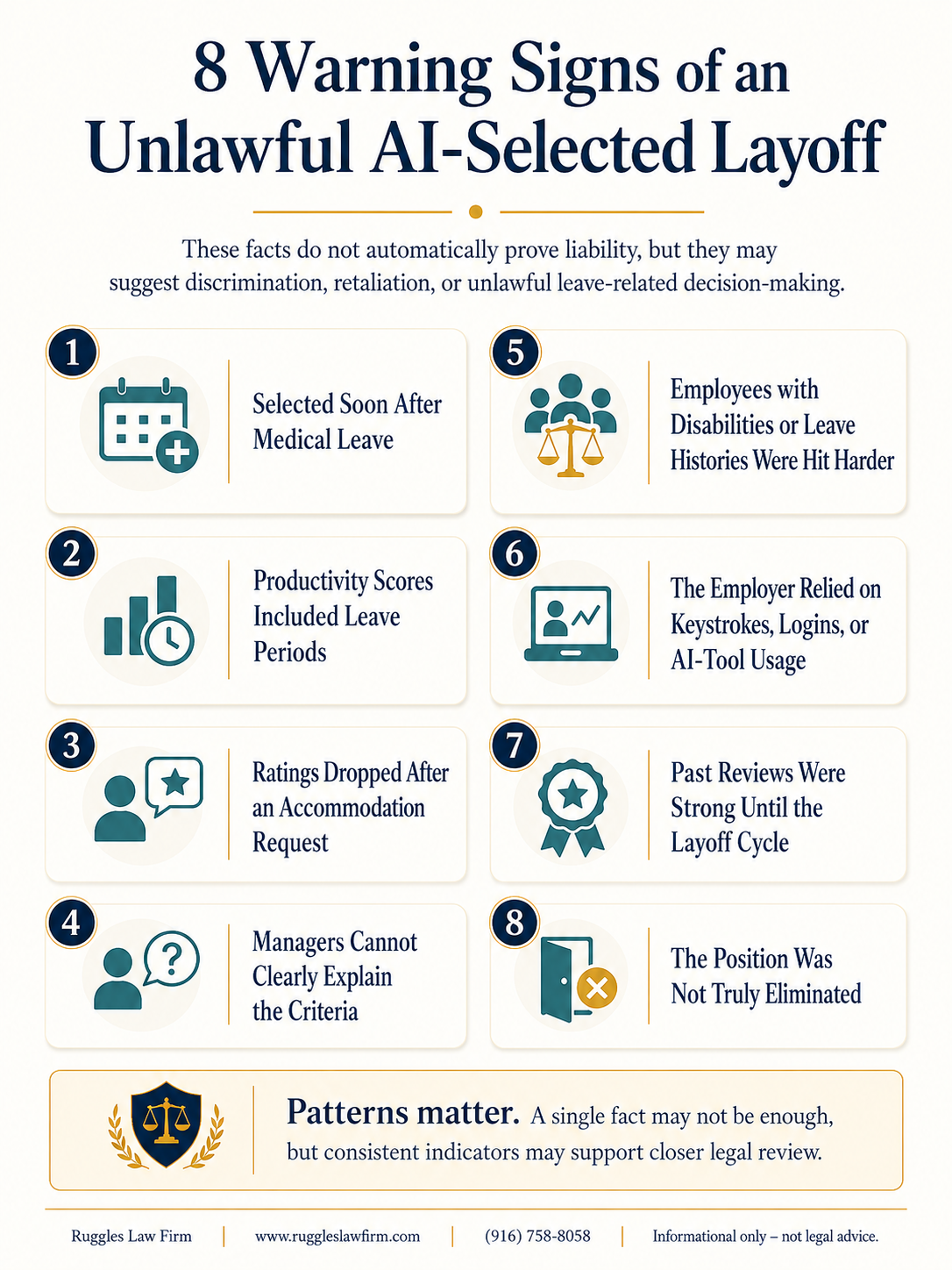
- The employee was selected shortly after requesting medical leave, pregnancy accommodation, parental leave, or another protected accommodation.
- The evaluation period included weeks or months when the employee was lawfully absent, without any adjustment.
- The employer says the selection was “data driven” but cannot identify the data, weights, or decision maker.
- Strong reviews abruptly changed after protected leave, an accommodation request, or a discrimination complaint.
- Managers privately disagreed with the selection or were told they could not remove employees from the list.
- A score measured AI usage, keystrokes, badge swipes, online presence, or response time rather than actual job results.
- Employees with similar performance but no leave history were retained.
- The stated reason changed—from restructuring, to performance, to “culture,” to cost—after the employee asked questions.
- The employer eliminated the role but soon posted a substantially similar position.
- The system used salary, tenure, schedule, location, leave, or health-related data that may function as a proxy for age, disability, sex, or pregnancy.
- Overrides were permitted, but managers used them inconsistently or only against members of a protected group.
- The severance agreement contains an unusually broad release paired with a very short deadline and little explanation of the selection process.
Evidence California Employees Should Preserve
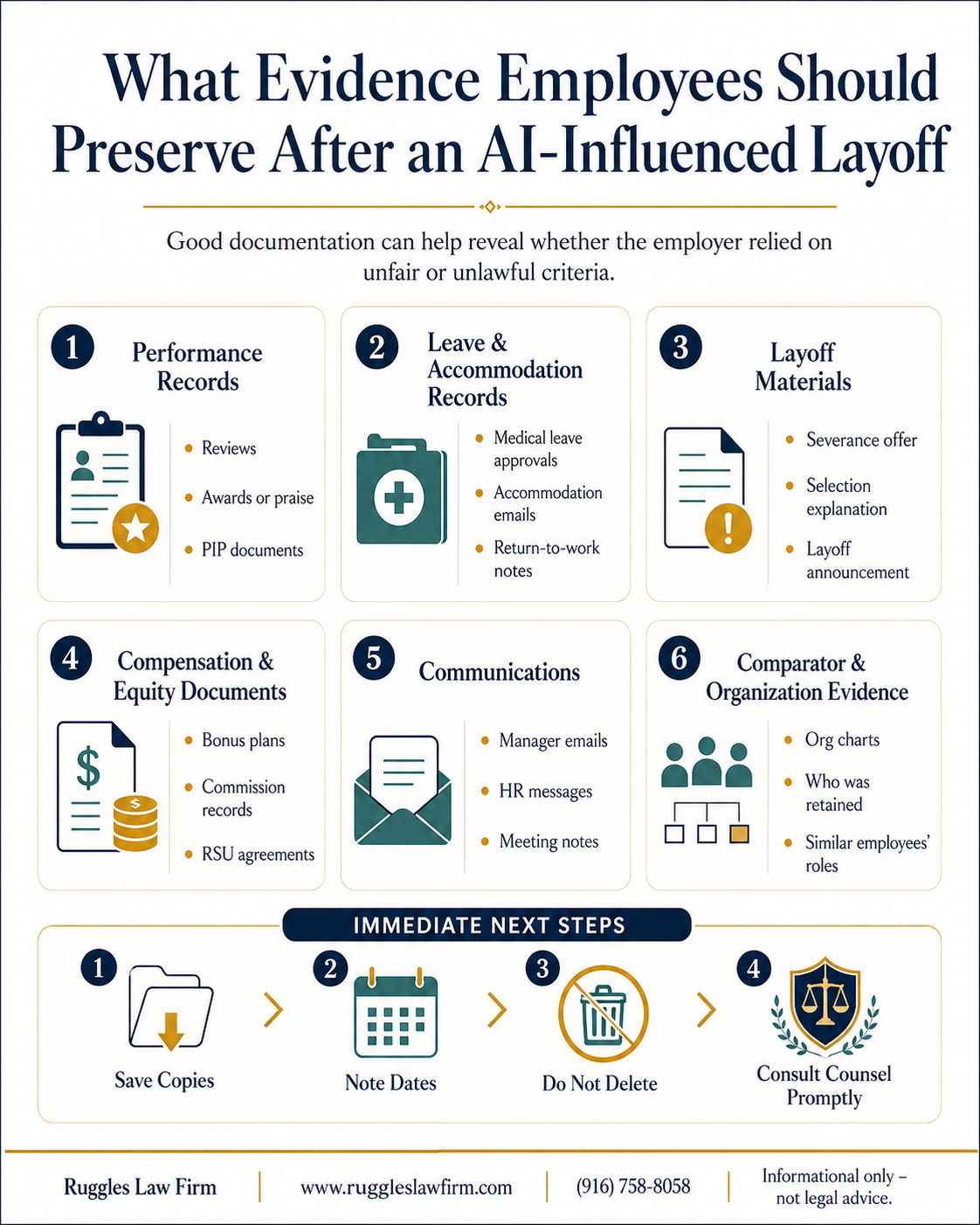
Preserve evidence lawfully. Do not take trade secrets, confidential customer data, privileged attorney communications, source code, or files you are not authorized to access. But do not assume you must leave behind your own employment history.
- Performance records. Save reviews, goals, awards, praise, quota results, compensation statements, PIP documents, and written feedback already available to you.
- The data window. Record the dates used for the ranking and identify every day of approved leave, reduced schedule, or accommodation during that window.
- Dashboard evidence. Preserve screenshots or exports you are authorized to access showing productivity scores, rankings, attendance metrics, AI-tool usage, or changes over time.
- Leave and accommodation documents. Keep requests, approvals, medical restrictions, interactive-process communications, and return-to-work records.
- The layoff explanation. Write down who said what, when it was said, and whether the explanation changed. Preserve announcements, FAQs, decisional-unit descriptions, and organizational charts.
- Comparator information. Note retained employees doing similar work, including differences in performance, leave history, role, location, tenure, and qualifications. Do not guess about private medical information.
- Job postings and replacement evidence. Save public postings for the same or substantially similar work.
- Personnel records. California employees and former employees may request inspection or copies of personnel records under Labor Code section 1198.5, subject to the statute’s procedures and exceptions.
- Severance and equity documents. Preserve the offer, release, plan documents, grant agreements, vesting schedules, bonus plans, commission plans, and benefit information.
- A contemporaneous timeline. Use the practical approach discussed in the firm’s guide to meetings with Human Resources and keep the timeline factual rather than argumentative.
Questions Worth Asking After an Algorithmic Layoff
An employer may decline to answer some of these questions before litigation. Asking them can still clarify the explanation and create a useful record.
- Was any automated-decision system, algorithm, AI tool, productivity dashboard, or vendor recommendation used in selecting employees?
- What was the decisional unit, and who was compared with whom?
- What dates were used to measure performance?
- Were approved leave periods removed, prorated, or otherwise normalized?
- Did the system use attendance, availability, log-ins, keystrokes, badge data, AI usage, sentiment, location, salary, or tenure?
- What weight was assigned to each factor?
- Who reviewed the score, and what information did that person receive?
- Could managers override the recommendation? If so, who did and why?
- Was the system tested for adverse impact on employees with disabilities, employees on leave, pregnant employees, women, older employees, or other protected groups?
- Was a third-party vendor involved, and what function did it perform?
- What records are being preserved regarding the model, inputs, output, validation, and final decision?
- What specific facts caused this employee to be selected rather than a retained comparator?
How AI-Related Risk Can Affect Severance Negotiations
A questionable algorithm does not automatically create a winning lawsuit. It can nevertheless create meaningful severance leverage—especially when the employer wants a broad release before disclosing how the selection was made.
Potential negotiation subjects include:
- Additional salary continuation or a larger lump-sum payment.
- Employer-paid COBRA or other health-benefit support.
- Payment of earned or disputed bonuses and commissions.
- RSU vesting, acceleration, extended exercise periods, or cash treatment of lost equity.
- A neutral or agreed reference and confirmation of the stated reason for separation.
- Removal or correction of inaccurate performance records.
- Rehire eligibility and internal transfer consideration.
- Mutual or more balanced non-disparagement terms.
- A longer review period and production of plan or selection information.
Equity-compensated employees should separately evaluate the value of unvested awards. See the firm’s guide to lost RSUs and severance leverage. Employees who received a performance warning before the layoff should also review the California PIP employee guide.
Employees age 40 or older should examine whether the release complies with the Older Workers Benefit Protection Act. Group termination programs may trigger disclosure requirements concerning the decisional unit, eligibility factors, job titles, and ages of selected and non-selected employees. See 29 U.S.C. § 626(f) and Oubre v. Entergy Operations, Inc., 522 U.S. 422 (1998). Those disclosures can be important, but they are not a complete statistical analysis by themselves.
Before signing
A severance agreement generally buys a release of claims the employer may not yet have explained. The correct time to investigate an AI-assisted selection process is before the release becomes effective—not after the employer has purchased finality.
What Does Not, By Itself, Prove an Unlawful AI Layoff?
- The employer used AI, an algorithm, or workforce analytics.
- The employee was on leave when a company-wide layoff occurred.
- The employee disagrees with a performance score.
- A protected group had fewer retained employees without a valid denominator or statistically meaningful comparison.
- The system made an error unrelated to a protected characteristic or protected activity.
- The employer chose a lower-cost structure for legitimate reasons and applied the selection criteria consistently.
- A manager relied on objective job-related data after independently correcting leave and accommodation effects.
- The employee was qualified and performed well. Good performance helps, but it does not create immunity from a legitimate reduction in force.
A strong analysis must connect the challenged practice to a protected characteristic, protected leave, protected activity, or a separate legal duty. It must also account for the employer’s legitimate explanation rather than assuming that every unfair result is illegal. Employment law has never promised a workplace free of bad decisions. It does prohibit certain bad reasons.
Deadlines Can Expire While the Employee Is Still Asking Questions
California employees generally must submit an employment discrimination intake to the Civil Rights Department within three years of the last alleged harm. See CRD complaint process and Government Code section 12960. Federal discrimination charges are commonly subject to a 300-day deadline in California, although rules vary by claim and circumstance. See EEOC time limits.
FMLA lawsuits are generally subject to a two-year limitations period, extended to three years for willful violations. See U.S. Department of Labor FMLA limitations guidance. Contract, wage, privacy, retaliation, and local-law claims may have different deadlines. A severance deadline can be much shorter than any statute of limitations. Waiting for the employer to explain itself may not preserve a claim.
A Practical Framework for Evaluating an AI-Assisted Layoff
| Question | Why it matters |
|---|---|
| What exact employment practice is challenged? | A claim is stronger when it identifies a specific score, factor, ranking, data window, or override rule. |
| What protected circumstance is implicated? | Disability, pregnancy, age, race, sex, protected leave, accommodation, or protected complaints must be connected to the decision. |
| How did the system treat that circumstance? | Look for direct use, proxy use, missing-data rules, unadjusted leave, or subjective inputs. |
| Did a human independently review the result? | A real review may correct errors; a rubber stamp may preserve the system’s bias. |
| What did the employer say, and did the explanation change? | Inconsistent explanations can support an inference of pretext. |
| What happened to comparable employees? | Comparators and properly framed statistics help test whether the criteria were applied consistently. |
| What did the employee sign or release? | A release can extinguish valuable claims and leverage. |
The Bottom Line
California employers are likely to use more AI—not less—to rank employees, monitor work, predict performance, and select positions for elimination. The legal issue is not whether a computer participated. The issue is whether the process measured legitimate job criteria without treating protected status, protected leave, or the need for accommodation as evidence that the employee had less value.
The phrase “data driven” sounds reassuring. Sometimes it is. Sometimes it means the employer has converted old assumptions into a formula, added decimals, and made the result harder to question. California’s updated regulations recognize that automation can facilitate human decisions and that proxies can reproduce discrimination without using an obvious protected label.
Employees who are selected for a layoff after medical leave, pregnancy, parental leave, an accommodation request, or an abrupt change in performance scoring should preserve the data and have the severance agreement reviewed before signing.
The Ruggles Law Firm represents California employees in severance negotiations, disability discrimination, retaliation, wrongful termination, and compensation disputes. Visit Ruggles Law Firm or call 916-758-8058 for a confidential evaluation.
Frequently Asked Questions About AI Layoffs in California
These answers provide general California employment-law information. The analysis depends on the system used, the selection criteria, the employee’s protected circumstances, and applicable deadlines.
Can a California employer use AI to decide who gets laid off?
Yes. California does not ban AI-assisted layoff decisions. However, the employer must comply with the FEHA, protected-leave laws, disability-accommodation duties, age-discrimination laws, and other employment protections. The system’s inputs, design, and effect matter more than the label attached to the technology.
Does California require an employer to tell me that AI was used?
California’s FEHA regulations clarify how discrimination law applies to automated systems, but they do not create a universal rule requiring every private employer to give every employee a pre-layoff AI notice. Other laws, contracts, local ordinances, or future legislation may create additional duties. Employees can still ask what systems and criteria were used.
Is a productivity dashboard considered an automated-decision system?
It can be. California’s definition includes computational processes that make or facilitate human decisions regarding employment benefits. A dashboard that merely displays raw information may be less consequential than a system that ranks, predicts, recommends, or flags employees, but both can become evidence if managers rely on them.
Can my employer count time on medical leave as low productivity?
Protected leave generally cannot be used as a negative factor under the FMLA. A system that compares total output without adjusting for a protected absence may create legal risk under the FMLA, CFRA, FEHA, ADA, or related laws, depending on coverage and the facts.
What if the employer says people—not AI—made the decision?
That may be relevant, but it is not conclusive. California’s definition covers systems that facilitate human decisions. Important questions include whether the reviewer saw the underlying data, corrected leave or accommodation effects, had authority to override the ranking, and actually exercised independent judgment.
Can an algorithm discriminate even if it never uses race, sex, age, or disability?
Yes. A system may use proxies closely correlated with protected characteristics, or a neutral practice may disproportionately harm a protected group. The legal standards differ for intentional discrimination and disparate impact, so the specific input and legal theory must be identified.
Can salary be used as a layoff criterion?
Cost reduction can be a legitimate business reason. However, salary may correlate with age, tenure, job level, or other characteristics. Salary-based selection becomes more suspicious when combined with age-coded remarks, inconsistent application, unexplained exceptions, or a pattern of selecting older employees.
Can AI usage be part of my performance review?
Potentially. The employer should be able to explain why AI usage is related to the job, whether employees had equal access and training, and how leave or accommodations were treated. A raw usage count may measure presence or opportunity rather than actual performance.
Are keystroke and mouse-activity scores reliable proof of performance?
Not necessarily. Those metrics may ignore planning, judgment, meetings, field work, accessibility tools, and quality. Their legal significance depends on job relatedness, accuracy, consistency, and whether they penalize protected leave or disability-related work methods.
Can AI penalize me for intermittent leave?
It should not lawfully treat protected intermittent leave as a negative factor. Employees should compare the scoring window with their leave dates and determine whether deadlines, attendance, availability, and output were adjusted.
What if I was laid off while pregnant or on parental leave?
A layoff during pregnancy or parental leave is not automatically unlawful. However, selection criteria cannot penalize pregnancy, related limitations, protected leave, or sex. Employees should ask whether the data window counted time away and whether comparable employees who were continuously present were treated differently.
Can an AI layoff violate the Pregnant Workers Fairness Act?
Yes, depending on the facts. The PWFA requires reasonable accommodation for known pregnancy-related limitations absent undue hardship and prohibits certain adverse actions connected to accommodation rights. An automated score cannot be used to avoid those duties.
Can an AI layoff violate the ADA or FEHA?
Yes. Risk may arise if the system screens out disabled employees, measures disability-related limitations rather than essential job performance, uses medical information unlawfully, denies accommodation, or treats accommodation and leave as evidence of low value.
Does the employer have to accommodate me in an automated assessment?
The ADA and FEHA may require reasonable accommodation in an employment assessment or decision process. An employee may need a different way to demonstrate qualifications, an adjusted data window, accessible technology, or correction of disability-related data.
Can a software vendor be liable?
Possibly. California recognizes that a business entity acting as an employer’s agent can be directly liable under FEHA in appropriate circumstances, and the automated-decision regulations expressly address agents. Liability depends on the vendor’s role, size, conduct, and the claim asserted.
Can I demand the algorithm or source code?
Not automatically. Source code may be proprietary and is not ordinarily produced simply because an employee asks. In litigation, relevant model documentation, inputs, validation, outputs, and decision records may be discoverable subject to protective orders and proportionality rules.
What records must California employers keep about automated decisions?
California’s updated FEHA regulations require covered entities to retain relevant employment records, including automated-decision system data, for at least four years. The exact records at issue depend on the employment practice and system.
Should I take screenshots of my performance dashboard?
Only if you are authorized to access and retain the information. Preserve your own scores, reviews, and work records lawfully. Do not take trade secrets, customer information, privileged communications, or files outside your authorized access.
Can I request my personnel file after a layoff?
California Labor Code section 1198.5 generally gives current and former employees rights to inspect or receive copies of personnel records relating to performance or grievances, subject to procedures and exceptions. Make the request in writing and preserve proof of delivery.
What is the best evidence that protected leave affected the score?
The strongest evidence often compares the scoring period with the leave period, shows that the denominator was not adjusted, identifies a lower score caused by absence, and shows that decision makers relied on that score. Comparator and override evidence may strengthen the analysis.
What if my manager praised me but the algorithm rated me poorly?
That inconsistency may justify investigation. Determine whether the manager had authority to correct the score, whether the rating measured actual job duties, and whether the employer changed its explanation after the layoff.
Does a reduction in force protect the employer from discrimination claims?
No. A genuine reduction in force can be a legitimate reason for eliminating positions, but the employer must still choose employees without unlawful discrimination or retaliation. The selection criteria and their application remain subject to review.
Can statistics prove an AI layoff case?
Statistics can be important, especially in disparate-impact or group-layoff cases, but the analysis must use the correct decisional unit, comparison group, time period, sample size, and variables. A raw percentage without context may mislead rather than prove discrimination.
Can I be fired after asking how the algorithm works?
A general question about a layoff process is not always legally protected. However, complaints that reasonably oppose discrimination, retaliation, leave interference, or accommodation violations may be protected under applicable law. Keep the complaint factual and identify the protected concern.
Can an AI-based PIP create severance leverage?
Yes, particularly when the PIP relies on inaccurate metrics, counts protected leave, conflicts with prior reviews, or appears designed to justify a planned termination. The strength of leverage depends on documents, timing, and the legal connection to protected activity or status.
Should I sign the severance agreement to avoid losing the offer?
Do not assume the first deadline is nonnegotiable. Ask for time to review the agreement and obtain legal advice. Signing may release discrimination, leave, retaliation, wage, equity, and other claims.
Can I negotiate for lost RSUs after an AI-assisted layoff?
Yes. Unvested RSUs are often forfeited under plan terms, but potential discrimination or leave-related risk may create negotiation leverage for vesting, acceleration, a cash substitute, or a later separation date. The plan documents and release deadline matter.
What deadlines apply to an AI discrimination claim?
Deadlines vary. California CRD employment complaints are generally due within three years of the last harm; federal discrimination charges are commonly due within 300 days in California; and FMLA claims are generally subject to two years or three years for willful violations. Other claims differ.
What should I do first after an AI-assisted layoff?
Preserve the layoff notice, severance agreement, performance records, leave and accommodation documents, authorized dashboard information, and a factual timeline. Do not sign a release or remove confidential company information. Promptly consult counsel because both severance and filing deadlines can be short.
Is every unfair algorithmic result illegal?
No. Employment law does not prohibit every inaccurate, opaque, or unfair decision. A viable claim generally requires a connection to protected status, protected leave, protected activity, accommodation duties, contract rights, wages, or another recognized legal rule.
RLF Blog Post Disclaimer Updated 07/13/2026
Contact the Ruggles Law Firm at 916-758-8058 to Evaluate Your Potential Lawsuit Matt Ruggles has a thorough understanding of California employment laws and decades of practical experience litigating employment law claims in California state and federal courts.
Using all of his knowledge and experience, Matt and his team can quickly evaluate your potential claim and give you realistic advice on what you can expect if you sue your former employer.
Contact the Ruggles Law Firm at 916-758-8058 for an initial case consultation. Blog posts are not legal advice and are for information purposes only.