
A Practical Guide to Reviewing and Negotiating Severance in California
By Matthew J. Ruggles
Executive Severance Is Not a Thank-You Card

A severance agreement usually arrives at one of the most uncomfortable moments in a person’s professional life. You may be a C-suite officer, vice president, regional manager, senior sales executive, finance leader, technology executive, or long-term manager who just received a calendar invitation titled something like “Transition Discussion,” “Organizational Update,” or the corporate classic, “Quick HR Check-In.”
Those meeting titles are not exactly Shakespeare. But they often mean the same thing: your employment is ending, the company has prepared paperwork, and someone would very much like you to sign it before you have enough time to understand what it actually does.
A severance agreement is not a routine exit form. It is a contract. In many cases, it is the final contract governing one of the most important financial relationships in your life. For executives and managers, it can affect money, claims, equity, reputation, references, future employment, confidentiality, non-disparagement, commissions, bonuses, and even whether you can perform the next job you are offered.
The employer almost certainly had legal help drafting the agreement. That does not make the employer villainous. It makes the employer prepared. You should be prepared too.
Matt’s Legal Perspective
The best severance negotiations are not emotional. They are analytical. The question is not merely whether the termination was fair. The question is what legal, financial, business, and reputational risk the employer is trying to buy peace from.
1. What a Severance Agreement Really Is
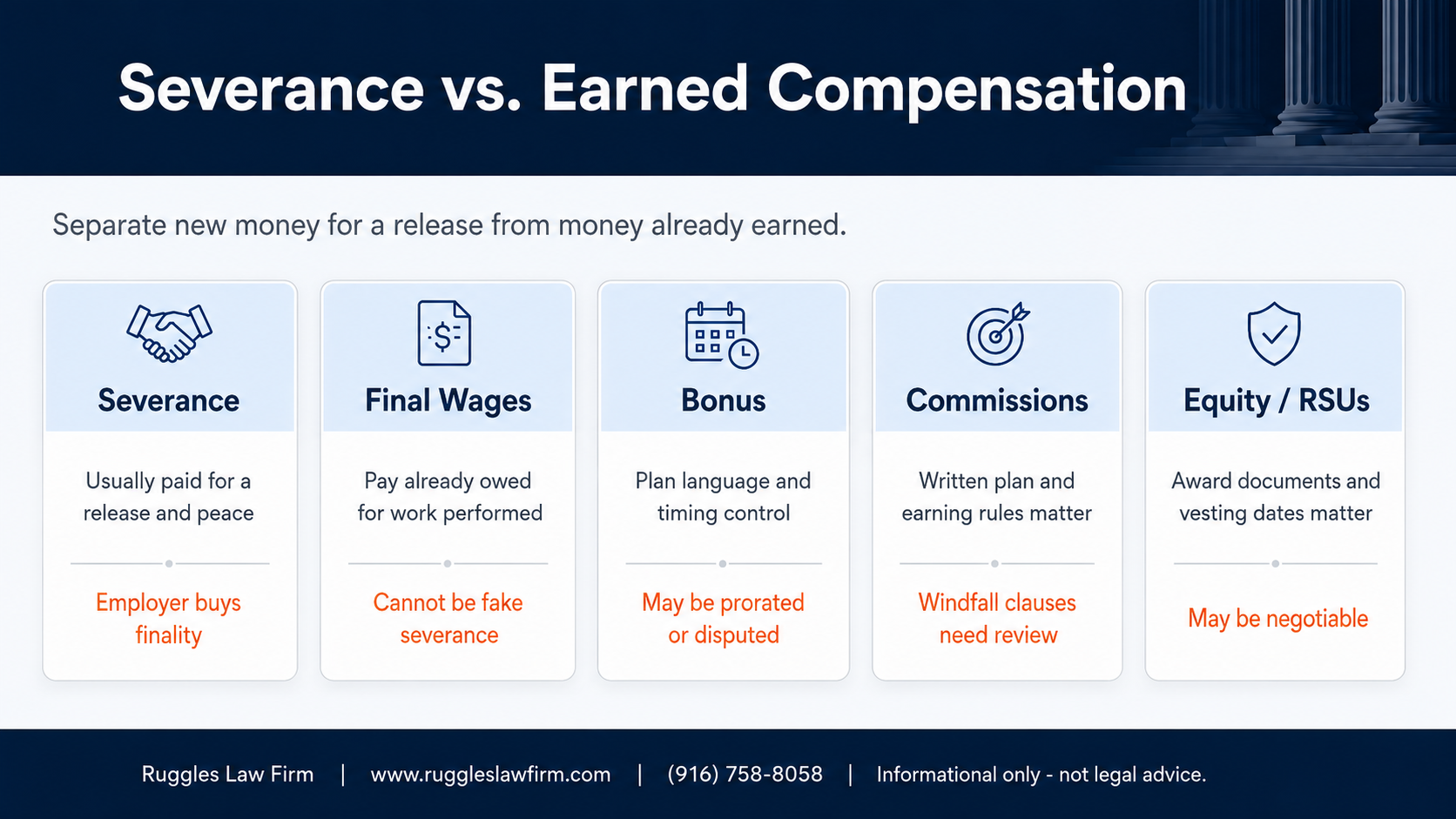
A severance agreement is usually an exchange. The employer offers compensation or benefits. The employee gives promises in return. Those promises often include a broad release of claims, confidentiality obligations, non-disparagement language, cooperation duties, return-of-property terms, and sometimes restrictions on future employment.
The employee may receive salary continuation, a lump-sum payment, COBRA reimbursement, bonus treatment, commission payment, RSU or stock option treatment, outplacement services, transition consulting pay, neutral reference language, or an agreed departure announcement. For executives, the real value may be buried outside the headline severance number.
The agreement may also interact with an employment agreement, commission plan, bonus plan, equity award agreement, change-in-control plan, long-term incentive plan, deferred compensation arrangement, handbook policy, or formal severance plan. That is why the phrase “standard agreement” should not end the conversation. Standard can still be expensive.
For more information, read my previous blog: How to Negotiate a Severance Package in California
2. Severance vs. Final Wages vs. Bonus vs. Commission vs. Equity
One of the most important executive severance questions is whether the money being discussed is truly severance or whether the company is mixing several different categories together. That distinction matters because severance is usually paid in exchange for a release, while earned compensation may already be owed.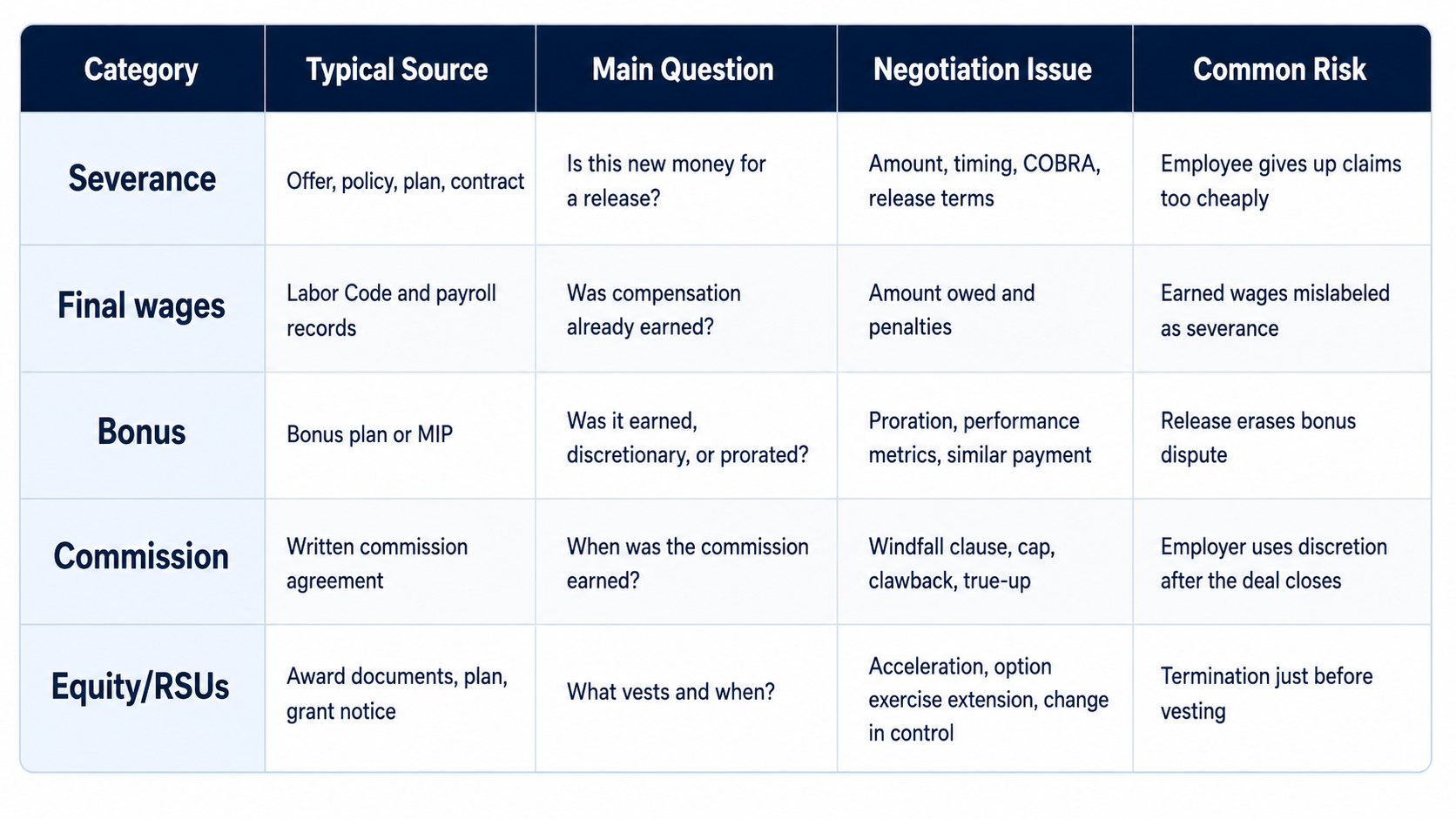
3. Why Employers Offer Severance
Employees often think severance is a reward for loyalty. Sometimes there is an element of that. More often, severance is the price of certainty. Employers offer severance because they want a clean ending, a release of legal claims, confidentiality, cooperation, reduced reputational risk, and a lower chance of litigation.
The more senior the employee, the more the company may want certainty. A CFO knows financial issues. A Chief People Officer knows complaints. A VP of Sales knows forecast gaps, commission disputes, and customer issues. A regional manager may know what policies were actually followed in the field, not just what the policy manual says happened in the field. The General Counsel, of course, knows everything, which is why companies tend to speak to general counsel departures in soothing tones and with carefully selected punctuation.
Severance is often the company’s way of buying peace. Peace can be valuable. But the employee should understand what the employer is buying before deciding whether the price is acceptable.
4. Why Executives and Managers Need a Different Strategy

Executive severance is different because executive compensation is different. A mid-level manager may focus primarily on salary continuation, COBRA, reference language, and the release. A C-suite officer, vice president, director, or senior sales leader often has to evaluate a much broader package.
- Base severance and payment timing
- Prorated annual bonus or management incentive plan payment
- Sales commissions, accelerators, and windfall adjustments
- RSUs, stock options, performance shares, and vesting dates
- Change-in-control rights and good-reason resignation provisions
- Consulting or transition services compensation
- Indemnification and D&O insurance issues
- Internal and external announcement language
- Mutual non-disparagement and reference protocols
- Non-compete, non-solicitation, confidentiality, and cooperation obligations
A professional severance negotiation is not an emotional outburst. It is a business discussion. Executives negotiate complex business terms every day. They should not suddenly pretend negotiation is rude merely because the document involves their own career and compensation.
5. Why the First Offer Is Usually Not the Whole Story
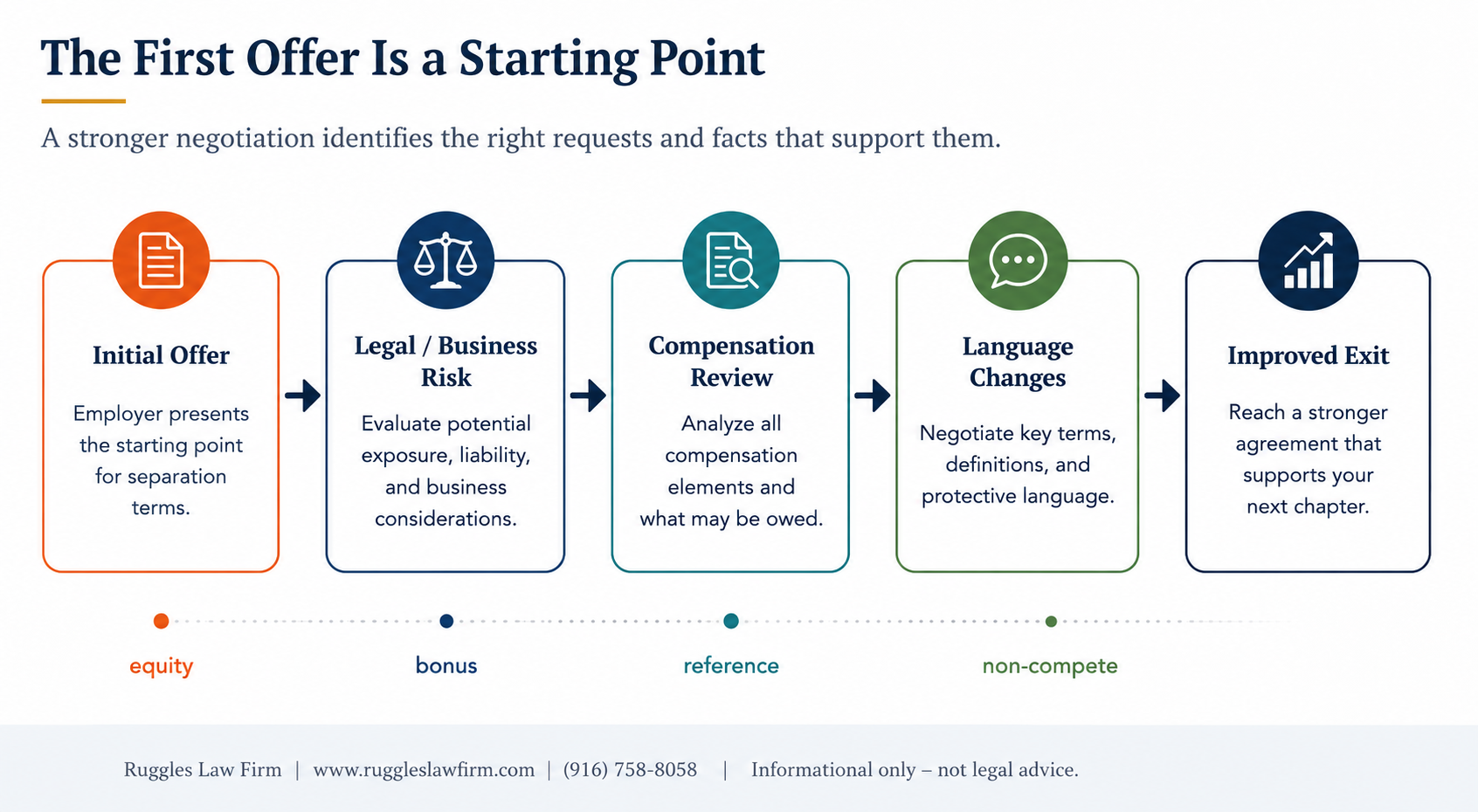
Many employees assume the first severance offer is final. Sometimes it is. Often it is simply the first number the company is willing to put on paper. The first offer may be based on years of service, job level, internal policy, budget, precedent, risk assessment, or the company’s confidence that the employee will sign without asking questions.
A stronger negotiation does not simply say, “Please give me more money.” It explains why the company should improve the offer. Depending on the facts, the request may involve more months of pay, COBRA, bonus treatment, commission payment, equity vesting, option exercise extensions, removal of unlawful restrictions, neutral references, or a mutually acceptable announcement.
Sometimes the most valuable term is not the headline severance payment. Removing an unlawful or overbroad non-compete may be worth more than another month of salary if it protects the employee’s next position. Preserving earned commissions may matter more than calling the payment “severance.” Reference language may protect a career that took twenty years to build.
For more information, read my previous blog: Non-Negotiable Severance in California: 5 Myths Dispelled by a Lawyer
6. How Much Severance Should a California Executive Ask For?

This is the question nearly every severance client wants answered first. It is also the question most likely to be answered incorrectly by internet formulas. There is no universal California rule that says an executive gets one month per year of service, two weeks per year of service, or six months because the termination felt unfair. Those formulas may appear in company policies or informal practices, but they are not the law.
A better question is: what is the reasonable settlement value of the legal, contractual, financial, and reputational issues the company is trying to resolve? The answer depends on title, tenure, compensation, company policy, contract language, bonus and equity rights, commission disputes, whether claims exist, the strength of those claims, the employer’s desire for a quiet transition, and the employee’s need for reference protection.
For a senior executive, a strong request may combine several components: additional base pay, COBRA reimbursement, prorated bonus, earned commission, RSU vesting treatment, option exercise extension, agreed announcement language, neutral reference language, mutual non-disparagement, and a release limited to appropriate claims. The best package may not be the package with the largest headline salary number. It may be the package that protects the next job.
As a practical matter, the demand should be ambitious enough to create room to negotiate but credible enough to preserve leverage. A demand that ignores the documents, the facts, and the applicable law can make the employee look emotional. A demand that connects the facts to legal risk, unpaid compensation, executive transition value, and future career protection is much harder to dismiss.
- Length of service and prior performance history
- Level of compensation and total rewards package
- Whether severance is already owed by contract or plan
- Unpaid bonus, commission, equity, or deferred compensation issues
- Timing of termination after leave, complaint, protected activity, or age-related replacement
- Employer need for cooperation, transition help, or confidentiality
- Reference, reputation, and announcement issues
- Strength of the release the employer wants
For more information, read my previous blog: How to Negotiate RSU Acceleration in California Severance Agreements
7. The Release: What You Are Giving Up

The release is the heart of most severance agreements. It is also the provision employees often read too quickly. A release typically says the employee gives up all claims against the company and related parties arising before the agreement is signed.
That may include claims for wrongful termination, discrimination, harassment, retaliation, failure to accommodate, medical leave violations, unpaid wages, unpaid commissions, unpaid bonuses, breach of contract, emotional distress, defamation, whistleblower retaliation, age discrimination, penalties, and attorney’s fees.
California courts generally enforce clear, explicit, and comprehensible releases of employment claims where the employee knowingly and voluntarily signs the agreement. In Skrbina v. Fleming Companies (1996) 45 Cal.App.4th 1353, the Court of Appeal enforced a release of FEHA claims signed in exchange for severance benefits where the release clearly notified the employee of its effect. In Perez v. Uline, Inc. (2007) 157 Cal.App.4th 953, the Court of Appeal rejected unconscionability and economic duress challenges to a severance release where the employer was not withholding an acknowledged debt and the employee received severance consideration for the release.
The practical point is not that releases are invalid. Many are enforceable. The practical point is that the employee should understand what is being sold. Severance is the price. The release is the product.
For more information, read my previous blog: Defamation and Wrongful Termination: What California Employees Need to Know from Hearn v. PG&E
8. Knowing-and-Voluntary Waivers Under California Law
A severance agreement should be understandable. That sounds obvious, but employment agreements sometimes read as if they were assembled by a committee of lawyers trapped in a conference room without sunlight.
Courts evaluating releases consider whether the language was clear, whether the employee had an opportunity to review it, whether consideration was provided, whether the employee was improperly pressured, and whether the agreement fairly notified the employee of the rights being released. California also provides statutory protections for certain separation agreements. Government Code section 12964.5 requires, among other things, that an employer offering a separation agreement notify the employee of the right to consult an attorney and provide a reasonable time period of at least five business days to do so, subject to statutory exceptions and rules.
For executives, the knowing-and-voluntary issue can matter even when the employee is sophisticated. Sophistication does not cure every drafting problem. A confusing agreement can still be a confusing agreement, even if the employee once managed a division large enough to have its own weather system.
Unconscionability may also matter if an agreement is procedural and substantively unfair. Armendariz v. Foundation Health Psychcare Services, Inc. (2000) 24 Cal.4th 83 remains the central California Supreme Court authority for unconscionability analysis, and Civil Code section 1670.5 gives courts authority to address unconscionable contractual terms.
9. Employees Over 40: OWBPA and ADEA Waivers

If the employee is 40 or older, a severance agreement that releases federal age discrimination claims must comply with the Older Workers Benefit Protection Act, 29 U.S.C. section 626(f). These rules are technical, mandatory, and important.
In an individual termination, a valid ADEA waiver generally must be written in a manner calculated to be understood by the employee, specifically refer to ADEA rights or claims, not waive future claims, provide consideration beyond what the employee is already entitled to receive, advise the employee in writing to consult an attorney, provide at least 21 days to consider the agreement, and provide 7 days to revoke after signing. In certain group termination or reduction-in-force programs, the consideration period is generally 45 days, and the employer must provide required decisional-unit disclosures.
In Oubre v. Entergy Operations, Inc. (1998) 522 U.S. 422, the United States Supreme Court held that an employee may not waive ADEA claims unless the waiver satisfies OWBPA requirements, even if the employee keeps the severance money. In Syverson v. International Business Machines Corp. (9th Cir. 2007) 472 F.3d 1072, the Ninth Circuit held that confusing release language failed the OWBPA requirement that the waiver be written in a manner calculated to be understood by the average eligible employee.
For employees over 40, OWBPA defects can create real leverage. For employers, sloppy age-waiver drafting can defeat the very release the employer thought it purchased.
10. Civil Code Section 1542 and Unknown Claims
California severance agreements frequently include a Civil Code section 1542 waiver. Section 1542 addresses unknown claims. In practical terms, it protects a releasing party from accidentally releasing claims that the person did not know or suspect existed at the time of signing, unless the protection is knowingly waived.
This matters because employees often discover important facts after termination. A senior employee may later learn that younger employees were treated differently, that a supposedly eliminated position was refilled, that commission calculations were changed, that decision makers discussed medical leave, or that the employer’s stated reason was not the real reason.
A broad release with a 1542 waiver may make later-discovered claims harder to pursue. In Brae Transportation, Inc. v. Coopers & Lybrand (9th Cir. 1986) 790 F.2d 1439, the Ninth Circuit addressed whether a release was a general release implicating section 1542 or a more specific release directed to particular claims. In Perez v. Uline, Inc. (2007) 157 Cal.App.4th 953, the Court of Appeal held the employee understood he was releasing known and unknown claims even though the agreement did not specifically cite section 1542.
The practical problem with unknown claims is that they are unknown. Lawyers are paid to worry about things like that. We are delightful dinner guests.
11. Non-Compete and Non-Solicitation Clauses in California Severance Agreements

California strongly protects employee mobility. Business and Professions Code section 16600 provides that, except as provided in the chapter, every contract restraining anyone from engaging in a lawful profession, trade, or business is void to that extent. Effective January 1, 2024, the statute expressly states it must be read broadly in accordance with Edwards v. Arthur Andersen LLP (2008) 44 Cal.4th 937, to void non-compete clauses in the employment context no matter how narrowly tailored unless a statutory exception applies.
In Edwards, the California Supreme Court rejected the narrow-restraint exception and held that employment non-competes are void unless a statutory exception applies. In DePuy Synthes Sales, Inc. v. Howmedica Osteonics Corp. (9th Cir. 2022) 28 F.4th 956, the Ninth Circuit applied California law to void non-compete and non-solicitation restrictions despite another state’s choice-of-law clause. Latona v. Aetna U.S. Healthcare Inc. (C.D. Cal. 1999) 82 F.Supp.2d 1089, likewise demonstrates that a valid confidentiality provision does not save an otherwise void non-compete or overbroad non-solicitation provision.
Executives and sales leaders should pay particular attention to provisions labeled as non-solicitation, customer protection, conflict-of-interest, confidentiality, or transition restrictions. Labels matter less than practical effect. If a clause prevents a California employee from doing the next job, serving customers, contacting business relationships, or working in the same field, it deserves careful review.
12. Confidentiality and Non-Disparagement Clauses

Confidentiality and non-disparagement provisions are common in severance agreements. Some are reasonable. Some are overbroad. Some appear to have been drafted by someone who believed the employee should never again speak, write, think, blink, or communicate with other mammals.
California law imposes important limits. Government Code section 12964.5 prohibits separation-agreement provisions that prohibit disclosure of information about unlawful acts in the workplace, and requires specified carve-out language for nondisparagement or similar clauses restricting discussion of workplace conditions. Code of Civil Procedure section 1001 prohibits settlement-agreement provisions that prevent or restrict disclosure of factual information related to certain claims filed in civil or administrative proceedings, including workplace harassment, discrimination, and retaliation claims.
Federal labor law may also matter. In McLaren Macomb, 372 NLRB No. 58 (2023), the National Labor Relations Board held that an employer violates Section 8(a)(1) of the National Labor Relations Act by proffering severance agreements with confidentiality and non-disparagement provisions that broadly restrict employees’ Section 7 rights. This issue can matter even when the employee never signs the agreement.
Executives should also consider whether non-disparagement is mutual, whether truthful statements are protected, whether agency cooperation is preserved, whether the employee may discuss unlawful workplace conduct, and whether the company’s officers and board members are restricted from disparaging the departing executive.
13. Bonuses, Commissions, Equity, RSUs, and Windfall Provisions

For executives, sales leaders, and highly compensated employees, severance is often not the largest financial issue. The real money may be in bonuses, commissions, accelerators, RSUs, stock options, performance shares, deferred compensation, change-in-control benefits, or long-term incentive compensation.
This is where severance negotiations often become financially significant. It is also where employers sometimes try to use plan language to avoid paying compensation that the employee believes has already been earned. A common example is the so-called “windfall” provision in commission plans.
A windfall provision usually gives the employer discretion to reduce, adjust, cap, or reinterpret commissions if the company later decides the commission is too large, unexpected, disproportionate, or inconsistent with what the company intended to pay. The employee closes the deal. The customer signs. Revenue arrives. The commission becomes substantial. Then the company suddenly develops an allergic reaction to the plan it wrote.
Under California law, earned wages and commissions receive strong protection. Labor Code section 221 prohibits an employer from collecting or receiving from an employee any part of wages previously paid. Labor Code section 2751 requires certain commission agreements to be in writing and to describe the method by which commissions are computed and paid. Labor Code sections 201-203 govern final pay and waiting time penalties. The precise outcome depends on the plan language, whether the commission was earned under the plan, whether discretion was reserved lawfully and clearly, and whether the employer is trying to use vague discretionary language as a retroactive escape hatch.
In severance negotiations, compensation claims should be separated from severance. If commissions, bonuses, or wages are already owed, the company should not repackage them as consideration for a release. Severance is money paid for peace. Earned compensation is money paid for work already performed. Those are not the same thing, even if the company puts both in the same paragraph and hopes nobody notices.
For more information, read my previous blog: The Complete Guide to California Commission Disputes: Unpaid Commissions, Chargebacks, Windfall Clauses, Commission Plans, and Employee Rights
14. Severance Pay, Final Wages, and Waiting Time Penalties

Severance is not automatically owed in California. But severance may be owed if promised by contract, offer letter, executive agreement, change-in-control plan, written severance policy, formal plan, or another enforceable commitment.
In Chapin v. Fairchild Camera & Instrument Corp. (1973) 31 Cal.App.3d 192, the Court of Appeal held that a sale of a business division could trigger severance obligations under the employment contract when employees were hired by the purchaser under substantially different terms. In Iljas v. Ripley Entertainment Inc. (N.D. Cal. 2019) 403 F.Supp.3d 793, the court distinguished discretionary severance from an implied contractual obligation, finding that inconsistent prior payments did not create a coherent severance policy.
For executives, the first question is whether the company is offering something new or merely agreeing to pay what it already owes. A “without cause” termination provision, a “good reason” resignation clause, a change-in-control trigger, or a written severance plan can dramatically change the negotiation. You do not thank someone for returning your own wallet. At least not with too much enthusiasm.
If severance is contractually owed and qualifies as wages, Labor Code sections 201-203 may become relevant. However, severance classification can be fact-specific and may depend on the governing plan or contract.
15. ERISA and Formal Severance Plans
Some severance arrangements are governed by ERISA, the federal statute governing many employee benefit plans. Not every severance agreement is an ERISA plan. But a formal severance program with eligibility rules, a plan administrator, discretionary determinations, claims procedures, and ongoing administration may be governed by ERISA.
In Nevill v. Shell Oil Co. (9th Cir. 1987) 835 F.2d 209, the Ninth Circuit held that ERISA preempted state law claims for severance benefits where the employer’s severance arrangement qualified as an ERISA plan. In Winterrowd v. American General Annuity Ins. Co. (9th Cir. 2003) 321 F.3d 933, the Ninth Circuit confirmed that severance benefits can fall under ERISA. In Patel v. Sugen, Inc. (N.D. Cal. 2005) 354 F.Supp.2d 1098, the court held that claims arising from individual release agreements, rather than from the plan itself, were not preempted in that context.
ERISA matters because it can affect exhaustion requirements, deadlines, remedies, standards of review, available claims, and whether state law theories are preempted. If the severance offer refers to a plan, plan administrator, claims procedure, appeal deadline, or summary plan description, do not ignore it. Employment law deadlines sometimes hide in plan documents like raccoons in an attic.
16. The Top Severance Negotiation Opportunities

A severance negotiation is strongest when it connects facts to employer risk. The following are common leverage points for executives and managers:
Sudden performance problems after years of success
Strong reviews followed by abrupt criticism after a new supervisor, new CEO, private equity acquisition, or protected activity may justify closer review.
Termination after medical leave or accommodation request
Timing after disability disclosure, medical leave, return-to-work restrictions, or accommodation requests may implicate FEHA, CFRA, FMLA, or pregnancy-related protections.
Termination after protected complaints
Complaints about discrimination, harassment, unpaid wages, safety, fraud, legal compliance, or retaliation may create leverage when followed by adverse action.
Unpaid bonuses or commissions
The employer may owe compensation independent of severance. Do not let a release erase a wage dispute without valuing it.
Equity or RSUs about to vest
Termination shortly before vesting may be innocent, but the timing should be reviewed.
Change in control or restructuring
Mergers, acquisitions, and reorganizations may trigger contractual severance rights or create business incentives to negotiate.
Age issues
Replacing an older executive with a younger or cheaper employee does not automatically prove discrimination, but the facts, comments, statistics, and OWBPA compliance matter.
Reputation and reference protection
For senior employees, a neutral reference and agreed announcement can be worth significant money over the long term.
Restrictive covenant problems
Void non-competes, overbroad non-solicits, and unlawful confidentiality or non-disparagement provisions can create negotiation leverage.
Employer wants a quiet, fast, clean resolution
Sometimes leverage exists because the employer wants certainty and a smooth transition.
For more information, read my previous blog: When Do You Have Legal Leverage to Negotiate a Bigger Severance Package in California?
17. The Top Severance Negotiation Mistakes

Signing too quickly
Do not sign under emotional pressure. A release can permanently waive valuable claims.
Assuming the offer is non-negotiable
Some offers are negotiable. Some are not. Assuming the answer before asking is not strategy; it is surrender with better stationery.
Focusing only on salary continuation
Executives should also evaluate bonus, equity, commissions, benefits, references, restrictions, and future employment.
Ignoring the release
The release is what the employer is buying. Read it as if the employer wrote it for itself, because it did.
Treating earned compensation as severance
Earned wages, commissions, and bonuses should not be mislabeled as severance consideration.
Ignoring restrictive covenants
A bad restriction can damage future employment more than the severance payment helps.
Failing to negotiate reference language
Reputation is currency, especially for senior employees.
Overplaying weak claims
Credibility matters. Exaggerated threats can reduce leverage.
Underplaying strong facts
The opposite mistake is also common. Employees often minimize facts counsel would recognize as important.
Waiting until the deadline
Calling a lawyer two hours before expiration is possible. It is also not ideal, like packing for a two-week trip while the airport shuttle is honking in the driveway.
18. Executive Case Studies

Case Study 1: The VP Whose Performance Problems Appeared After a New Boss
A vice president with twelve years of strong reviews, promotions, and no written discipline received a severance offer after a new CEO arrived. The company described vague leadership concerns. The negotiation focused on the abrupt change in performance narrative, lack of documentation, and the company’s desire for a smooth transition. The improved terms included additional salary continuation, COBRA reimbursement, mutual non-disparagement, and neutral reference language.
Case Study 2: The Sales Executive and the Windfall Commission Problem
A senior sales executive closed a major enterprise deal. After termination, the company claimed the commission was a windfall and would be reduced under discretionary plan language. The negotiation separated earned compensation from severance. The strongest point was that the employer should not use vague post hoc discretion to avoid paying compensation earned under the plan simply because the deal became expensive.
Case Study 3: The CFO Removed After a Private Equity Acquisition
A CFO stayed after a private equity acquisition to assist with integration. Nine months later, the new ownership group decided to install its own finance leader. The negotiation focused on contractual severance rights, transition value, equity treatment, cooperation obligations, indemnification, and announcement language. This was primarily a business negotiation, not a litigation threat.
Case Study 4: The Manager Terminated After Medical Leave
A regional manager returned from medical leave with temporary restrictions. Within two months, the employer claimed performance concerns and offered modest severance. The negotiation focused on timing, accommodation issues, lack of prior documentation, and inconsistent explanations. The improved resolution included additional severance, COBRA reimbursement, removal of negative reference language, and unemployment non-opposition language.
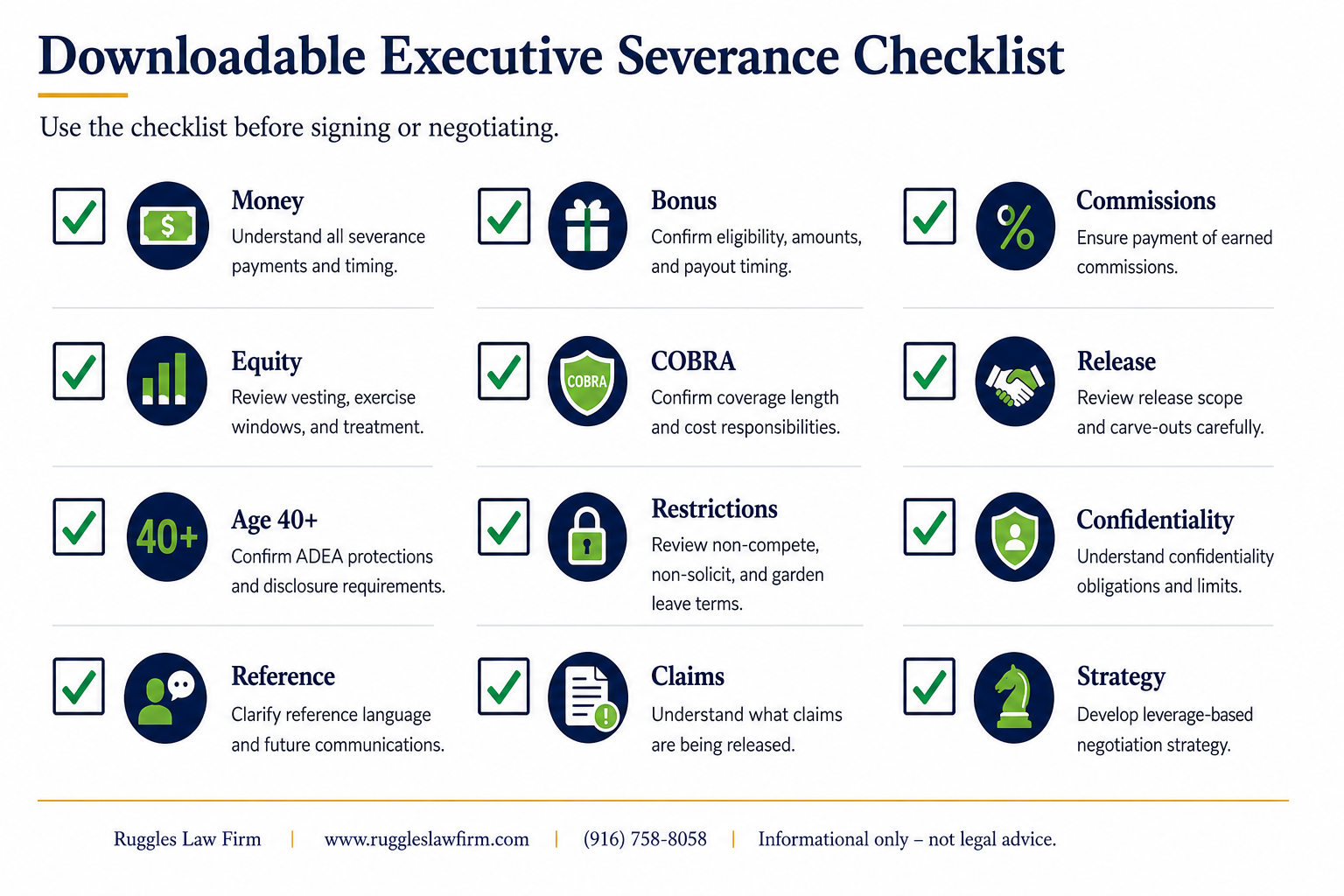
19. Downloadable Executive Severance Checklist
Click here to download a printable checklist!
Money
- How many weeks or months are offered?
- Lump sum or salary continuation?
- Is severance already owed under contract, policy, or plan?
- Is the company offering new money or merely paying what it already owes?
Bonus
- Was the bonus earned?
- Is it prorated?
- What metrics control payment?
- Have comparable employees been paid?
Commissions
- Were deals closed before termination?
- Does the commission plan contain a windfall provision?
- Does the employer claim discretionary authority to reduce payment?
- Are commissions being treated as severance instead of wages?
Equity
- What is vested?
- What is unvested?
- What vesting dates are approaching?
- Can vesting be accelerated or option exercise periods extended?
COBRA and benefits
- Will the employer reimburse COBRA premiums?
- For how long?
- Are dependents covered?
- What happens if new employment begins?
Release
- What claims are being released?
- Does it include a Civil Code section 1542 waiver?
- Are future claims excluded?
- Are agency rights preserved?
Age 40+
- Does the agreement satisfy OWBPA?
- 21 or 45 days?
- 7-day revocation?
- ADEA specifically referenced?
Restrictive covenants
- Non-compete?
- Non-solicitation?
- Choice of law outside California?
- Does the practical effect interfere with future work?
Reputation
- Neutral reference?
- Agreed announcement?
- LinkedIn transition language?
- Mutual non-disparagement?
Strategy
- What is the strongest leverage point?
- What is the deadline?
- Who has authority to approve changes?
- Should counsel communicate directly?
FAQ
Frequently Asked Questions: California Severance Agreements
These answers provide general information, not individualized legal advice.
Final Thoughts: Do Not Negotiate the End of Your Career Chapter Blindfolded
A severance agreement is not just paperwork. It is the formal closing document for a major professional relationship. For executives, C-suite officers, managers, sales leaders, and highly compensated employees, it can affect compensation, reputation, equity, future employment, and legal rights.
The employer has almost certainly had legal help. The agreement was drafted to protect the company. That is not shocking. That is the point.
Before signing, understand what you are receiving, what you are releasing, what compensation may already be owed, what future restrictions apply, what legal claims may exist, what terms can be improved, and what risks the employer is trying to eliminate.
A good severance negotiation does not need to be hostile. It needs to be informed, strategic, and timely. After you sign, your leverage may leave the building faster than the HR representative after saying, “This was a difficult decision.”