
What California Employees Need to Know Before, During, and After an HR Investigation
By Matthew J. Ruggles
The Direct Answer: What Rights Does a California Employee Have During an Internal Investigation?
A California employer usually may investigate work-related complaints, require an employee to attend a reasonably scheduled interview, insist on truthful answers, review company systems, preserve evidence, and impose reasonable interim rules. But an employer may not retaliate for protected complaints or truthful participation, demand that an employee lie or sign an inaccurate statement, invade protected privacy without justification, force disclosure of attorney-client communications, or disregard special union, public-sector, disability, whistleblower, and public-safety rights.
An internal investigation is not a criminal trial, and most private-sector employees do not receive courtroom-style discovery, cross-examination, or an automatic right to have a lawyer inside the interview. Still, the process matters. California cases repeatedly recognize that an investigation that ignores the accused employee, overlooks favorable evidence, applies unequal standards, or appears designed to justify a predetermined termination can become powerful evidence of pretext.
Employees should prepare, remain truthful, preserve relevant records, document each step, and obtain advice early when the allegations could lead to termination, reputational harm, loss of equity or commissions, or criminal exposure. The Ruggles Law Firm can be reached at (916) 758-8058.

1. Why California Employers Conduct Workplace Investigations
Employers investigate because a complaint, report, policy concern, safety incident, wage issue, interpersonal conflict, or allegation of misconduct has created a need to determine what happened. In harassment matters, California law also requires employers to take reasonable steps to prevent and correct unlawful conduct. A prompt and competent investigation is often part of that obligation.
Common triggers include discrimination or harassment complaints, retaliation allegations, whistleblower reports, workplace safety concerns, alleged dishonesty, conflicts of interest, bullying, misuse of confidential information, attendance problems, expense irregularities, threats, workplace violence, and alleged violations of company policy. Investigations may also begin after a company receives an anonymous hotline report, a complaint from a former employee, or information from someone who does not want to participate.
If you are the person making the complaint, the quality of your initial report matters. Our guide to making a workplace complaint in California explains why a concise written complaint, a dated timeline, and a clear request for investigation usually create a stronger record than an undocumented conversation.
Employee-side reality
The fact that an employer opens an investigation does not mean the employer has concluded that anyone did anything wrong. It does mean the company is creating a record. Employees should create an accurate record of their own.
2. When California Law Requires a Prompt, Thorough, and Impartial Investigation
California’s Fair Employment and Housing Act, including Government Code section 12940, requires covered employers to take reasonable steps to prevent and correct discrimination and harassment. The implementing complaint-process regulation, 2 California Code of Regulations section 11023, calls for a timely response, an impartial and timely investigation by qualified personnel, documentation and tracking, appropriate remedial action, and timely closure.
The California Civil Rights Department has published workplace-harassment guidance emphasizing that an effective process should be fair, prompt, thorough, and conducted by someone who is qualified and impartial. The exact scope depends on the allegations. A two-sentence scheduling dispute may not require the same process as a multi-year harassment complaint involving senior management.
The investigation need not be perfect. But “not perfect” is not the same as one-sided, careless, or outcome-driven. The employer should identify the material issues, interview people with relevant knowledge, review reasonably available evidence, give the accused employee a meaningful opportunity to respond, and reach findings using a stated standard.
| Legal source | Core principle | Employee takeaway |
|---|---|---|
| Gov. Code § 12940 and 2 CCR § 11023 |
Reasonable steps to prevent and correct unlawful harassment; timely, impartial complaint process. | A complaint about protected-category harassment should not disappear into an HR inbox. |
| Cotran v. Rollins Hudig Hall International, Inc. (1998) 17 Cal.4th 93 | In a good-cause employment setting, the focus is whether the employer acted honestly after an appropriate investigation, not whether a later jury independently agrees misconduct occurred. | The process, evidence reviewed, notice, and opportunity to respond matter. |
| Silva v. Lucky Stores, Inc. (1998) 65 Cal.App.4th 256 | A fair process considers both sides and gives the accused a reasonable opportunity to present a position and contradict adverse information. | Ask to submit your timeline, witnesses, and documents. |
| King v. U.S. Bank National Assn. (2020) 53 Cal.App.5th 675 | Ignoring contradictions, motives, and exculpatory evidence can support a finding that the investigation was not genuine. | Document what the investigator refused to consider. |
3. Complainant, Witness, or Accused Employee: Your Role Changes the Risks
A workplace investigation often feels like one process, but the employee experience differs sharply depending on role. A complainant is trying to ensure the misconduct is understood and stopped. A witness is usually being asked for firsthand facts. An accused employee – often called the respondent – must answer allegations without guessing, retaliating, or inadvertently creating a second problem.
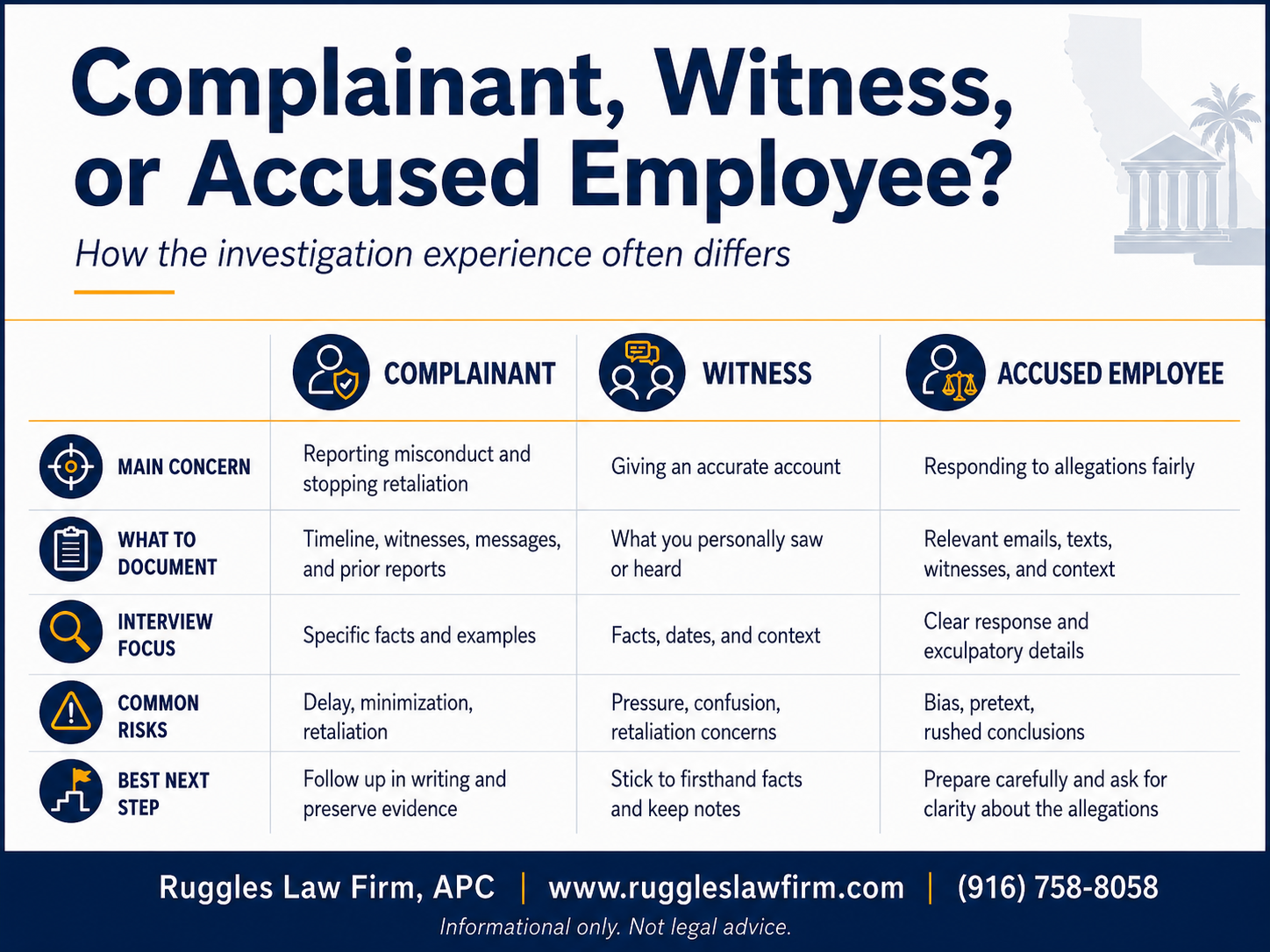
If you are the complainant
- Give concrete examples: who, what, when, where, witnesses, and documents.
- Separate what you personally observed from what someone else told you.
- Explain whether the conduct relates to a protected category, protected complaint, leave, wages, safety, or whistleblowing.
- Report retaliation or changed treatment promptly and in writing.
- Use the evidence-preservation steps in our guide to documenting and proving workplace harassment.
If you are a witness
- Answer only from personal knowledge and identify uncertainty.
- Do not coordinate stories with coworkers or fill gaps with assumptions.
- Preserve your own notes and any lawful, relevant records.
- Truthful participation may be legally protected, particularly when the interview concerns discrimination, harassment, retaliation, safety, wages, or other protected conduct.
If you are the accused employee
- Ask for enough information to understand the conduct, approximate dates, policies, and context at issue.
- Prepare a chronology and identify documents and witnesses that support or contradict the allegations.
- Do not contact the complainant to “clear things up” unless the investigator expressly authorizes it.
- Do not retaliate, intimidate, delete records, coach witnesses, or speculate about motives without evidence.
- Correct material inaccuracies promptly and in writing, but avoid an emotional essay that creates new admissions or side disputes.
4. The Typical Workplace Investigation Roadmap
No two investigations are identical, but most follow a recognizable sequence. Understanding the sequence helps an employee know when to preserve evidence, request clarification, and make a written submission.
- Intake and scope. HR or another decision-maker receives a complaint and defines the issues to investigate.
- Interim measures. The employer may separate employees, change reporting lines, preserve systems, issue no-contact instructions, or place someone on leave.
- Document collection. The investigator gathers emails, texts, policies, time records, performance documents, video, access logs, and other relevant materials.
- Interviews. The complainant, witnesses, and respondent are interviewed, often more than once.
- Credibility and factual analysis. The investigator compares accounts, corroboration, inconsistencies, motives, and available records.
- Findings and decision. The investigator or employer decides whether allegations are substantiated under the applicable standard and what action, if any, to take.
- Closure and follow-up. The company communicates limited closure information, implements corrective action, and monitors for retaliation.
Employees preparing for an HR interview may also benefit from Preparing to Meet with Human Resources and Meeting with Human Resources: Tips for Employee Success.
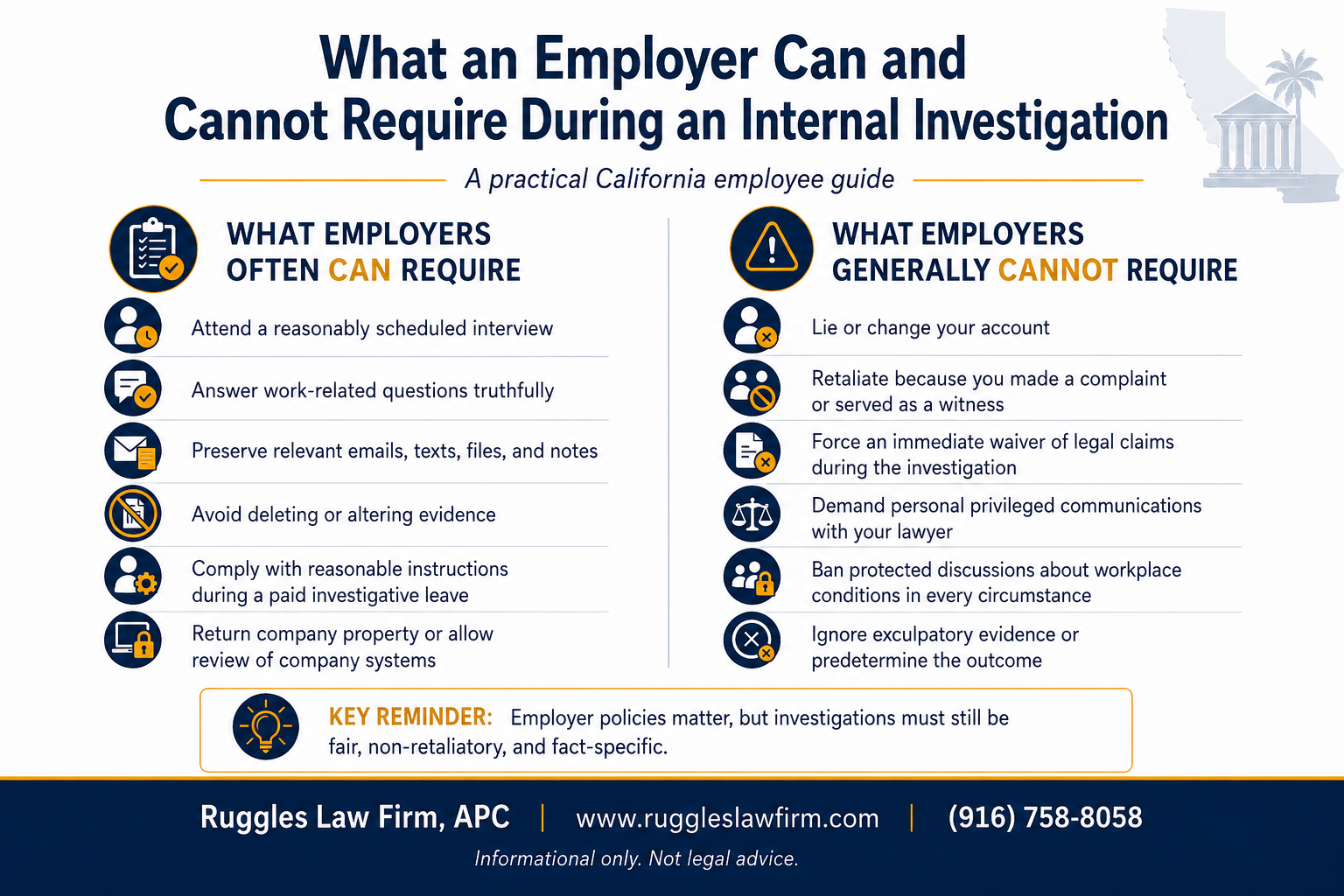
5. What an Employer Can Usually Require During an Investigation
Private employers generally have broad authority to investigate workplace conduct. Subject to contracts, collective bargaining agreements, public-sector rules, disability accommodations, and statutory protections, an employer can usually require reasonable cooperation.
Attendance at a reasonably scheduled interview
An employer may direct an employee to attend an interview related to workplace conduct. If the timing creates a legitimate medical, disability, childcare, religious, or representation issue, request a reasonable adjustment promptly rather than simply failing to appear.
Truthful answers to work-related questions
An employer may insist that an employee answer legitimate questions honestly. In McGrory v. Applied Signal Technology, Inc. (2013) 212 Cal.App.4th 1510, the court distinguished protected opposition from dishonesty and refusal to cooperate. A complaint about discrimination is protected; lying in the investigation is not transformed into protected conduct merely because the investigation concerns discrimination.
Preservation and production of company records
The company may require employees not to delete or alter relevant work email, messages, files, calendars, or other company records. It may also review company-owned devices and systems, subject to privacy laws, policies, and the circumstances. Employees should not destroy evidence, but they also should not remove trade secrets, privileged documents, or unrelated confidential files from company systems.
Return of property and temporary access restrictions
During an investigation or leave, the employer may collect a laptop, badge, keys, credit cards, or phone; disable access; and preserve the device for review. Ask for a written inventory of returned property and whether personal data on a company device can be retrieved under supervision.
Reasonable interim no-contact or noninterference instructions
An employer may direct employees not to contact specified witnesses, not to retaliate, and not to interfere with evidence. The instruction should be clear and tailored. Ask whether it prohibits ordinary operational contact, whether a manager should route necessary communications, and how long it lasts.
Cooperate truthfully, but ask questions when a request is unclear. You may ask what the meeting concerns, whether discipline is possible, who will attend, whether it will be recorded, whether you may submit a written response, and whether any representation right applies.
6. What an Employer Generally Cannot Lawfully Require
A false statement, altered evidence, or predetermined confession
An employer cannot lawfully require an employee to lie, destroy evidence, backdate a document, or sign a statement the employee believes is inaccurate. If asked to sign an interview summary, read it carefully, request corrections, and distinguish acknowledgment of receipt from agreement with the substance.
Retaliation for protected complaints or truthful participation
Government Code section 12940(h), Labor Code section 1102.5, Labor Code section 6310, and other laws protect different forms of reporting and participation. Protected activity can include opposing discrimination, reporting suspected legal violations, raising safety concerns, or assisting an investigation. Crawford v. Metropolitan Government of Nashville & Davidson County (2009) 555 U.S. 271 confirms under Title VII that an employee who reports harassment in response to questions during an internal investigation can be protected from retaliation.
Disclosure of privileged attorney communications
An employer generally may ask about underlying facts, but it should not require an employee to disclose confidential communications with the employee’s own lawyer. The privilege protects communications, not the facts themselves. Do not forward legal advice to coworkers or use a company email account for attorney communications.
A waiver of claims disguised as an interview form
An employer may request acknowledgments, confidentiality terms, or a written statement. A release of legal claims, arbitration agreement, resignation, or severance agreement is different. Do not sign a broad waiver merely because it appears in an “investigation packet.”
Unlawful discrimination, harassment, or invasions of privacy
Investigative questions and searches should be reasonably related to legitimate issues. California recognizes a constitutional privacy interest, analyzed in cases such as Hill v. National Collegiate Athletic Assn. (1994) 7 Cal.4th 1. Privacy is not absolute, especially on company systems, but an unlimited demand for unrelated medical, romantic, financial, or personal information may require clarification or legal review.
The forfeiture of union or special public-employee rights
Union-represented employees may have Weingarten rights to request a representative at an investigatory interview they reasonably believe could lead to discipline. Peace officers, firefighters, certain public employees, and employees covered by collective bargaining agreements may have additional notice, timing, recording, representation, or response rights.
7. How to Prepare for and Handle the Investigation Interview
The safest interview style is calm, precise, truthful, and organized. Employees often hurt themselves by trying to sound certain when they are not, volunteering irrelevant grievances, guessing what others thought, or making categorical statements that documents later disprove.
- Before the interview: request the subject matter, review relevant policies and records, prepare a private chronology, list witnesses, and identify documents.
- At the beginning: ask who is present, who represents whom, whether the meeting is recorded, whether discipline is possible, and whether confidentiality or no-contact instructions apply.
- During questioning: listen to the entire question, pause, answer what was asked, distinguish memory from inference, and say when you do not know or do not remember.
- When shown a document: read it fully, confirm the date and context, and do not accept the interviewer’s characterization without reviewing it.
- At the end: ask whether you may submit additional evidence, correct the interview summary, receive status updates, and report retaliation.
- Immediately afterward: write a dated memorandum recording who attended, the duration, key questions, your answers, documents shown, requests made, and any instructions given.
Our companion article, After a Difficult Meeting with HR, explains how to send a professional confirmation email without turning the follow-up into an angry brief.
Useful phrasing
“I want to cooperate and answer accurately. I do not want to guess. May I review the relevant email and provide a supplemental written response?”
8. Can You Bring a Lawyer, Union Representative, or Coworker?
Most private-sector, nonunion employees do not have an automatic legal right to bring a personal attorney into an employer’s internal interview. An employer may permit counsel, especially for executives or serious allegations, but may also insist that counsel remain outside. Even when counsel cannot attend, an employee can usually consult a lawyer before and after the interview.
Union-represented employees are different. Under NLRB v. J. Weingarten, Inc. (1975) 420 U.S. 251 and current NLRB guidance, a represented employee who reasonably believes an investigatory interview may lead to discipline may request a union representative. The employee generally must make the request; the employer is not ordinarily required to volunteer the right.
Public employees, peace officers, firefighters, educators, and employees covered by a civil-service system or collective bargaining agreement may have broader representation rights. Read the applicable policy and agreement before the interview.
Practical request
“Because this interview may lead to discipline, I request the representative available to me under the collective bargaining agreement and applicable law. I am willing to cooperate once the representative is present.”
9. Can You Record an HR Interview in California?
California generally requires the consent of all parties before recording a confidential communication. Penal Code section 632 can impose criminal and civil consequences for intentionally recording a confidential conversation without consent. An HR office, private video meeting, or telephone interview is commonly treated as confidential.
Do not secretly record merely because the conversation concerns your job. Ask for permission. If the employer records, ask for a copy or transcript. Even when the employer refuses recording, you can take notes and prepare a detailed memorandum immediately afterward. Narrow statutory exceptions exist, but employees should not assume one applies without advice.
Peace officers have special statutory recording rights under Government Code section 3303(g). That rule does not automatically apply to ordinary private-sector employees.
10. Should You Sign an Interview Statement, Confidentiality Form, or Investigation Notice?
A signature can mean different things. It may acknowledge receipt, verify that the summary is accurate, promise confidentiality, consent to recording, or agree to waive rights. Read the language directly above the signature line.
- If the statement is accurate, confirm whether you are verifying every word or only acknowledging receipt.
- If it is incomplete, ask to attach a written supplement.
- If it is inaccurate, identify specific corrections and do not certify it as true.
- If you are told you must sign, ask whether refusal will be treated as insubordination and request time to review.
- Never sign a release, resignation, repayment agreement, arbitration agreement, or severance agreement on the spot without understanding it.
An employer may note that you refused to sign. A calm written explanation is usually more useful than a dramatic standoff.
11. Does the Employer Have to Tell an Accused Employee the Allegations?
A standard private-sector investigation does not always require the employer to disclose every witness name, document, or detail before the interview. But a meaningful opportunity to respond usually requires enough information to understand the substance: the general conduct, time period, location or context, and policy at issue.
Cotran and Silva are frequently cited because they focus on notice and a fair opportunity to respond in a good-cause employment context. The cases do not create courtroom discovery for every at-will employee. They do show why an investigation becomes less reliable when the employer withholds the substance of the charge and then faults the employee for failing to rebut it.
Ask for workable detail
“I understand witness identities may be protected. To respond accurately, please identify the approximate dates, conduct, context, and policies at issue.”
12. Can an Employee See the Investigation Report or Personnel File?
There is no general rule giving every private-sector employee the complete investigation report, witness statements, or unredacted evidence. Employers often treat reports as confidential, attorney-client privileged, or attorney work product, although privilege depends on the purpose and handling of the investigation.
California employees do have statutory rights to inspect and receive copies of certain personnel records relating to performance or grievances under Labor Code section 1198.5. Effective January 1, 2026, the statute expressly includes specified education and training records. It also allows redaction of nonsupervisory employee names and excludes certain records, including records relating to an investigation of a possible criminal offense.
A termination or discipline notice, performance document, signed statement, or final corrective memorandum may be obtainable even when the complete report is not. Make a focused written request and do not assume silence means the report does not exist.
13. Confidentiality, No-Contact Rules, and Employee Speech Rights
Employees frequently hear: “This is confidential. Do not discuss it with anyone.” That sentence is often overbroad unless the employer explains what it means. Investigators ordinarily cannot promise absolute secrecy because the accused employee needs enough information to respond, decision-makers need the facts, and witnesses may need to be re-interviewed.
Investigator-side commentary emphasizes a “need-to-know” approach rather than a promise of total confidentiality. Its analysis of the Nestlé matter also shows why blanket speech restrictions and interim measures can create labor-law problems. From the employee perspective, the lesson is to ask who may receive the information, what discussion is restricted, whether the instruction is time-limited, and whether communications with a lawyer, union, agency, doctor, or spouse are excluded.
The National Labor Relations Act may protect concerted discussions by covered nonsupervisory employees about workplace conditions. Other laws protect reports to government agencies, law enforcement, or counsel. At the same time, employees should not gossip, intimidate witnesses, disclose private personnel information, or coordinate testimony.
A balanced response
“I will not interfere with the investigation or contact listed witnesses. Please clarify whether the instruction permits confidential communications with my lawyer, union representative, government agencies, and immediate family.”
14. Involuntary Investigative Leave: How Companies Usually Treat Employees
Investigative leave (sometimes called administrative leave or suspension pending investigation) is an interim measure. Employers use it to separate the employee from witnesses, preserve records, reduce safety or operational risks, and avoid the appearance that the company ignored a serious allegation. Leave is not necessarily a finding of guilt, but it can be stigmatizing and financially significant.

What usually happens at the start of leave
- The employee receives a short verbal or written notice stating that an investigation is pending.
- Badge, system, email, building, and customer access may be suspended.
- Company property may be collected and preserved.
- The employee may be instructed to remain available during business hours and attend interviews.
- The employer may designate one HR contact and restrict contact with coworkers, clients, or vendors.
- The notice may say the leave is non-disciplinary, but the employer may reserve the right to impose discipline later.
Is investigative leave normally paid?
Many employers place an accused employee on paid leave while facts are gathered, especially where the company wants to characterize the measure as neutral and temporary. Paid status is not universal. Pay may depend on exempt or nonexempt status, a contract, a collective bargaining agreement, a civil-service rule, the reason for leave, and company policy. Ask in writing about salary, hourly pay, overtime, commissions, bonus eligibility, equity vesting, benefits, paid-time-off accrual, expense reimbursement, and the treatment of scheduled leave.
What communications should the employee receive?
A sound process identifies an HR contact, tells the employee how to submit documents, provides reasonable status updates, and avoids leaving the employee indefinitely in professional limbo. There is no universal private-sector deadline, but unexplained delay can become relevant where leave causes lost pay, missed opportunities, reputational harm, or retaliation.
Can leave itself be an adverse employment action?
Yes, depending on the circumstances. Dahlia v. Rodriguez (9th Cir. 2013) 735 F.3d 1060 and Whitehall v. County of San Bernardino (2017) 17 Cal.App.5th 352 illustrate that administrative leave can support a retaliation claim where it carries material consequences or would deter protected activity. A fully paid, brief, neutral leave may be treated differently from a lengthy or humiliating leave that strips duties, compensation, promotion opportunities, credentials, or reputation.
Questions to ask immediately
- Is the leave paid, and will all benefits and accruals continue?
- Is the leave disciplinary or non-disciplinary?
- What company property must be returned, and may I retrieve personal files?
- Who is my contact, and how often will I receive an update?
- What communications are restricted, and what exceptions apply?
- Must I remain available during specified hours?
- How will commissions, bonuses, equity, scheduled vacation, and expense reimbursements be handled?
- May I submit a written response, witnesses, and documents?
15. The Accused Employee’s Perspective: How to Respond Without Making Things Worse
An accused employee may feel angry, embarrassed, or betrayed. Those reactions are understandable but dangerous if they drive the response. The investigation may examine not only the original allegation but also how the employee reacts after learning of it.
Build a fact-based response
- Write a private chronology before reviewing other people’s versions, so your memory is not contaminated.
- Identify the exact facts you admit, deny, do not remember, or believe require context.
- Collect lawful, relevant documents and identify where company-controlled records can be found.
- List witnesses and explain what each person is expected to know; do not merely provide a list of allies.
- Identify inconsistent enforcement or comparators carefully, using specific examples rather than broad accusations.
- Submit a concise supplemental response if the interview did not cover a material issue.
Do not contact or pressure the complainant
A text saying “Why are you doing this to me?” can be characterized as intimidation or retaliation. Even an apology can be misread as an admission. Route necessary operational contact through HR while a no-contact instruction is in place.
Demand fairness, not a courtroom
Ask the investigator to review exculpatory evidence, interview material witnesses, and give you a chance to respond to new allegations. Do not insist on cross-examining the complainant or receiving every confidential document unless a contract or statute provides that right.
If criminal conduct is alleged
The California Civil Rights Department’s workplace-investigation guidance emphasizes preserving relevant evidence and conducting a fact-based inquiry. Employees should also distinguish an employer’s administrative investigation from any separate law-enforcement investigation, because the two processes may involve different rights, risks, and standards.
16. What Makes an Investigation Prompt, Thorough, and Impartial?
A fair investigation is not defined by whether the employee likes the outcome. It is defined by a process reasonably designed to discover the facts.
| Feature | What a sound process looks like | Warning sign |
|---|---|---|
| Prompt scope | Issues are identified early and adjusted when new, material allegations emerge. | Months of unexplained delay or shifting scope after the employer learns the original theory is weak. |
| Qualified investigator | The investigator understands interviewing, evidence, credibility, policy, and applicable law. | A decision-maker with a personal stake conducts a cursory “investigation” of their own conduct. |
| Impartiality | The investigator tests both inculpatory and exculpatory evidence. | Questions assume guilt, favorable witnesses are ignored, or management accounts are accepted without scrutiny. |
| Meaningful notice | The respondent receives enough information to answer the substance. | The employee is asked vague questions and later criticized for not rebutting undisclosed allegations. |
| Relevant evidence | Material documents, electronic records, and witnesses are reviewed. | Only selected messages are quoted; context and contrary documents are omitted. |
| Consistent standard | The same burden and credibility factors apply to all parties. | Different proof standards or discipline are applied based on status or protected characteristics. |
| Documented reasoning | Findings identify the evidence and explain why it was credited. | A conclusory report simply repeats the accusation. |
The California Civil Rights Department’s Workplace Harassment Prevention Guide emphasizes that workplace investigations should be prompt, thorough, fair, and conducted by qualified and impartial personnel. Those principles also explain why an internal “we investigated ourselves” process may lose credibility when the investigator has a personal stake or the structure creates the appearance that the outcome was predetermined.
17. How Credibility Should Be Evaluated
Most workplace investigations involve conflicting accounts. Credibility is not a popularity contest, and demeanor alone is unreliable. Investigators commonly examine the level of detail, internal consistency, consistency with documents, contemporaneous reporting, corroboration, opportunity to observe, motive to misstate, plausibility, admissions against interest, and whether an account changes when challenged.
A witness can be credible about one point and mistaken about another. A complainant’s delay in reporting does not automatically make the allegation false. An accused employee’s nervousness does not establish guilt. Trauma, disability, language, neurodivergence, power dynamics, and fear of retaliation can affect presentation. A fair investigator distinguishes presentation style from evidentiary reliability.
Employees can help by explaining why a discrepancy exists instead of pretending it does not. “I initially said Tuesday because I remembered the staff meeting, but the calendar shows it was Wednesday” is more credible than doubling down on a demonstrably incorrect date.
18. Red Flags of a Biased or Pretextual Investigation

California decisions do not require every employer to conduct an idealized investigation. They do recognize that serious defects can support an inference of unlawful motive. Nazir v. United Airlines, Inc. (2009) 178 Cal.App.4th 243 is frequently cited for the proposition that a deeply flawed, one-sided investigation can be evidence of pretext.
- The investigation begins immediately after protected activity but ignores the employee’s underlying complaint.
- The investigator interviews only management-selected witnesses.
- The employer refuses to review readily available exculpatory documents.
- Allegations or reasons for discipline shift as each earlier explanation is disproved.
- The accused is never interviewed or is given no meaningful opportunity to respond.
- Comparable employees are treated differently for similar conduct.
- The investigator uses hostile, leading questions and accepts management hearsay without testing it.
- Discipline appears drafted before the investigation is complete.
- The decision-maker reads only a summary and ignores material portions of the report.
- The employer uses the investigation to pressure resignation or a rushed release.
In King v. U.S. Bank National Assn., the employer’s failure to interview the accused decision-maker, examine contradictions, and pursue exculpatory evidence supported a whistleblower verdict. The California Civil Rights Department’s investigation guidance reflects the same underlying principle: relevant witnesses should be interviewed, relevant documents should be reviewed, and the accused employee should receive a meaningful opportunity to respond. A determined effort to build a case, rather than discover the truth, can expose investigative bias.
If the stated reason for discipline is false, read Fired for a False Reason in California. A false reason is not always independently unlawful, but it can be powerful evidence that the employer is hiding discrimination, retaliation, or another prohibited motive.
19. Retaliation Against Complainants and Witnesses
A company may investigate a complaint and still retaliate against the person who made it. Retaliation often appears as a sequence rather than a single dramatic event: exclusion from meetings, lost accounts, schedule changes, micromanagement, negative evaluations, leave, a PIP, discipline, or termination.
Yanowitz v. L’Oreal USA, Inc. (2005) 36 Cal.4th 1028 recognizes that a series of actions may collectively be materially adverse. Lawson v. PPG Architectural Finishes, Inc. (2022) 12 Cal.5th 703 explains California’s whistleblower burden-shifting framework under Labor Code section 1102.6. Timing, shifting explanations, differential treatment, and investigative defects can help show retaliatory motive.
Employees should compare treatment before and after the protected activity and document the timeline. Our articles on protected activity, what to do when HR ignores a complaint, and harassment as retaliation explain how to identify and document the pattern.
An employer may discipline genuine misconduct discovered during an investigation. Retaliation law does not immunize an employee from legitimate rules. The question is whether protected activity was a contributing or motivating factor and whether the employer can prove the action would have occurred for legitimate reasons.
20. Evidence Preservation: Build a Record Without Taking What Is Not Yours
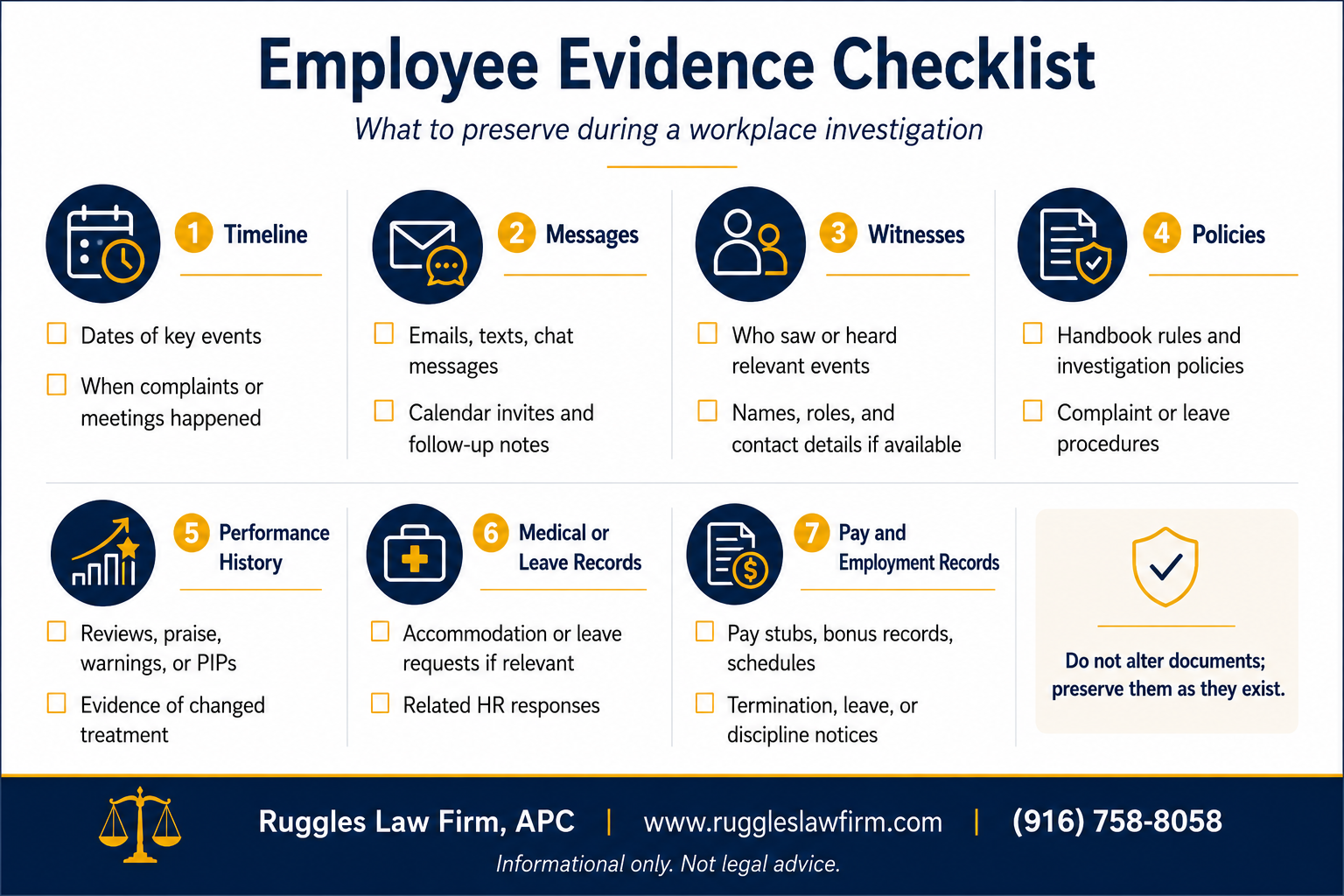
Preserve evidence lawfully. Do not delete messages, alter documents, wipe a phone, destroy notes, or ask someone else to do so. But do not download entire databases, privileged legal files, customer information, trade secrets, medical records, or confidential personnel files simply because they might be useful.
Useful categories
- A dated chronology of events, complaints, interviews, leave, discipline, and follow-up.
- Emails, texts, chats, calendar invitations, meeting notes, and policy acknowledgments that you may lawfully retain.
- Performance reviews, awards, warnings, PIPs, job descriptions, compensation plans, schedules, and organizational charts.
- Names and contact information for witnesses, with a short explanation of their knowledge.
- Leave, accommodation, safety, wage, or whistleblower communications relevant to protected activity.
- Pay stubs, bonus or commission records, equity statements, and benefit information if leave or termination affects compensation.
- Copies of every notice, statement, instruction, or document you signed or were asked to sign.
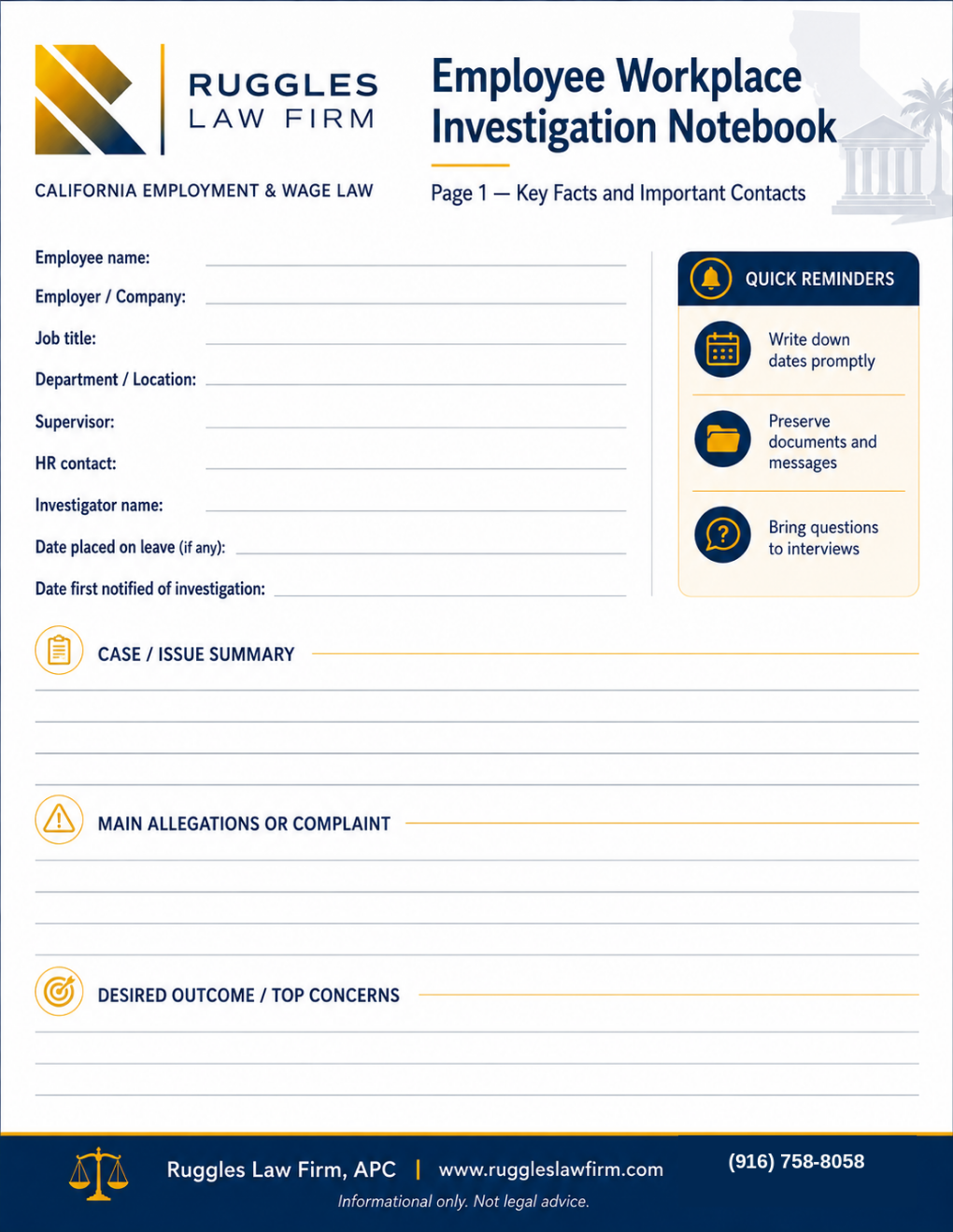
The downloadable notebook below is designed to help employees record facts without turning the notes into a stream of conclusions. Write contemporaneously, label estimates as estimates, and distinguish facts from assumptions.
Employee Workplace Investigation Notebook – record key contacts, dates, events, interview questions, evidence, and follow-up deadlines.
21. What to Do When the Investigation Ends

Returned to work
Ask whether restrictions are lifted, confirm your duties and reporting line, and document any lost compensation or opportunities. Watch for retaliation, isolation, unusual scrutiny, or a sudden negative record.
No action on your complaint
Request written confirmation that the company completed its review, ask what steps will prevent recurrence, and preserve the response. The employer may not disclose confidential discipline imposed on another employee, but it can usually state that the matter was reviewed and appropriate action was taken.
Written warning or PIP
Read every allegation and deadline. Submit a measured response that corrects inaccuracies and commits to reasonable expectations without admitting facts that are false. See our Employee Guide to Performance Improvement Plans and PIP Insights.
Termination
Request the termination reason, final pay information, benefit notices, personnel records, and any severance proposal. Preserve evidence immediately. Do not sign a release at the termination meeting. At-will status may allow termination for a mistaken or unfair reason, but not for discrimination, retaliation, whistleblowing, protected leave, wage complaints, safety reports, or other prohibited motives.
Severance discussions
An investigation can create both risk and leverage. A company may want confidentiality, non-disparagement, cooperation, return of property, and a release. The employee may seek additional pay, COBRA, equity treatment, commission protection, neutral references, non-disparagement, and carefully drafted separation language. Read Is Severance Really Non-Negotiable? before signing.
22. Public Employees, Peace Officers, and Firefighters Have Additional Rules
Public employment can involve constitutional due process, civil-service rules, collective bargaining rights, Skelly procedures, and special statutes. The rules differ significantly from ordinary private employment.
Compelled administrative answers and criminal use
Lybarger v. City of Los Angeles (1985) 40 Cal.3d 822 and Spielbauer v. County of Santa Clara (2009) 45 Cal.4th 704 address the government’s ability to compel job-related answers while protecting the employee against criminal use of compelled statements. A public employee may be disciplined for refusing to answer properly compelled administrative questions after receiving appropriate protections; the agency cannot force the employee to waive the protection against criminal use.
Peace officer interrogation rights
Government Code section 3303 regulates interrogations that may lead to punitive action, including timing, notice of the nature of the investigation, reasonable duration, representation, recording, and other safeguards.
Public employees should identify the precise statute, memorandum of understanding, personnel rule, and agency policy that applies before deciding whether to answer, request representation, record, or refuse a directive.
23. Key Case Law About Employer Internal Investigations
| Case | What the court addressed | Practical employee lesson |
|---|---|---|
| Cotran v. Rollins Hudig Hall International, Inc. (1998) 17 Cal.4th 93 | Whether an employer with an implied good-cause limitation acted on an honest belief after an appropriate investigation. | Notice, a reasonable opportunity to respond, substantial evidence, and an honest decision-making process matter. |
| Silva v. Lucky Stores, Inc. (1998) 65 Cal.App.4th 256 | Adequacy of an investigation into alleged sexual harassment before discharge. | The employer should listen to both sides and allow the accused to present and contradict evidence. |
| Nazir v. United Airlines, Inc. (2009) 178 Cal.App.4th 243 | Evidence of discrimination and pretext, including a one-sided investigation. | Serious investigative irregularities can help show the stated reason is not genuine. |
| McGrory v. Applied Signal Technology, Inc. (2013) 212 Cal.App.4th 1510 | Discipline after an investigation involving noncooperation and dishonesty. | Protected complaints do not authorize lying or refusing reasonable cooperation. |
| King v. U.S. Bank National Assn. (2020) 53 Cal.App.5th 675 | Whistleblower retaliation and an investigation that failed to test the employer’s theory. | Ignored contradictions and exculpatory evidence can support a verdict for the employee. |
| Crawford v. Metropolitan Government of Nashville & Davidson County (2009) 555 U.S. 271 | Retaliation against an employee who disclosed harassment in response to an internal inquiry. | Truthful participation in an internal discrimination investigation can be protected opposition. |
| Yanowitz v. L’Oreal USA, Inc. (2005) 36 Cal.4th 1028 | What counts as adverse action in a retaliation case. | A pattern of smaller actions may collectively be materially adverse. |
| Dahlia v. Rodriguez (9th Cir. 2013) 735 F.3d 1060 | First Amendment retaliation and administrative leave. | Leave can be adverse when it materially affects the employee or would deter protected activity. |
| Whitehall v. County of San Bernardino (2017) 17 Cal.App.5th 352 | Whistleblower retaliation involving leave and termination. | The timing and consequences of investigative leave can support retaliation. |
| Lybarger v. City of Los Angeles (1985) 40 Cal.3d 822 | Compelled statements by public employees where criminal exposure exists. | Public employees need proper immunity and admonition protections. |
| Spielbauer v. County of Santa Clara (2009) 45 Cal.4th 704 | Whether a public employer may compel job-related answers. | The government can require answers for administrative purposes if criminal-use protections are preserved. |
| NLRB v. J. Weingarten, Inc. (1975) 420 U.S. 251 | Union representation at investigatory interviews. | Union-represented employees should affirmatively request representation when discipline is reasonably possible. |
| Kearney v. Salomon Smith Barney, Inc. (2006) 39 Cal.4th 95 | California’s strong policy concerning confidential call recording. | Do not secretly record an HR call without analyzing consent and applicable law. |
24. A 12-Step Employee Checklist
- Do not delete, alter, forward, or conceal relevant evidence.
- Ask whether you are a complainant, witness, or subject of the investigation.
- Request the general subject matter, participants, format, and recording status.
- Review the handbook, investigation policy, collective bargaining agreement, and leave notice.
- Prepare a chronology and witness list before the interview.
- Answer truthfully; do not guess or exaggerate.
- Ask to submit documents and a supplemental written response.
- Clarify confidentiality, no-contact, and availability instructions.
- If placed on leave, confirm pay, benefits, bonus, equity, commissions, property, and status updates.
- Document the interview immediately afterward.
- Report retaliation or changed treatment promptly and factually.
- Obtain legal advice early if termination, criminal exposure, public-employee rights, or significant compensation is at stake.
Download: Employee
Workplace Investigation
Notebook
This free three-page PDF helps employees record key facts, contacts, dates, interview questions, evidence, and follow-up deadlines.
Frequently Asked Questions About California Workplace Investigations
Answers for complainants, witnesses, employees on investigative leave, and accused employees.
1. What is a workplace investigation?
A workplace investigation is an employer-directed process for gathering facts about a complaint, policy violation, performance issue, safety concern, or alleged misconduct. It usually includes interviews, document review, credibility analysis, findings, and a decision about corrective action.
2. Why is HR investigating me?
HR may be investigating because someone complained, a manager reported a concern, an audit identified a problem, or the company received information through another channel. An investigation does not itself prove wrongdoing, but it signals that the company is building a formal record.
3. Must a California employer investigate every complaint?
Not every workplace complaint requires a full formal investigation, but complaints involving discrimination, harassment, retaliation, safety, wages, whistleblowing, violence, or serious policy violations often require prompt fact gathering. The scope should be proportional to the allegations.
4. Does California require workplace investigations to be impartial?
For harassment complaint procedures, California regulations call for an impartial and timely investigation by qualified personnel. More broadly, a biased or one-sided investigation can undermine an employer’s defense and support an inference of pretext.
5. How quickly should an investigation begin?
There is no single deadline for every private investigation. A serious complaint should generally be addressed promptly, with immediate steps to preserve evidence and protect employees. Unexplained delay can impair evidence and may support a claim that the process was not genuine.
6. How long can a workplace investigation take?
The time depends on the number of allegations, witnesses, documents, leave schedules, electronic evidence, and criminal or regulatory overlap. Employees should request reasonable status updates, particularly when they are on leave or losing compensation or opportunities.
7. Who can conduct the investigation?
HR, in-house counsel, a manager, an outside lawyer, or a professional investigator may conduct it. The important questions are whether the investigator is qualified, sufficiently independent, and free from conflicts or pressure to reach a predetermined result.
8. Is HR really neutral?
HR works for the employer, not the employee. That does not mean every HR investigator is biased, but employees should understand HR’s institutional role. Evaluate the process by what evidence is gathered, whether both sides are heard, and whether the stated rules are applied consistently.
9. When should an employer use an outside investigator?
An outside investigator is often appropriate when allegations involve senior leadership, HR itself, high-profile employees, complex legal issues, or a serious appearance of internal bias. California law does not require an outside investigator in every case.
10. What standard of proof is used?
Many employers use a preponderance or “more likely than not” standard, but policies vary. A workplace investigation is not a criminal trial and generally does not require proof beyond a reasonable doubt. Ask what standard and policy apply.
11. Is an HR investigation the same as a criminal investigation?
No. The employer is deciding workplace facts and policy compliance, while law enforcement determines whether criminal laws may have been violated. The two processes can overlap but use different powers, rights, burdens, and timelines.
12. Can HR investigate an anonymous complaint?
Yes. An anonymous complaint can trigger an investigation, but anonymity may limit the ability to test credibility or obtain details. The employer should seek corroborating evidence and give the accused enough substance to respond meaningfully.
13. What if the complainant refuses to participate?
The employer may continue using available documents, prior statements, witnesses, and other evidence. A refusal to participate does not automatically make the complaint false, but it can limit what the employer can reliably conclude.
14. Can the employer interview former employees or nonemployees?
Yes. Former employees, contractors, vendors, customers, and other nonemployees may have relevant information. They may not be required to cooperate unless another legal mechanism applies, so the investigator must assess reliability and obtain information voluntarily.
15. Can my employer require me to attend an interview?
Usually yes, if the interview is reasonably related to work and scheduled in a lawful manner. Employees with union, public-sector, contractual, disability, or other special rights may be entitled to representation or reasonable adjustments.
16. Can my employer require truthful answers?
Generally yes. An employer can discipline dishonesty or reasonable noncooperation. Answer accurately, distinguish memory from assumption, and do not guess. Protected activity does not create a right to lie.
17. Can I be fired for refusing to participate?
A private employer may treat refusal to cooperate as insubordination, especially for at-will employees. The analysis changes if the request violates a privilege, disability right, union right, public-employee protection, or other law. Seek advice before refusing.
18. Can I be fired for lying during the investigation?
Dishonesty can be an independent basis for discipline or termination. Even if the original allegation is not substantiated, a false statement, evidence destruction, or witness interference can create a separate reason for discharge.
19. Can the employer require a written statement?
The employer may request one and may require reasonable cooperation. A written response can help if it is factual and focused. Do not sign a statement that is inaccurate; request corrections or attach a supplement.
20. Must I sign the investigator’s summary?
Not necessarily, but refusal may be documented or treated as noncooperation depending on policy. Determine whether the signature confirms accuracy or merely acknowledges receipt. If the summary is wrong, identify specific corrections in writing.
21. Can the employer require confidentiality?
An employer may impose lawful, tailored confidentiality or noninterference rules to protect witnesses and the process. A blanket ban on all discussion may conflict with labor, union, public-sector, whistleblower, or agency-reporting rights. Ask about scope and duration.
22. Can I talk to a coworker, union, or lawyer?
You can generally consult your own lawyer, and union-represented employees may have representation rights. Discussions with coworkers may be protected in some circumstances but can also violate a lawful no-contact instruction or appear to coordinate testimony. Get clarity first.
23. Can HR order me not to contact the complainant?
Yes, a temporary no-contact instruction is common and often reasonable. Follow it. Ask how necessary work communications will be routed and whether the restriction applies outside work or to incidental contact.
24. Can the company search my work email or computer?
Usually the company has broad rights to review company-owned systems, particularly when policies limit expectations of privacy. The scope should still be related to legitimate business purposes, and special rules may apply to privileged or personal information.
25. Can the company demand my personal phone?
The employer may request relevant messages or data, but ownership, privacy, consent, reimbursement, BYOD policies, and the scope of the request matter. Do not erase data, but do not surrender unrestricted access without understanding the request and obtaining advice when necessary.
26. Can HR demand communications with my attorney?
Generally no. Attorney-client communications are privileged. HR may ask about the underlying facts, which are not privileged merely because you discussed them with a lawyer. Keep attorney communications off company systems.
27. Can the employer require return of company property?
Yes. The company may require return of laptops, phones, badges, documents, keys, credit cards, and other property. Ask for a receipt and a supervised process for retrieving personal data from company devices.
28. Can the company disable my email and system access?
Yes, especially during leave or when evidence preservation is important. Loss of access should not prevent you from identifying relevant records by date, sender, subject, or location for the investigator to retrieve.
29. Can the employer record the interview?
The employer may record with appropriate consent and notice. Ask before the interview whether audio, video, transcription, or AI note-taking will be used and request a copy if possible.
30. Can I secretly record the interview?
Usually that is risky in California. Penal Code section 632 generally requires all-party consent for confidential communications. Ask for permission or take detailed notes instead unless counsel confirms a narrow exception.
31. May I take notes during the interview?
Usually yes, although an employer may impose reasonable limits involving confidential materials. If note-taking is prohibited, ask why and create a detailed memorandum immediately afterward.
32. Can I get the questions in advance?
Most employers do not provide a full question list. You can request the general topics, policies, time period, and documents to review so you can answer accurately.
33. Can I bring a private attorney to the interview?
Most nonunion private employees have no automatic right to bring counsel inside. The employer may allow it. Even when counsel cannot attend, consulting counsel beforehand can help you prepare and avoid preventable mistakes.
34. Do union employees have a right to a representative?
Union-represented employees may request a Weingarten representative at an investigatory interview they reasonably believe could lead to discipline. The employee generally must make the request, and the representative may provide active assistance.
35. Can a nonunion employee bring a coworker?
There is no general current federal right for every nonunion employee to bring a coworker. Company policy, state or local law, disability accommodation, or a particular agreement may allow it.
36. Must HR tell me the allegations?
The employer should provide enough substance for a meaningful response, especially when the decision depends on your answer. It may withhold witness identities or sensitive details. Ask for approximate dates, conduct, context, and policies.
37. Can HR surprise me with an interview?
Yes, surprise interviews are common, particularly when evidence preservation is a concern. You can ask for a short break, representation if entitled, or reasonable time to review a document and supplement your answer.
38. Do I have a right to know who accused me?
Ordinary private employees usually do not have an absolute right to know every complainant or witness identity. The need for confidentiality must be balanced against the need to provide enough information to respond.
39. May I submit witnesses and documents?
Yes, you should ask to do so. Explain what each witness knows and why each document matters. A refusal to consider clearly material evidence should be documented.
40. Must the investigator consider exculpatory evidence?
A reliable investigation should consider evidence that supports and undermines the allegation. Ignoring obvious exculpatory evidence can support an inference that the outcome was predetermined.
41. Do I have a right to respond to new allegations?
A fair process ordinarily gives the respondent a reasonable opportunity to address material new allegations before findings are finalized. The extent of that opportunity varies by policy, contract, and public-sector due-process rules.
42. Can I correct an inaccurate interview summary?
Ask to review it and submit corrections promptly. If review is denied, send your own dated summary identifying material inaccuracies and omitted evidence.
43. Can I request an accommodation for the interview?
Yes. An employee with a disability may request a reasonable accommodation, such as breaks, accessible technology, additional processing time, a quieter setting, or another effective adjustment. Make the request early and explain the functional need.
44. What if the allegations could be criminal?
Do not assume the workplace interview is harmless. A statement may be shared with law enforcement or used to identify evidence. Consult criminal and employment counsel before answering detailed questions when prosecution is realistically possible.
45. Does the Fifth Amendment protect a private employee?
Usually the Fifth Amendment restricts government action, not a private employer. A private employer may impose employment consequences for refusal, subject to contracts and other laws. Criminal counsel should evaluate the competing risks.
46. Can a public employer compel answers?
A public employer may compel job-related administrative answers if it preserves the employee’s protection against criminal use of compelled statements. Lybarger and Spielbauer govern important aspects of this issue.
47. Do peace officers have special investigation rights?
Yes. The Public Safety Officers Procedural Bill of Rights includes notice, timing, representation, recording, and interrogation rules. Firefighters and other public employees may have separate protections.
48. What is investigative leave?
It is a temporary removal from active duties while the employer gathers facts. It may be paid or unpaid and may include access restrictions, property return, no-contact instructions, and an obligation to remain available.
49. Is investigative leave usually paid?
Many employers use paid leave, particularly for serious allegations and salaried employees, but there is no universal private-sector rule. Policy, classification, contract, CBA, and public-sector rules matter.
50. Do benefits continue during investigative leave?
Often they do during paid leave, but employees should confirm health coverage, retirement contributions, PTO accrual, disability coverage, and other benefits in writing.
51. What happens to bonuses, commissions, and equity?
Treatment varies. Ask whether leave affects performance metrics, commission credit, bonus eligibility, vesting dates, exercise periods, and termination definitions. Preserve the governing plans and statements.
52. Can the employer prohibit me from working or contacting clients?
Yes, that is common during leave. Follow the instruction and ask how ongoing client matters, deadlines, and commissions will be handled.
53. How long can investigative leave last?
There is no universal private-sector maximum. The duration should be reasonably related to the investigation. Repeated unexplained extensions, particularly with financial or reputational harm, deserve scrutiny.
54. Does leave mean the company thinks I am guilty?
Not necessarily. Employers often describe leave as neutral. But the surrounding communications, unequal treatment, duration, and consequences can reveal whether it is genuinely interim or effectively punitive.
55. Can investigative leave be retaliation?
Yes, depending on timing, motive, and consequences. Leave imposed after protected activity, especially when unusually harsh or inconsistent, may be part of a retaliation claim.
56. Can the company tell coworkers why I am on leave?
The company should generally limit disclosures to legitimate business needs and avoid defamatory or unnecessary statements. Managers may need to explain coverage without broadcasting unproven allegations.
57. What should I ask when placed on leave?
Ask whether it is paid and non-disciplinary; whether benefits, bonuses, commissions, and equity continue; what property to return; who your contact is; what communications are restricted; and when you will receive updates.
58. Can the employer terminate me while I am on leave?
Yes, if it reaches a lawful decision. Termination may still be wrongful if motivated by discrimination, retaliation, whistleblowing, protected leave, or another prohibited reason.
59. What if I return to work without an explanation?
Request confirmation that the leave ended, clarify duties and restrictions, and document lost pay or opportunities. Monitor for retaliation or a sudden PIP.
60. What does “unsubstantiated” mean?
It usually means the investigator concluded the evidence did not meet the applicable standard. It does not necessarily mean the complaint was false or malicious. “Inconclusive” and “unfounded” may have different policy definitions.
61. Do I have a right to the full report?
Most private employees do not have an automatic right to the entire report. Contracts, public-sector rules, litigation discovery, or personnel-record laws may provide access to some materials.
62. Can I request my personnel file?
Yes. Labor Code section 1198.5 provides current and former employees rights to inspect and receive copies of qualifying personnel records, subject to timing, exceptions, redactions, and other limits.
63. Can the employer redact witness names?
Yes. Labor Code section 1198.5 permits redaction of nonsupervisory employee names in covered personnel records, and other privacy interests may support redaction.
64. What if the investigator is biased?
Identify specific facts: relationship to a party, financial interest, hostile assumptions, selective evidence, inconsistent standards, or refusal to interview material witnesses. Request a neutral investigator or submit a written objection without personal attacks.
65. What are the strongest red flags?
Predetermined conclusions, no interview of the accused, ignored exculpatory evidence, shifting allegations, unequal treatment, hostile questioning, selective quoting, and discipline drafted before the investigation closes are significant warning signs.
66. What if HR ignores my complaint?
Follow up in writing, restate the key facts, request a timeline, preserve evidence, and escalate through available channels. Continued inaction may be relevant to employer liability and retaliation.
67. Can the company retaliate against the complainant?
No. California and federal laws prohibit retaliation for many good-faith complaints and participation activities. Document changes in duties, evaluations, scheduling, compensation, access, and treatment.
68. Can the company retaliate against a witness?
No, when the witness’s participation is protected by applicable law. Truthful answers about harassment, discrimination, safety, wages, or legal violations can be protected. Witnesses should report retaliation promptly.
69. What should I do if I am falsely accused?
Stay calm, preserve evidence, prepare a chronology, identify witnesses, ask for specific allegations, and provide a focused response. Do not retaliate, contact the complainant, or launch a social-media defense.
70. Can a false accusation support a defamation claim?
Sometimes, but workplace communications may be privileged and the analysis depends on falsity, publication, fault, privilege, and damages. Internal accusations are not automatically actionable.
71. What if I receive a PIP after the investigation?
Review whether the PIP is supported, consistent with past reviews, achievable, and connected to the allegations. Respond professionally, correct inaccuracies, meet legitimate expectations, and document retaliation or pretext.
72. What if I am fired after the investigation?
Request the stated reason, final pay and benefits information, personnel records, and any severance proposal. Preserve evidence and evaluate whether the investigation was genuine or used to conceal an unlawful motive.
73. Should I negotiate severance after an investigation?
Often yes. Potential terms include pay, COBRA, commissions, equity, reference language, non-disparagement, confidentiality, cooperation, return of property, and characterization of separation. Do not focus only on salary continuation.
74. What evidence should I preserve?
Preserve timelines, complaints, emails, texts, chats, calendar entries, performance records, policies, leave notices, pay records, commission and equity documents, witness information, and interview notes that you may lawfully retain.
75. When should I contact an employment lawyer?
Contact counsel early when the allegations could lead to termination, professional licensing harm, criminal exposure, loss of significant compensation, public-employee discipline, retaliation, or a rushed severance release. Early advice is often more useful than trying to repair an avoidable mistake later.