
How to Protect Your Job, Reputation, and Legal Rights During a California Workplace Investigation
By Matthew J. Ruggles
Being falsely accused at work is one of the fastest ways for an ordinary workday to turn into a career emergency. A coworker may say you harassed someone, falsified records, stole time, bullied a subordinate, violated a safety rule, misused confidential information, or threatened workplace violence. Human Resources may schedule an interview, cut off computer access, place you on leave, or ask you to sign a statement—sometimes before telling you what supposedly happened.
The instinctive response is usually: “This is a lie, so HR will see through it.” That is not a strategy. Employers make decisions with incomplete information, and California law does not automatically turn every mistaken or unfair decision into a lawsuit. The employee’s job is to protect credibility, preserve evidence, respond intelligently, and recognize when the accusation is being used as a cover for retaliation, discrimination, bonus avoidance, or a predetermined termination.
Key point
The most important question is rarely whether a coworker’s accusation was false in the abstract. The practical and legal questions are: What did the employer reasonably believe, how did it investigate, did it apply its rules consistently, and was the accusation used to conceal an unlawful motive?
The Short Answer: A False Accusation Is Serious, but Not Automatically Illegal
California generally presumes indefinite employment is at will under Labor Code section 2922. That means a private employer may often discipline or discharge an employee for a mistaken reason, an unfair reason, or no stated reason—so long as the real reason is not prohibited by statute, public policy, contract, or a collective bargaining agreement.
The California Supreme Court’s decision in Cotran v. Rollins Hudig Hall International, Inc. (1998) 17 Cal.4th 93 illustrates the problem. In an implied-contract “good cause” case, the issue was not whether the accused employee actually committed the harassment. The issue was whether the employer, acting in good faith after an investigation appropriate under the circumstances, had reasonable grounds to believe the misconduct occurred. The court described an adequate process as one involving notice of the claimed misconduct, a meaningful opportunity to respond, and a reasoned conclusion supported by substantial evidence.
That does not mean employers receive a blank check. A sham investigation, shifting accusation, selective enforcement, failure to interview the accused, purposeful avoidance of exculpatory evidence, or sudden accusation after protected activity may support claims for retaliation, discrimination, breach of contract, whistleblower retaliation, or—in unusually strong facts—defamation.
- False accusation alone: often not enough for a viable claim.
- False accusation plus unlawful motive: may support retaliation or discrimination.
- False accusation plus contractual “good cause” rights: may support a contract claim if the investigation was not fair or honest.
- False accusation deliberately republished with malice: may support defamation, subject to privileges and a short limitations period.
- False accusation plus public-employee or union rights: may trigger additional procedural protections.
What Counts as a False Workplace Accusation?
“False accusation” is an everyday phrase, not a single California cause of action. The label can describe several very different situations:
| Type | What it looks like | Why the distinction matters |
|---|---|---|
| Fabricated fact | A coworker knowingly invents an event that never occurred. | Evidence of motive and deliberate falsity may matter to credibility, privilege, malice, and retaliation. |
| Exaggeration | A tense conversation becomes “threatening,” or blunt feedback becomes “harassment.” | The dispute may turn on context, policy definitions, comparators, and proportional discipline. |
| Mistaken perception | A witness honestly but incorrectly identifies who said or did something. | An honest mistake is different from a deliberate lie, especially for defamation. |
| Misleading omission | The accuser reports the employee’s response but omits the provocation, instruction, or earlier conversation. | Documents and complete timelines become critical. |
| Opinion presented as fact | “He is unsafe,” “she is dishonest,” or “they are hostile” appears without supporting conduct. | Ask what specific acts support the conclusion. |
| Policy disagreement | The employee followed a normal practice that HR later characterizes as misconduct. | Actual policy language, training, custom, and comparator evidence matter. |
| Pretextual accusation | A weak allegation is elevated because management wants a different outcome—termination, bonus avoidance, or retaliation. | The investigation process itself may reveal the illegal motive. |
Not every disputed allegation is a lie. Two witnesses can experience the same event differently. A strong response avoids the trap of calling everyone dishonest before the evidence is known. It identifies precisely what is false, what is incomplete, what is opinion, and what objective evidence resolves the dispute.
Why Employees Make False or Misleading Accusations
Motives vary. Some accusations are deliberate; others begin as emotion, office politics, or a poorly worded complaint and harden into “facts” through repetition. Common motives include:
- Fear of discipline or an effort to redirect blame.
- Competition for a promotion, account, commission, bonus, schedule, or managerial role.
- Resentment after a performance review, PIP, coaching, or denied request.
- A personal relationship or friendship that deteriorated.
- An attempt to retaliate against someone who reported harassment, safety problems, wage issues, fraud, leave violations, or discrimination.
- A desire to frame ordinary supervision as bullying or harassment.
- Group dynamics in which witnesses repeat one another without firsthand knowledge.
- Management pressure to produce a reason for an already desired termination.
Motive is relevant, but motive alone does not prove falsity. An employee accused shortly after disciplining a subordinate should document that chronology, but should still respond to the substance. A timeline is evidence; indignation is not.
What to Do in the First 24 to 48 Hours
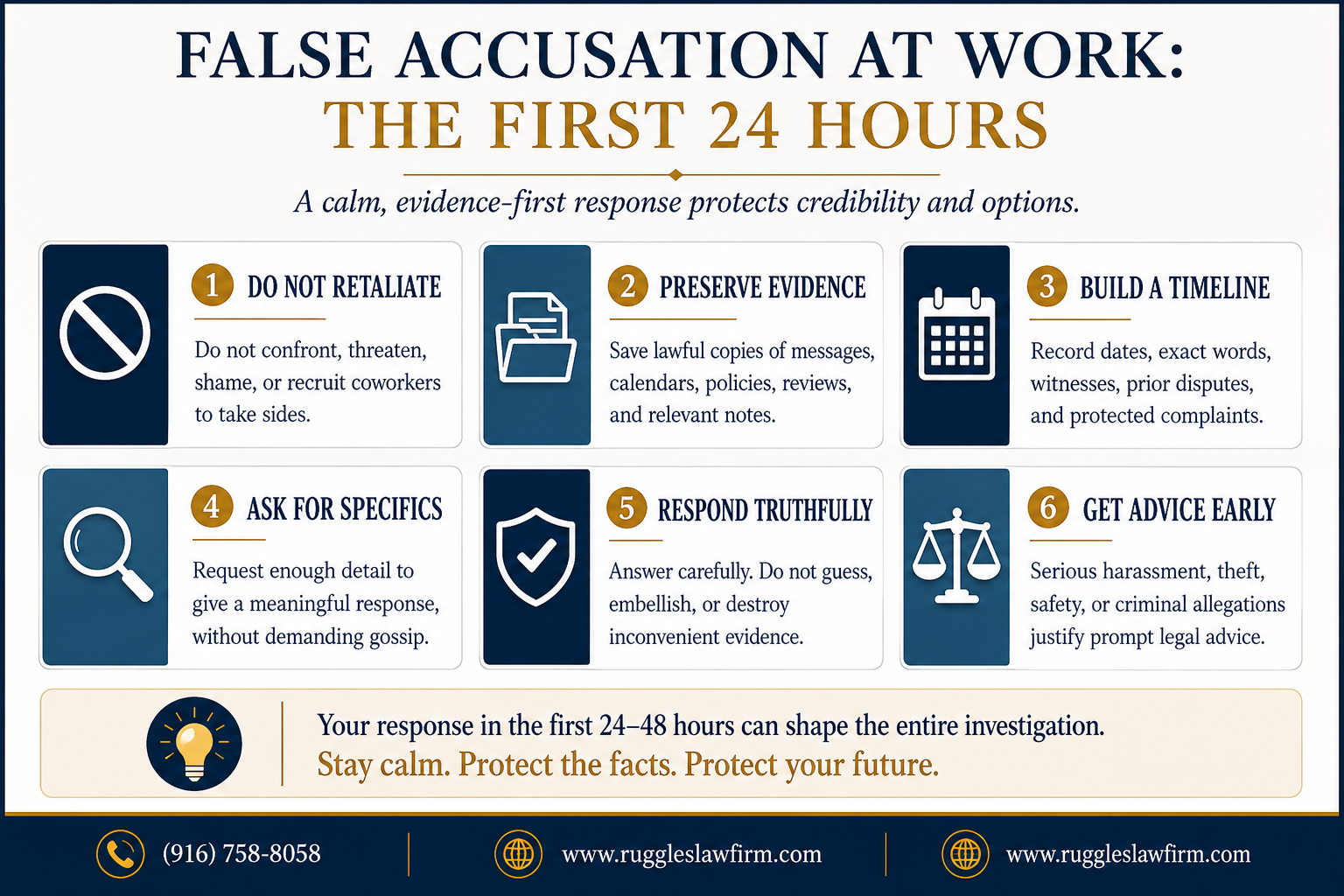
- Slow down. Do not send the angry all-staff email. Do not confront the accuser in the parking lot. Do not threaten to sue everyone before you know the allegation.
- Write a privileged chronology for your attorney. Identify the accusation, dates, witnesses, prior interactions, relevant policies, performance events, and any protected complaints you made.
- Preserve evidence lawfully. Keep personal copies of records you are entitled to possess. Do not remove trade secrets, patient records, customer data, privileged files, or confidential information unrelated to your defense.
- Ask for enough detail to respond. Request the conduct, approximate dates, policy at issue, and whether HR wants documents or witness names. The employer may protect identities or details, but a meaningful response requires meaningful notice.
- Review the handbook, offer letter, equity plan, bonus plan, union contract, and investigation policy. Procedures can create expectations even when they do not form a contract.
- Assume every communication may become an exhibit. Write calmly, accurately, and without sarcasm.
- Consult counsel early when the accusation could end your career. Allegations of harassment, theft, violence, fraud, patient abuse, data misuse, or criminal conduct justify prompt advice.
Backdating notes, deleting messages, coaching witnesses, or editing screenshots can transform a defensible case into a credibility disaster—and may create separate policy or legal violations. Preserve records as they exist.
What a California Employer Should Do After Receiving an Accusation
California does not impose one identical investigation procedure for every workplace dispute. The clearest regulatory duties arise when an employer receives allegations of discrimination, harassment, or retaliation under the Fair Employment and Housing Act (FEHA). Government Code section 12940 prohibits discrimination, harassment, and retaliation and requires reasonable steps to prevent and correct prohibited conduct. California Code of Regulations, title 2, section 11023 requires covered employers’ policies to provide for a fair, timely, and thorough investigation, appropriate due process, reasonable conclusions based on collected evidence, limited—not absolute—confidentiality, and protection against retaliation.
A fair investigation ordinarily includes the following features. The exact scope depends on the accusation, workplace, and available evidence.
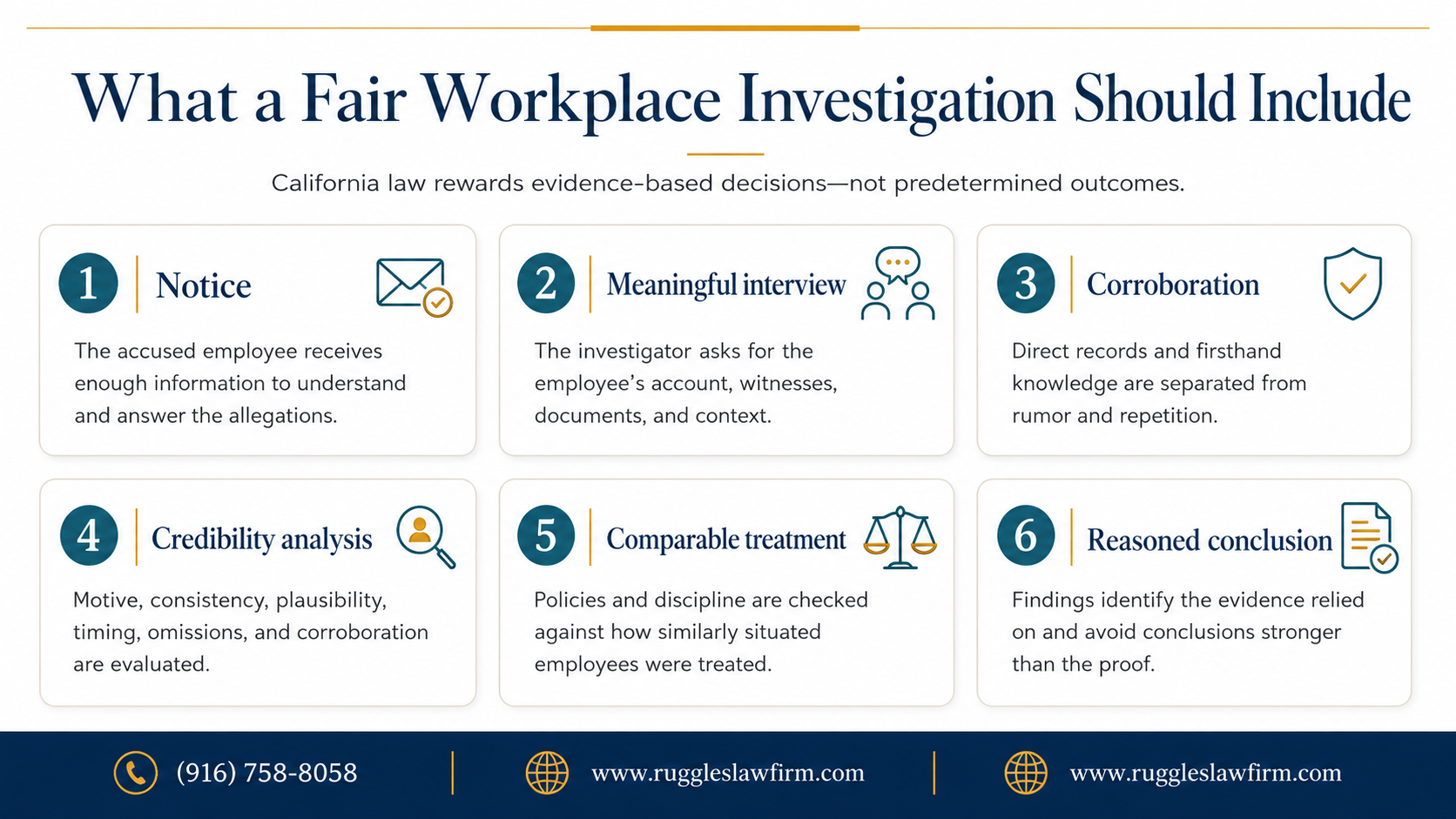
1. The accused employee is interviewed
Failing to interview the respondent is a glaring problem when the employer intends to make findings about that person. In King v. U.S. Bank National Assn. (2020) 53 Cal.App.5th 675, the Court of Appeal described evidence supporting a finding that the employer deliberately failed to investigate. The investigator did not interview King, did not determine whether he had documents or witnesses that refuted the allegations, and ignored reasons to question the accusers’ credibility. The case also involved a defamation verdict and substantial damages.
Investigator-focused commentary from Van Dermyden Makus likewise identifies three central failures in King: not interviewing the respondent, not assessing credibility objectively, and not gathering critical evidence. Reframed for employees, the lesson is straightforward: identify the witnesses, documents, normal practices, and business reasons the investigator will miss unless you state them clearly.
2. The accusation is specific enough to answer
An accused employee does not necessarily receive every witness statement or the investigator’s entire file. But “people have concerns about your leadership” is not a usable charge. Ask for the specific conduct, approximate time period, policy involved, and examples. Cotran emphasizes notice and a meaningful opportunity to respond, particularly where contractual good-cause rights are at stake.
3. Exculpatory evidence is actually reviewed
An investigation is not neutral merely because HR opened a file. The investigator should consider documents and witnesses that cut both ways. In Nazir v. United Airlines, Inc. (2009) 178 Cal.App.4th 243, a deeply criticized investigation—one that failed to give the employee meaningful information, ignored his side, and showed other serious irregularities—helped support an inference of pretext.
4. Credibility is analyzed rather than announced
“We found her credible” is a conclusion, not an analysis. Credibility should be tested against firsthand knowledge, contemporaneous records, consistency, motive, timing, plausibility, omissions, and objective business practices. Van Dermyden Makus’s investigator guidance on “tough questions” emphasizes giving witnesses a fair chance to explain inconsistent statements and contradictory documents. That protects complainants and respondents alike.
5. Policy and comparator evidence are checked
If the alleged violation concerns timekeeping, data entry, customer contact, social media, expense reports, or supervision, the investigator should understand how the work is actually performed. In King, the evidence suggested the investigator misunderstood normal data-entry practices. In Wawrzenski v. United Airlines, Inc. (2024) 106 Cal.App.5th 1275, the published portion held that evidence of more favorable treatment of male employees with comparable social-media conduct could support discriminatory intent and pretext.
What an Employer Can and Cannot Require During the Investigation
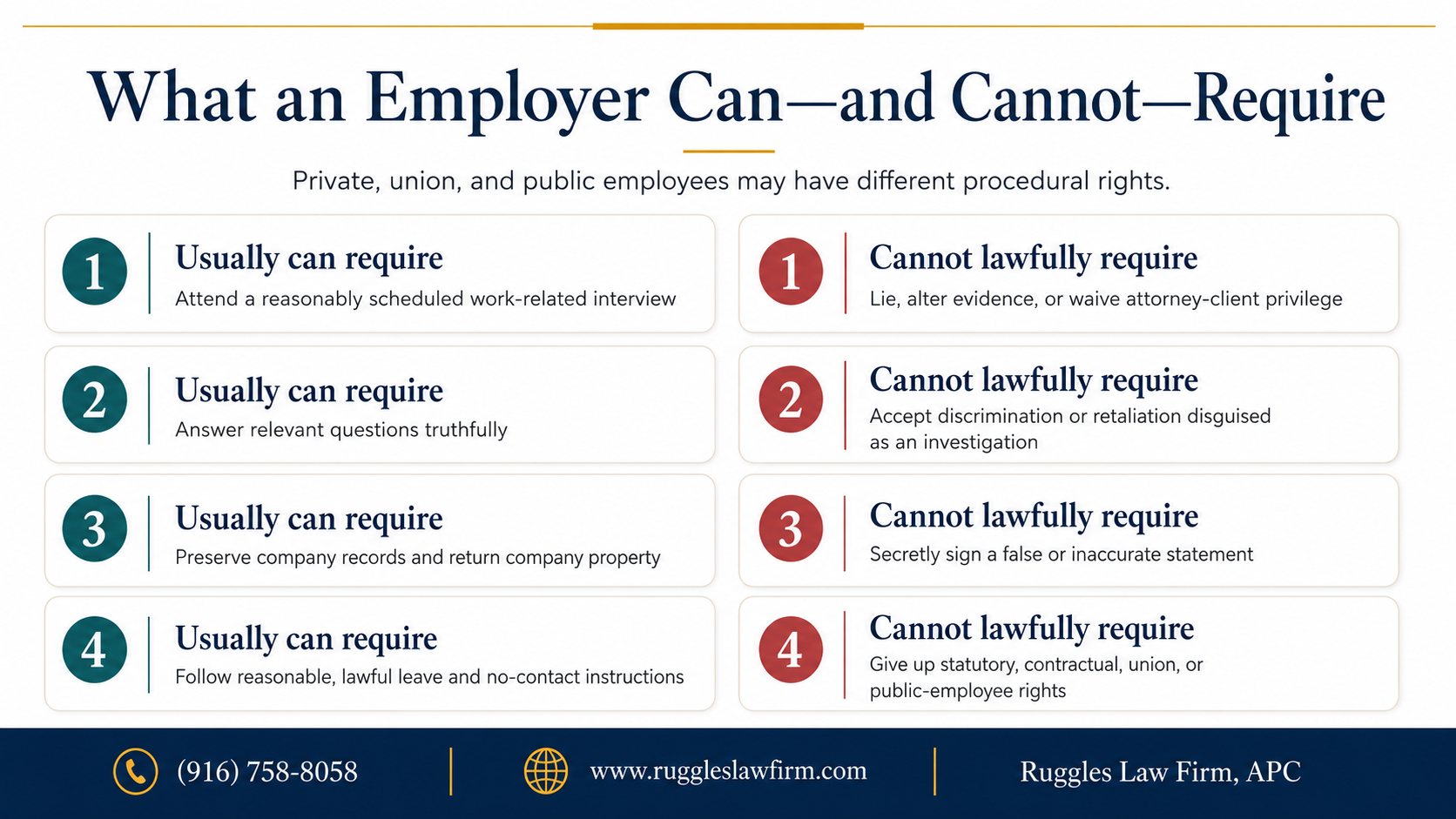
Private employers usually have broad authority to investigate work-related conduct. An employer can generally direct an employee to attend a reasonably scheduled interview, answer relevant questions truthfully, preserve company evidence, return company property, and follow lawful instructions designed to prevent retaliation or evidence tampering.
McGrory v. Applied Signal Technology, Inc. (2013) 212 Cal.App.4th 1510 is an important warning. The employer’s investigator did not substantiate the central discrimination claim, but found the manager had violated other policies and had been deceptive or uncooperative. The Court of Appeal held FEHA did not protect lying or withholding information during an internal investigation. In plain English: being falsely accused does not create a license to be evasive, misleading, or insubordinate.
An employer can generally require an employee to:
- Attend an interview during working time or while on paid leave.
- Answer reasonable questions about work-related events truthfully.
- Identify relevant witnesses and documents.
- Preserve and return employer-owned records and devices.
- Follow a reasonably tailored no-contact or anti-retaliation instruction.
- Remain available during paid investigative leave.
- Comply with ordinary policies concerning confidentiality, data security, and workplace conduct.
An employer generally cannot lawfully require an employee to:
- Make a knowingly false statement or adopt HR’s wording when it is inaccurate.
- Destroy, alter, backdate, or conceal evidence.
- Disclose privileged communications with the employee’s personal attorney.
- Waive statutory, contractual, union, or public-employee rights as the price of answering ordinary questions.
- Accept discriminatory or retaliatory treatment merely because it is labeled an “investigation.”
- Secretly record a confidential interview in violation of Penal Code section 632.
Representation rights vary. Nonunion private employees ordinarily do not have an automatic right to have personal counsel sit in an internal HR interview, although an employer may permit it. Union-represented employees may have representation rights under federal labor law and their collective bargaining agreement. Public employees—especially peace officers and firefighters—may have additional statutory and constitutional protections.
A practical answer when HR refuses counsel
Ask to reschedule briefly so you can obtain advice; request permission to bring a support person; ask whether the interview is disciplinary; take careful notes; and do not guess. A calm request preserves credibility even when the employer says no.
How Employers Usually Handle Involuntary Investigative Leave
Employers commonly place an accused employee on paid administrative or investigative leave while allegations are reviewed. Typical steps include disabling system access, collecting a badge or laptop, directing the employee not to contact specified coworkers, assigning one HR contact, continuing base pay and benefits, and requiring availability for interviews.
Employers often call paid leave “non-disciplinary” and “neutral.” The label is not conclusive. Leave may damage reputation, eliminate access to commissions or bonuses, isolate the employee, or become part of a retaliatory sequence. In Whitehall v. County of San Bernardino (2017) 17 Cal.App.5th 352, the placement of a public employee on administrative leave after protected conduct was part of a viable whistleblower case. Whether leave is materially adverse depends on context.
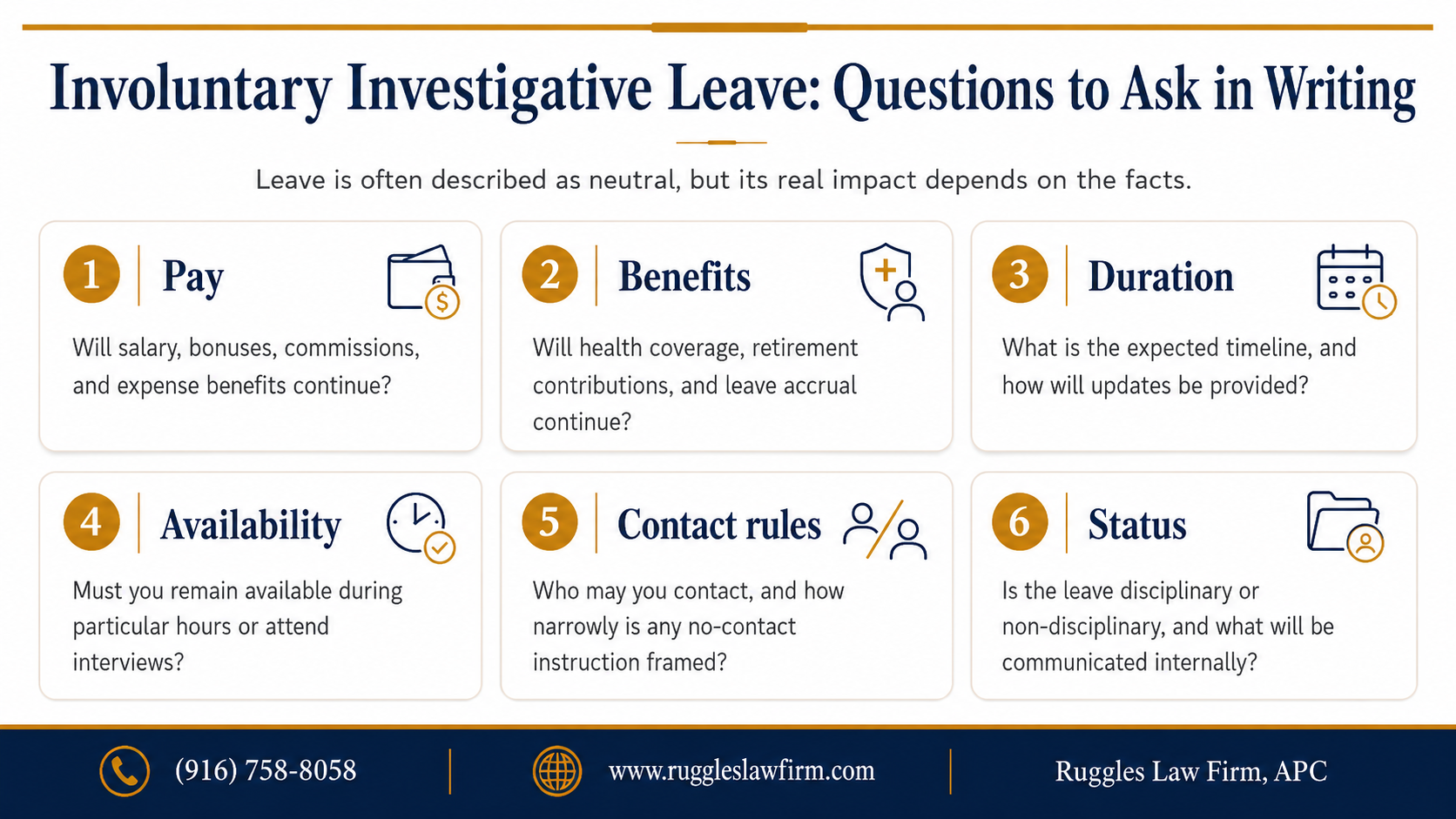
Ask these questions in writing
- Is the leave paid, and will salary continue on the normal schedule?
- Will commissions, bonuses, equity vesting, health insurance, retirement contributions, and leave accrual continue?
- Is the leave considered disciplinary or non-disciplinary?
- What is the expected duration, and when will updates be provided?
- Must the employee remain available during specific hours?
- What contact with coworkers, clients, or vendors is prohibited?
- What company property must be returned, and how may personal data be retrieved?
- What will the company tell coworkers and clients about the absence?
- Who is the employee’s point of contact for benefits, payroll, and investigation questions?
Investigator commentary concerning interim measures warns that leave and broad confidentiality commands should be tied to legitimate, specific interests rather than used reflexively. For the accused employee, the important task is to comply with lawful instructions while documenting whether the employer applies them consistently and whether the leave expands beyond what the investigation actually requires.
How a Competent Investigator Should Evaluate Credibility
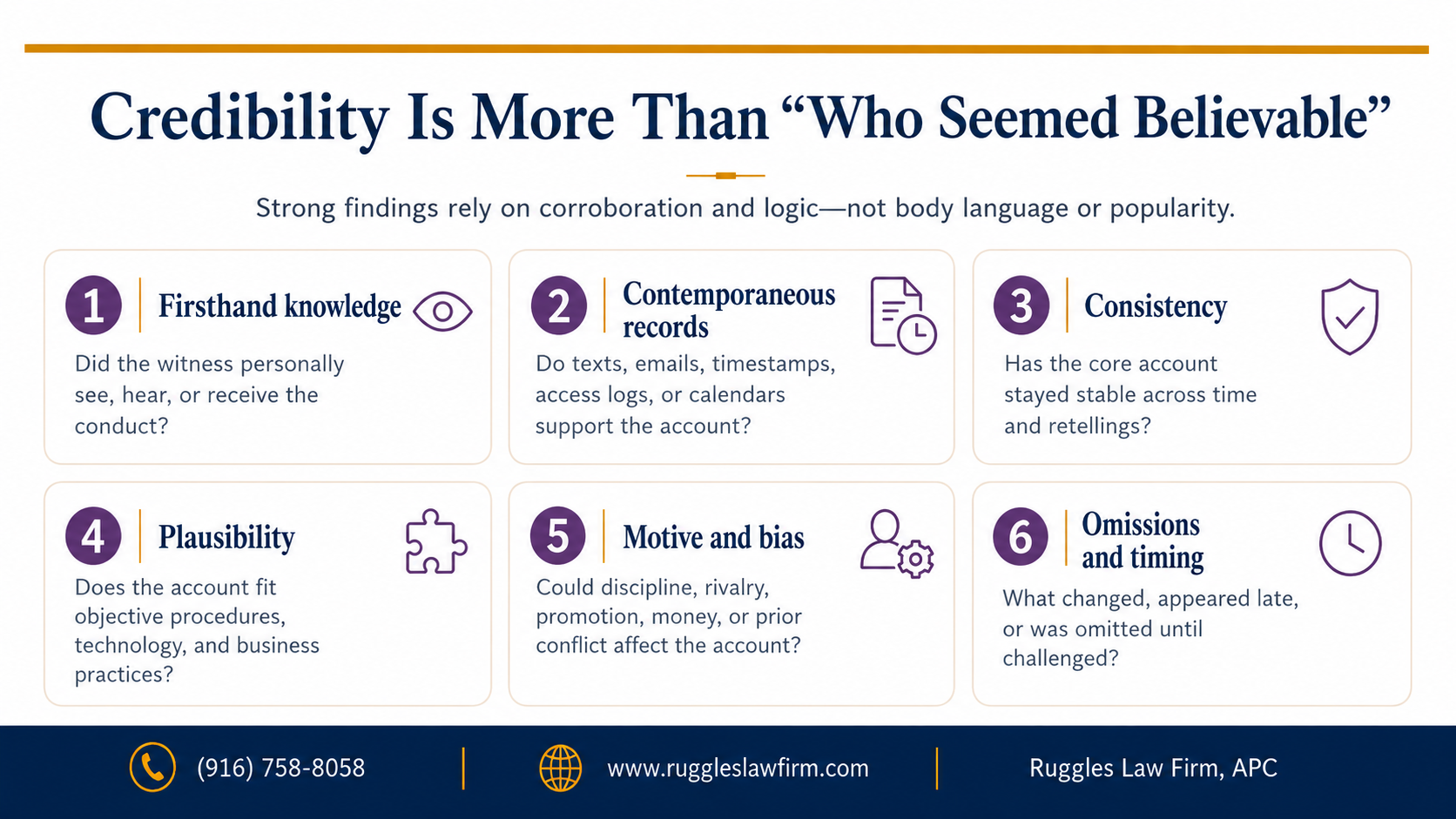
Workplace investigations often use a “preponderance of the evidence” or “more likely than not” standard, but policies vary. Whatever the standard, the investigator should not decide credibility based on who is more emotional, confident, senior, popular, or polished. Demeanor is culturally variable and can be distorted by stress, disability, neurodivergence, trauma, or the unnatural setting of an HR interview.
A disciplined credibility analysis asks:
- Firsthand knowledge: Did the witness personally observe the event, or repeat what someone else said?
- Contemporaneous corroboration: Are there messages, calendars, logs, screenshots, access records, or earlier reports?
- Consistency: Has the core story remained stable? Minor differences may reflect memory; material changes require explanation.
- Plausibility: Does the account fit actual technology, staffing, policy, geography, and business practice?
- Motive or bias: Did the accuser face discipline, lose a promotion, compete for money, or have a personal conflict?
- Omissions: Was important context left out until a document surfaced?
- Timing: Did the accusation arise immediately after protected activity, a denied request, or the employee’s own complaint?
- Comparators: How did the employer investigate and discipline other employees accused of similar conduct?
A common investigative failure is “corroboration by repetition”: three witnesses say the same thing because all three heard it from one source. That is not the same as three independent firsthand accounts. Ask the investigator to distinguish direct knowledge from office echo.
Common Types of False Workplace Accusations
False harassment or discrimination allegations
These accusations are uniquely sensitive. Employers must investigate without retaliating against a good-faith complainant, but they must also give the accused employee a meaningful chance to respond. The employee should avoid attacking the complainant’s character and instead identify precise factual errors, missing context, contemporaneous messages, normal supervisory decisions, and witnesses.
A complaint may be legally protected even if it is ultimately unsubstantiated, so long as it was made in good faith. Conversely, a knowingly fabricated accusation is different. The employee should allow evidence—not insults—to establish that difference. For a fuller explanation of what conduct becomes unlawful harassment, see When Does Workplace Harassment Become Illegal in California?
False theft, fraud, expense, or timekeeping allegations
These cases often turn on systems. Preserve receipts, approvals, calendar entries, time records, audit trails, expense rules, delegation practices, and evidence showing how others handled the same process. Ask the investigator to understand the actual workflow before treating an unusual timestamp or batch entry as proof of fraud.
False workplace violence or threat allegations
Take these accusations seriously even when absurd. Do not contact the accuser directly. Identify the exact words attributed to you, location, witnesses, security footage, access logs, prior messages, and whether the employer is using a workplace-violence policy with defined standards. If law enforcement becomes involved, obtain criminal counsel promptly; an internal employment interview and a criminal investigation have different risks.
False bullying, insubordination, or “hostile leadership” allegations
California does not make all bullying illegal. A manager can be blunt, demanding, or unpopular without violating FEHA. But “bullying” may be used as shorthand for specific policy violations—or as a weapon against a manager who enforced standards. Separate subjective labels from concrete events: What was said? To whom? When? What instruction or performance issue preceded it?
False confidentiality or data-misuse allegations
Identify what information was accessed, why access was authorized, how the system was normally used, whether the employee received training, and whether similarly situated employees were disciplined. Do not copy sensitive data in an effort to defend yourself. Preserve metadata, access history, policy language, and authorization records through lawful channels.
Anonymous complaints
An anonymous complaint may be legitimate, but anonymity makes credibility testing harder. The employer should seek corroboration rather than treat anonymity as proof. The accused employee can ask for the substance, dates, locations, policy, and evidence without insisting on the complainant’s identity. A fair response is possible only if the allegation is specific enough to test.
How to Prepare for the Investigative Interview
The investigative interview is not a deposition, but it can determine whether you keep your job. Prepare with the same respect you would give an important sworn statement.
- Identify the allegation precisely. Reduce each charge to a testable sentence.
- Create a dated timeline. Include the accusation, relevant prior events, complaints, discipline, promotions, bonuses, and witness interactions.
- Match evidence to each allegation. Avoid a document dump. Explain what each item proves.
- Separate facts from inferences. “She was angry after the review” is an observation; “she invented everything to steal my job” is a conclusion.
- Prepare concise answers. Start with the direct answer, then context. Long speeches create opportunities for confusion.
- Admit what is true. If you sent the message but deny the alleged meaning, say so. Credibility improves when you do not deny the undeniable.
- Do not guess. “I do not remember, but I can check my calendar” is better than a confident answer later disproved.
- Ask to correct the record. If HR prepares notes or a statement, read it carefully and submit written corrections promptly.
- End with witnesses and documents. Name the evidence the investigator should obtain, and explain why it matters.
For practical preparation strategies, see Ruggles Law Firm’s guides on preparing to meet with Human Resources, meeting with HR, and what to do after a difficult HR meeting.
The answer that causes the most damage
“Everyone knows she lies” is rarely useful. Name the specific prior inconsistent statement, document, motive, or firsthand witness. Precision beats popularity contests.
Documents and Evidence to Preserve
Preserve evidence before access disappears, but do it lawfully. The best file is organized by allegation and date—not a random download of the company server.
| Category | Examples | Caution |
|---|---|---|
| Communications | Emails, texts, chats, calendar invitations, voice messages, meeting follow-ups. | Keep complete threads; cropped screenshots can look misleading. |
| Policies and training | Handbook provisions, investigation policy, code of conduct, training acknowledgments. | Use the version in effect at the time. |
| Performance history | Reviews, praise, awards, goals, PIPs, warnings, promotion records. | Good reviews do not disprove misconduct, but abrupt changes may show pretext. |
| Business records | Approvals, audit logs, access records, receipts, schedules, CRM entries. | Do not take confidential records you lack authority to possess. |
| Comparator evidence | How others were investigated or disciplined for similar conduct. | Names and details may require discovery; preserve what you lawfully know. |
| Protected activity | Complaints about harassment, wages, safety, fraud, leave, discrimination, or legal compliance. | Document who knew, when, and what happened next. |
| Damages | Pay, bonus, commissions, benefits, equity, job-search records, medical care. | Needed if discipline or termination causes loss. |
California Labor Code section 1198.5, as amended effective January 1, 2026, gives current and former employees rights to inspect and receive copies of personnel records relating to performance—including education or training records—or grievances, generally within 30 calendar days of a written request. The statute contains exceptions, including records relating to investigation of a possible criminal offense, reference letters, certain examination materials, and several categories of public employees. It also allows redaction of nonsupervisory employee names.
A personnel-file request does not necessarily produce the entire investigation report. Ask specifically for termination notices, disciplinary memoranda, performance records, policies you signed, training records, and any statement attributed to you. Litigation can suspend the statutory inspection right while the lawsuit is pending, so timing matters.
Can You Sue a Coworker or Employer for Defamation?
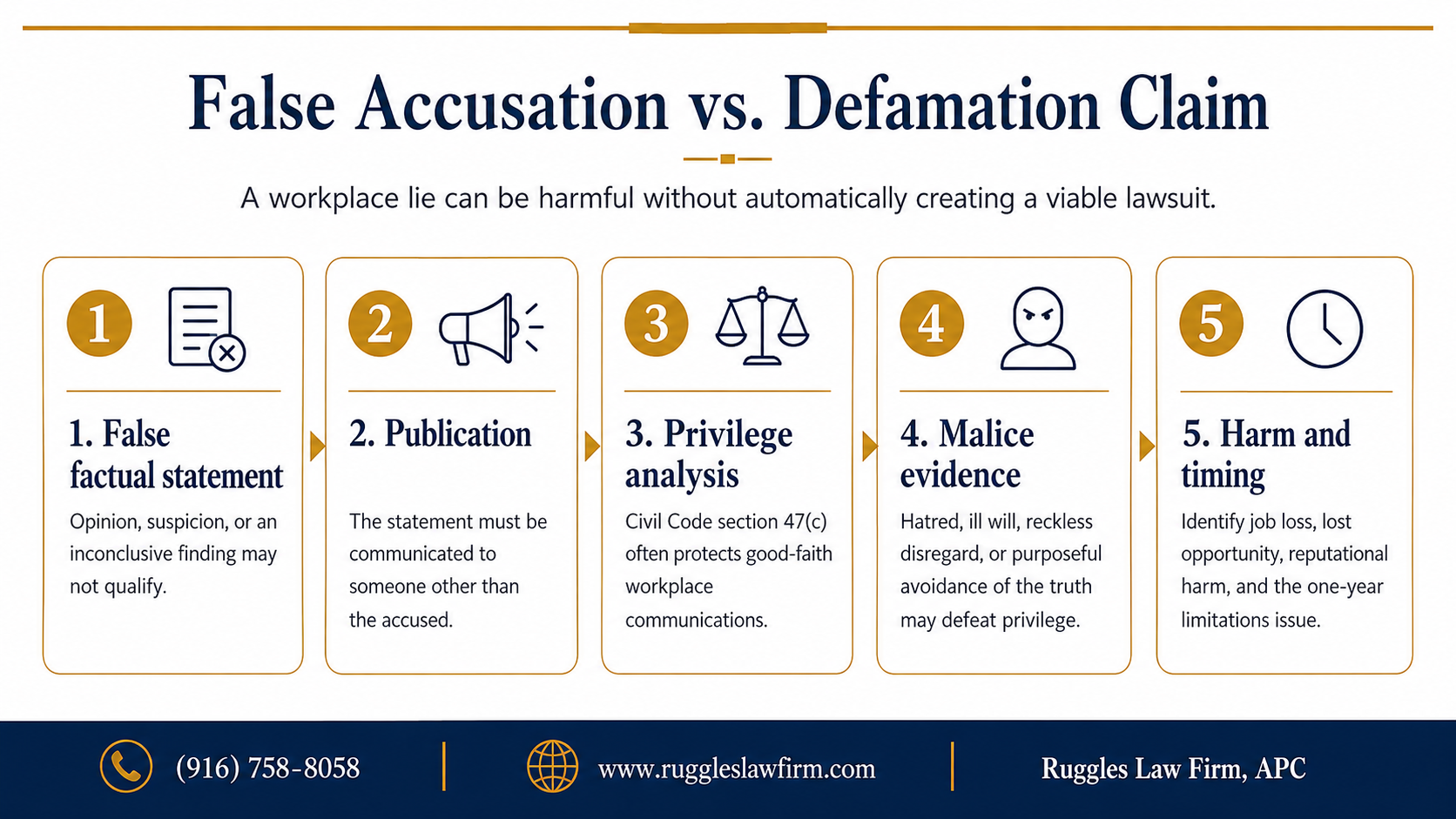
Sometimes—but workplace defamation claims are more difficult than most employees expect. California defamation law generally requires a false and unprivileged statement of fact communicated to someone other than the plaintiff, with the required fault and resulting harm. Internal workplace communications often receive a conditional “common interest” privilege under Civil Code section 47(c).
The common-interest privilege
Section 47(c) protects communications made without malice among people sharing a legitimate interest. It expressly covers certain employment references and good-faith sexual-harassment complaints and related communications. The privilege reflects a practical reality: employees and employers must be able to report and investigate misconduct without every unsubstantiated complaint producing automatic defamation liability.
Noel v. River Hills Wilsons, Inc. (2003) 113 Cal.App.4th 1363 explains that mere negligence, mistake, or careless blundering is not necessarily enough to prove the malice required to defeat the conditional privilege. The employee generally needs evidence of hatred or ill will, reckless disregard, lack of reasonable grounds, or a willful avoidance of accuracy.
Purposeful avoidance of the truth
King presents unusually strong facts. The evidence supported findings that the employer deliberately failed to investigate, ignored reasons to doubt the accusers, failed to interview the accused employee, and made damaging statements. The case shows that “we were investigating” is not a magic phrase when the process was designed to avoid the truth.
The Hearn issue is currently unsettled
Hearn v. Pacific Gas & Electric Co. (2025) 108 Cal.App.5th 301 addressed whether an employee could pursue defamation based on allegedly false statements that contributed to termination. The California Supreme Court granted review in 2025. As of this article’s publication, review remains pending. The scope of a separate defamation claim when the same publication caused termination is therefore an evolving issue, and employees should not rely on a simplified internet summary.
The limitations period is short
Code of Civil Procedure section 340(c) generally provides a one-year limitations period for libel and slander. Accrual and republication issues can be complicated. An employee who believes false statements were communicated outside a legitimate need-to-know group, to prospective employers, clients, licensing bodies, or law enforcement should obtain prompt advice.
A statement can be false and deeply unfair yet still be privileged. The strongest cases usually involve evidence of deliberate falsity, reckless disregard, purposeful avoidance of contradictory evidence, excessive publication, or statements to people who had no legitimate need to know.
When the Investigation Becomes Evidence of Retaliation or Discrimination
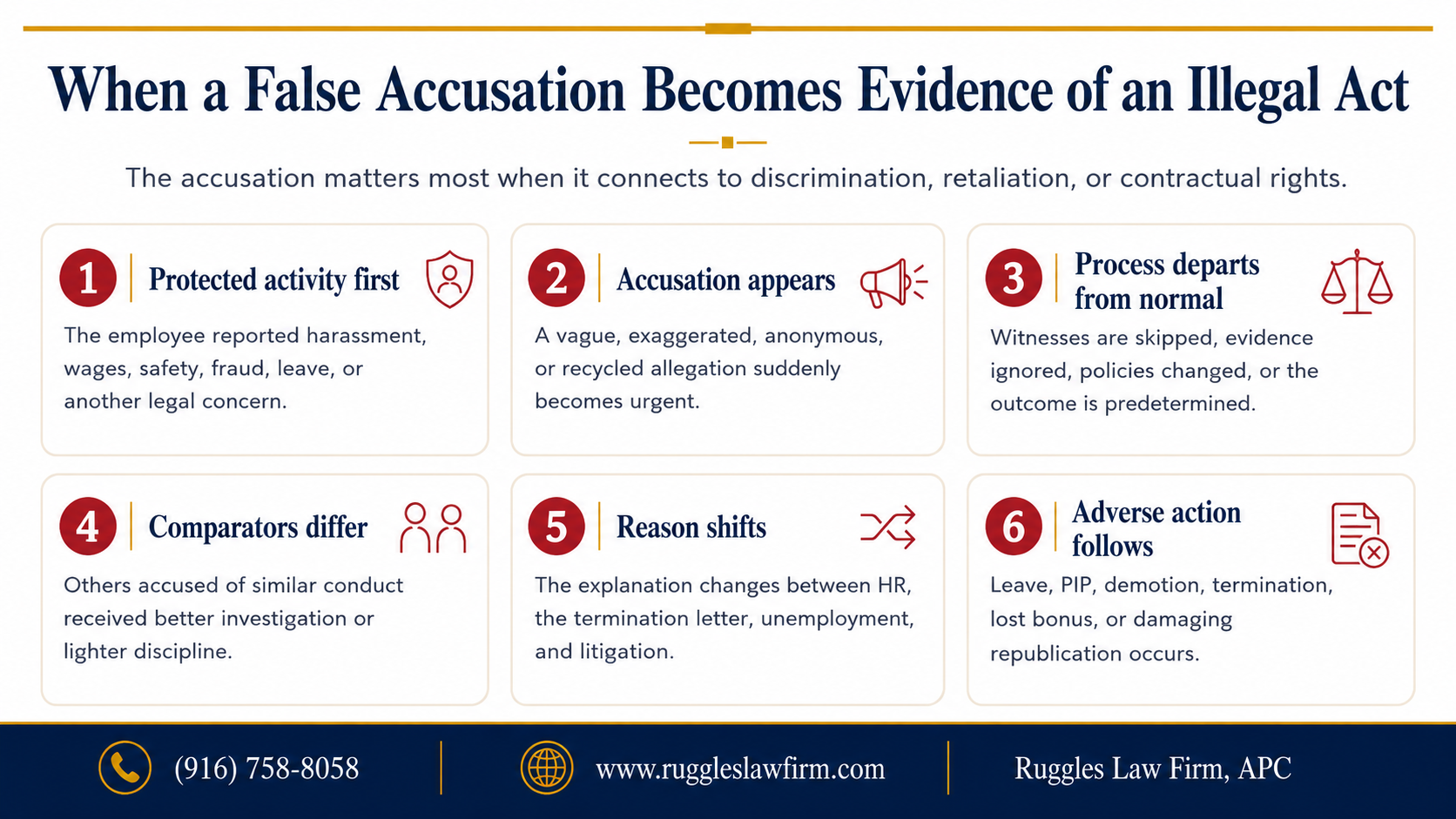
An unfair investigation can matter even when the employee cannot sue simply because the accusation was false. Courts may treat investigation irregularities as circumstantial evidence that the employer’s stated reason was a pretext for discrimination or retaliation.
In Nazir, the Court of Appeal catalogued serious investigative defects and held the evidence could support pretext. In Mendoza v. Western Medical Center Santa Ana (2014) 222 Cal.App.4th 1334, evidence concerning the employer’s investigation and termination after a harassment report supported retrial of a retaliation claim. In Wawrzenski, comparator evidence and termination shortly after complaints supported triable FEHA issues.
Red flags that the accusation is a pretext
- The allegation suddenly appears after the employee reports harassment, wages, safety, fraud, leave violations, or discrimination.
- The investigator receives a conclusion (“terminate”) before interviewing witnesses.
- The employer refuses to identify conduct, dates, or the policy allegedly violated.
- Exculpatory documents or named witnesses are ignored without explanation.
- The accusation changes when the original theory fails.
- The employer disciplines the accused more harshly than employees outside a protected class or employees who did not complain.
- Longstanding positive reviews abruptly become “performance concerns” after protected activity.
- HR’s reason differs from the termination letter, unemployment submission, internal announcement, or litigation position.
- The employer uses investigative leave to remove the employee from bonus-producing work or allow equity to expire.
- Decision-makers repeat inflammatory allegations more broadly than necessary.
Government Code section 12940(h) prohibits retaliation for opposing FEHA violations or participating in FEHA-related proceedings. Labor Code section 1102.5 protects many disclosures of suspected legal violations, and Labor Code section 1102.6 establishes a favorable burden framework once protected activity is shown to be a contributing factor in the adverse action.
Employees who reported legal concerns before the accusation should preserve proof of what they reported, to whom, when, and who knew. Ruggles Law Firm’s guide to protected activity, workplace complaint guide, and article on being fired after a complaint explain those connections in greater detail.
What to Do When the Investigation Ends
If the allegation is unsubstantiated
Ask for written confirmation that the investigation has concluded and whether the allegation was unsubstantiated, inconclusive, or sustained in part. Employers often decline to share detailed findings. Still, request correction of inaccurate personnel records, restoration of duties and access, clarification of communications made to coworkers or clients, and protection against retaliation.
If you receive a warning or PIP
Respond in writing without turning the rebuttal into a manifesto. Identify specific inaccuracies, attach key evidence, reserve rights, and state the performance steps you will follow. A PIP after an accusation may be legitimate, or it may be a bridge to termination. See The California Employee Guide to Performance Improvement Plans.
If you are terminated
Request the termination reason in writing, obtain the personnel file, preserve the investigation communications, apply for unemployment, protect health coverage, review equity and commission deadlines, and avoid signing a severance agreement under pressure. Compare the stated reason with earlier explanations. Ruggles Law Firm’s guides on false reasons for termination, wrongful termination, and California severance agreements provide next steps.
If the employer offers severance
A release may waive discrimination, retaliation, defamation, wage, contract, and other claims. The value of the release depends on the legal and factual leverage—not on whether the employer calls the package “standard.” Evidence of a biased investigation, inconsistent reasons, bonus avoidance, reputational harm, or protected activity may affect negotiations. See Legal Leverage to Negotiate a Bigger Severance in California.
Special Rules for Union and Public Employees
Union and public employees may have rights that do not apply to ordinary at-will private employees. A collective bargaining agreement may require just cause, progressive discipline, notice of charges, representation, grievance procedures, or arbitration. Union-represented employees should request representation before an interview reasonably believed to lead to discipline.
Public employees with a protected property interest in employment may have due-process rights before serious discipline. Skelly v. State Personnel Board (1975) 15 Cal.3d 194 requires notice of proposed discipline, the reasons, the materials supporting it, and an opportunity to respond. In Spielbauer v. County of Santa Clara (2009) 45 Cal.4th 704, the California Supreme Court held a public employer could compel job-related answers under threat of discipline if the employee was not required to waive constitutional protection against criminal use of those compelled statements. Peace officers and firefighters have additional statutory protections.
When allegations may also be criminal—such as theft, assault, patient abuse, bribery, or falsification—do not assume the workplace interview is harmless. Employment counsel and criminal counsel may need to coordinate before the employee answers questions.
Published California Cases Employees Should Know
| Authority | Rule or lesson for accused employees |
|---|---|
| Cotran v. Rollins Hudig Hall International, Inc. (1998) 17 Cal.4th 93 | In an implied-contract good-cause case, the focus is whether the employer acted fairly, honestly, in good faith, and on reasonable grounds after an appropriate investigation—not whether a later jury decides the misconduct actually occurred. |
| McGrory v. Applied Signal Technology, Inc. (2013) 212 Cal.App.4th 1510 | FEHA does not immunize deception or refusal to cooperate in an internal investigation; internal communications may receive conditional privilege. |
| Nazir v. United Airlines, Inc. (2009) 178 Cal.App.4th 243 | A deeply flawed or biased investigation can support an inference that the employer’s reason was pretextual. |
| Mendoza v. Western Medical Center Santa Ana (2014) 222 Cal.App.4th 1334 | Investigation defects and the sequence after a harassment report can support retaliation evidence. |
| King v. U.S. Bank National Assn. (2020) 53 Cal.App.5th 675 | Purposeful failure to interview the accused, evaluate credibility, and gather contradictory evidence supported defamation and wrongful-termination liability on unusually strong facts. |
| Noel v. River Hills Wilsons, Inc. (2003) 113 Cal.App.4th 1363 | The common-interest privilege usually requires more than negligence or mistake to establish malice. |
| Whitehall v. County of San Bernardino (2017) 17 Cal.App.5th 352 | Administrative leave can be part of an actionable retaliatory sequence depending on context. |
| Wawrzenski v. United Airlines, Inc. (2024) 106 Cal.App.5th 1275 | Comparator evidence and inconsistent policy enforcement can support discrimination and pretext. |
| Hearn v. Pacific Gas & Electric Co. (2025) 108 Cal.App.5th 301, review granted | The California Supreme Court is reviewing the relationship between termination-causing statements and separate defamation claims; the issue remains unsettled. |
Frequently Asked Questions About False Workplace Accusations in California
These answers provide general information, not legal advice. The correct result depends on the employee’s status, policies, contract, union rights, public-employment rules, and the specific accusation.
Can my employer fire me based on a false accusation?
Often, yes, if you are an at-will private employee and the employer honestly acts for a lawful reason. A mistaken decision is not automatically wrongful termination. The analysis changes when the accusation is a pretext for discrimination or retaliation, violates a contract or collective bargaining agreement, or is accompanied by actionable defamation.
Does my employer have to prove the accusation beyond a reasonable doubt?
No. Workplace investigations are not criminal trials. Employers commonly use a “more likely than not” standard or another policy standard. The important questions are whether the process was fair under the circumstances, whether the conclusion had reasonable evidentiary support, and whether the employer applied its rules lawfully and consistently.
Does every California employer have a legal duty to investigate every complaint?
Not in exactly the same way. FEHA regulations expressly require covered employers’ policies to provide fair, timely, thorough investigations of harassment, discrimination, and retaliation allegations. Other complaints may trigger duties under safety, whistleblower, contract, union, public-employment, licensing, or industry rules.
Do I have a right to see the written complaint?
A private employee usually has no universal right to receive the complainant’s entire statement. But a meaningful opportunity to respond generally requires enough information about the conduct, dates, and policy at issue. Contract, union, public-employee, and personnel-record rights may provide more.
Do I have a right to know who accused me?
Not always. An employer may protect a complainant’s identity when possible, especially where safety or retaliation concerns exist. But anonymity cannot substitute for evidence, and the allegations must usually be described with enough specificity for a fair response.
Can HR investigate an anonymous complaint?
Yes. HR should determine what can be corroborated independently and should not treat anonymity as proof. The employee should ask for the substance, time frame, locations, policy, and objective evidence rather than focusing only on the identity.
Does HR have to interview me before deciding?
There is no single rule governing every private at-will workplace. However, interviewing the accused is a core feature of a reliable investigation. Cotran emphasizes notice and a chance to respond in the good-cause context, and King sharply criticized an investigator’s deliberate failure to interview the respondent.
Can I refuse to participate in the investigation?
You can refuse, but a private employer may often treat refusal as insubordination or make a decision without your evidence. McGrory shows the risks of deception or noncooperation. Obtain advice before refusing, especially if criminal exposure, privilege, disability, or public-employee rights are involved.
Can I bring a lawyer to the HR interview?
A nonunion private employee ordinarily has no automatic California right to have personal counsel present, though the employer may allow it. Ask. Even if counsel cannot attend, the employee can obtain advice before and after the interview.
Can I bring a coworker or union representative?
A union-represented employee may have representation rights in an investigatory interview reasonably expected to result in discipline, and a collective bargaining agreement may provide more. Nonunion employees generally depend on employer policy and permission.
Can I secretly record the interview?
Usually not safely. California Penal Code section 632 generally prohibits intentionally recording a confidential communication without all parties’ consent. Ask openly for permission or take detailed notes. Narrow statutory exceptions exist, but employees should not assume one applies.
Should I give HR a written statement?
A focused written statement can be helpful when the allegations are complex or documents matter. It can also lock in avoidable mistakes. Draft carefully, separate fact from inference, identify supporting evidence, and consider legal review before submitting it.
Should I sign HR’s interview notes or statement?
Only if accurate. Read every sentence. Correct omissions, loaded wording, and conclusions you did not make. If HR will not revise it, write that you acknowledge receipt but do not agree, and submit a dated correction.
Can I correct something I said in the interview?
Yes. Correct it promptly and transparently: explain what was inaccurate, provide the correct information, and identify the source used to verify it. A prompt correction is usually better than allowing a known error to remain.
Should I turn over texts that help me?
Relevant texts can be powerful, but preserve full threads and context. Do not alter metadata or crop selectively. Consider privacy, trade-secret, patient, customer, and device-ownership issues before copying or producing records.
Can the employer search my personal phone?
The answer depends on consent, policy, ownership, privacy expectations, and the investigation. Do not simply hand over an unlocked personal device without understanding the scope. Offer targeted records or seek advice about a reasonable protocol.
Can HR demand access to my personal email?
An employer may request relevant information, but that does not automatically entitle it to unrestricted access to an entire personal account. A targeted production, search protocol, or screenshots with context may address the legitimate need while protecting unrelated private material.
Can the employer review my company computer and email?
Usually. Employees commonly have limited privacy expectations in employer-owned systems, particularly under written monitoring policies. Assume company email, chat, devices, and access logs may be reviewed.
What evidence should I preserve first?
Preserve the accusation notice, relevant messages, calendars, policies, performance history, prior complaints, approvals, audit records, witness names, and proof of damages. Create a dated chronology and keep original files intact.
Should I contact witnesses?
Usually not to coordinate stories. It may be appropriate to identify witnesses or ask someone to preserve a record, but a no-contact instruction, retaliation concerns, or the risk of appearing to influence testimony may make direct outreach unwise.
Should I confront the accuser?
No. Direct confrontation can create a new retaliation, intimidation, or safety allegation. Communicate through HR, the investigator, your representative, or counsel.
Can I discuss the investigation with coworkers?
It depends on policy, role, union rights, and the scope of any confidentiality instruction. Broad restrictions can raise labor-law issues, but ignoring an instruction can create risk. Ask HR to define the subject matter, duration, and permitted discussions with counsel or a representative.
Can HR promise complete confidentiality?
Usually no. A fair investigation may require disclosing allegations or witness information, and safety or legal duties may require sharing information. Employers should generally promise limited need-to-know treatment, not absolute secrecy.
Will investigative leave usually be paid?
Many employers use paid leave, particularly for serious allegations, but California does not impose one universal rule for all private employees. Check policy, contract, exempt-status issues, and whether benefits, commissions, or bonuses continue.
Can an employer place me on unpaid investigative leave?
Possibly, depending on status, policy, contract, wage law, and the reason. Unpaid leave may raise wage, contract, discrimination, or retaliation issues. Get written clarification immediately.
Do my benefits continue while I am on leave?
Often on paid leave, but never assume. Ask in writing about health insurance, retirement contributions, equity vesting, commissions, bonus eligibility, paid leave accrual, and expense benefits.
How long can investigative leave last?
There is no single private-sector maximum. An unexplained or strategically prolonged leave may support arguments about unfairness, retaliation, disability accommodation, or constructive discharge. Ask for regular status updates.
Can paid leave still be an adverse employment action?
Yes, depending on context. Whitehall illustrates that administrative leave can be part of a retaliatory sequence. Lost opportunities, stigma, bonus effects, duties, and the overall pattern matter.
Can the company disable my access and take my laptop?
Usually. Employers commonly secure systems and property during investigations. Before surrendering a device, ask for a reasonable way to retrieve purely personal information and document what was returned.
Can HR search my locker, desk, or office?
Employer property and written policies often reduce privacy expectations, but the answer depends on the setting and whether the space is personal, locked, or jointly used. Do not obstruct a lawful search; document concerns and obtain advice.
What should I do if I am falsely accused of sexual harassment?
Avoid contacting the complainant. Ask for specific conduct, dates, and policy provisions. Preserve complete communications, identify witnesses and context, disclose any relationship truthfully, and obtain advice before submitting a broad written statement.
What should I do if I am falsely accused of theft or fraud?
Preserve approvals, receipts, audit trails, access logs, standard practices, delegation records, and evidence of who benefited. Because criminal exposure is possible, coordinate employment and criminal advice before answering detailed questions.
What should I do if I am falsely accused of workplace violence?
Treat the situation as urgent. Do not approach the accuser. Preserve exact language, witnesses, video, access data, and prior messages. Follow safety instructions and obtain counsel if police, restraining orders, or licensing consequences are possible.
What if the accusation is “time theft”?
Compare time records with schedules, workload, remote-work practices, manager approvals, system logins, meal periods, and how others recorded time. Wage records can be technical, and employers sometimes confuse poor procedures with intentional dishonesty.
What if the accusation is really about performance?
Ask for measurable examples, prior coaching, expectations, and comparator treatment. An accusation framed as “dishonesty” or “poor leadership” may be ordinary performance management—or a pretext following protected activity.
Can a discrimination complaint against me be false but still protected?
Yes. A good-faith complaint may be protected even if the employer does not substantiate it. Knowingly fabricated allegations are different, but the accused employee should focus on evidence rather than retaliatory attacks on the complainant.
What if someone accuses me after I complained about them?
Document both timelines. The later accusation may be legitimate, retaliatory, or mixed. Ask the employer to use a neutral investigator and to evaluate both matters separately and consistently.
Can I sue the coworker who lied?
Possibly, but workplace defamation claims face privileges, proof of malice, damages issues, anti-SLAPP risks, and a one-year limitations period. Many cases are stronger against the employer for unlawful termination or retaliation than against the individual accuser.
What are the basic elements of defamation?
Generally, a false and unprivileged statement of fact must be published to another person with the required fault and cause actionable harm. Opinion, truth, privilege, consent, and damages can defeat or limit the claim.
What is the common-interest privilege?
Civil Code section 47(c) conditionally protects good-faith communications among people with a shared legitimate interest, including many internal workplace complaints and investigations. Malice can defeat the privilege.
What does “malice” mean in a workplace defamation case?
It can mean hatred or ill will, or lack of reasonable grounds coupled with reckless disregard for the employee’s rights. Mere mistake or sloppy investigation is often not enough. Purposeful avoidance of the truth can be stronger evidence.
Can HR be liable for repeating the accusation?
Sometimes, but internal republication to decision-makers is often conditionally privileged. Liability is more plausible when HR acts with malice, knowingly changes the accusation, deliberately avoids contradictory evidence, or publishes it beyond legitimate need-to-know recipients.
Do I have a right to the final investigation report?
Private employees generally do not have a universal right to the complete report. Contract, union, public-record, public-employee, discovery, or personnel-record rules may provide access to portions or related documents.
Does the employer have to tell me whether the accusation was sustained?
Not always. Employers often provide a general outcome rather than details about another employee’s discipline. Ask for your status, any findings against you, policy expectations, restoration of duties, and correction of inaccurate records.
Can I inspect my personnel file?
Labor Code section 1198.5 generally allows current and former employees to inspect and receive copies of performance and grievance records, subject to timing rules and exceptions. It does not guarantee the entire investigation file.
Can I place a rebuttal in my personnel file?
Many employers will accept a written rebuttal even when not legally required. Keep it concise, factual, and tied to documents. Request written confirmation that it will be maintained with the challenged record.
How do I request my personnel records?
Submit a dated written request under Labor Code section 1198.5 for records relating to performance, training, education, grievances, discipline, and termination. Identify yourself and ask how reproduction costs will be handled.
What should I do with an inaccurate disciplinary memo?
Acknowledge receipt without agreeing, if permitted; identify precise inaccuracies; attach key evidence; request correction; and preserve a copy. Do not refuse to receive the document merely because you dispute it.
What if HR puts me on a PIP after clearing me?
The PIP may address separate concerns or may continue the same retaliatory plan. Compare it with prior reviews, objective goals, comparator treatment, and the investigation outcome. Respond promptly and document compliance.
Should I negotiate severance after a false accusation?
Often worth evaluating. A negotiated exit may protect compensation, benefits, references, non-disparagement, and the wording of internal records. The decision depends on claim strength, career goals, and the employer’s leverage.
Will a false accusation affect unemployment benefits?
The employer may contest benefits by alleging misconduct, but the unemployment agency makes its own determination. Preserve the termination notice and investigation record and respond accurately to agency questions.
Can the employer tell future employers I was fired for misconduct?
Employers often limit references, but California law conditionally privileges certain good-faith employment communications. A negotiated reference clause can reduce uncertainty. Deliberately false or malicious statements may create liability.
What if HR reports the accusation to police?
A knowingly false report to law enforcement can raise serious issues, and Civil Code section 47 contains limits concerning knowingly false criminal reports. If police contact you, obtain criminal counsel before providing a statement.
What if the workplace investigation overlaps with a criminal case?
Do not treat the HR interview as consequence-free. Statements can create employment, licensing, and criminal risks. Public employees may have special compelled-statement protections; private employees may face difficult choices requiring coordinated advice.
Do I have a Fifth Amendment right to refuse HR questions at a private company?
The Fifth Amendment generally restrains government action, not an ordinary private employer. A private employer may discipline refusal, subject to contract and statutory limits. Criminal exposure still warrants immediate legal advice.
What special rights do public employees have?
Public employees with a property interest may have Skelly due-process rights before serious discipline. Compelled answers may receive criminal-use protection under cases such as Spielbauer. Statutes, civil-service rules, and union agreements may add more.
What special rights do peace officers have?
The Public Safety Officers Procedural Bill of Rights imposes detailed requirements concerning interrogation, notice, representation, timing, and discipline. Officers should consult counsel or their association immediately.
What rights do union employees have?
Union employees may have representation rights, just-cause protections, access to grievance and arbitration procedures, and contractual investigation rules. Invoke those rights early and comply with deadlines.
Does at-will employment mean I have no rights?
No. At-will status does not authorize discrimination, retaliation, whistleblower violations, wage violations, protected-leave interference, defamation without privilege, or breach of an enforceable contract. It does make “the accusation was wrong” alone insufficient in many cases.
What if my offer letter or handbook promises a fair investigation?
The language may support a contract or promissory argument depending on disclaimers, wording, and reliance. Even if not contractual, deviations can be evidence of pretext or unfairness.
How can a false accusation relate to discrimination?
Evidence may show the employer believed accusations against one protected group more readily, ignored similar conduct by comparators, used stereotypes, or imposed harsher discipline. Wawrzenski illustrates the importance of comparator evidence.
How can a false accusation relate to retaliation?
An accusation appearing soon after protected complaints may be used to justify a predetermined adverse action. Timing alone is rarely conclusive, but timing plus procedural departures, shifting reasons, or biased witnesses can be powerful.
What protected activity should I document?
Reports of suspected harassment, discrimination, wage violations, safety problems, fraud, legal violations, leave interference, or other protected concerns. Record the date, content, recipients, and decision-makers who knew.
What does “pretext” mean?
Pretext means the employer’s stated reason is not the true reason—or is not the full reason. It may be shown through implausibility, inconsistency, unequal treatment, shifting explanations, timing, or a biased investigation.
Why are comparator employees important?
Comparators show how the employer treated others accused of similar conduct. Differences in supervisor, history, policy, or severity matter, but unusually favorable treatment of similarly situated employees can support discrimination or pretext.
Do good performance reviews prove the accusation is false?
Not necessarily. A high performer can commit misconduct. But a sudden shift from strong reviews to sweeping criticism immediately after protected activity can support pretext, particularly when objective performance remains strong.
How detailed should my timeline be?
Include dates, participants, exact words where remembered, documents, prior complaints, discipline, leave, access changes, investigation contacts, outcomes, and damages. Distinguish what you personally know from what someone told you.
When should I call an employment lawyer?
Promptly when the accusation threatens termination, licensing, criminal exposure, significant bonus or equity, public reputation, immigration status, or when it follows protected activity. Early advice often prevents avoidable interview and evidence mistakes.
What deadlines may apply?
Defamation generally has a one-year limitations period. FEHA, whistleblower, wage, contract, public-employee, union, and administrative deadlines differ. Some are very short. Do not wait for an internal appeal to end before checking deadlines.
Can I file a complaint with the California Civil Rights Department?
Potentially, if the accusation or resulting discipline involved protected-category discrimination, harassment, retaliation, or failure to prevent prohibited conduct. A false accusation by itself is not necessarily a FEHA violation.
Can I file with the Labor Commissioner?
Potentially for wage-related retaliation or Labor Code claims within the agency’s jurisdiction. Other whistleblower claims may proceed through court or different agencies. The correct forum depends on the statute.
What if I reported fraud or legal violations before the accusation?
Labor Code section 1102.5 may protect qualifying disclosures, and section 1102.6 provides a favorable burden framework when protected activity contributed to the adverse action. Preserve proof of the report and who knew about it.
What damages might be available?
Depending on the claim, damages can include lost pay and benefits, emotional distress, reputational harm, punitive damages, statutory penalties, and attorney’s fees. Contract and defamation remedies differ from FEHA and whistleblower remedies.
What is the best first step when I learn of the accusation?
Stop reacting and start preserving. Write a confidential chronology, save lawful evidence, review policies, ask for specifics, and obtain advice before making a broad statement.
What is the biggest mistake falsely accused employees make?
They let justified anger destroy credibility—by confronting the accuser, sending emotional messages, deleting records, exaggerating, coordinating stories, or refusing to answer. The best defense is precise, documented, truthful, and calm.
Related Ruggles Law Firm Resources
Fired for a False Reason in California?
Protected Activity in California Retaliation Cases
How to Make a Workplace Complaint in California
What to Do When HR Ignores Your Complaint
Preparing to Meet with Human Resources
Meeting with Human Resources: Tips for Employee Success
After a Difficult Meeting with HR
Performance Improvement Plans: An Employee Guide
Defamation and Wrongful Termination: Hearn v. PG&E
Wrongful Termination in California
California Severance Agreements
Legal Leverage to Negotiate a Bigger Severance
Reported a Safety Complaint at Work in California
Is Being Fired After Filing a Complaint Wrongful Termination?