
California Commission Clawbacks and Windfall Policies
Former Littler Mendelson equity partner with more than 30 years of employment law and litigation experience. Representing California employees in substantial compensation disputes.
Can your employer reduce a large commission under a clawback or windfall policy? A policy label alone does not authorize taking earned wages. The answer turns on the lawful earning conditions, the provision the employer invokes, and when it changed the calculation. Some advances can be recovered; a retroactive reduction of earned compensation presents a different issue.
If a major sale led to a reduced payout, a higher quota, or a lost accelerator, start with the documents that explain the change. A substantial claim can involve compensation never paid as well as money deducted later. This guide explains what I examine as a California commission clawback lawyer and how employees can prepare for review.
Start with your situation
Before contacting the firm, identify your employer, California work location, approximate shortfall, employer explanation, and any deadline. Include the amount, explanation, and deadline in the intake form's brief description field.
You can also call 916-758-8058 before signing a repayment agreement, revised plan, or severance release.
Explore the guide19 sections · 50 frequently asked questions
Can an employer claw back commissions in California
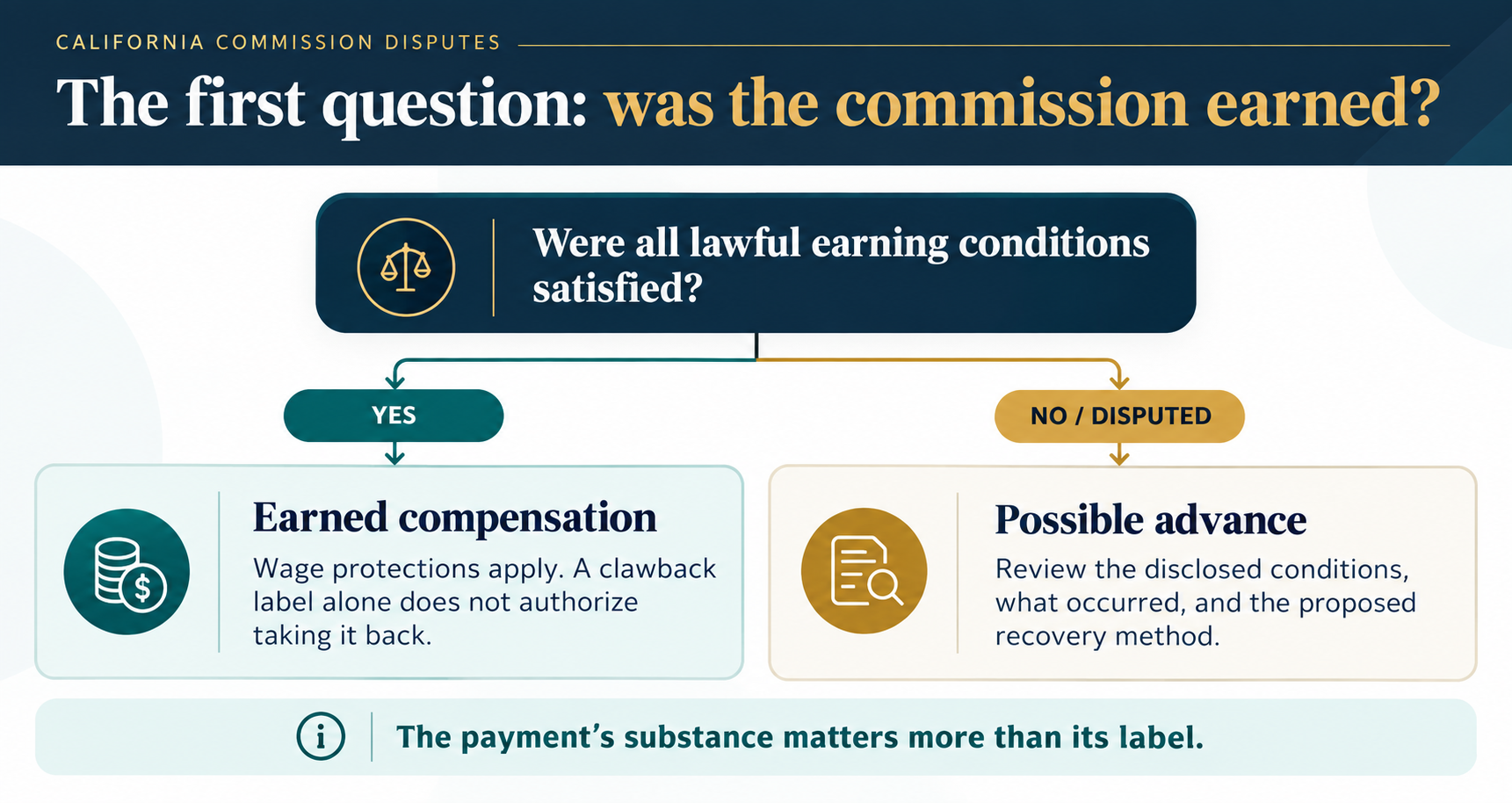
Sometimes. California distinguishes between an advance paid before a commission is earned and compensation that has already become earned wages. A valid, clearly disclosed earning condition may support recovery of an advance when that condition fails. An employer generally cannot take back earned wages simply by calling the deduction a clawback.
Labor Code section 200 includes commissions within its definition of wages. Section 221 prohibits employers from collecting or receiving back wages previously paid to an employee. When the employer withholds a commission before paying it, the analysis also involves the compensation agreement and applicable wage payment requirements.
That distinction matters. A company may say it never “clawed back” anything because the disputed money never reached your bank account. That response does not resolve whether it failed to pay compensation you earned.
Your job title and salary do not answer the question either. Being a highly paid salesperson, manager, or employee exempt from overtime does not automatically eliminate your right to earned commissions. The governing agreement, your work, and the timing of the employer’s action require examination.
When is a sales commission earned
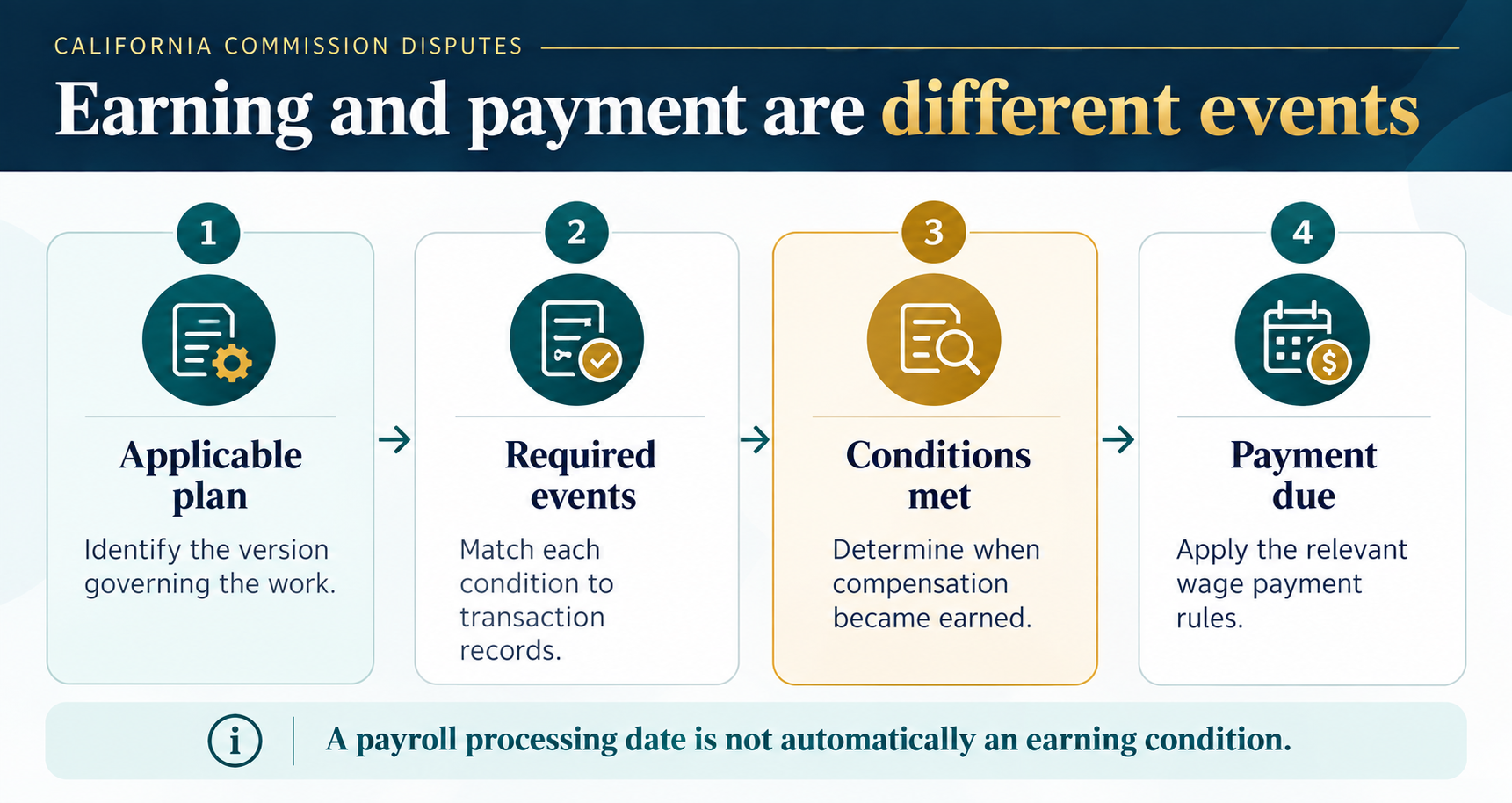
Start with the earning conditions in the compensation plan. Depending on the agreement, relevant events may include an executed customer contract, an accepted order, shipment, implementation, customer payment, or expiration of a specified cancellation period. The enforceability and application of those conditions must also be assessed.
Distinguish an earning condition from a payroll processing date. A provision saying commissions are processed the following month does not necessarily mean the employee must work until that date to earn the money. Likewise, an internal finance review may verify a calculation without giving management unlimited power to replace it.
Ask the company to identify the exact condition it claims remained unsatisfied. Then compare that answer with the plan and the transaction records. “Finance has not approved it” is incomplete if the agreement does not explain what finance approval means or how it affects earning.
In a large commission dispute, the timeline should show when the plan took effect, when you performed the work, when the customer committed, when any remaining conditions occurred, and when management first proposed reducing the payout. Those dates help distinguish an existing limitation from a rule introduced after the commission was earned.
For a closer look at the wage distinction, read What Are Earned Wages in California.
What California law requires in a written commission agreement
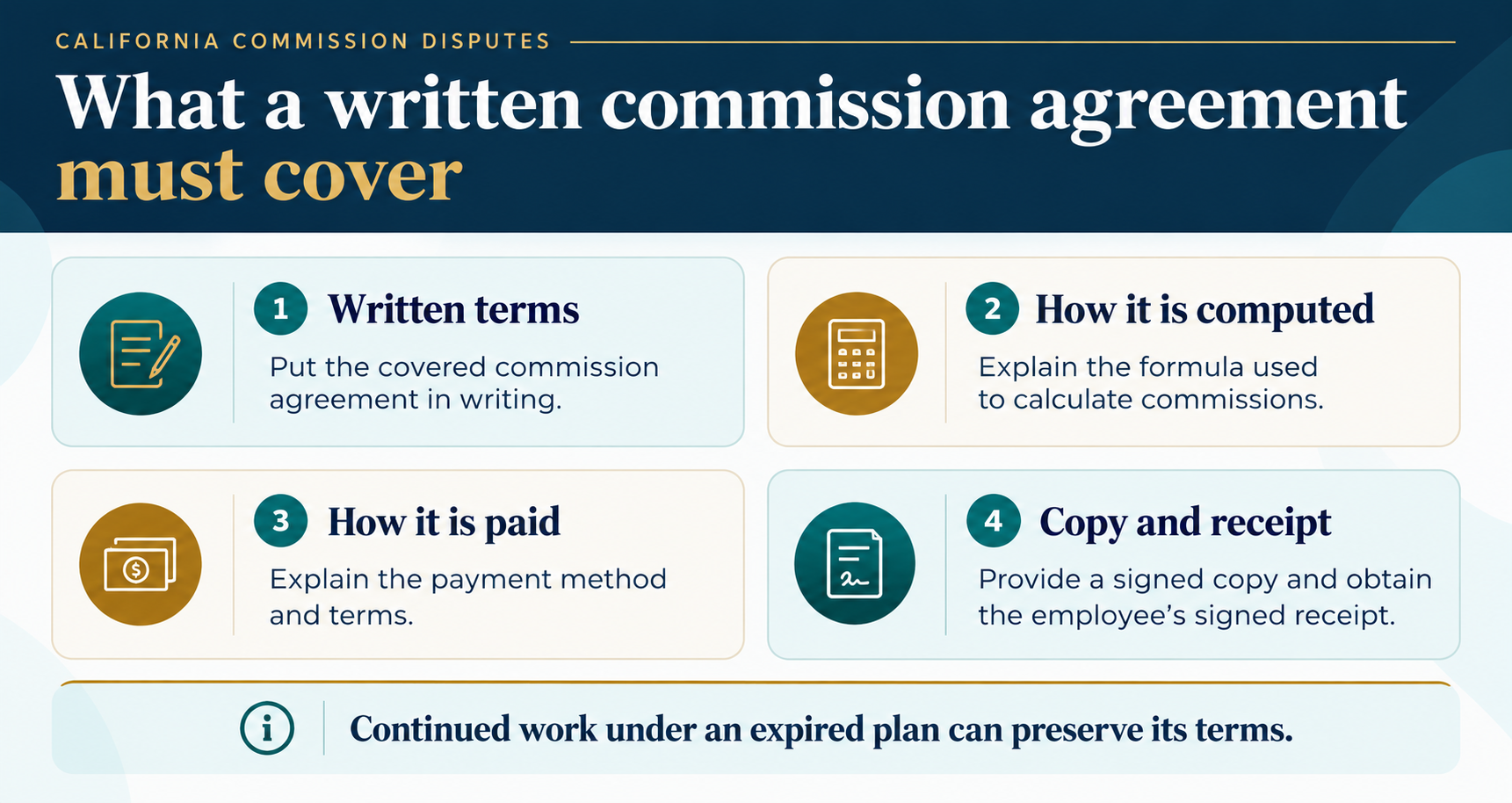
Labor Code section 2751 generally requires an employment agreement involving commissions for services in California to be in writing and explain how commissions are computed and paid. The employer must provide a signed copy and obtain the employee’s signed receipt.
The statute also addresses an expired agreement when the parties continue working under its terms: those terms are presumed to continue until the agreement is superseded or employment ends. An employer’s failure to issue the next annual plan therefore deserves attention.
Collect the complete agreement, including incorporated policies, amendments, quota letters, account assignments, and special deal approvals. A compensation dashboard may show a number without identifying the rules behind it.
If you never received a written plan, your claim does not disappear. Offer letters, emails, prior payments, presentations, and the parties’ conduct may help establish the compensation promised. Missing documentation creates issues to investigate; it does not automatically establish either the amount owed or liability.
Are windfall provisions in commission plans enforceable
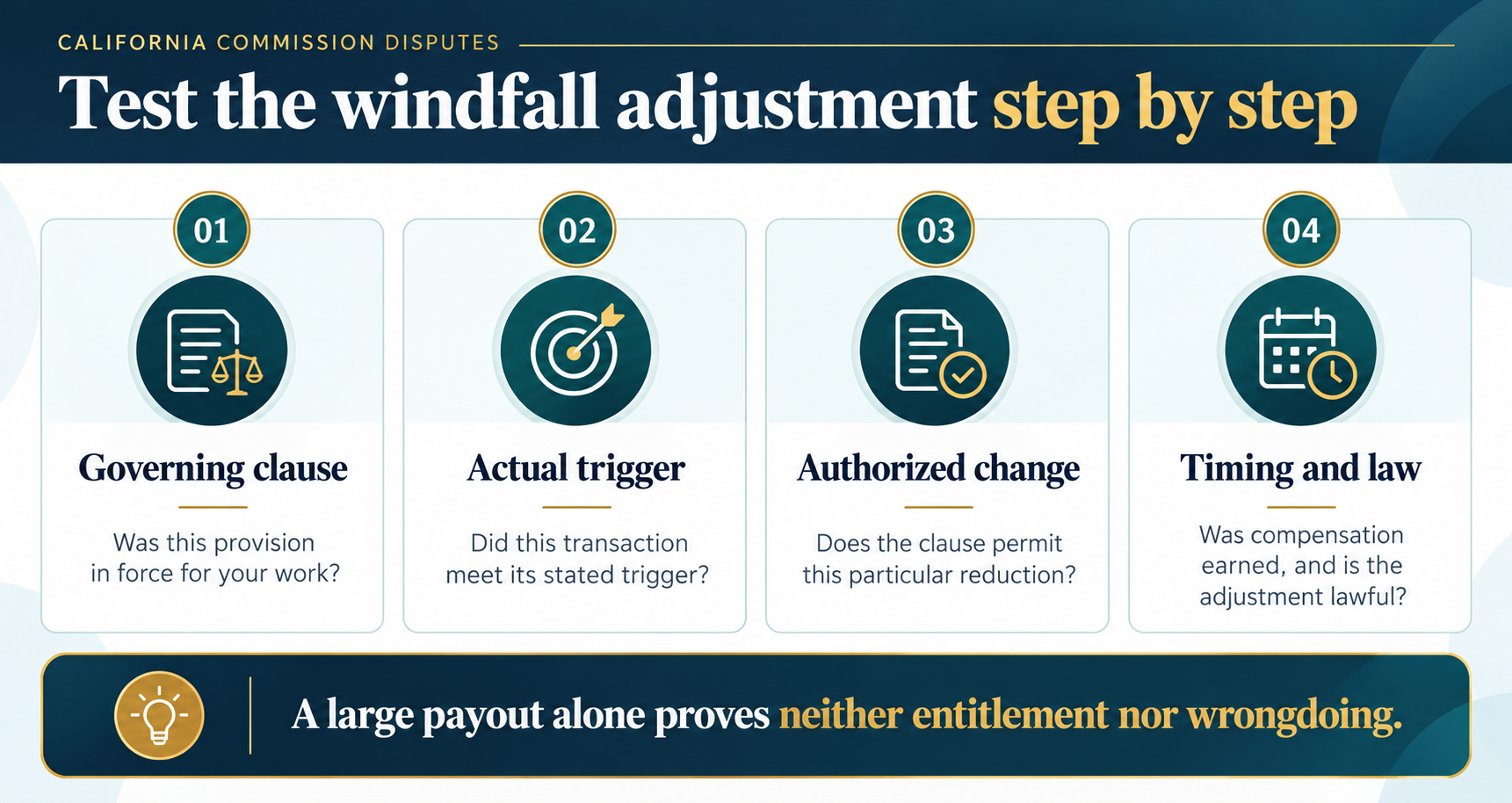
A windfall provision allows an employer to review or adjust compensation from an unusually large or unexpected transaction. Companies may use different labels, including extraordinary transaction, mega deal, special opportunity, or excessive attainment. The legal effect depends on the actual language and its application.
Some plans establish a different commission rate for transactions exceeding a stated threshold. Others reserve broad discretion to reduce payouts that management considers disproportionate to the employee’s contribution. Still others contain no identifiable windfall provision until a dispute arises.
California law does not make every windfall clause unlawful. A clearly disclosed and otherwise lawful limitation adopted before the relevant work may affect what the employee can earn. Conversely, inserting a cap after earning conditions were satisfied presents a materially different issue.
The questions that test a windfall adjustment
- Where is the provision, and which version governed your work?
- What event triggers it, and did that event actually occur?
- Does it authorize review, a specific reduction, or both?
- Who could approve an exception, and was approval obtained?
- Was the commission already earned when the adjustment was imposed?
- Did the employer follow its own procedure and calculation method?
The company’s explanation should be tested against the documents. If a clause concerns transactions acquired through a merger, for example, management must explain why it applies to a customer relationship you developed independently. If the plan specifies an alternative rate, ask why the company selected a different number.
A large commission alone proves neither entitlement nor wrongdoing. The stronger argument connects the promised formula to completed work and identifies precisely where the employer departed from the agreement or violated wage protections.
What if management has sole discretion over commissions
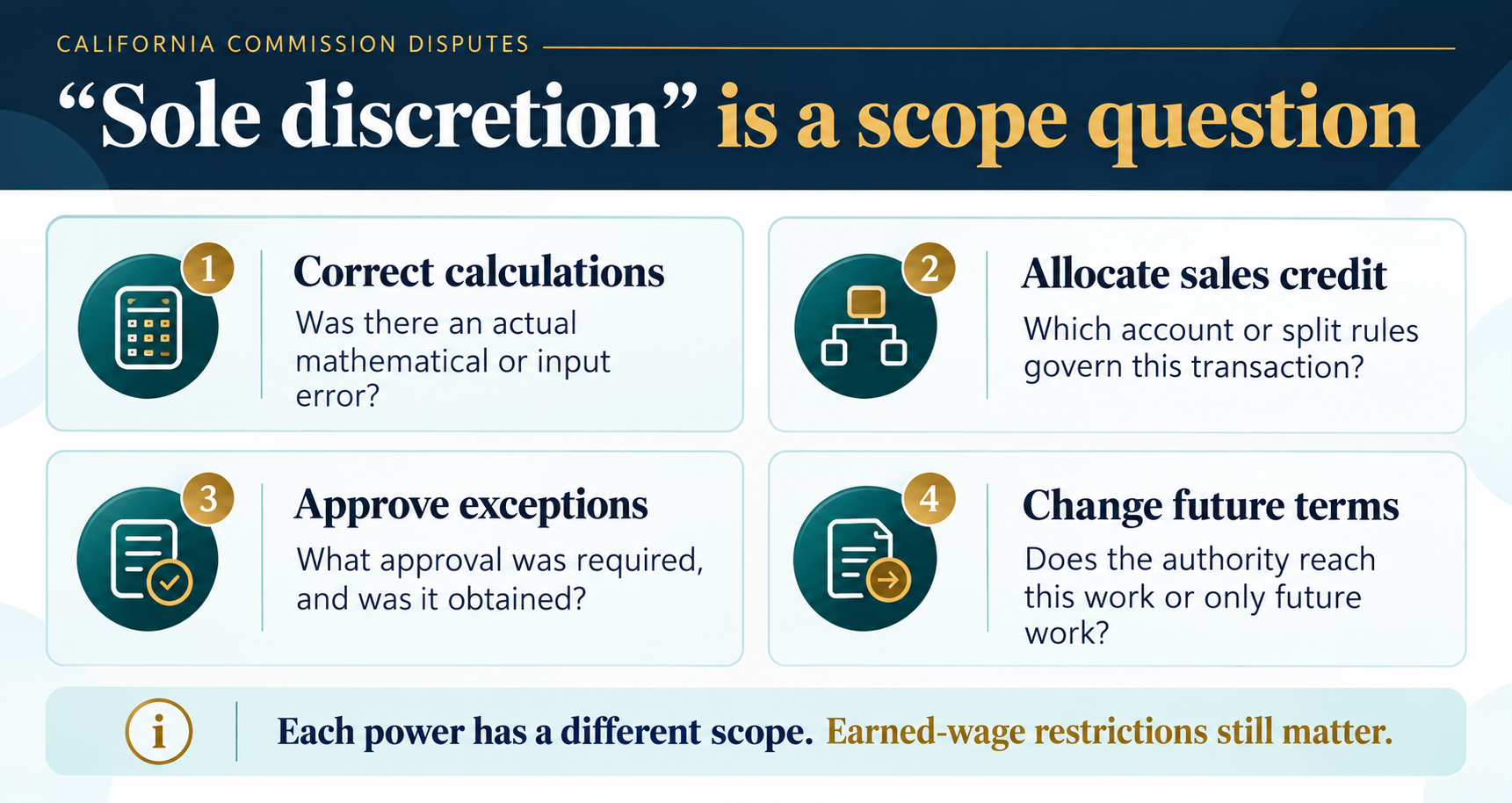
Read a “sole discretion” clause in the context of the entire plan. Authority to correct calculations, resolve account disputes, approve exceptions, and change future compensation can involve different powers. A reservation addressing one subject does not necessarily answer every commission dispute.
An employer may argue that the plan makes any projected payout conditional until final approval. An employee may respond that approval occurred, that the asserted discretion does not cover the transaction, or that the employer used the clause to take away earned wages. The evidence determines which argument has support.
Do not assume that the words “sole discretion” defeat your claim. Do not assume they can be ignored, either. Contract interpretation, wage law, and any applicable duty of good faith require analysis together. A sound demand addresses the employer’s strongest language directly and explains why it does not justify the particular reduction.
Three examples of substantial commission disputes
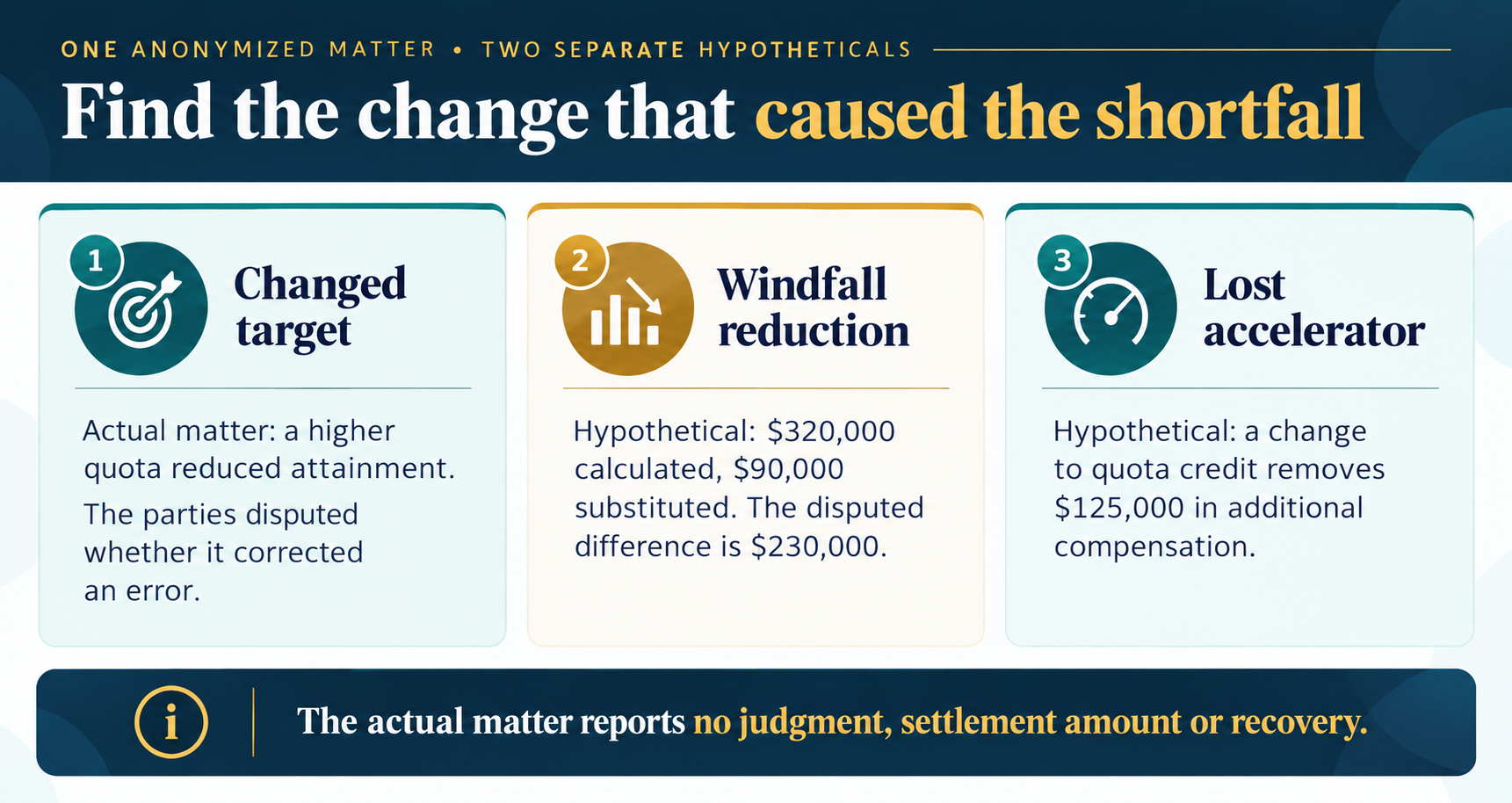
The first example is adapted from an actual matter. “Alex” and “Company A” are pseudonyms; nonessential identifying details have been omitted or generalized. It describes disputed positions and the analytical approach, not findings by a court. The two examples that follow are hypothetical and are unrelated to that matter.
An actual matter involving a changed quota calculation
In a commission matter I handled, a salesperson we will call Alex challenged a substantial reduction in compensation. Alex maintained that the sales work had been completed under assigned targets and that earlier company approvals supported the original calculation. Company A later increased a target used to measure that performance, reducing the resulting payout.
The plan contained management review and adjustment provisions. The parties disagreed about whether those provisions permitted this particular change. Alex challenged the reduction as a retrospective change to earned compensation. Company A maintained that it was correcting a calculation error. The employee's position required testing against that explanation and the actual plan language.
The central issue was the basis for the revised target. Increasing the quota can lower attainment even if credited sales stay the same. If attainment determines an accelerator, that change can also reduce the applicable payout rate. Focusing only on the final payment would miss the mechanism producing the shortfall.
My analysis compared the assigned target, the later calculation, the relevant approvals, and the plan's review provisions. I asked the employer to identify the claimed error and the provision authorizing the correction. The distinction between authority to review a calculation and authority to change an earned compensation obligation was central to the dispute.
The practical lesson is to request a calculation that can be reproduced. Calling a reduction a windfall adjustment or an error correction does not answer whether the company used the right inputs or had authority to change them. This account does not report a judgment, settlement amount, or recovery, and it does not predict another matter's outcome.
A hypothetical SaaS commission reduced after a major sale
An account executive works for fourteen months on an enterprise software transaction. Applying the stated commission schedule and accelerator produces a $320,000 payout. After the customer signs and the company receives the payment required by the plan, management substitutes a $90,000 payment under a windfall policy.
The potential shortfall is $230,000. The review should determine whether the policy existed beforehand, whether it covered this transaction, and whether the company had already approved the commission. Statements that the payout exceeded the sales budget may be relevant, but they must be evaluated alongside any legitimate contractual defense.
A hypothetical accelerator removed after quota is exceeded
A strategic account manager’s plan increases the commission rate after a specified quota threshold. A large closing pushes the employee above that threshold. The employer then raises the quota retroactively or excludes the transaction from attainment, eliminating $125,000 in additional compensation.
The dispute concerns both the transaction and its effect on other sales. The employee needs the original quota, attainment records, accelerator formula, and every subsequent calculation. Reviewing only the final commission statement may miss the full shortfall across the compensation period.
The difference between an advance and an unlawful commission clawback
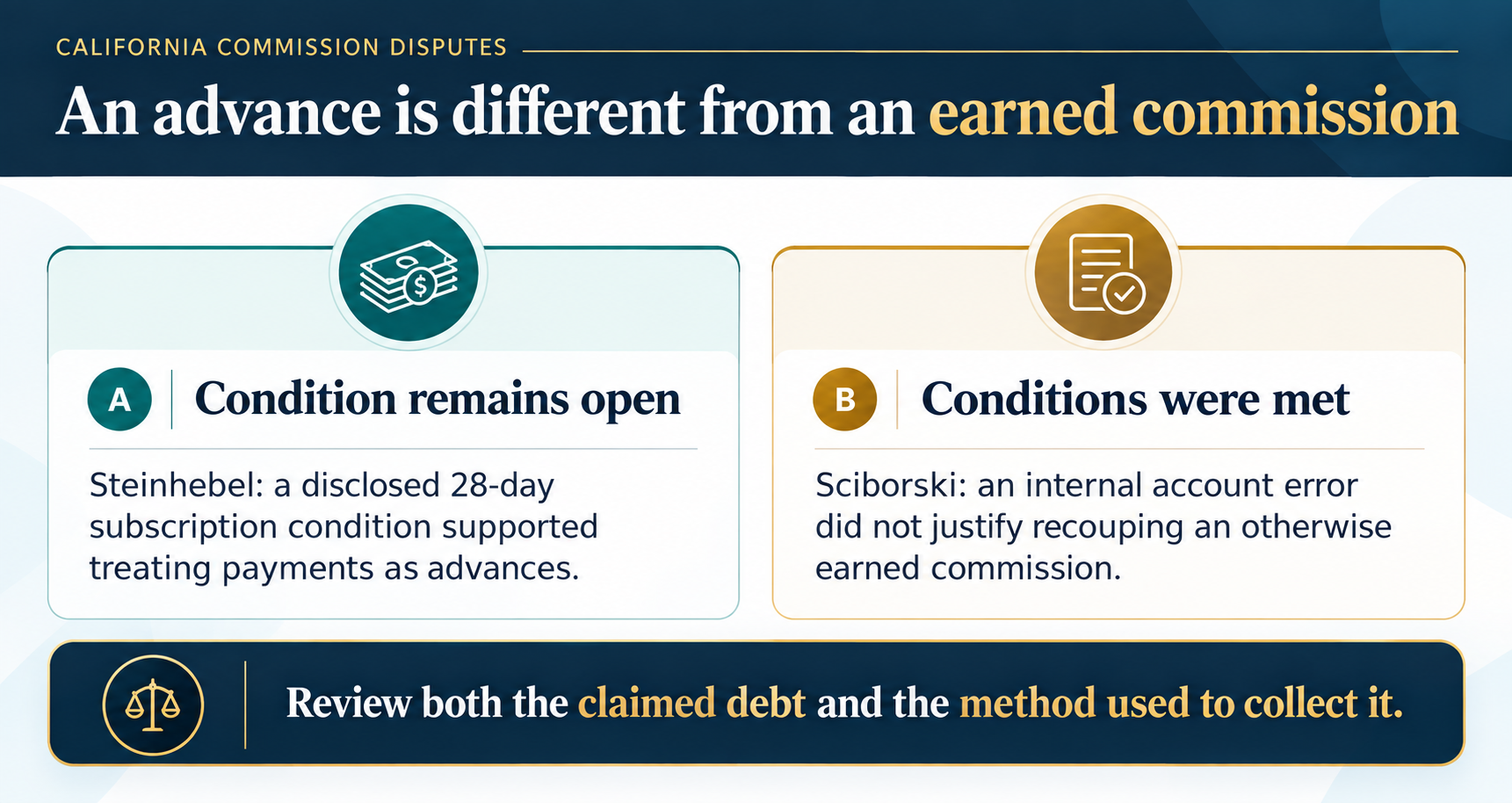
In Steinhebel v. Los Angeles Times Communications, LLC (2005) 126 Cal.App.4th 696, the court upheld chargebacks under an agreement requiring newspaper customers to retain subscriptions for at least 28 days. Payments made before that condition occurred were advances. The decision illustrates why an employer may sometimes recover a payment that never became an earned commission.
By contrast, in Sciborski v. Pacific Bell Directory (2012) 205 Cal.App.4th 1152, the employer sought to recover a commission after an account assignment error. The employee had satisfied the express earning conditions. The court rejected reliance on an implied condition allowing the company to recoup the commission because of its own clerical mistake.
These decisions require a comparison of the actual earning conditions with what happened. A payroll label such as “advance,” “provisional,” or “recoverable” does not eliminate the need for that comparison.
Customer cancellation also requires a closer look. Was there a defined cancellation period? Did cancellation occur within it? Had the commission already become earned? Did the employer apply the correct amount? A clawback provision covering one unpaid installment may not authorize reversal of compensation on an entire contract.
Separate the employer’s claimed repayment right from the method it uses to collect. A demand for repayment and deductions from current wages raise related but distinct issues. Review both before agreeing to a negative commission balance or repayment schedule.
For additional discussion, read What Is an Advanced Commission in California.
Can an employer shift business losses onto the sales team
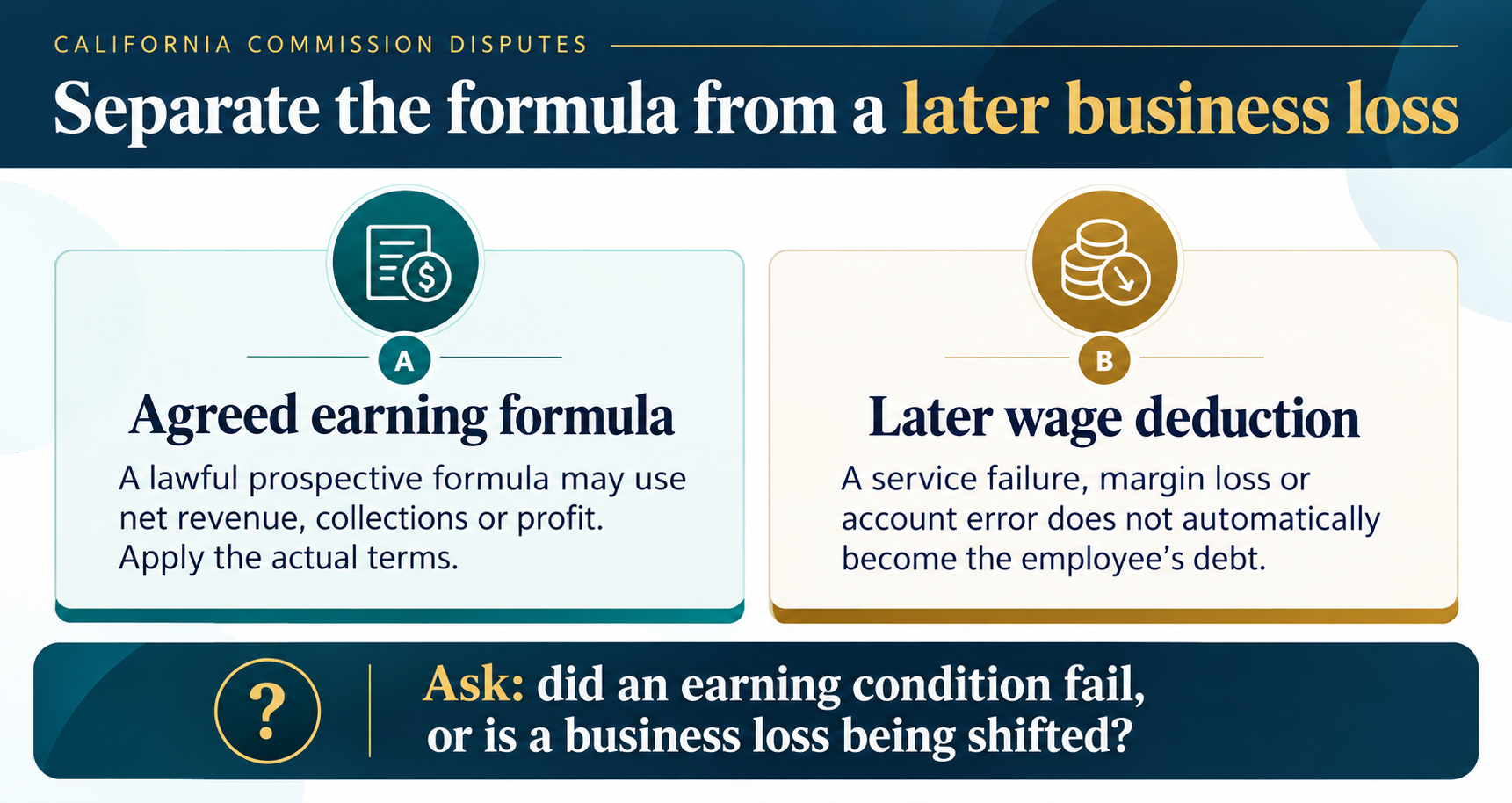
An employer’s business problem does not automatically become the employee’s wage obligation. In Hudgins v. Neiman Marcus Group, Inc. (1995) 34 Cal.App.4th 1109, the court rejected deductions for unidentified merchandise returns allocated among commissioned sales employees. The decision addresses unlawful shifting of business losses through wage deductions.
That does not mean every commission formula based on net revenue, collections, or profit is invalid. The formula may define compensation prospectively. The critical distinction is between applying a lawful agreed calculation and charging an employee for business costs or losses in a manner California law prohibits.
If your employer cites a service failure, pricing mistake, implementation problem, or margin shortfall, request the contractual basis and supporting calculation. Determine whether the event affected an unsatisfied earning condition or became an excuse to reduce compensation already earned. Signing a plan does not automatically validate an otherwise unlawful wage deduction.
Can the company change the commission plan after the sale
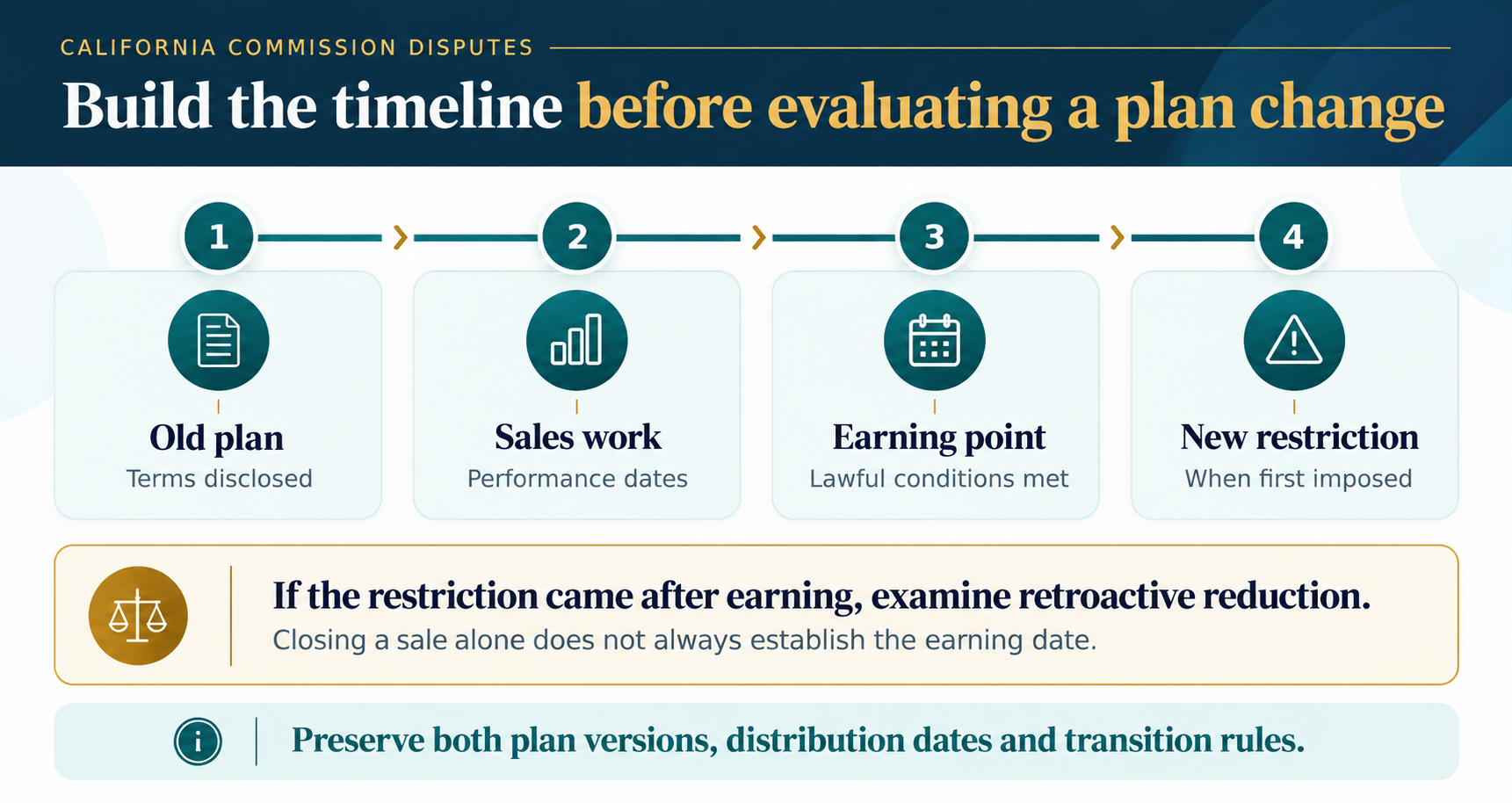
The date of a sale matters, but it may not resolve when the commission was earned. Employers may have authority to change compensation prospectively, subject to applicable contractual and legal requirements. A purported change that reaches back to completed work or earned compensation requires different scrutiny.
Preserve the old plan and the new one. Compare effective dates, commission rates, caps, credit allocation, and any new approval requirements. Check whether a document circulated after the transaction claims an earlier effective date.
Also examine the transition rules for opportunities already in progress. A deal may span several compensation periods. The company may contend a later plan governs the closing; the employee may have evidence of a specific earlier commitment or exception. Those disputes need a transaction timeline and careful reading of both plans.
For additional discussion, see Can My Employer Change My Commission After the Sale in California.
Why enterprise and technology sales disputes require detailed calculations
A substantial commission claim can be hidden inside an apparently small adjustment. Reducing credited revenue may also move an employee below an accelerator threshold. Removing a transaction from one quarter may change compensation on several other transactions.
In SaaS and enterprise sales, distinguish annual recurring revenue, total contract value, bookings, and collected revenue. These measures can produce very different payouts. Use the measure actually promised in the plan, including rules for renewals, expansions, multiyear contracts, channel sales, and split accounts.
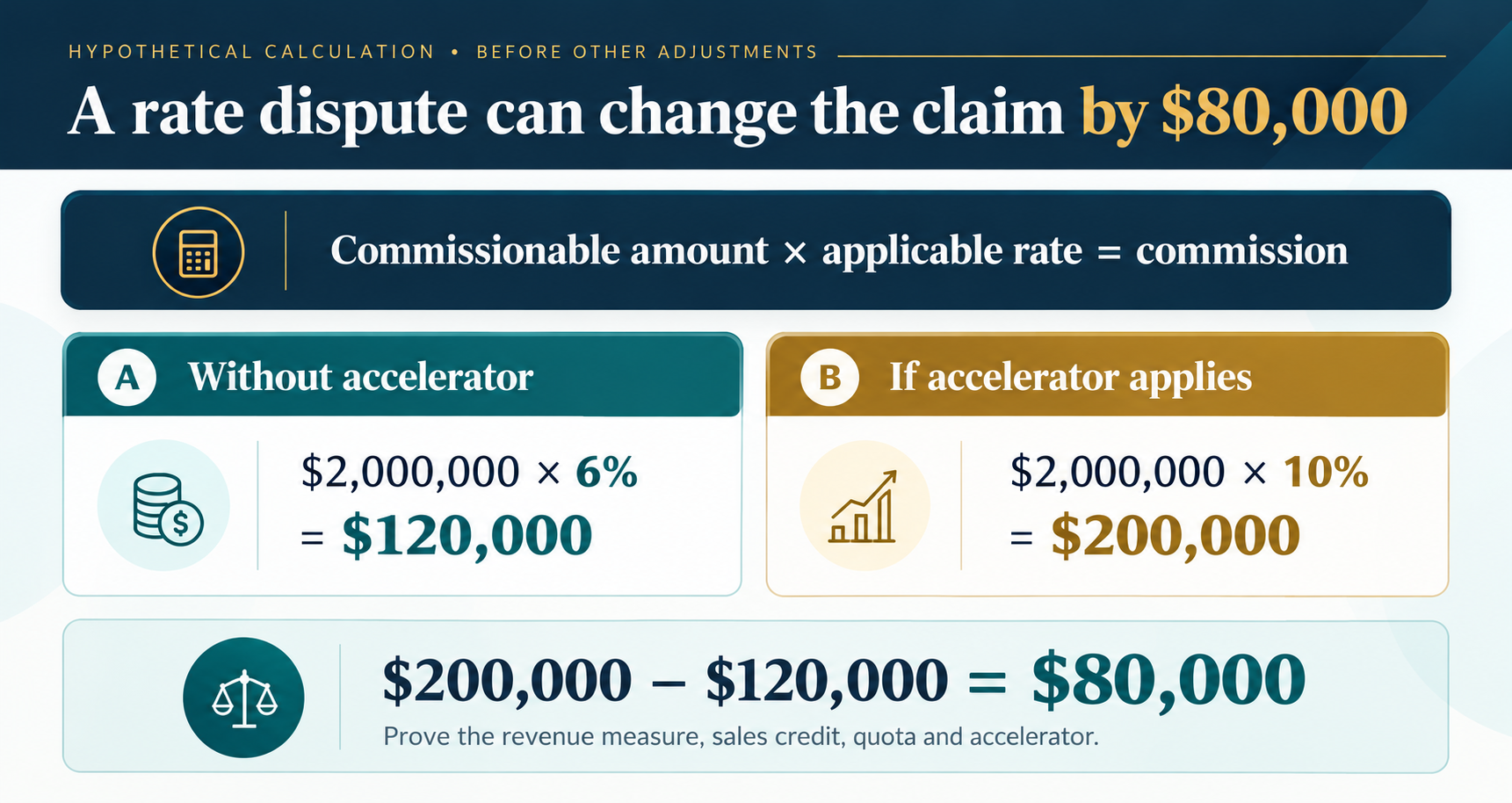
An effective damages analysis reconstructs the calculation in steps: commissionable revenue, applicable credit, quota attainment, rate, accelerator, lawful adjustments, and amounts already paid. Show the employer’s calculation beside yours and identify the source for each disputed input.
For example, a $2 million transaction at a 6 percent rate produces $120,000 before other adjustments. If a valid accelerator makes the applicable rate 10 percent, the figure becomes $200,000. The $80,000 difference depends on proving the accelerator applies, rather than simply pointing to the size of the sale.
Distinguish a sales forecast from an approved compensation calculation. Both may be useful evidence, but they do different work. A screenshot showing an estimated payout should be paired with the governing formula and records establishing the underlying transaction.
Are commissions owed after termination or resignation
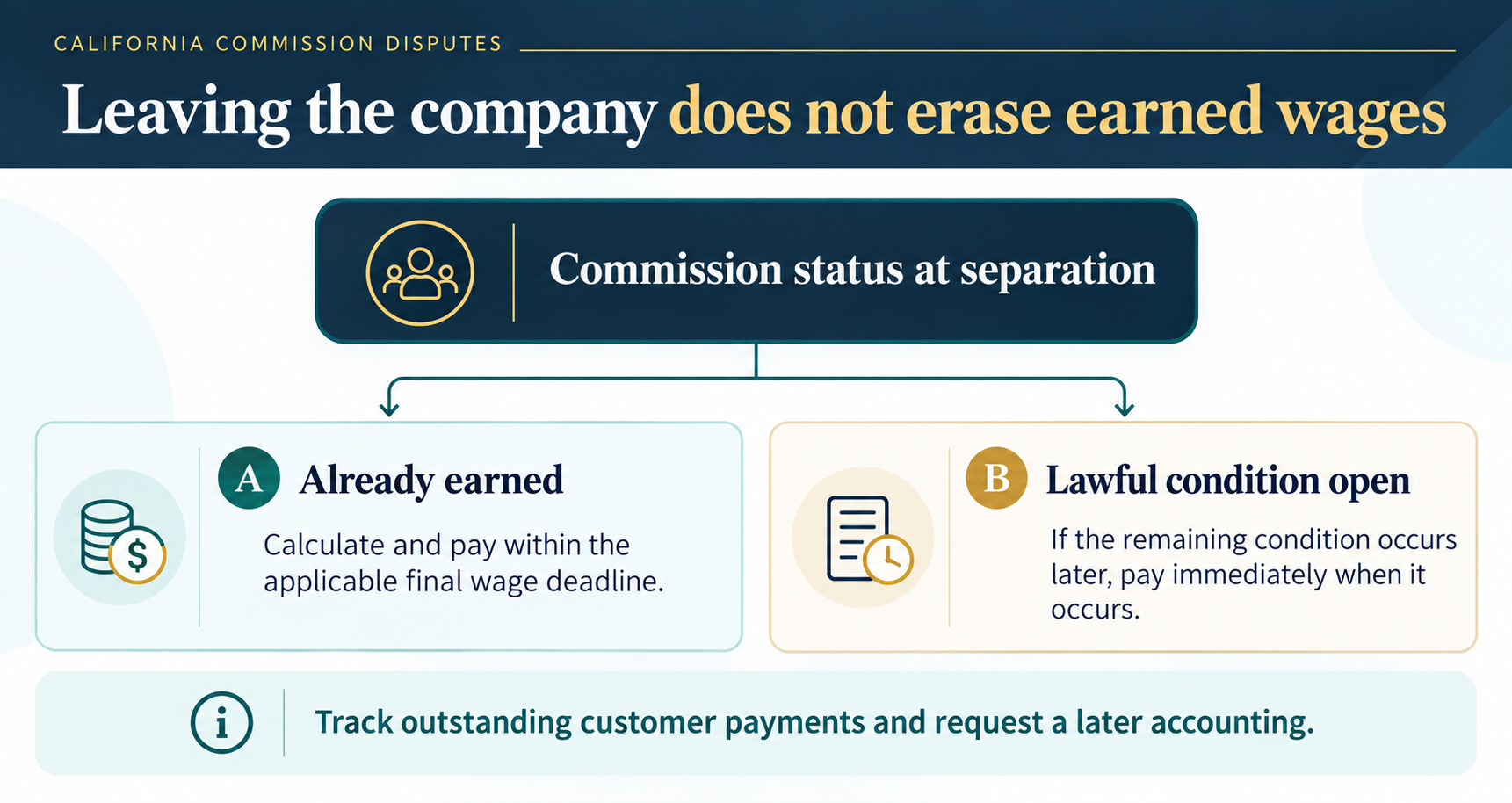
Leaving the company does not automatically erase earned commissions. The California Labor Commissioner’s guidance on final pay explains that commissions earned by termination must be calculated and paid within the applicable final payment deadline. An employer cannot simply wait for its normal commission processing cycle.
If a lawful earning condition remains outstanding, such as customer payment, the guidance states that the commission must be paid immediately when that condition occurs. This makes it important to identify postdeparture transactions and request an accounting of later payments.
An “employed on payment date” clause requires review. The questions include whether continued employment is a lawful earning condition or an attempted forfeiture of compensation already earned. The answer cannot be determined from the label alone.
Before signing a separation agreement, identify each outstanding commission and any alleged repayment obligation. A release may affect disputed compensation claims. Review provisions stating that all compensation has been received, that no commissions remain due, or that severance will be offset against a commission balance.
When significant commissions and severance overlap, they should be evaluated together. Our California severance agreement practice addresses the compensation and release issues that can arise when employment ends.
What evidence helps prove an unpaid commission claim
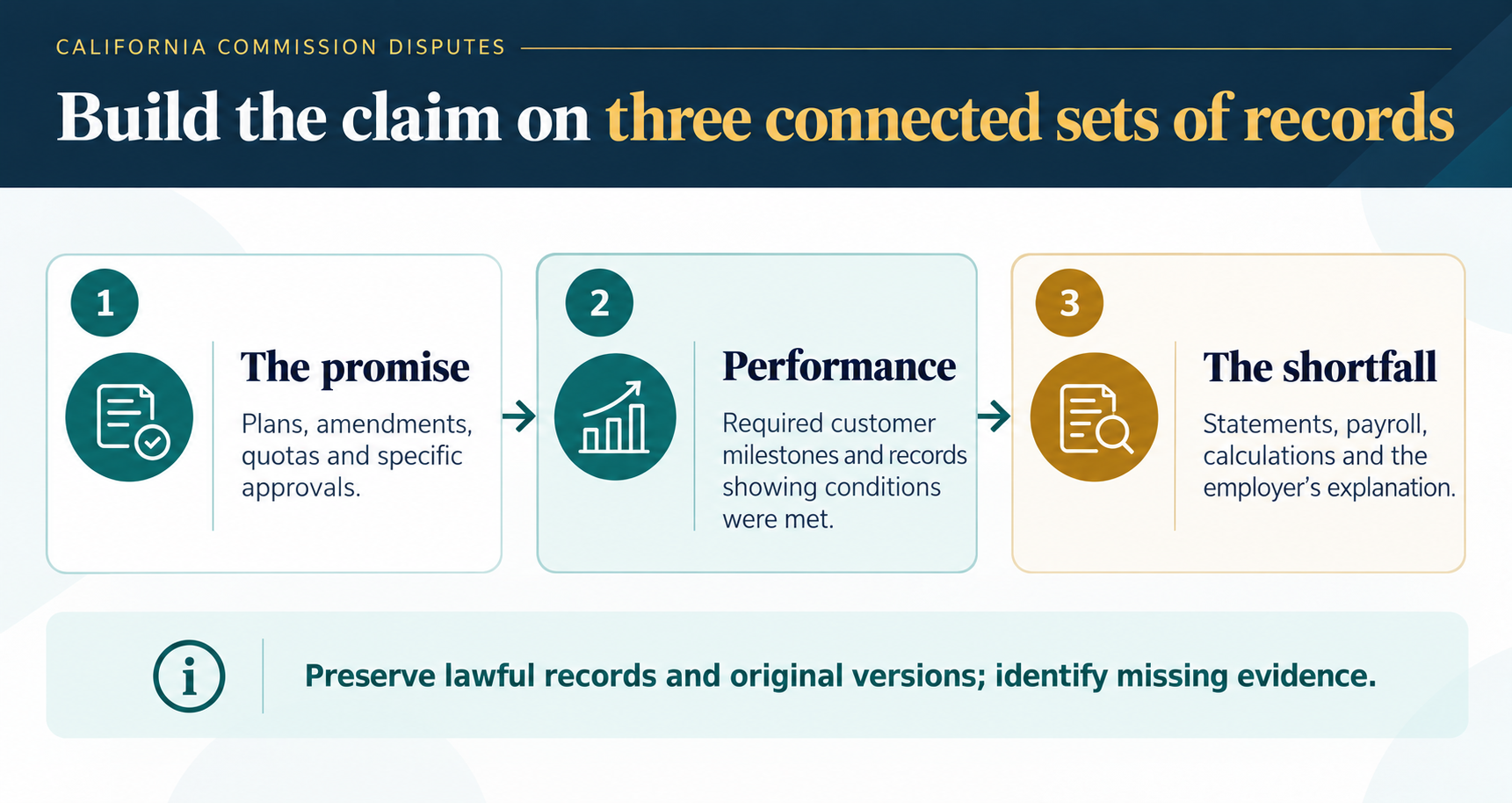
The most useful evidence connects the compensation promise, your performance, and the employer’s reason for reducing payment. An organized record lets counsel assess both the amount at stake and the defenses likely to arise.
Gather documents you lawfully possess or can appropriately obtain:
- The offer letter, commission plans, amendments, quota notices, and signed acknowledgments.
- Account assignments, split agreements, territory changes, and special approvals.
- Commission statements, pay stubs, and original calculation spreadsheets.
- Relevant customer milestones and records of payment or cancellation.
- Emails explaining a windfall adjustment, clawback, cap, or denied accelerator.
- Your objections and the company’s responses.
- Any termination notice, severance proposal, arbitration agreement, or repayment demand.
Build a short chronology while events are fresh. Record who told you the commission would be paid, what was said, when the company changed its position, and which documents corroborate each event. Distinguish your recollection from a written statement.
Preserve original versions where available. A spreadsheet with formulas can reveal a disputed calculation that a PDF conceals. An email transmitting the plan can establish when it was distributed. An approval trail may show that management knew the anticipated payout before authorizing the transaction.
Do not remove unrelated customer files, trade secrets, or company databases, and do not bypass access restrictions. If critical records remain with the employer, identify them for counsel so preservation and lawful production can be addressed.
You do not need to arrive with a complete litigation file. The plan, the amount withheld, the relevant dates, and the employer’s explanation are often enough to begin a focused review.
For a practical explanation of proving the deduction was improper, see Proving Commission Chargebacks Are Illegal in California.
What a persuasive commission demand should establish
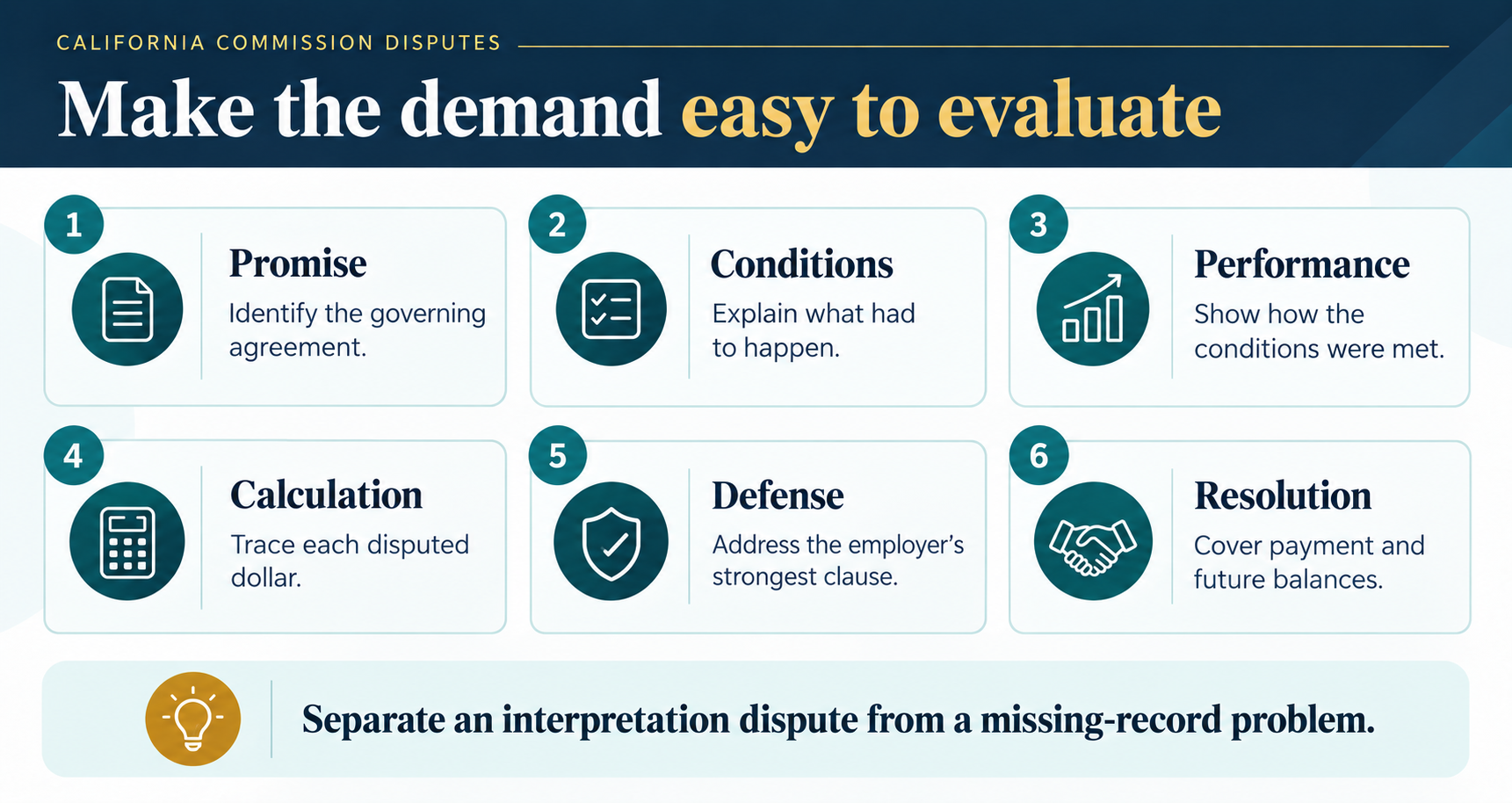
A substantial claim should be presented so that someone outside the sales organization can follow it. The demand should identify the agreement, explain the earning conditions, show how you satisfied them, and calculate the unpaid balance. Attach the most useful supporting records and address the provision the employer relies upon.
An unsupported demand for the largest possible number can distract from a strong claim. If the dispute turns on two reasonable interpretations of a crediting rule, calculate both. Identify the amount owed under either interpretation and the additional amount that depends on resolving the disputed language in your favor.
Separate uncertainty about the formula from uncertainty about the facts. A missing customer payment record presents an evidence problem. A disagreement about whether renewals count toward an accelerator presents an interpretation problem. Each requires a different response, and combining them can make the demand harder to evaluate.
Consider what a resolution must cover beyond the immediate check. Does the employer still show a negative commission balance? Will the adjustment reduce future payments? Are other transactions awaiting review under the same policy? Will the company provide a final accounting after customers pay outstanding invoices?
For an employee who remains with the company, prospective clarity may matter almost as much as recovering the existing shortfall. A resolution should address the disputed transactions and avoid leaving the same calculation problem to recur next quarter.
The objective is to give the employer a documented basis to correct the payment and give you a clear assessment of what remains contested. If negotiation fails, that preparation also helps identify the records, witnesses, and decisions that further proceedings must examine.
How to respond when your employer cuts a substantial commission
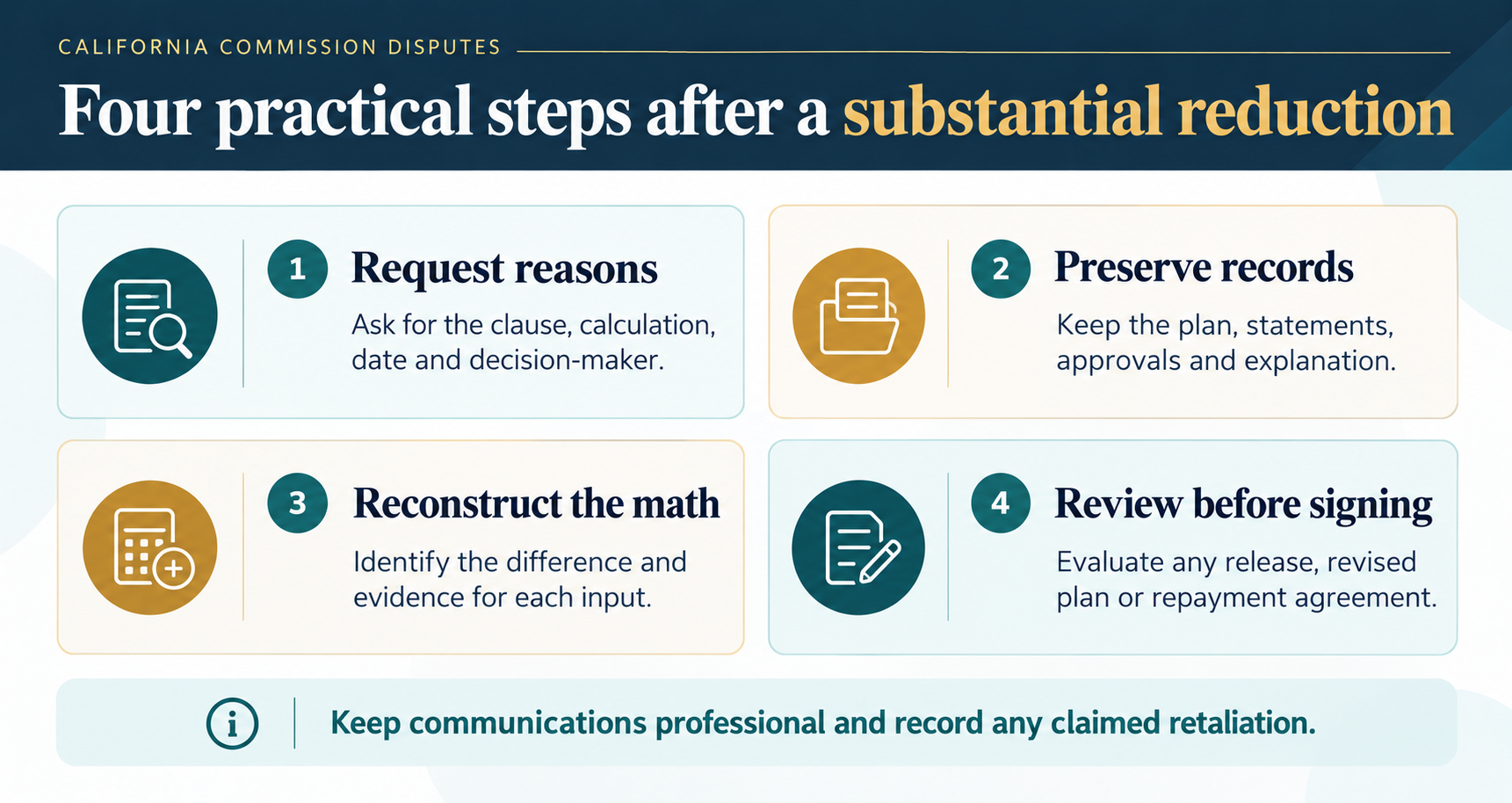
Request a written explanation identifying the plan provision, calculation, decision date, and person responsible. Keep your response factual. State the amount you believe is owed, the formula supporting it, and the condition you believe you satisfied.
Avoid agreeing casually that the payment was an “overpayment” or that the company has a valid repayment claim. Ask for time to review any proposed acknowledgment, revised plan, release, or repayment agreement. A document presented as routine administration may contain substantive concessions.
If you remain employed, maintain professional communications and continue documenting your work. Under Labor Code section 98.6, complaints about unpaid wages can be protected from retaliation. Record any subsequent threats, account removals, discipline, or other adverse actions and their stated reasons.
Timing alone does not prove retaliation. Earlier performance records, management knowledge of the complaint, and inconsistent explanations may also matter. Our discussion of workplace retaliation explains the broader issues.
Consult counsel before resigning over the dispute. Resignation may affect income, evidence access, and potential claims; a constructive discharge claim has demanding requirements. A substantial commission problem warrants a deliberate strategy.
What can you recover in a California commission dispute
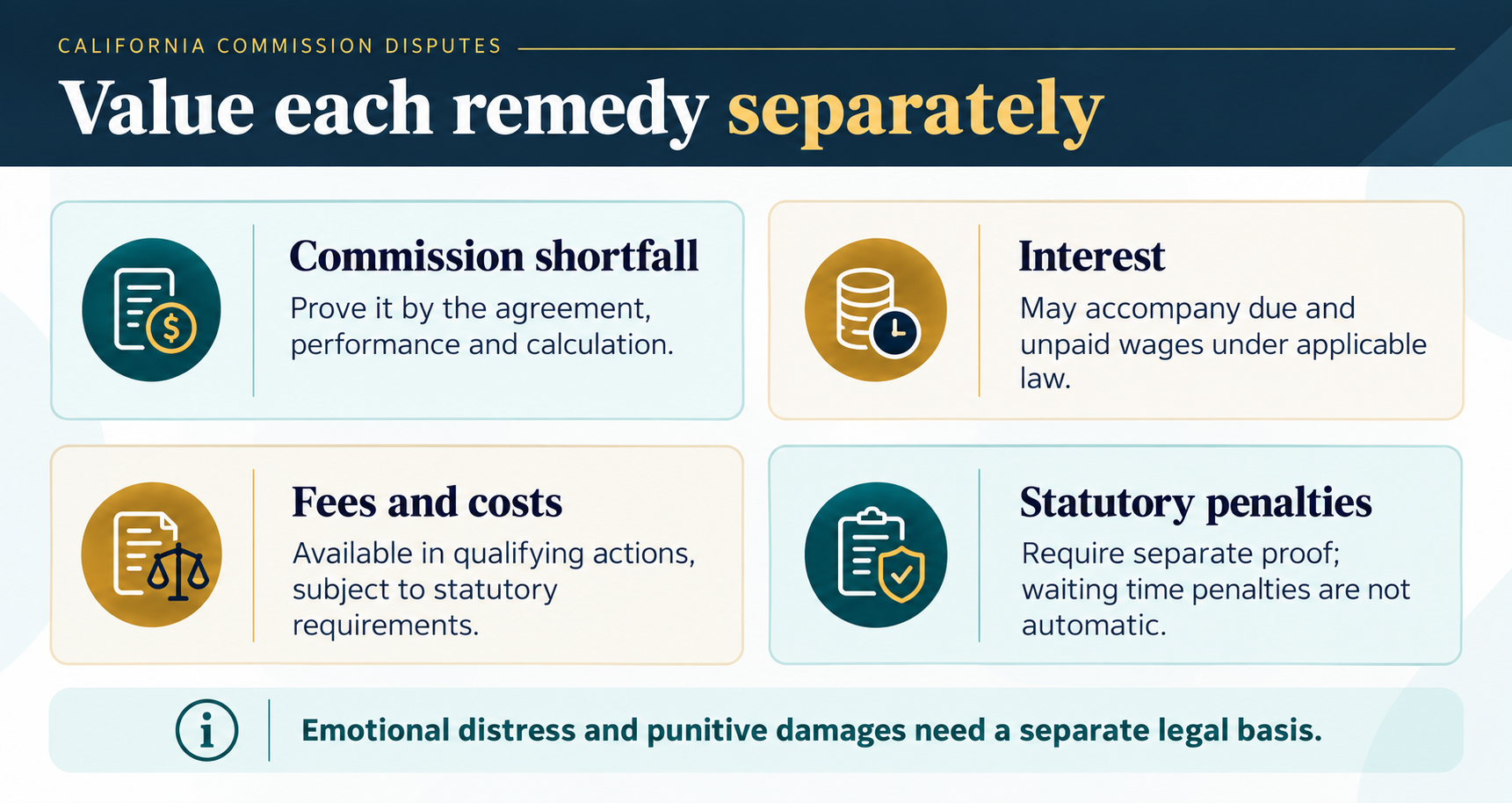
The starting point is the commission shortfall supported by the agreement and evidence. Depending on the claims and circumstances, available relief may also include interest, attorney’s fees, costs, and statutory penalties.
Labor Code section 218.6 provides for interest on due and unpaid wages in an action for nonpayment. Section 218.5 addresses attorney’s fees and costs in qualifying wage actions, subject to its requirements and exceptions.
Section 203 may provide waiting time penalties when an employer willfully fails to pay final wages. Those penalties can reach 30 days of wages, but they are not automatic. A qualifying good faith dispute may defeat penalties even when wages ultimately are owed.
Separate retaliation or other legally supported claims may change the available remedies. Emotional distress damages and punitive damages do not automatically accompany an unpaid commission claim. A credible valuation distinguishes the unpaid compensation from additional relief that requires its own factual and legal foundation.
Should you pursue negotiation arbitration or a wage claim
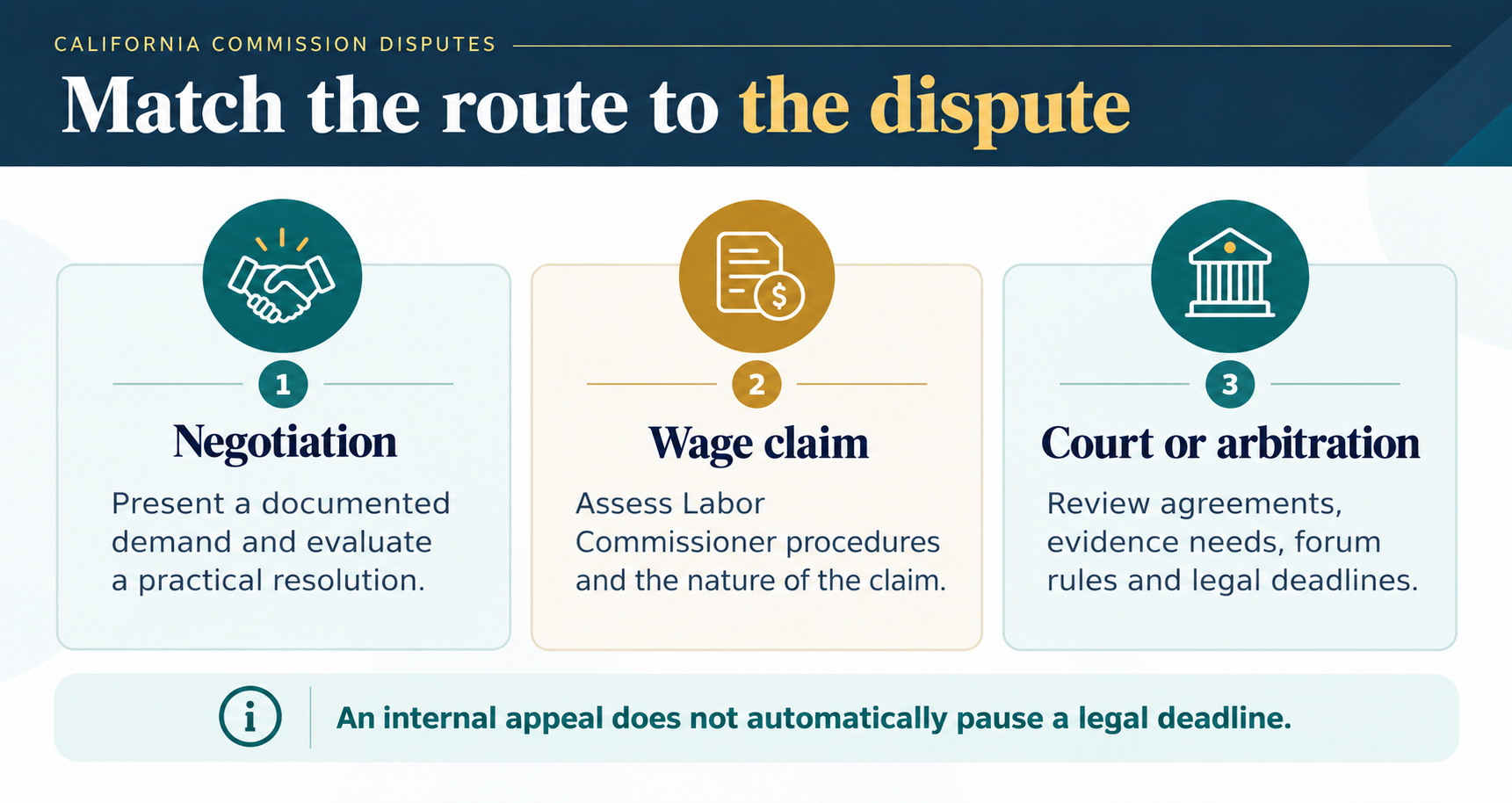
The best approach depends on the amount, complexity, evidence, employment relationship, and applicable agreements. A documented demand may resolve a clear calculation dispute. A contested six figure claim may require discovery into compensation approvals, account changes, and internal communications.
Potential avenues include a Labor Commissioner wage claim, a civil lawsuit, or arbitration where an enforceable agreement applies. Review forum provisions before choosing a course. A commission plan and a separate employment agreement may contain different dispute procedures.
An out of state headquarters or choice of law clause does not automatically displace California protections. Labor Code section 925 restricts certain required forum and choice of law provisions for employees who primarily reside and work in California. Its application depends on statutory conditions, contract timing, and exceptions, including certain individually negotiated agreements with counsel.
Do not assume an internal appeal pauses legal deadlines. The Labor Commissioner’s filing guidance identifies different periods, including three years for illegal wage deductions and four years for written contract claims. Other claims and penalties can have shorter periods. Have counsel determine the deadlines that apply to your facts.
50 FAQs About California Commission Clawbacks and Windfall Policies
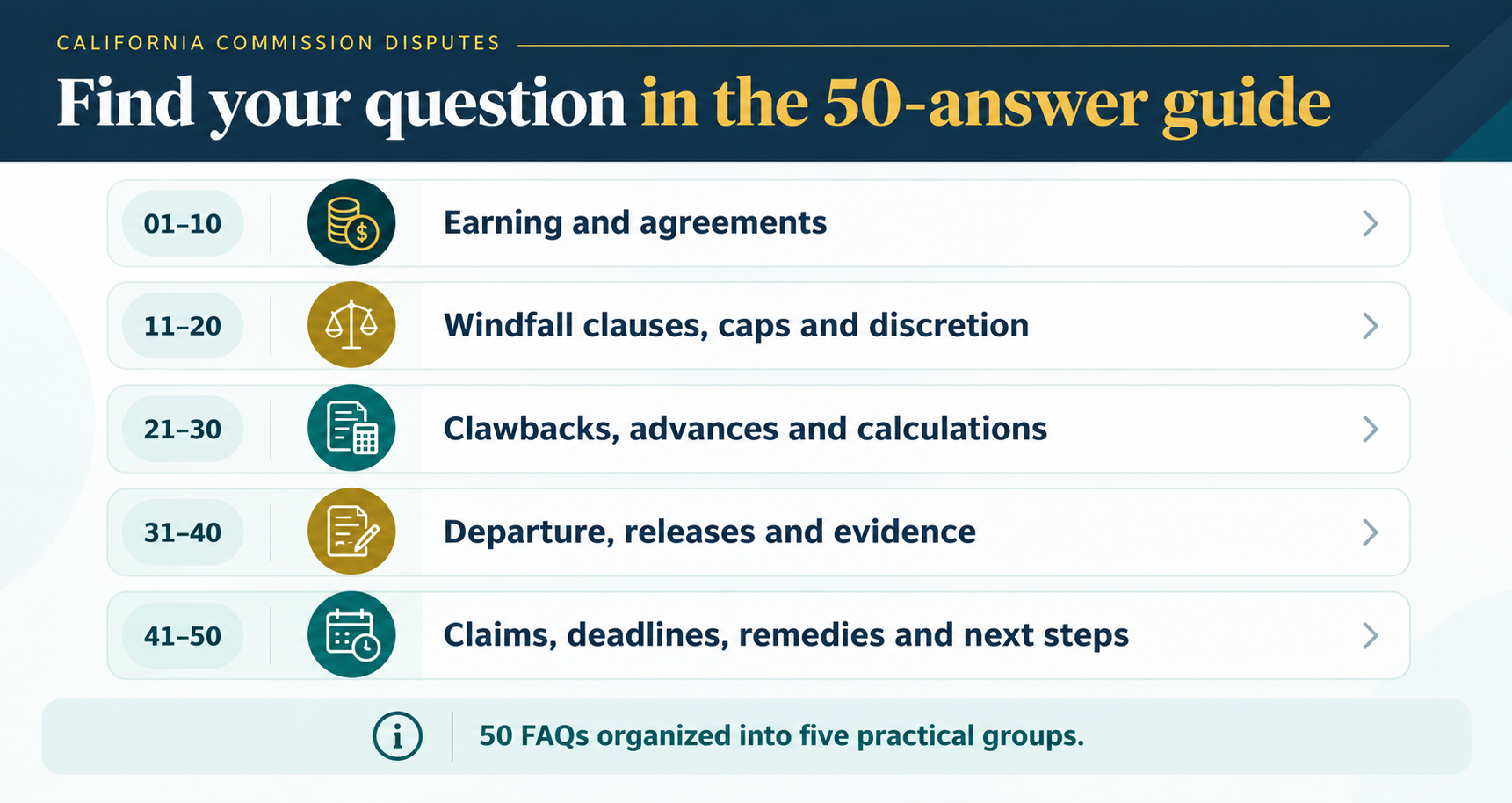
These answers address common employee commission disputes. The agreement, earning conditions, timing, and supporting records determine how the rules apply to a particular claim.
Earning commissions and understanding the agreement
1 Can my employer take back a commission already paid
An employer generally cannot recover earned wages simply because it regrets the payment. Recovery of a genuine advance can be different if a lawful, clearly disclosed earning condition was never satisfied. Determine what the payment represented, which condition allegedly failed, and how the employer proposes to recover it.
2 Can my employer withhold a commission before paying it
Withholding may still violate the agreement or wage payment requirements if the commission has been earned and is due. Section 221 specifically addresses wages previously paid, so an unpaid commission claim may involve other legal grounds. The company cannot resolve the dispute merely by saying no clawback occurred.
3 What makes a commission an earned wage
A commission generally becomes earned when the applicable lawful earning conditions are satisfied. Those conditions must be identified in the governing arrangement and compared with the actual transaction. A customer signature, payment, or completed service milestone may matter, depending on the agreement. See What Are Earned Wages in California.
4 Does closing a sale automatically earn the commission
Not always. A plan may lawfully require an additional event, such as customer payment or expiration of a defined cancellation period. However, the employer should identify the actual earning condition it relies upon. A vague statement that the sale is still under review does not explain the governing rule.
5 Is the commission payment date the same as the earning date
Not necessarily. Earning and payment are separate questions. A processing schedule can identify when payroll calculates compensation without establishing an additional earning condition. Review whether the employer is relying on a genuine condition or merely its preferred administrative timetable.
6 Does a commission agreement have to be in writing
Labor Code section 2751 generally requires a written agreement explaining how commissions for covered employment in California are computed and paid. The employer must provide a signed copy and obtain the employee’s signed receipt. Whether a particular incentive falls within the statute requires examination of its substance.
7 What if the company never gave me a commission plan
Preserve the offer letter, emails, recruiting materials, compensation presentations, and records of earlier payments. Those materials may help establish the agreement and calculation. The absence of a written plan does not automatically eliminate your claim, but it also does not establish the amount you are entitled to recover.
8 What happens when my annual commission plan expires
Section 2751 addresses an expired agreement when the parties continue working under its terms: those terms are presumed to remain effective until superseded or employment ends. Preserve the expired plan and communications about the next plan, including when any replacement was actually distributed.
9 Does my signature make every commission provision enforceable
No. A signed agreement is important evidence, but it does not automatically authorize deductions prohibited by California wage law. Conversely, signing may establish notice and acceptance of lawful earning conditions. The correct analysis examines the provision itself, its timing, and its application to the disputed compensation.
10 Do highly paid or overtime exempt employees have commission rights
Yes. High compensation and overtime exemption do not automatically eliminate protection for earned commissions. The scope of an exemption and the nature of the payment still matter. An executive or senior salesperson should not assume wage protections apply only to hourly employees.
Windfall policies caps and employer discretion
11 What is a windfall provision in a commission plan
It is a provision addressing unusually large or unexpected compensation from a transaction or level of attainment. Some provisions specify a different rate; others authorize review or reserve discretion. Read the actual language, including thresholds and exceptions, rather than relying on management’s shorthand description.
12 Are all windfall commission policies illegal in California
No. A lawful limitation disclosed before the relevant work may affect what compensation is earned. A later reduction of earned wages raises a different issue. Examine the provision, the transaction, and the timing together.
13 Can my employer cut a commission because it is too large
The size of the payment alone does not establish a right to reduce it. The employer needs a valid contractual and legal basis for the adjustment. Ask for the governing provision and the actual calculation, particularly if management previously approved the transaction with knowledge of the anticipated commission.
14 What if management says the payout exceeded the budget
A compensation budget is not necessarily an earning condition. Compare that explanation with the plan and any cap or extraordinary transaction clause. Financial concern may explain the decision without legally justifying it.
15 Does sole discretion language defeat a commission claim
Not automatically. Determine what discretion the clause reserves and whether the company exercised it consistently with the agreement and applicable law. Authority to resolve account attribution may differ from authority to reduce a final earned payment. Ignoring the clause is as unhelpful as treating it as unlimited.
16 Does an uncapped compensation promise matter
It can. Preserve recruiting statements, advertisements, offer communications, and sales kickoff materials using that term. Compare them with the complete plan and any disclosed exceptions. The word uncapped does not automatically override every other provision, but conflicting representations may be significant evidence.
17 Can the company introduce a commission cap after the deal closes
A later cap requires close review, particularly when earning conditions were already satisfied. Closing alone may not establish earning, so collect the applicable dates and both plan versions. See Can My Employer Change My Commission After the Sale in California.
18 Can management raise my quota retroactively
Compare the original quota, effective dates, amendment language, and the resulting calculation. A retroactive increase may affect the current transaction and other accelerator payments. The employer’s authority to set future quotas does not automatically answer whether it can revise compensation already earned under an earlier quota.
19 Can a company remove a deal from accelerator calculations
Check the plan’s eligibility and crediting rules, including any disclosed exclusion. Recalculate the entire affected period: removing one qualifying deal may reduce the accelerator on other transactions too.
20 What if the employer applies its windfall policy inconsistently
Comparable transactions may help test the employer’s explanation, but superficial similarities can be misleading. Compare plan versions, approval requirements, deal size, account ownership, and earning conditions. Different treatment may support further investigation; it does not automatically establish a wage violation or unlawful discrimination.
Clawbacks advances and disputed calculations
21 What is the difference between an advance and a recoverable draw
An advance generally pays compensation before it is earned. A recoverable draw is often a payment credited against later commissions under the agreement. Whether a balance can be recovered, and by what method, requires review of the terms and wage protections. See What Is an Advanced Commission in California.
22 Can the employer claw back a commission when a customer cancels
Sometimes, if cancellation means a valid earning condition was not satisfied. Check the stated cancellation window, the date and reason for cancellation, and whether the commission already became earned. A cancellation after the relevant period may present a different issue from one within it.
23 What if the customer fails to pay
A lawful customer payment condition may affect whether a commission is earned. Confirm whether payment actually failed, remained pending, or was received but credited elsewhere. Also check whether the plan treats partial collections separately. The employer’s assertion of nonpayment should be supported by an accounting.
24 Can an implementation failure justify a clawback
The answer depends on the agreement and the status of the commission. A specific lawful implementation condition may matter. An attempt to charge the salesperson for the employer’s later service failure raises different issues. Identify what failed, when it failed, and the precise provision said to authorize the deduction.
25 Can the company reverse the entire commission for a partial refund
Compare the plan’s adjustment rule with the actual refund and amount reclaimed. Even if some adjustment is permissible, reversing the entire commission may exceed what the agreement allows.
26 What if the employer assigned the account to me by mistake
An internal assignment error does not automatically defeat an otherwise earned commission. Sciborski illustrates the importance of express earning conditions and the employer’s inability to rely on an unlawful implied basis for recoupment. Preserve the assignment history, supervisory approvals, and records of the work you performed.
27 Can an employer deduct a clawback from unrelated future commissions
That collection method requires separate analysis. Even if the employer claims a repayment right, it must establish that deductions from future wages are lawful. Review the underlying balance, the agreement, and each deduction. A negative balance on a compensation dashboard does not itself prove a valid debt.
28 Can the company deduct repayment from my final paycheck
Final wage deductions are subject to significant restrictions. Do not assume a claimed debt permits an employer to withhold final compensation. California’s guidance on wage deductions discusses limits on employer self-help, including final paycheck offsets. Have the particular repayment demand reviewed.
29 What if the company says it accidentally paid me twice
Ask for the payment records and calculation. A genuine duplicate payment differs from a retroactive change to earned compensation. Even with an actual overpayment, the proposed method of recovery needs separate review.
30 Can a commission be recalculated using a different revenue measure
Check the measure promised in the plan. Bookings, annual recurring revenue, total contract value, profit, and cash collected can produce different results. The employer should identify why its chosen measure applies. A disagreement over the input can materially change compensation even when the stated percentage stays constant.
Leaving the company and preserving evidence
31 Are commissions still owed after I am fired
Earned commissions do not automatically disappear when employment ends. The Labor Commissioner’s guidance requires payment within the applicable final wage deadline and addresses commissions awaiting lawful conditions. Identify each outstanding transaction, whether its conditions were met, and whether later customer payments will trigger additional compensation.
32 Do I forfeit earned commissions by resigning
Resignation does not automatically forfeit earned wages. However, commissions that remain unearned require analysis of any lawful outstanding conditions. Before leaving, identify the relevant transactions, preserve appropriate records, and consider how you will obtain an accounting after company access ends.
33 What if I must be employed on the payout date
Examine whether continued employment is a lawful earning condition or an attempted forfeiture of already earned compensation. The language, nature of the payment, timing, and reason employment ended can matter. A payroll processing date should not automatically be treated as an earning condition.
34 What if the customer pays after I leave
If customer payment is the remaining lawful earning condition, the Labor Commissioner’s guidance states that the commission must be paid immediately when that condition occurs. Request an accounting mechanism for outstanding transactions. Your departure alone does not establish that the employer may retain all later commissions.
35 Can a severance agreement release a commission dispute
A release may affect genuinely disputed commission claims, so review it before signing. Identify outstanding compensation and any acknowledgment that all wages were paid. Labor Code sections 206 and 206.5 protect wage payment rights; they should not be read as making every negotiated settlement invalid.
36 Can the employer withhold the undisputed part while we argue
Labor Code section 206 requires timely, unconditional payment of wages the employer concedes are due, while preserving remedies for the claimed balance. Ask the employer to identify any conceded amount. A disagreement over one transaction does not automatically justify withholding unrelated compensation.
37 What documents should I bring to a commission lawyer
Bring the plan and amendments, assigned quota, commission statements, disputed calculation, employer explanation, and key approvals. Include separation documents and a short chronology identifying any deadline.
38 Can I save company documents to prove my claim
Preserve records you lawfully possess or may appropriately obtain, but do not bypass access controls or collect unrelated confidential material. Identify documents that remain with the employer so counsel can address preservation and lawful production. Do not assume a compensation dispute authorizes downloading the entire customer database.
39 Can emails or oral promises support my claim
They may help establish the agreement, approval, interpretation, or timing. Preserve the original communications and identify who made an oral statement, when, and who heard it. Authority to make the promise and written terms restricting modifications may matter. Distinguish a specific commitment from an estimate or informal prediction.
40 What makes a commission claim persuasive
The clearest record connects the governing promise to completed earning conditions and a supported calculation. It also addresses the employer’s strongest defense. For more on organizing proof, see Proving Commission Chargebacks Are Illegal in California.
Claims remedies and legal representation
41 Can I pursue unpaid commissions while still employed
Generally, you do not have to leave your job before asserting wage rights. The strategy should account for ongoing responsibilities, document access, and retaliation concerns. Keep communications professional and obtain advice about presenting the dispute without making unnecessary concessions or disrupting your employment.
42 What if my employer retaliates after I complain
Labor Code section 98.6 protects covered complaints about unpaid wages. Preserve the complaint, management’s knowledge, subsequent actions, and stated reasons. Timing and surrounding evidence matter. Threats, account removals, or discipline may warrant review, but a commission disagreement does not make every later management decision unlawful.
43 Should I resign if the company refuses to pay
Do not resign solely on the assumption that it will strengthen the claim. Resignation can affect income, access to records, and other legal issues. Constructive discharge has demanding requirements. An attorney can help assess the compensation claim and your employment options before you make that decision.
44 How long do I have to bring a commission claim
The deadline depends on the claim and when it accrued. The Labor Commissioner identifies three years for illegal deductions and four years for written contract claims, while some other claims or penalties have shorter periods. Do not rely on a single deadline for every possible remedy.
45 Does an internal commission appeal stop the filing deadline
Do not assume so. Preserve the internal appeal deadline and have counsel calculate the legal deadlines separately. Any proposed tolling agreement needs review of its terms and enforceability.
46 Can I recover interest penalties and attorney fees
Potentially. Interest, qualifying attorney’s fees, and certain penalties may be available depending on the claims and facts. Waiting time penalties require more than simply proving a shortfall. A realistic evaluation separates unpaid compensation from additional remedies and identifies the requirements for each.
47 Must I go to arbitration instead of court
An enforceable arbitration agreement may affect the forum. Review all relevant agreements, amendments, and dispute procedures before filing. Arbitration does not itself determine whether the commission reduction was lawful; it determines where and how the dispute may be decided.
48 Does an out of state employer have to follow California law
An employer’s headquarters alone does not answer which law applies. Where you reside and work, the claim’s connection to California, and contractual provisions matter. Section 925 may restrict certain required forum and choice of law clauses, subject to its dates, conditions, and exceptions.
49 What if I am called an independent contractor or paid a bonus
Both labels require substantive review. A true contractor may have different commission remedies, while misclassification may bring employee protections into play. Likewise, a payment labeled a bonus may operate as a sales commission or another form of wages. The actual working relationship and compensation arrangement control the analysis.
50 How does Ruggles Law Firm evaluate a substantial commission dispute
We start with the compensation promise, the earning conditions, the amount at stake, and the employer’s explanation. We assess supporting records, defenses, deadlines, forum, and practical recovery options. Call 916-758-8058 to discuss an evaluation and provide your employer’s name, work location, approximate shortfall, and any urgent deadline.
Discuss your commission dispute with Ruggles Law Firm
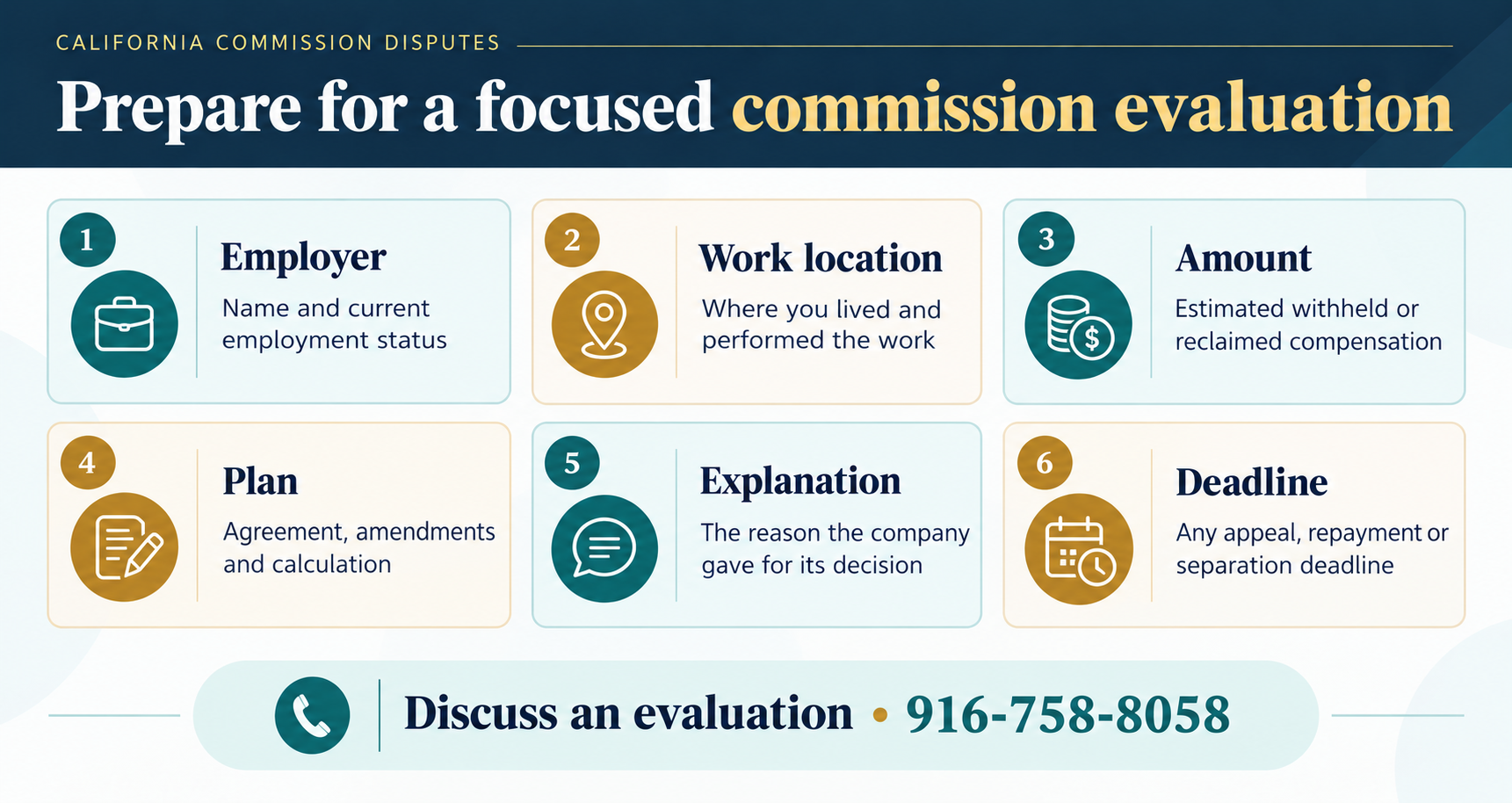
Ruggles Law Firm represents California employees against corporate employers in substantial compensation disputes. We evaluate the agreement, the evidence, the likely defenses, and the practical options for recovering unpaid compensation.
If you are an enterprise account executive, SaaS or technology salesperson, medical device representative, or sales leader facing a substantial commission loss, contact the firm. We serve employees in Sacramento, the San Francisco Bay Area, Silicon Valley, and throughout California.
Use the firm's intake form to identify your employer and where you worked in California. Select the option for commissions that were improperly clawed back or reduced. In the brief description, include the approximate amount, the employer's explanation, and any repayment, severance, or filing deadline. Keep your plan and commission statements available for the firm's follow-up.
A reduction described as final by human resources can still warrant legal review. The company's internal decision does not determine whether its compensation practices comply with California wage law.
Call 916-758-8058 to discuss a significant unpaid commission, clawback, or windfall adjustment.
About the Author Matthew J Ruggles
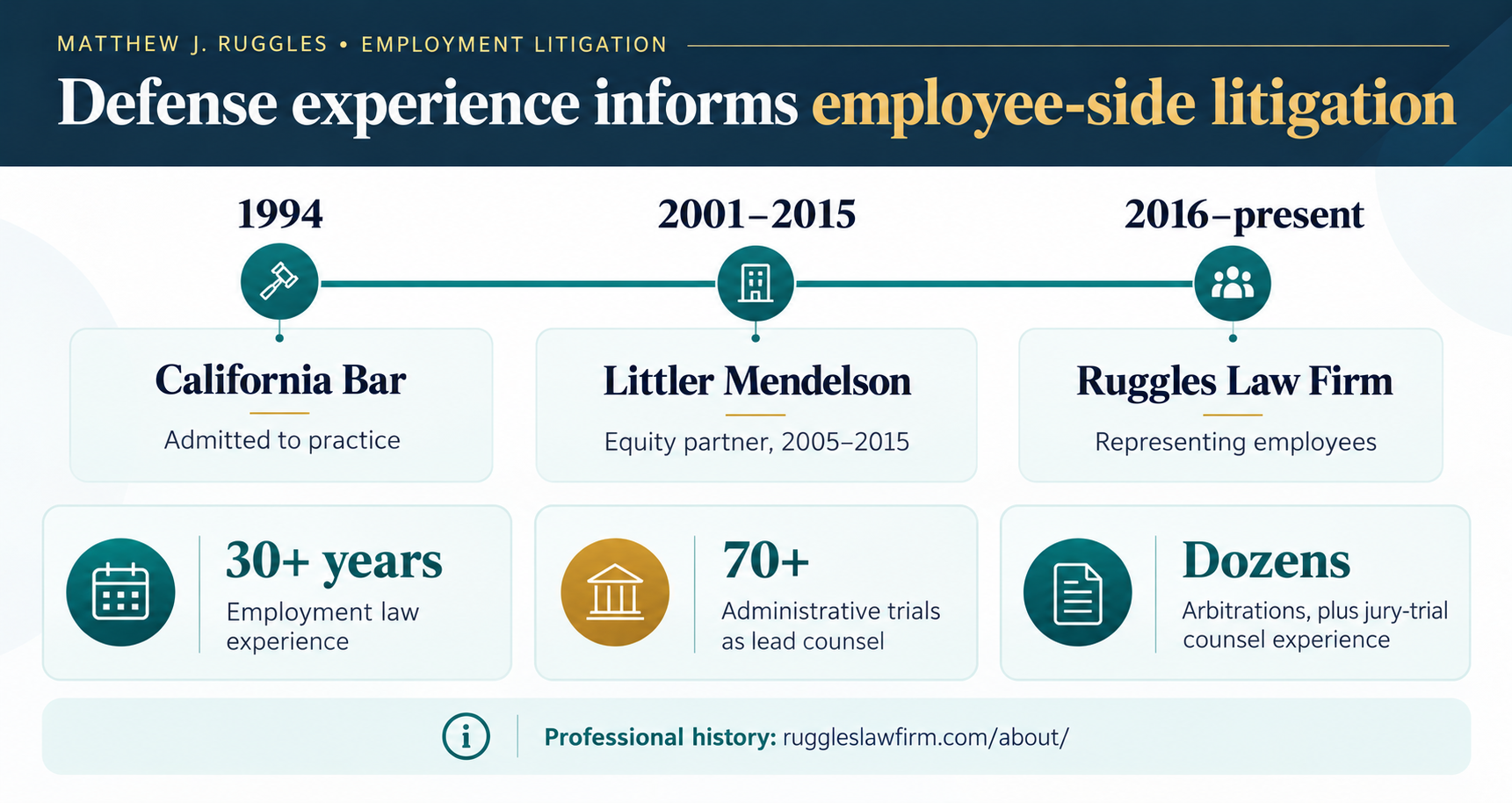
Matthew J. Ruggles is the principal of Ruggles Law Firm, P.C., a California employment litigation firm representing employees against corporate employers. Admitted to the California Bar in 1994, he has more than 30 years of employment law experience and has served as lead counsel in hundreds of lawsuits.
Before founding Ruggles Law Firm in 2016, Matt spent more than two decades working on the employer side of employment disputes. He practiced at Littler Mendelson from 2001 through 2015 and was an equity partner from 2005 through 2015. His defense work included representing major corporate employers in individual employment cases, wage and hour class actions, and other complex litigation.
Matt’s experience includes jury trials in California state and federal courts, dozens of arbitrations, and more than 70 administrative trials as lead counsel. His work has addressed wage claims, wrongful termination, discrimination, harassment, retaliation, civil procedure, and arbitration issues.
He now uses that defense and litigation experience to evaluate employee claims, anticipate employer arguments, develop evidence, and pursue practical recovery strategies. Read Matt Ruggles’s full professional biography.
This article provides general information about California law and is not legal advice for a particular dispute. Reading it or contacting the firm does not by itself establish an attorney-client relationship. The actual-matter example uses pseudonyms and generalized details; the separately labeled hypotheticals are illustrations. No example guarantees a result. Every matter requires an individual assessment.