
By Matthew J. Ruggles
When Workplace Hostility Crosses the Line Into Illegal Retaliation
Your workplace changed after you complained. Meetings became colder. Your manager started correcting you in public. Coworkers who once shared information now somehow forgot to include you. Then came the extra scrutiny, the impossible deadlines, the suspiciously sudden performance concerns, or the warning that continuing to complain would be bad for your career. You may be asking: can harassment be retaliation in California?
The direct answer
Yes. Under California law, a sufficiently serious or cumulative campaign of hostility, intimidation, humiliation, obstruction, isolation, or sabotage can be an adverse employment action in a retaliation claim when it is used to punish protected activity. But not every rude comment, awkward interaction, or chilly meeting after a complaint is unlawful. The conduct must be material when viewed in context, and the employee must be able to connect it to legally protected activity.
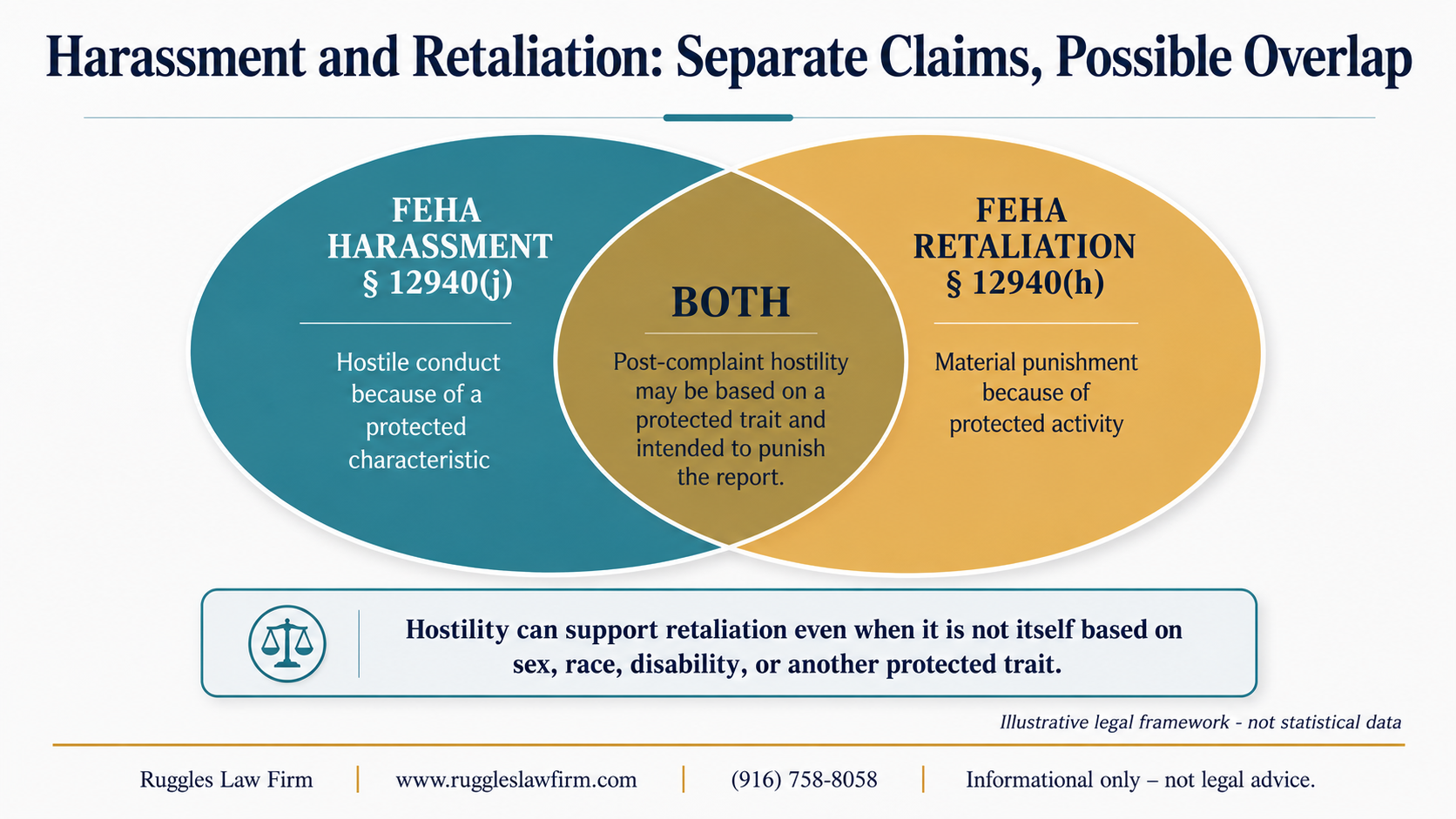
That answer requires a distinction many employees – and some HR departments – blur. California’s Fair Employment and Housing Act, or FEHA, separately prohibits retaliation and harassment. Retaliation under Government Code section 12940(h) is punishment for opposing conduct prohibited by FEHA or for participating in a FEHA complaint or proceeding. Harassment under section 12940(j) generally means severe or pervasive hostile conduct because of sex, race, disability, age, or another protected characteristic. The same facts can fit one box, both boxes, or neither. Law is considerate that way.
I’m Matt Ruggles, and I have practiced California employment law for more than 30 years. I began my career representing employers and now represent employees exclusively. I wrote this guide for employees who spoke up about discrimination or harassment and then found themselves targeted in a new way. The goal is to explain what retaliation is, what harassment is, what is not harassment, when hostility becomes actionable retaliation, and what evidence usually matters.
Key Takeaways About Retaliatory Harassment in California
- A FEHA retaliation claim generally requires protected activity, a materially adverse employment action, and a causal link between the two.
- California courts evaluate an alleged retaliatory campaign collectively and in context; a series of smaller acts can matter even when no single act would support a claim by itself.
- Workplace harassment that is sufficiently severe or pervasive can itself qualify as an adverse employment action for retaliation purposes.
- A separate FEHA harassment claim ordinarily requires hostile conduct tied to a protected characteristic and conduct severe or pervasive enough to alter the work environment.
- Mere social slights, ordinary criticism, legitimate performance management, or general unpleasantness usually are not enough – although the timing, manner, and surrounding pattern can change the analysis.
- Purposeful obstruction of a complaint, threats for continuing to report, public humiliation, sabotage, and coordinated isolation can be materially different from simple inaction or office awkwardness.
What Is Workplace Retaliation Under California Law?
In plain English, retaliation is work-related punishment because an employee exercised a protected right. The punishment does not have to arrive as a termination letter. California law recognizes that employers can punish employees through demotions, bad assignments, discipline, schedule cuts, denied opportunities, threats, exclusion from information needed to perform the job, or a sustained campaign that makes continued employment materially harder.
Under section 12940(h), it is unlawful to discharge or otherwise discriminate against a person because the person opposed practices forbidden by FEHA or filed, testified, or assisted in a FEHA proceeding. The California Supreme Court states the familiar three-part framework in Yanowitz v. L’Oreal USA, Inc. (2005) 36 Cal.4th 1028: protected activity, adverse employment action, and a causal link. The current California civil jury instruction uses the same basic structure and asks whether protected activity was a substantial motivating reason for the employer’s decision.
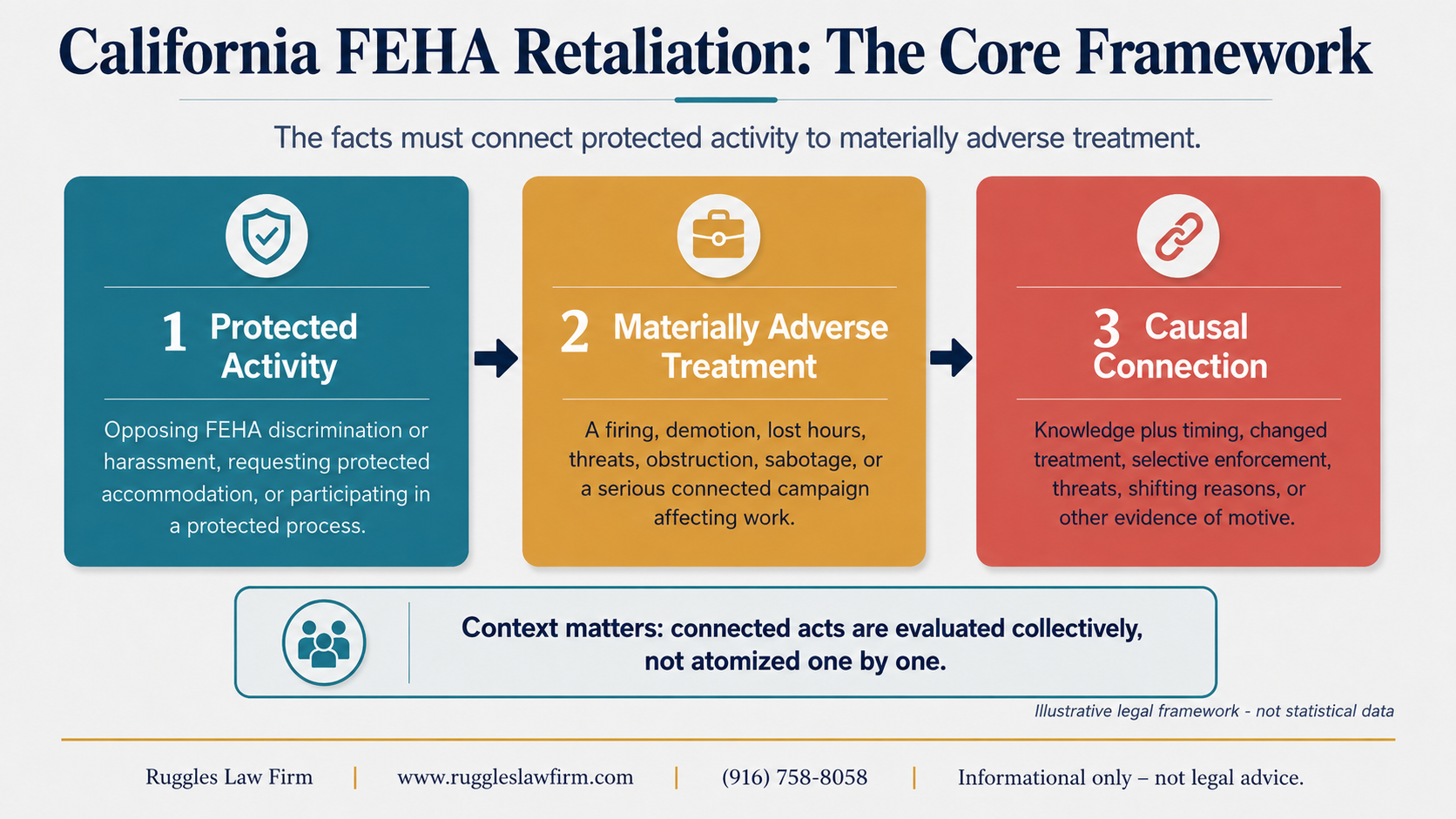
Element 1: Protected Activity
Protected activity under FEHA includes reporting or opposing discrimination or harassment, assisting another employee’s complaint, participating in an investigation, filing with the California Civil Rights Department, and requesting disability or religious accommodation. The employee does not have to prove the underlying complaint ultimately would have won. Under Yanowitz, opposition is protected when the employee reasonably and in good faith believes the conduct is unlawful.
There are two practical limits. First, the concern must fit a law. A complaint that a supervisor is rude, plays favorites, or makes bad business decisions may not be FEHA-protected unless the employee connects it to discrimination, harassment, accommodation, or another protected right. Second, the employer must know enough to understand that the employee is opposing potentially unlawful conduct. No magic words are required, but a complaint so vague that it sounds like a personality dispute creates an avoidable proof problem.
For a deeper discussion, see Protected Activity in California Retaliation Cases: What Counts?
Matt’s Practical Tip
Describe facts, identify the protected basis honestly, and ask for an investigation. A sentence such as ‘I believe I am being targeted because of my disability and because I requested accommodation’ is much more useful than ‘my boss is toxic.’ Accurate legal clarity is not aggression. It is documentation.
See How to Make a Workplace Complaint in California: Verbal vs. Written
Element 2: A Materially Adverse Employment Action
An adverse employment action is not limited to firing or demotion. Yanowitz explains that FEHA reaches the spectrum of employment actions reasonably likely to adversely and materially affect job performance or career advancement. The court also drew a limit: a mere offensive utterance or even a pattern of social slights ordinarily does not materially affect employment. The question is objective and contextual.
California courts also resist the employer’s favorite slicing exercise – examining each incident alone, declaring each one small, and then pretending the pattern never happened. Retaliatory acts may be considered collectively. A campaign of selective discipline, isolation from essential meetings, public disparagement, withheld support, and threats may materially alter employment even if each event would look less serious on a blank sheet of paper.
Element 3: A Causal Connection
The employee must connect the treatment to the protected activity. Useful evidence can include close timing, proof that the decision-maker knew about the complaint, a sudden change from positive to negative reviews, statements showing anger about the report, selective enforcement of rules, treatment different from comparable employees, skipped procedures, and explanations that shift as questions become harder. Timing matters, but timing alone is not always enough. The calendar can raise an eyebrow; it cannot always carry the entire case.
What Is Workplace Harassment Under California Law?
Employees use the word harassment to describe many kinds of mistreatment. The legal definition is narrower. Under Government Code section 12940(j), FEHA prohibits harassment because of protected characteristics such as sex, gender, race, national origin, disability, medical condition, religion, age, sexual orientation, gender identity or expression, and other listed traits. The conduct can be verbal, visual, physical, digital, or relational. A loss of pay or other tangible benefit is not required.
A hostile-work-environment claim generally asks whether the conduct was severe or pervasive enough to alter working conditions. It need not be both. Government Code section 12923 emphasizes the totality of the circumstances, recognizes that a single incident can create a triable issue when sufficiently serious, and states that a victim need not prove a measurable decline in productivity. The work can still get done while the law is being violated.
The California Supreme Court’s recent decision in Bailey v. San Francisco District Attorney’s Office makes the point vivid. The court held that a jury could find a coworker’s one-time use of an extreme racial epithet sufficiently severe under the totality of the circumstances. The court did not declare every isolated remark actionable. It rejected the opposite shortcut: that one incident can never be enough.
For a fuller explanation of the basic line, see What Is and Is Not Workplace Harassment Under California Law.
What Is Not Workplace Harassment?
California law is not a general workplace civility code. A workplace can be unpleasant, badly managed, or unfair without violating FEHA. That is not an endorsement of bad management. It is the line the statute draws. General bullying, office politics, favoritism unrelated to a protected trait, personality conflicts, a curt email, an eye roll, ordinary job criticism, or a manager who is equally abrasive to everyone usually do not constitute FEHA harassment. See Workplace Bullying vs. Workplace Harassment in California.
Personnel management decisions also are not automatically harassment. Hiring, firing, assignments, discipline, performance reviews, scheduling, and corrective counseling are activities supervisors must perform. Janken v. GM Hughes Electronics (1996) 46 Cal.App.4th 55, 63-65, and Reno v. Baird (1998) 18 Cal.4th 640, 646-647, explain that commonly necessary personnel actions generally are not harassment merely because the employee dislikes or disputes them.
But do not stop there. In Roby v. McKesson Corp. (2009) 47 Cal.4th 686, 706-710, the California Supreme Court explained that discrimination and harassment are distinct but can overlap. A personnel action may be relevant to harassment when it helps communicate a hostile message, and the demeaning manner in which a legitimate management issue is handled can matter. A performance review is not a legal sacrament. Its timing, language, audience, accuracy, and place in a larger campaign all remain evidence.
Conduct that usually is not harassment or retaliation by itself includes:
- A supervisor giving accurate, work-related criticism in a professional manner.
- A neutral policy change that affects the team rather than the reporting employee alone.
- A good-faith investigation that asks difficult but relevant questions.
- A coworker becoming temporarily awkward after learning about a complaint.
- A preexisting performance process supported by records created before protected activity.
- A single social snub, rude remark, or minor inconvenience with no material work consequence.
Matt’s Observation
Employees often ask whether one event is ‘enough.’ The better question is what the event means in context. One eye roll is probably an eye roll. A threat from the HR director who has just blocked your harassment complaint is not simply poor facial etiquette.
When Can Harassment Become Retaliation in California?
Harassment can become retaliation when the hostility is used as punishment for protected activity and is materially adverse when viewed as a whole. The motive is different from a traditional hostile-environment claim. Traditional FEHA harassment is hostile conduct because of a protected characteristic. Retaliatory harassment is hostile conduct because the employee complained, opposed unlawful conduct, requested protected accommodation, or participated in a protected process.
Sometimes the same conduct supports both claims. Suppose a woman reports sex-based comments. Her supervisor then intensifies the sexual ridicule specifically to punish the report, strips her client access, and tells coworkers she cannot be trusted. The post-complaint sexual conduct may support harassment under section 12940(j), while the entire punitive campaign may support retaliation under section 12940(h). Separate legal theories; overlapping facts.
Other times the new hostility is not based on sex, race, disability, or another trait at all. A manager may mock the employee for being a ‘complainer,’ threaten consequences for escalating to corporate HR, withhold information, encourage coworkers to isolate the employee, or engineer failure. That conduct may not be a standalone section 12940(j) harassment claim, but it can still be evidence of an adverse retaliatory course under section 12940(h).
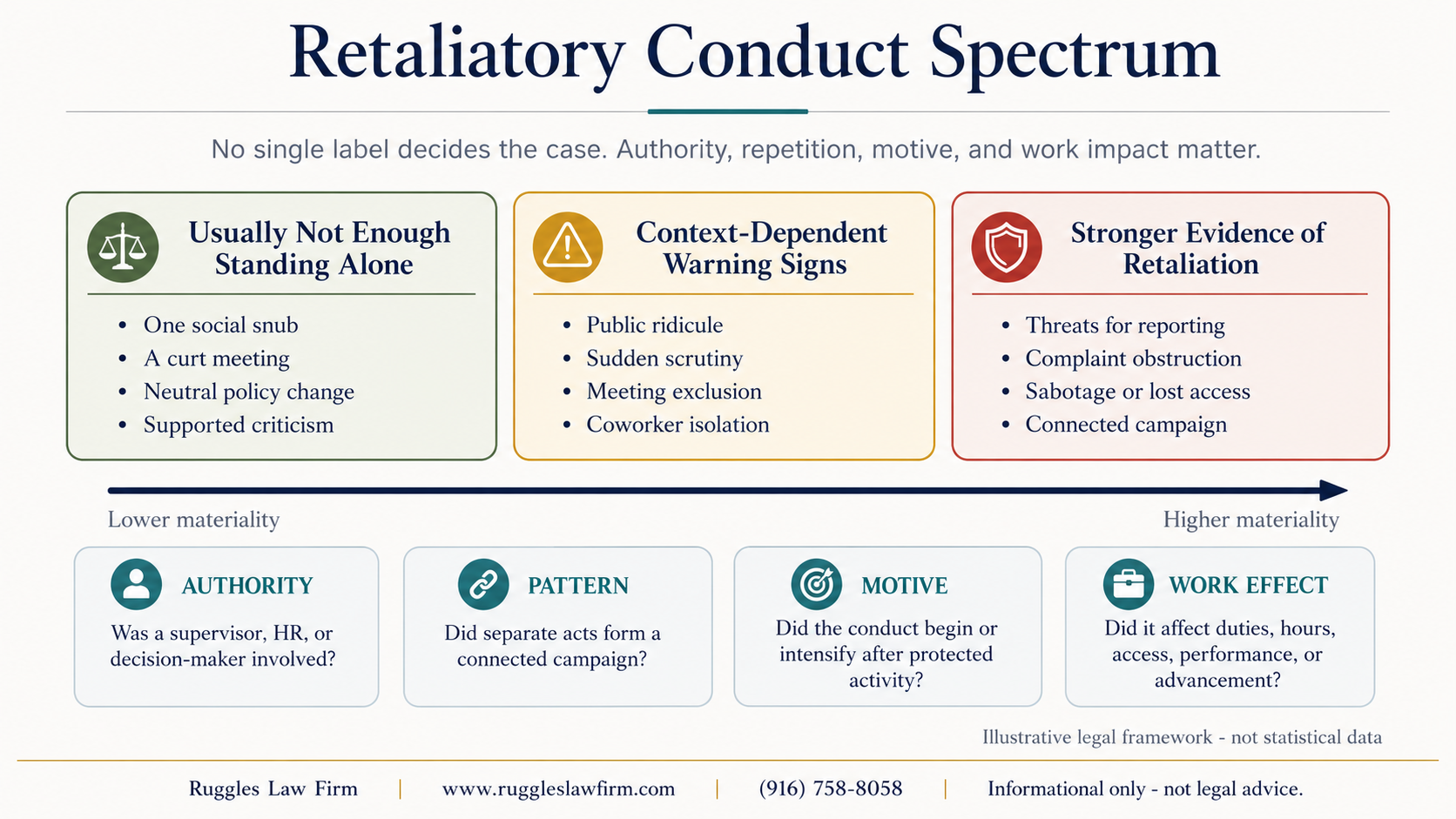
Examples That Can Support a Retaliatory-Harassment Claim
- A supervisor repeatedly humiliates the employee in front of clients or coworkers only after the employee reports harassment.
- HR deliberately blocks the complaint process, warns the employee to stop escalating, or threatens punishment for continuing.
- Management strips meaningful duties, denies access to necessary systems, withholds information, or sets impossible deadlines designed to create failure.
- The employee is subjected to coordinated monitoring, selective discipline, false accusations, or public attacks that materially damage performance or advancement.
- Coworker hostility is encouraged, directed, ratified, or knowingly used by management as a way to punish the employee.
- A series of smaller acts – worse shifts, exclusion from key meetings, revoked training, denied opportunities, and repeated ridicule – forms a connected punitive campaign.
Examples That Usually Are Not Enough Standing Alone
- A coworker stops making small talk or declines lunch invitations.
- A manager is curt during one meeting but takes no action affecting the employee’s work.
- HR conducts a fair investigation and limits disclosure to people who need the information.
- The employee receives criticism supported by records created well before the complaint.
- A business reorganization changes duties for multiple employees for documented reasons.
- The employer fails to investigate, without additional facts showing purposeful obstruction or punishment; inaction may matter to harassment liability, but it is not automatically retaliation.
Published California Cases That Explain Retaliatory Harassment
Bailey v. San Francisco District Attorney’s Office (2024) 16 Cal.5th 611
Bailey is the most direct modern California authority. An employee reported an extreme racial slur. She alleged that the HR manager then obstructed a formal complaint, chastised her for discussing the incident, became increasingly hostile, and threatened that she would suffer consequences. The California Supreme Court held that a course of conduct effectively withdrawing the employee’s means of reporting and addressing harassment could constitute an adverse employment action. It emphasized collective and contextual review, while carefully stating that an employer’s mere failure to investigate is not automatically retaliation. The court found triable issues; it did not decide ultimate liability. Key pages: 16 Cal.5th at 629-634 (harassment) and 638-641 (retaliation).
Yanowitz v. L’Oreal USA, Inc. (2005) 36 Cal.4th 1028
Yanowitz supplies the governing FEHA retaliation framework. It holds that protected opposition can rest on a reasonable, good-faith belief; defines adverse action broadly but excludes mere offensive utterances and social slights; requires a practical appreciation of workplace realities; and allows connected acts to be considered together. Most important here, the court expressly recognized that workplace harassment, if sufficiently severe or pervasive, can itself constitute an adverse employment action. Key pages: 36 Cal.4th at 1042-1044, 1052-1056, 1060-1061.
Light v. Department of Parks & Recreation (2017) 14 Cal.App.5th 75
The published portion of Light applied the collective approach to a course of alleged retaliation. The employee presented evidence of isolation and relocation, threats and a physical confrontation, revoked training, a denied promotion, and hours reduced to zero. The Court of Appeal held that the whole course could create a triable issue even though criticism or ostracism alone ordinarily would not. The opinion reiterates that sufficiently severe or pervasive workplace harassment can satisfy retaliation’s adverse-action element. Key pages: 14 Cal.App.5th at 91-93.
Roby, Reno, and Janken: Management Decisions Versus Harassing Conduct
Janken and Reno explain that necessary personnel decisions ordinarily are discrimination or retaliation issues, not harassment merely because they are disputed. Roby prevents that distinction from becoming an evidence shredder. Personnel actions can help prove harassment when they communicate a hostile message, and unnecessarily demeaning implementation can itself be harassing. Together, the cases require a realistic analysis of both the official action and the interpersonal conduct surrounding it.
How Do You Prove Harassment Was Retaliation?
Retaliation rarely arrives with a memo titled ‘Punishment for Protected Activity.’ It usually appears as a story about performance, attitude, insubordination, fit, restructuring, or communication. The employee’s task is not merely to prove that treatment became unpleasant. It is to show a protected event, a material change, and evidence that the change was motivated by the protected event.
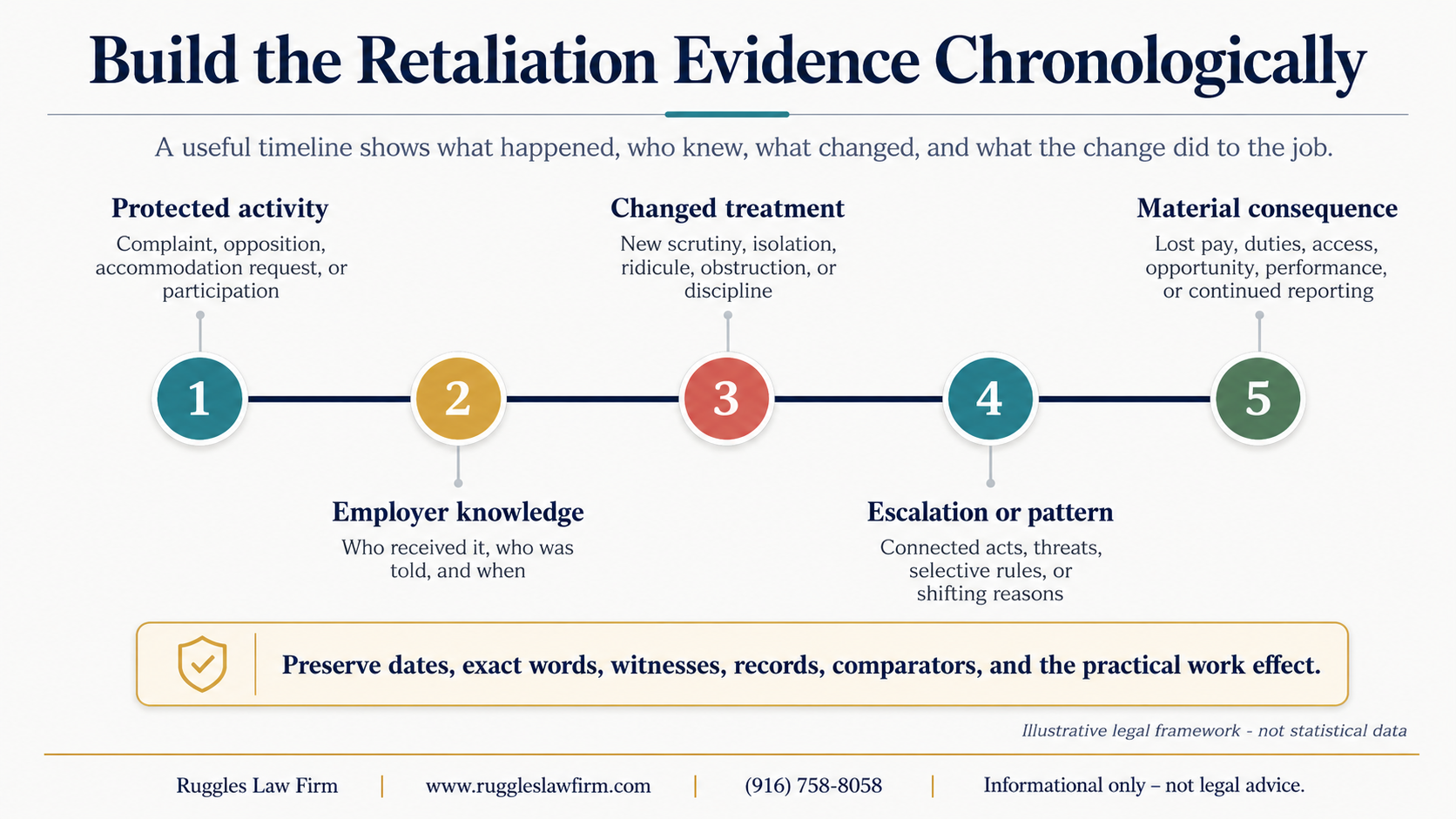
The most useful evidence often includes:
- The protected complaint itself. Preserve the email, intake form, text, meeting confirmation, or witness who heard it. A clear written complaint reduces arguments about what the employer knew.
- A before-and-after timeline. Record dates, actors, exact words, witnesses, and work consequences. Compare the period before the complaint with the period after it.
- Decision-maker knowledge. Identify who knew about the protected activity and when. Suspicious timing means little if the relevant actor genuinely had no knowledge.
- Performance history. Save reviews, praise, awards, quota data, attendance records, and prior coaching. A sudden negative narrative is more revealing when it conflicts with the existing record.
- Comparators and selective enforcement. Note whether similarly situated employees who did not complain were treated differently for comparable conduct.
- Shifting explanations. Compare what the employer said in meetings, emails, discipline, termination documents, and unemployment proceedings. Evolution under pressure is not always clarification.
- Material effect. Document lost pay, hours, duties, training, clients, support, access, advancement, or the practical effect of threats and obstruction on your ability to work and report misconduct.
- Witnesses and contemporaneous reactions. Identify people who observed threats, ridicule, changed treatment, or management instructions. A case can proceed without eyewitnesses, but corroboration helps.
For practical preservation guidance, read How to Document and Prove Sexual Harassment in California and Sexual Harassment Without Witnesses in California. The evidence principles apply beyond sexual harassment. Preserve only materials you are lawfully entitled to possess. Do not access accounts after authorization ends, take trade secrets, or copy privileged material merely because it might be useful. A strong case does not improve when the evidence was collected by creating a second problem.
What If HR Ignores, Minimizes, or Blocks the Complaint?
An inadequate investigation can matter, but it must be analyzed precisely. Under section 12940(j), an employer can face liability for coworker harassment when management knew or should have known and failed to take immediate and appropriate corrective action. Under section 12940(k), employers also must take reasonable steps to prevent discrimination and harassment. Those are not automatically retaliation claims.
Bailey draws the line. Mere inaction – simply failing to investigate further – is not necessarily an act of retaliation. Purposeful obstruction, intimidation, or threats designed to stop the employee from using the complaint process can be. Ask whether HR was merely ineffective, or whether someone with authority actively withdrew access, blamed the reporter, threatened consequences, or escalated hostility because the employee persisted. See What If HR Ignores Your Sexual Harassment Complaint in California?
What Should an Employee Do About Possible Retaliatory Harassment?
- Write down the protected activity. Identify exactly what you reported, when, to whom, and why you believed it involved a protected right.
- Document the changed treatment separately. Do not assume the first complaint automatically covers later retaliation. Report the new conduct factually and identify its timing.
- Use precise language. Explain the work impact: removed responsibilities, lost hours, denied access, threats, sabotaged deadlines, public humiliation, or blocked reporting. Avoid conclusions unsupported by facts.
- Follow policy when reasonably possible. Escalate to another HR representative, compliance channel, owner, board contact, or designated hotline when the first recipient is involved or refuses to act.
- Preserve records lawfully. Keep copies of your own complaints, schedules, reviews, pay records, and communications you are permitted to retain. Do not secretly record confidential conversations without legal advice; California recording law can create serious issues.
- Keep performing where possible. Continue meeting legitimate expectations and respond calmly to inaccurate discipline in writing. Retaliation cases are easier to defend when the employee gives the employer no genuine performance distraction.
- Do not resign impulsively. Constructive discharge has a demanding standard, and resignation can change damages and strategy. Get individualized advice before making an irreversible decision when circumstances allow.
- Calendar deadlines. A FEHA complaint generally must be filed with the California Civil Rights Department within three years of the unlawful practice under Government Code section 12960(e)(5). A civil action ordinarily must be filed within one year after the right-to-sue notice under section 12965(c), subject to exceptions and tolling rules. Other claims can have much shorter deadlines, especially against public entities.
Timing questions are fact-specific. Read California Employment Discrimination: Deadlines to File a Lawsuit, but do not use a general article as a personal calendar. Missing a deadline does not become less final because the underlying facts were compelling.
Matt’s Legal Perspective
Retaliatory harassment often begins before the employer makes its final move. The paperwork starts growing. The tone changes. Ordinary mistakes become character flaws. Meetings you need become meetings you were never supposed to attend. Do not focus only on whether each event is outrageous. Document whether the events are connected, selective, and materially changing your ability to succeed.
Who Can Be Liable, and What Remedies May Be Available?
The employer is the usual defendant on a FEHA retaliation claim. In Jones v. The Lodge at Torrey Pines Partnership (2008) 42 Cal.4th 1158, the California Supreme Court held that nonemployer individuals generally are not personally liable for FEHA retaliation. Harassment is different: section 12940(j)(3) expressly imposes personal liability on an employee who personally commits prohibited harassment. Other statutes and common-law claims can alter the defendant analysis, so labels should not be chosen casually.
Depending on the facts and defendants, remedies can include lost wages and benefits, emotional-distress damages, injunctive relief, reinstatement or front pay in appropriate cases, attorney’s fees, and sometimes punitive damages against qualifying private defendants. Public-entity rules and proof requirements differ. The value of a claim depends on liability evidence, damages, mitigation, credibility, and collectability – not on an online calculator with an encouraging font.
The Bottom Line: Harassment Can Be Retaliation, but Context Controls
California law does recognize harassment as a possible form of retaliation. Yanowitz says sufficiently severe or pervasive workplace harassment can itself be an adverse employment action. Light shows that a series of connected injuries must be viewed together. Bailey confirms that purposeful obstruction, intimidation, and threats aimed at stopping an employee from pursuing a harassment complaint can be actionable retaliation.
But the law also preserves boundaries. General rudeness, ordinary criticism, social discomfort, and legitimate management do not become illegal merely because they happen after a complaint. The employee still must show protected activity, material harm, and a causal connection. The strongest cases usually have a clear complaint, decision-maker knowledge, an identifiable change, a connected pattern, objective work consequences, and an employer explanation that does not survive contact with its own records.
If your workplace became hostile after you reported discrimination or harassment, do not assume every bad act is retaliation – and do not assume the absence of a firing means you have no claim. Call the Ruggles Law Firm at 916-758-8058 for an initial consultation of your circumstances. You can also review our workplace retaliation practice page.
Frequently Asked Questions
These answers provide general California information. Individual facts, employers, statutes, and deadlines can change the analysis.
Frequently Asked Questions: Harassment as Retaliation in California
These answers provide general information, not individualized legal advice.
Related Ruggles Law Firm Guides
- Protected Activity in California Retaliation Cases
- How to Make a Workplace Complaint in California
- What Is and Is Not Workplace Harassment Under California Law
- Workplace Bullying vs. Workplace Harassment in California
- Examples of Workplace Harassment in California
- How to Document and Prove Sexual Harassment in California
- Sexual Harassment Without Witnesses in California
- What If HR Ignores Your Sexual Harassment Complaint?
- Is Being Fired After Filing a Complaint Wrongful Termination?
- Fired for a False Reason in California
- California Employment Discrimination: Deadlines to File a Lawsuit
Updated 07/13/2026
Contact the Ruggles Law Firm at 916-758-8058 to Evaluate Your Potential Lawsuit Matt Ruggles has a thorough understanding of California employment laws and decades of practical experience litigating employment law claims in California state and federal courts. Using all of his knowledge and experience, Matt and his team can quickly evaluate your potential claim and give you realistic advice on what you can expect if you sue your former employer.
Contact the Ruggles Law Firm at 916-758-8058 for an initial consultation. Blog posts are not legal advice and are for information purposes only.