
When Sexual Harassment Turns Into Workplace Retaliation in California
By Matthew J. Ruggles
An employee reports sexual comments, unwanted touching, repeated invitations, or a supervisor’s conduct at a work event. The original behavior may stop. Then a different campaign begins: prolonged staring, “snitch” labels, threats, public ridicule, isolation, impossible assignments, revoked training, or a sudden effort to make the employee fail. The question becomes: can that new harassment also be illegal retaliation?
The Direct Answer:
Yes. Under California’s Fair Employment and Housing Act (FEHA), harassment can itself qualify as a materially adverse employment action when it is sufficiently serious or cumulative, is used to punish protected activity, and materially affects the employee’s work or access to workplace protections. But sequence and context matter. Pre-complaint misconduct cannot be retaliation for a later complaint, mere inaction is not automatically retaliation, and ordinary social slights usually are not enough.
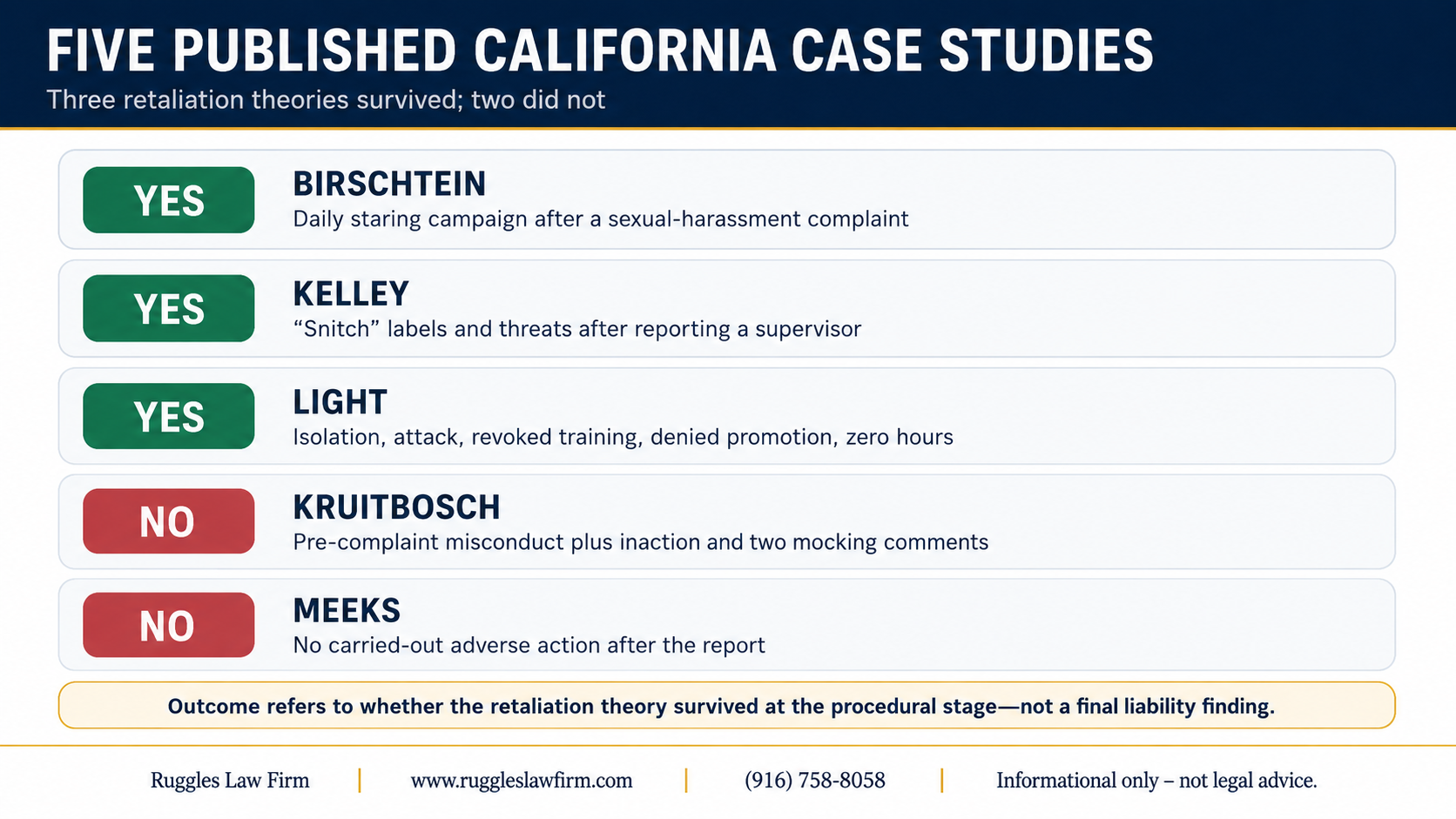
I’m Matt Ruggles. I have practiced California employment law for more than 30 years, first representing employers and now representing employees exclusively. This article is a case-study companion to my broader guide, Can Harassment Be Retaliation Under California Law?. It focuses on five published California decisions involving sexual-harassment complaints and alleged retaliation—three in which the retaliation theory survived and two in which it did not.
Key Takeaways About Sexual Harassment and Retaliation in California
- Reporting sexual harassment, supporting another employee’s complaint, and participating in an investigation can be protected activity under FEHA.
- Retaliation is not limited to termination or demotion. A sufficiently serious course of hostile treatment can materially affect employment.
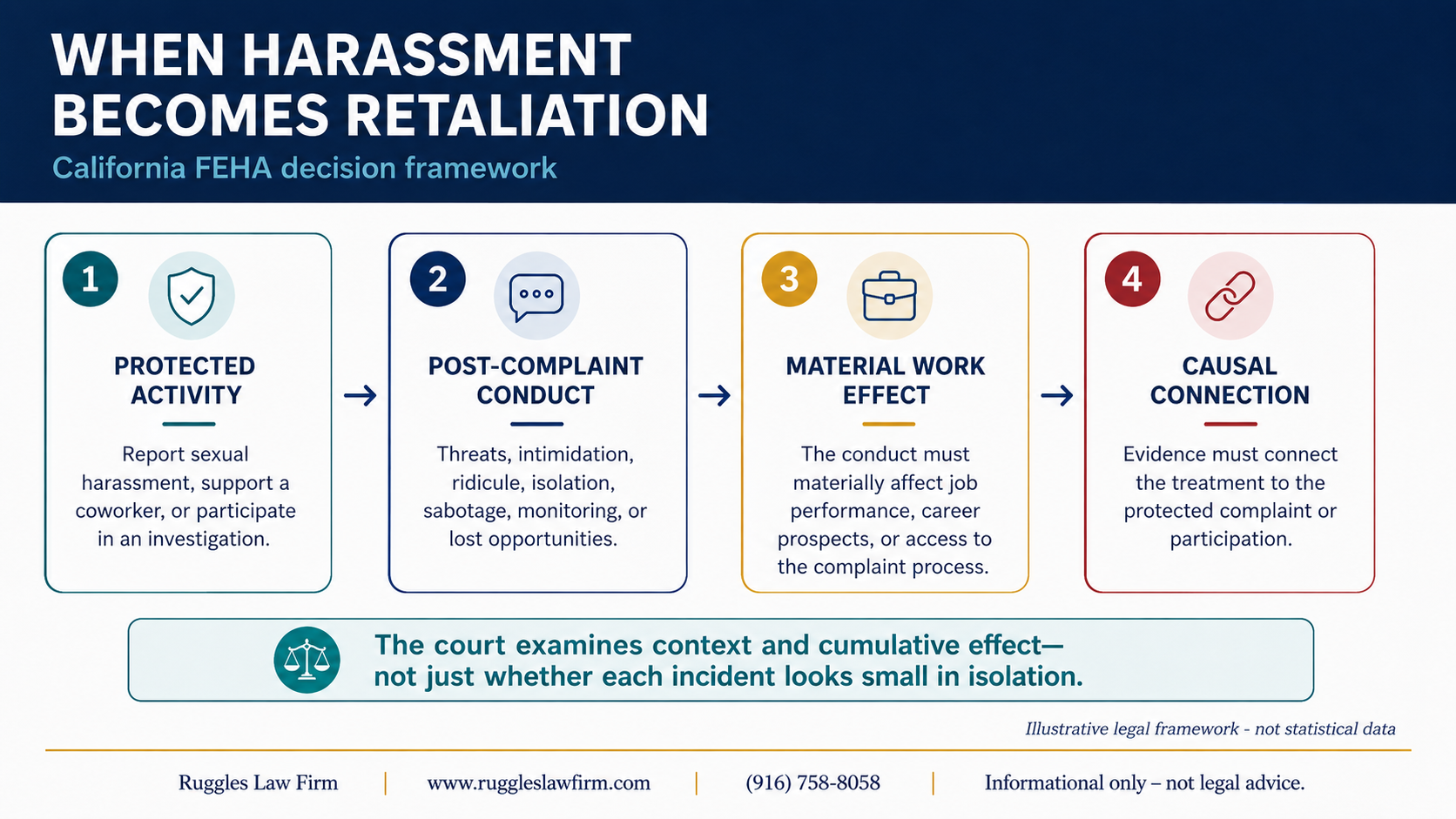
- California courts evaluate connected acts collectively and in workplace context rather than dismissing each event as “small” in isolation.
- The post-complaint conduct does not have to be sexual. Its retaliatory character comes from the motive: punishment for speaking up.
- A retaliation claim can survive even when the underlying harassment claim does not, if the employee held a sincere and objectively reasonable good-faith belief.
- Employer inaction may support liability for the underlying harassment, but inaction by itself is not automatically a retaliatory adverse action. Purposeful obstruction, threats, or a post-complaint hostile campaign are different.
- Timing helps, but the strongest cases also show employer knowledge, a clear change in treatment, material work consequences, and evidence connecting the change to the complaint.
The California Legal Framework: Harassment, Retaliation, and the Overlap
California law treats harassment and retaliation as related but distinct wrongs. Understanding the difference makes the five case studies much easier to evaluate.
Sexual harassment under Government Code section 12940(j)
California Government Code section 12940(j) prohibits harassment because of sex, gender, gender identity, gender expression, pregnancy, childbirth, sexual orientation, and other protected characteristics. A tangible loss such as reduced pay is not required. Current law also states that sexually harassing conduct need not be motivated by sexual desire.
A hostile-work-environment claim generally asks whether the conduct was severe or pervasive enough to alter working conditions. Under Government Code section 12923, a single incident can create a triable issue if sufficiently serious, the totality of the circumstances controls, measurable productivity loss is unnecessary, and a workplace’s historically rough culture does not lower the legal standard. For a deeper explanation, see Severe vs. Pervasive Sexual Harassment in California and Workplace Bullying vs. Workplace Harassment in California.
Retaliation under Government Code section 12940(h)
Section 12940(h) prohibits an employer or other covered person from discharging or otherwise discriminating against someone because the person opposed a practice forbidden by FEHA or filed, testified, or assisted in a FEHA proceeding. The familiar framework from Yanowitz v. L’Oréal USA, Inc. (2005) 36 Cal.4th 1028 asks whether the employee engaged in protected activity, experienced a materially adverse employment action, and can show a causal connection between the two.
Yanowitz also explains why retaliation can look like harassment. California law reaches the spectrum of employment actions reasonably likely to affect job performance or career advancement. Connected acts can be considered together, and sufficiently severe or pervasive workplace harassment may itself satisfy retaliation’s adverse-action requirement. Mere offensive remarks, social slights, and trivial inconveniences ordinarily do not.
Protected activity is discussed in more detail in Protected Activity in California Retaliation Cases: What Counts?. The employee does not need to predict the ultimate legal outcome perfectly. A reasonable, sincere, good-faith belief that the conduct violates FEHA can be enough.
The same facts can support both claims—or only one
Suppose an employee reports sex-based ridicule. The supervisor then intensifies the sexual comments to punish the report, strips the employee’s client access, and tells coworkers to freeze the employee out. The post-complaint sexual conduct may support a harassment claim under section 12940(j), while the entire punitive course may support retaliation under section 12940(h).
In a different case, the new hostility may contain no sexual content. Coworkers may call the employee a “snitch,” threaten consequences, refuse safety support, or block information needed to perform the job. That conduct may not be harassment because of sex, but it may be retaliatory harassment because it is punishment for reporting sexual harassment.
Five Published California Case Studies
Birschtein: The Sexual Comments Stopped, but the Staring Campaign Began
Post-complaint nonverbal conduct can be retaliatory harassment.
In Birschtein v. New United Motor Manufacturing, Inc. (2001) 92 Cal.App.4th 994, an assembly-line employee alleged that a coworker repeatedly asked her for dates and made explicit sexual remarks and fantasies. She complained to management. After the complaint, the coworker stopped speaking to her—but allegedly began driving slowly past her fixed workstation and staring at her repeatedly, sometimes stopping behind a pillar for several minutes. She could not simply relocate; her job required her to remain at the line.
The employer argued that staring was not actionable and that management had not imposed a traditional adverse action. The Court of Appeal rejected that categorical approach. In light of the earlier sexual conduct and the timing, a jury could find that the overt harassment had been transformed into a daily retaliatory staring campaign connected to the complaint. The court also left employer responsibility for the coworker’s conduct for further proceedings because management knew about the alleged conduct and its response was disputed.
Why the retaliation theory survived
The alleged conduct occurred after protected activity, was repeated and unavoidable, grew directly out of the earlier sexual harassment, and could be viewed as intimidation rather than a random glance. The court treated the sequence as a connected course instead of separating the sexual comments from the later staring.
The practical lesson is that retaliatory harassment does not need a spoken threat. Nonverbal intimidation, surveillance, blocking, leering, following, or repeated presence can matter when the context supplies the message. Document frequency, duration, location, witnesses, facial expressions or gestures, and why the conduct interfered with work. My guide on How to Document and Prove Sexual Harassment in California explains how to create a factual record without exaggeration.
Kelley: Coworkers Called Him a “Snitch” and Threatened Violence After He Reported a Supervisor
The underlying harassment claim failed, but the retaliation claim survived.
In Kelley v. The Conco Companies (2011) 196 Cal.App.4th 191, a male apprentice ironworker complained after a male supervisor directed graphic sexual insults and gestures at him. At later job sites, coworkers allegedly called him names tied to his report—including “snitch” and “narc”—and threatened to beat him. Kelley said he complained to company personnel repeatedly and that a supervisor heard some of the comments but did not intervene.
The Court of Appeal affirmed dismissal of Kelley’s sexual-harassment claim under the analysis then applied, but it reversed summary adjudication of his retaliation claim. His complaint could still be protected because he reasonably and in good faith believed the supervisor’s conduct violated FEHA. The post-complaint threats and complaint-focused labels created a clear inference of coworker retaliation. The court held that an employer may be liable for coworker retaliatory conduct when it knew or should have known, participated or encouraged the conduct, or failed to take reasonable steps to end it.
Why this case matters
Retaliation protection would be nearly useless if it disappeared whenever an employee’s original legal assessment was imperfect. Kelley separates the two questions: Was the original complaint reasonably made in good faith? And did the workplace punish the employee for making it?
Kelley comes with an important current-law caution. In 2019, the Legislature enacted section 12923(d), which rejects the idea that a workplace’s rough culture changes the legal harassment standard and expressly disapproves contrary language, reasoning, or holdings in Kelley. Current section 12940(j)(4)(C) also states that sexual desire is not required. The case remains important for its retaliation analysis, but its older harassment discussion should not be treated as the last word on present California law.
This study also shows why employees should not write only “my boss is inappropriate” or “the crew is toxic.” A complaint should identify the conduct, the protected basis, and the requested response. See Mistakes Employees Make When Reporting Sexual Harassment in California for examples of language that creates a clearer record.
Light: A Witness Supported a Coworker’s Sexual-Harassment Complaint and Became a Target
Participation in another employee’s investigation is protected activity.
In Light v. Department of Parks & Recreation (2017) 14 Cal.App.5th 75, a state employee participated in an internal investigation of a coworker’s complaint alleging sexual harassment and discrimination. Light’s evidence described a workplace in which management pressured employees about the investigation, accused her of betrayal when she would not disclose what she told investigators, isolated her, confronted her physically and verbally, rescinded promised training, rejected her for a promotion, and ultimately reduced her scheduled hours to zero.
The Court of Appeal held that a reasonable fact finder could view the alleged course collectively as materially adverse retaliation. The court reiterated that workplace harassment, if sufficiently severe or pervasive, can itself qualify as an adverse employment action. It also emphasized concrete employment consequences: lost training, a denied opportunity, changed placement, and no scheduled hours.
Why the retaliation theory survived
Light did not merely experience awkwardness after an investigation. The alleged hostility was linked to her participation, included intimidation and an attack, and was accompanied by decisions affecting training, promotion, location, and hours. The cumulative record mattered.
The broader lesson is that FEHA protects more than the person who made the original sexual-harassment complaint. Witnesses, corroborating employees, and participants in an investigation may also engage in protected activity. A manager cannot lawfully demand loyalty to the accused, pressure a witness to change an account, or punish someone for cooperating honestly.
Employees in that position should preserve the investigation request, interview date, any instruction about confidentiality, and later comments revealing anger about participation. A case can exist without eyewitnesses to every event; my article Sexual Harassment Without Witnesses in California explains how chronology and corroborating records can still establish credibility.
Kruitbosch: The Harassment Theory Survived, but Retaliation Did Not
Pre-complaint misconduct and mere inaction are not automatically retaliatory acts.
In Kruitbosch v. Bakersfield Recovery Services, Inc. (2025) 114 Cal.App.5th 200, a male employee alleged that a female coworker sent explicit messages and images and engaged in other sexual conduct away from work while he was on leave. When he returned, he reported the conduct. A supervisor allegedly said the company would do nothing, and an HR representative allegedly mocked the complaint through a social-media post and a sarcastic comment. The employee resigned shortly afterward.
The Court of Appeal reached a deliberately split result. It allowed a hostile-work-environment sexual-harassment theory to proceed based on the employer’s response, reasoning that an employer’s own response to off-site conduct can independently alter the workplace. But it affirmed dismissal of the retaliation and constructive-discharge theories.
Kruitbosch is the cleanest reminder that the same event can support one FEHA theory but not another. A poor response may help prove the employer failed to correct harassment under section 12940(j) or failed to take reasonable preventive steps under section 12940(k). It does not automatically prove that the employer took affirmative action to punish the report.
The boundary is illustrated by Bailey v. San Francisco District Attorney’s Office (2024) 16 Cal.5th 611, a race-harassment case applying the same FEHA retaliation provision. Bailey explains that mere failure to investigate is not necessarily retaliation, but purposeful obstruction, escalating hostility, and threats by an HR manager that effectively withdraw access to the complaint process may be materially adverse. In plain English: incompetence and retaliation can overlap, but they are not synonyms. See also What If HR Ignores Your Sexual Harassment Complaint in California?.
Meeks: Serious Harassment Allegations, but No Post-Report Adverse Employment Action
A harassment case does not automatically establish retaliation.
In Meeks v. AutoZone, Inc. (2018) 24 Cal.App.5th 855, a store manager alleged sexual comments, messages, touching, and other misconduct by a supervisor. She also testified that another manager threatened to fire her and her husband if she did not drop the complaint. AutoZone investigated and ultimately terminated the alleged harasser. The sexual-harassment claims were sent back for a new trial because of evidentiary errors, but the retaliation ruling was different.
The Court of Appeal affirmed summary adjudication for the employer on retaliation. After the report, Meeks remained a store manager and did not identify a loss of classification, position, salary, benefits, hours, promotion, or assignment. The alleged threat was not carried out. On that record, the court found no adverse employment action attributable to the employer after the protected report.
Meeks should not be read as a universal rule that threats never matter. Authority, wording, repetition, surrounding acts, and the threat’s effect on access to HR can change the analysis. Bailey later held that escalating threats and obstruction by an HR manager could support retaliation when viewed as a course of conduct. The careful question is what the threat did in the actual workplace context.
What Separates the “Yes” Cases From the “No” Cases?
The cases produce a practical five-part boundary test. It is not a substitute for the governing jury instructions, but it is a useful way to organize facts before memories blur and records disappear.
1. Did the conduct occur after protected activity?
Facts that strengthen retaliation
The hostile treatment began or intensified after a complaint,
interview, or support for a coworker.
Facts that weaken retaliation
The alleged misconduct ended before the complaint or is simply
the same pre-complaint event.
2. Is the motive connected to the report?
Facts that strengthen retaliation
Comments reference the complaint; decision-makers knew;
treatment changed sharply; rules were selectively enforced.
Facts that weaken retaliation
No evidence the actor knew about the complaint; the conduct
follows a documented preexisting process.
3. Is the effect material in context?
Facts that strengthen retaliation
Threats, essential information withheld, duties or hours lost,
public attacks, career opportunities removed, or HR access blocked.
Facts that weaken retaliation
One awkward interaction, a social snub, ordinary criticism, or
a minor inconvenience with no work consequence.
4. Is the employer responsible?
Facts that strengthen retaliation
Management orchestrated, encouraged, ratified, knew and acquiesced,
or failed to stop a known coworker campaign.
Facts that weaken retaliation
Independent coworker awkwardness that management did not know
about and had no reason to know about.
5. Does the evidence show a connected course?
Facts that strengthen retaliation
A dated timeline, repeated actors, escalating conduct,
inconsistent explanations, and objective work impact.
Facts that weaken retaliation
Speculation based only on timing, without knowledge,
changed treatment, or material consequence.
How to Document Retaliatory Harassment After a Sexual-Harassment Complaint
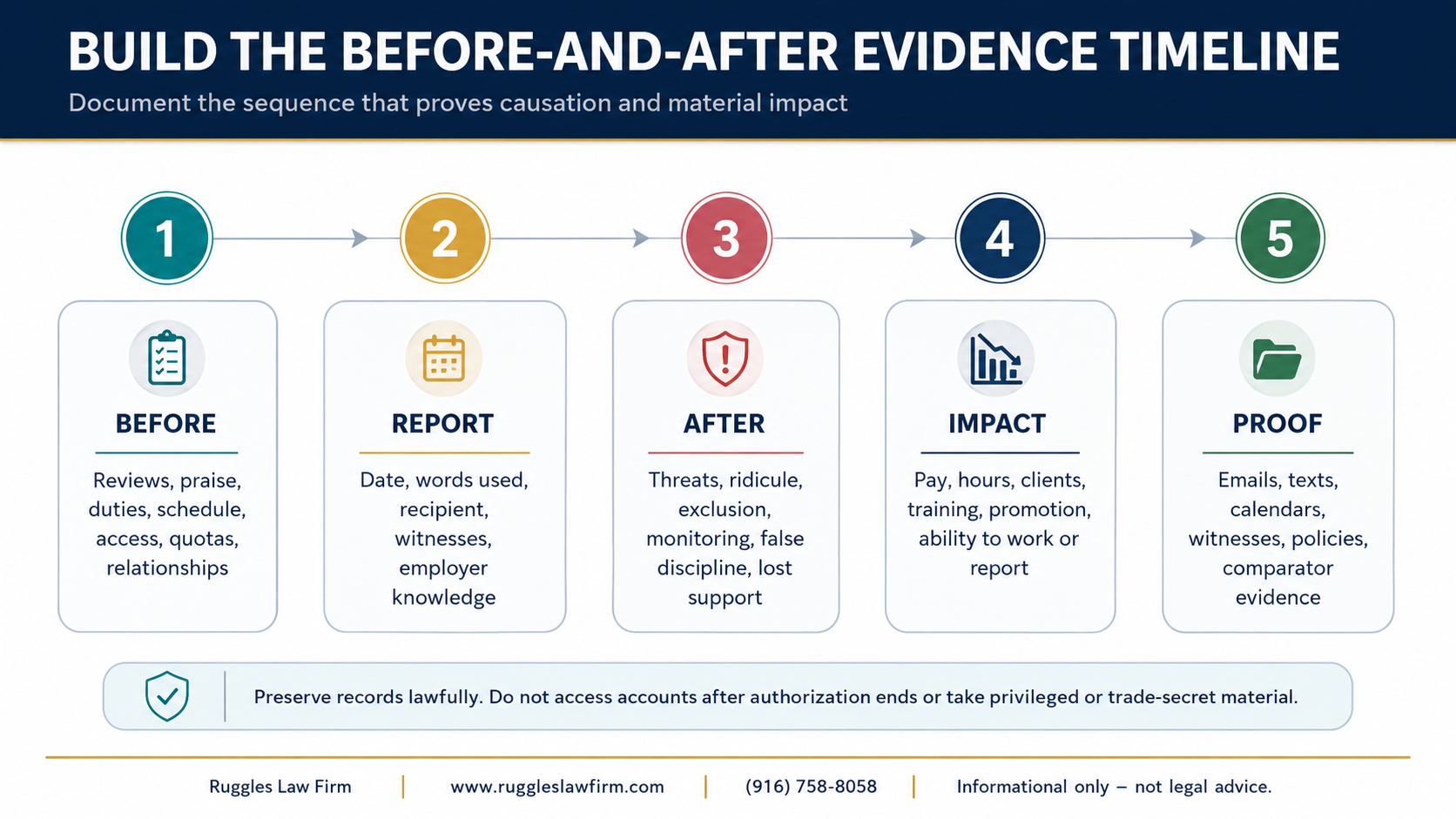
- Preserve the protected report. Keep the email, intake form, meeting invitation, hotline confirmation, or follow-up message showing what you reported and who received it.
- Build the baseline. Save reviews, praise, metrics, schedules, job duties, account lists, training plans, and prior coaching created before the complaint.
- Record each new event. Use dates, exact words, actors, witnesses, location, and work effect. “My manager retaliated” is a conclusion; “on July 8 she removed my two largest accounts and said I should have kept this internal” is evidence.
- Identify employer knowledge. Note when each decision-maker learned of the complaint. Timing is much more probative when knowledge can be shown.
- Document material effects. Track lost hours, pay, duties, clients, access, support, training, promotion opportunities, schedule stability, or the practical effect of threats on reporting and performance.
- Compare treatment. Note whether similarly situated employees who did not complain were treated differently for comparable conduct or performance.
- Preserve shifting explanations. Compare what management said in meetings, emails, discipline, termination documents, unemployment proceedings, and later declarations.
- Collect lawfully. Keep materials you are entitled to possess. Do not access systems after authorization ends, take privileged communications or trade secrets, or secretly record confidential conversations without legal advice.
For step-by-step evidence guidance, read How to Document and Prove Sexual Harassment in California. For practical choices at the moment conduct occurs, see How Should I Respond to Sexual Harassment in California?. Off-site events, conferences, dinners, and work travel can also matter; see Workplace Events and Sexual Harassment in California.
Report the Retaliation as a New Event
An employee’s first complaint does not automatically create a clear record of everything that happens later. When the workplace changes, report the new facts separately and connect them to the earlier protected activity without overstating what you know.
Sample follow-up language
Subject: Follow-Up Report of Retaliation After Sexual-Harassment Complaint
On [date], I reported [brief factual description of the sexual harassment] to [name/title].
Since that report, the following treatment has occurred: [list dated events, actors, exact statements, and work consequences].
Before my report, [brief objective baseline: duties, schedule, reviews, access, or performance]. The change began on [date] after [decision-maker] learned of my complaint.
I am concerned that this treatment is retaliation for reporting sexual harassment. It is affecting my work by [specific material effect]. Please investigate the retaliation, preserve relevant records, and confirm the steps the company will take to prevent further retaliation.
The point is not to sound like a pleading. The point is to give the employer enough factual notice to investigate and to create a dated record of protected activity, knowledge, changed treatment, and work impact. For guidance on whether reporting can affect career prospects—and how to reduce that risk—read Does Reporting Sexual Harassment Hurt Your Career in California?.
When HR Inaction Is Not Retaliation—and When HR Conduct Crosses the Line
Kruitbosch and Bailey should be read together. An employer’s mere failure to investigate a complaint is not, standing alone, a retaliatory adverse action for making that same complaint. The failure may still be important to the underlying harassment claim and the employer’s duty to prevent and correct harassment. But retaliation ordinarily requires punishment or a materially adverse response because the employee complained.
The analysis changes when HR does more than nothing. Purposeful obstruction, blaming the reporter, threatening career consequences, refusing access to the complaint channel available to others, coordinating ostracism, or escalating hostility because the employee persists can become a materially adverse course. A title does not immunize the conduct. In fact, an HR decision-maker’s authority can make an otherwise ambiguous threat more consequential.
A useful distinction
Ask whether HR was ineffective, or whether HR used its authority to punish the employee for invoking the process. The first may support a harassment or failure-to-prevent theory. The second may also support retaliation.
Deadlines and Strategic Cautions
A California Civil Rights Department complaint alleging a FEHA violation generally must be filed within three years of the unlawful practice under Government Code section 12960, subject to exceptions and tolling rules. That general rule is not a personal calendar. Government claims, contract claims, wage claims, defamation claims, and claims under other statutes may have different—and sometimes much shorter—deadlines.
Do not resign impulsively solely to strengthen a claim. Constructive discharge requires objectively intolerable or aggravated working conditions, and a resignation can change strategy, mitigation, and damages. Do not sign a severance agreement or release without understanding what claims it covers. Individual advice matters because the best next step depends on the employer, evidence, health and safety concerns, available reporting channels, and deadlines.
The Bottom Line
California law recognizes that harassment can be retaliation. Birschtein shows how sexual conduct can evolve into a nonverbal campaign of intimidation after a complaint. Kelley shows that complaint-focused threats and coworker hostility can be retaliatory even when the underlying harassment theory fails. Light shows that retaliation can target a witness and can be proven through a connected mix of hostility and concrete job consequences.
The limits matter just as much. Kruitbosch holds that pre-complaint conduct and mere inaction are not automatically retaliation, even when the employer’s response may support a harassment claim. Meeks shows that a serious sexual-harassment dispute still requires proof of a separate, materially adverse post-report action.
The strongest cases usually contain the same architecture: a clear protected complaint, employer knowledge, an identifiable change, a pattern or serious event that matters at work, and documents or witnesses connecting the change to the complaint. Do not assume every rude act is retaliation. Do not assume that the absence of a firing means retaliation did not occur.
Frequently Asked Questions About Sexual-Harassment Retaliation
These answers provide general information about California employment law. Individual facts, employers, evidence, procedural posture, and deadlines can change the analysis.
Can harassment itself be retaliation under California law?
Yes. A sufficiently serious or cumulative course of hostility, threats, humiliation, obstruction, isolation, or sabotage can qualify as a materially adverse employment action when it is used to punish protected activity and materially affects employment in context.
Does retaliatory harassment have to be sexual?
No. Traditional sexual harassment is conduct because of sex or another covered sex-related basis. Retaliatory harassment is hostile treatment because the employee reported, opposed, supported, or participated in protected activity. The same conduct may support both theories, but it does not have to contain sexual language to be retaliatory.
Can I have a retaliation claim if my original sexual-harassment claim does not succeed?
Potentially. Kelley and Yanowitz recognize that an employee may engage in protected activity by opposing conduct the employee sincerely and reasonably believes violates FEHA, even if a court later finds the underlying claim insufficient. The complaint still must be made in good faith, and the employee must prove a materially adverse response and causation.
Is HR’s failure to investigate automatically retaliation?
No. Bailey and Kruitbosch distinguish mere inaction from purposeful obstruction or punishment. Failure to investigate may matter to liability for the underlying harassment or failure to prevent it, but retaliation requires a materially adverse response because the employee complained. Threats, obstruction, or withdrawal of access to the HR process can change the result.
Can coworker hostility count as retaliation?
Yes, when it is sufficiently serious and connected to protected activity, and when the employer is legally responsible—for example, because management orchestrated, encouraged, knew about, acquiesced in, or failed to take reasonable action to stop the retaliatory campaign. Ordinary coworker awkwardness or an isolated social snub usually is not enough.
Can one threat be retaliation?
Possibly. Meeks found one uncarried threat insufficient on its record, while Bailey held that escalating threats and obstruction by an HR manager could support retaliation when considered as a course of conduct. The speaker’s authority, words, context, repetition, and effect on the employee’s work or access to reporting channels all matter.
Why can sexual harassment stop but retaliation continue?
Retaliation focuses on what happens because an employee complained, not merely whether the original sexual conduct continues. A harasser may stop making sexual comments yet begin staring, following, isolating, threatening, or sabotaging the employee. If the new treatment is materially adverse and connected to the report, it can support retaliation even though its form has changed.
Can repeated staring after a sexual-harassment complaint be retaliation?
Yes, in the right context. Birschtein held that repeated, unavoidable staring at an employee’s fixed workstation could be viewed as a retaliatory campaign when it began after her complaint and grew directly out of earlier sexual conduct. An occasional glance is not the same thing. Frequency, duration, location, gestures, prior conduct, and the practical effect on work all matter.
What made the conduct in Birschtein more than an ordinary glance?
The alleged staring was repeated, prolonged, and difficult to escape because the employee had to remain at a fixed assembly-line position. It also followed explicit sexual conduct and a management complaint. That sequence allowed the court to treat the staring as possible intimidation carrying a message: the spoken harassment had stopped, but the pressure had not.
Does nonverbal intimidation have to include a sexual gesture to be retaliatory?
No. Retaliatory meaning can come from context rather than sexual content. Following, blocking, glaring, monitoring, appearing repeatedly near a workstation, or using threatening body language may matter when the conduct begins after a complaint and reasonably communicates punishment or intimidation. The employee still must show materiality and a connection to protected activity.
Can an employer be liable when a coworker commits the retaliation?
Potentially. Coworker retaliation can create employer liability when management directs, encourages, ratifies, knows about, or fails to take reasonable steps to stop a serious complaint-related campaign. The analysis is stronger when the employee reports the new conduct, identifies the connection to the earlier complaint, and gives the employer a fair opportunity to respond.
Why did Kelley’s retaliation claim survive when his harassment claim did not?
The court separated the original complaint from the punishment that allegedly followed. Even though Kelley’s harassment theory failed under the analysis then used, he could still have reasonably and sincerely believed the conduct violated FEHA. Coworkers later called him a snitch and threatened him because he reported a supervisor. Protected opposition does not disappear merely because a court later disagrees with the employee’s legal assessment.
Are labels such as “snitch,” “narc,” or “troublemaker” evidence of retaliation?
They can be powerful evidence because they expressly tie the hostility to the employee’s report. A single immature label may not be materially adverse by itself. Repeated labels, threats, public ridicule, lost support, or interference with work can create a much stronger inference that coworkers or managers are punishing the employee for protected activity.
Can threats at a later job site be linked to an earlier sexual-harassment complaint?
Yes. Retaliation is not necessarily confined to the same office, crew, supervisor, or assignment. Kelley’s allegations involved complaint-focused hostility at later job sites. Evidence that information about the complaint followed the employee, that the later actors referenced it, or that management helped spread or use it can connect events across locations.
Are employees protected when they support someone else’s sexual-harassment complaint?
Yes. Light illustrates that a witness or corroborating employee may engage in protected activity by participating honestly in an investigation. FEHA protection is not reserved for the person who made the original complaint. Retaliation against witnesses would make workplace investigations less useful than a suggestion box with a shredder attached.
Can pressure to reveal or change an investigation statement be retaliation?
Potentially. Demanding loyalty to the accused, pressuring a witness to disclose confidential interview content, accusing the witness of betrayal, or punishing the witness for refusing to alter an account can support retaliation. Preserve the interview request, the date of participation, the exact pressure applied, and any later employment consequences.
Can lost training, a denied promotion, and reduced hours be considered together?
Yes. Light confirms that courts may evaluate connected acts collectively. Revoked training, denial of advancement, relocation, hostility, threats, and hours reduced to zero can form a materially adverse course even if the employer tries to isolate each event and call it minor. The practical question is what the combined treatment did to the employee’s work and career.
Why did the retaliation claim fail in Kruitbosch?
The alleged sexual conduct occurred before the employee reported it, so that conduct could not have been punishment for the later complaint. The employee alleged no further harassment by the coworker after reporting. The court also treated the employer’s refusal to investigate as mere inaction on the pleaded facts, and found the limited mocking responses insufficient to establish a materially adverse retaliatory course.
Can misconduct occurring before a complaint be retaliation for that complaint?
No. An event cannot be caused by a complaint that had not yet occurred. Pre-complaint conduct may prove the underlying harassment, explain why the employee reported, or supply context for later intimidation. But a retaliation theory needs a protected event followed by adverse treatment connected to that event.
Can off-duty sexual conduct still support a workplace harassment claim?
Potentially. Kruitbosch explains that off-site conduct does not automatically become irrelevant, particularly when the employer’s own response alters the workplace after the employee returns. The location, relationship to work, employer knowledge, workplace effects, and corrective response all matter. Off-duty conduct and retaliation remain separate questions and should not be casually blended together.
Why did the retaliation claim fail in Meeks?
The court found no sufficient post-report adverse employment action on the record before it. Meeks remained a store manager and did not identify a loss of pay, benefits, hours, position, promotion, or assignment. A threat allegedly was made, but it was not carried out. The serious harassment allegations therefore did not automatically establish the separate elements of retaliation.
Does an unfulfilled threat automatically establish retaliation?
No. A threat’s legal significance depends on the speaker’s authority, wording, credibility, repetition, surrounding conduct, and effect on the employee’s work or access to the complaint process. Meeks found one unfulfilled threat insufficient on its record. Other cases recognize that escalating threats by someone controlling HR access can be materially adverse.
How do Bailey and Meeks differ on workplace threats?
Meeks involved a threat the court found insufficient without a resulting employment change on that record. Bailey involved escalating hostility, obstruction, and threats by an HR manager whose authority could effectively block the complaint process. The contrast shows why courts examine the entire course, the speaker’s power, and what the threat practically did—not merely whether the word “threat” appears in a declaration.
Are the allegations summarized in these case studies the same as proven facts?
No. Several decisions arose at summary judgment or another preliminary stage. At that point, a court may decide only whether evidence or allegations are sufficient for a claim to proceed. The ruling does not necessarily establish that every event occurred, that every witness was credible, or that the employee ultimately prevailed.
Does an appellate decision allowing a retaliation claim mean the employee ultimately won?
Not necessarily. Reversal of summary judgment or permission to amend means the employee may continue litigating the claim. The employee may still need to prove the facts at trial, defeat additional motions, or resolve the case by settlement. Procedural victories matter, but they are not verdicts wearing smaller hats.
What five factors best separate the successful and unsuccessful retaliation theories?
The clearest factors are: conduct occurring after protected activity; proof the actors knew about the complaint; words or circumstances connecting the treatment to the report; a material workplace effect; and employer responsibility for the course. A dated before-and-after record strengthens each factor. Pre-complaint events, speculation, mere social discomfort, and no meaningful work consequence weaken the theory.
What if sexual comments stop but following, watching, or blocking begins?
Report the new conduct as a separate post-complaint event. Describe dates, locations, duration, proximity, gestures, witnesses, and why the conduct interfered with work or felt intimidating in context. Avoid relying only on labels such as “stalking” or “retaliation.” Specific facts make it easier to distinguish a punitive pattern from coincidence or ordinary workplace movement.
Can retaliation be proved without anyone admitting, “This is because you complained”?
Yes. Retaliatory motive is often proved circumstantially through timing, decision-maker knowledge, complaint-focused comments, sudden changes in treatment, selective enforcement, inconsistent explanations, comparator evidence, and departures from normal procedure. Direct admissions are useful but uncommon. Employers rarely issue a memorandum titled “Illegal Motive—Please Retain for Discovery.”
Can actions by several managers and coworkers be combined into one retaliatory course?
Potentially. California courts consider connected acts collectively when the evidence shows a coordinated or mutually reinforcing response to protected activity. Identify who knew what, when communications occurred, whether the same complaint was referenced, and how the acts combined to affect performance, access, opportunities, or working conditions.
Can conduct at different locations or on different assignments form one retaliation claim?
Yes, when evidence connects the events. The complaint may follow an employee through transfers, projects, crews, or job sites. References to the complaint, repeated actors, shared decision-makers, unusual communications, or consistent treatment across assignments can show a continuing course rather than unrelated workplace friction.
Does retaliation require a firing, demotion, or pay cut?
No. FEHA reaches materially adverse treatment that is reasonably likely to affect job performance, working conditions, or career advancement. Lost training, denied opportunities, reduced responsibility, blocked information, credible threats, severe humiliation, schedule changes, or a connected campaign may qualify even without termination or an immediate loss of pay.
Can reduced visibility or lost client access be materially adverse?
Potentially. Removing an employee from client contact, important meetings, presentations, lead assignments, or decision-making can damage performance, reputation, compensation, and advancement. Document what access existed before the complaint, when it changed, who made the decision, the stated reason, and the concrete effect on the employee’s role.
Can an employer avoid liability by calling the hostility “coworker drama”?
A label does not decide the issue. Ordinary interpersonal conflict is not automatically retaliation, but complaint-focused threats, coordinated isolation, sabotage, or loss of necessary support can be materially different. Employer knowledge and response are central. Once management learns that the conduct is tied to protected activity, dismissing it as drama may become evidence of an inadequate response.
What if the decision-maker claims not to know about the sexual-harassment complaint?
Knowledge is usually essential to causation. Look for meeting invitations, copied emails, HR communications, timing, comments revealing awareness, instructions from knowledgeable managers, or evidence that the decision-maker participated in the investigation. Suspicious timing is much less persuasive when the relevant actor genuinely did not know about the protected activity.
What if the employer had performance concerns before the complaint?
Preexisting, well-documented concerns can support a legitimate explanation. Compare the timing, severity, and accuracy of the earlier concerns with what happened after the complaint. A retaliation theory becomes stronger when standards suddenly change, minor issues become emergencies, positive history disappears, procedures are skipped, or comparable employees receive more favorable treatment.
Can a fair investigation still be followed by retaliation?
Yes. An adequate investigation of the original complaint does not authorize later punishment for making it. Examine what happened after the investigation: assignments, reviews, schedules, access, training, promotion decisions, coworker conduct, and management comments. The harassment response and the retaliation analysis are related, but one does not cancel the other.
Should an employee report post-complaint hostility as a separate retaliation complaint?
Usually, yes. The first sexual-harassment complaint does not automatically document later threats, isolation, discipline, or sabotage. A concise follow-up should identify the original protected report, list the new dated events, explain the work impact, and request investigation and protection from retaliation. This creates notice without turning the email into a closing argument.
How should an employee document staring, surveillance, or nonverbal intimidation?
Record dates, times, duration, location, distance, frequency, gestures, facial expressions, witnesses, and why the conduct was unusual or unavoidable. Note what changed after the complaint and how the behavior affected work. Preserve lawful corroboration such as schedules, workstation assignments, access logs, or contemporaneous messages. Do not secretly record confidential conversations without legal advice.
How should an employee document “snitch” comments or threats?
Write down the exact words, speaker, date, location, audience, tone, and any reference to the complaint. Report serious comments promptly and identify resulting work effects, such as lost support, safety concerns, assignment changes, or reluctance to use HR channels. Exact language is far more useful than the conclusion that everyone became hostile.
What evidence best shows a before-and-after change after reporting harassment?
Useful evidence includes the original complaint, pre-complaint reviews and metrics, schedules, duty lists, account assignments, praise, training plans, and later discipline or changes. Add decision-maker knowledge, complaint-focused statements, comparator treatment, and shifting explanations. The strongest timeline shows a stable baseline, a protected event, a clear change, and a measurable workplace consequence.
What should an employee do before resigning because of retaliatory harassment?
Do not resign impulsively when circumstances allow. Preserve evidence, report the post-complaint conduct, review available escalation channels, continue meeting legitimate expectations, calendar legal deadlines, and obtain individualized advice. Constructive discharge has a demanding standard, and resignation can affect damages, mitigation, benefits, and strategy. Safety and health concerns may require faster action, but the decision should be informed.