
Sacramento Disability Discrimination Lawyer
Helping California Employees With Disability Discrimination and Accommodation Claims
Ruggles Law Firm helps California employees with denied accommodations, medical leave disputes, and adverse treatment related to a disability. If your employer has rejected a work restriction, stopped responding to your request, or ended your employment after learning about your condition, we can help you evaluate what happened and your options.
Matthew J. Ruggles
30+ Years of Employment Litigation Experience
Quick Links
Disability Problems We Help Employees Evaluate
- An employer refuses to discuss an adjustment that could help you do your job.
- You are told to return without restrictions after medical leave, although you may be able to work with an accommodation.
- Your responsibilities, schedule, or opportunities change after you disclose a condition or request help.
- You face discipline or termination connected to disability-related limitations, leave, or an accommodation request.
These situations require a close look at the job, the communications, and the employer’s stated reasons. The sequence of events often matters as much as the final decision.
Matthew J. Ruggles brings more than 30 years of employment law experience, including prior representation of employers, to his work for California employees.
For an explanation of the broader topic, see Workplace Discrimination.
Understanding California Disability Discrimination
A disability discrimination concern can involve a denied accommodation, disability-related leave, or an adverse employment decision. We examine the job, what the employer knew, the adjustments discussed, and the explanation for its decision.

Employment-Related Claims
Our work focuses on California employees and workplace disputes. Tell us whether the problem concerns your job duties, an accommodation request, leave, discipline, or the end of your employment.
The Essential Duties of the Job
An effective accommodation must account for the essential duties of the job. Employers generally do not have to remove essential functions or provide an adjustment that creates undue hardship. The employer may select an effective alternative to the employee’s preferred option.
California and Federal Disability Protections
California’s Fair Employment and Housing Act, or FEHA, generally covers disability discrimination and accommodation claims against employers with five or more employees. The federal Americans with Disabilities Act, or ADA, generally applies to employers with at least 15 employees. Different rules can apply to harassment and federal employment.
California and Federal Standards
California’s definition of disability can be broader than the federal standard. The applicable law, employer size, and facts of the employment relationship affect which protections and procedures apply.
Medical Leave and Returning to Work
Using all available family or medical leave does not necessarily end the accommodation analysis. Additional unpaid leave may be a reasonable accommodation when it would enable a return to work and would not create undue hardship. The expected duration, medical information, and effect on the workplace matter.
Return-to-Work Restrictions
A blanket requirement that employees return fully healed or without restrictions can conflict with accommodation duties. If you can perform the essential duties with an adjustment, the employer should evaluate that option. An open-ended request with no indication of whether or when you can return presents different issues.
If your employer placed you on leave when you wanted to keep working, read our analysis of forced unpaid leave and disability accommodation.
Medication and Treatment
Medication or treatment that helps you function does not automatically remove legal protection. Under the ADA, the positive effects of mitigating measures generally are disregarded when determining disability, with an exception for ordinary eyeglasses and contact lenses. The accommodation you need is a separate, individualized question.
What Can Qualify as a Disability in California?
An Individual Assessment of Your Condition
California protects qualifying physical and mental conditions that limit a major life activity. A condition can affect activities such as walking, concentrating, sleeping, or working. California’s definition can be broader than the federal standard. Some claims also involve a history of disability or an employer’s perception of a disability.

The name of a diagnosis alone does not explain the workplace problem. We review the relevant limitations, the job requirements, and the information available to the employer.
Physical Limitations
Explain which tasks are difficult and what restrictions apply. A clear description of the work-related limitation helps identify adjustments that may allow you to perform the essential duties.
A Need for Medical Leave
If leave is requested, the expected duration and the available information about a return to work matter. Preserve the medical notes and communications addressing those questions.
Equipment and Work Arrangements
A workplace difficulty may call for equipment, a schedule adjustment, or another change. The accommodation discussion should address the actual duties and the effect of the proposed adjustment.
Mental Health Conditions
A condition affecting concentration, sleep, or another major life activity may warrant assessment even when the impairment is not visible. Relevant work restrictions can help explain the accommodation need.
Disability Discrimination Questions
Can a Mental Health Condition Qualify as a Disability?
Yes. Conditions affecting mental health can qualify for protection, depending on their effects and the applicable law. An impairment does not need to be visible to warrant an accommodation assessment.
Do I Have to Give My Employer My Entire Medical File?
Employers may seek relevant documentation when the disability or need for accommodation is not obvious. Under the ADA, the request should be limited to information needed to establish the disability and accommodation need. Complete medical files often contain unrelated information. Obtain advice if you receive an overly broad request.
Does My Employer Have to Approve the Exact Adjustment I Request?
An employer can choose another effective accommodation. Whether an alternative actually addresses your restrictions depends on the duties, medical information, and proposed arrangement.
Can I Request an Accommodation While I Am Still Working?
Yes. You can raise a disability-related work difficulty before a leave or termination occurs. Explain the limitation and the help you need, and keep a record of the discussion.
Should I Resign if My Employer Refuses to Help?
Get advice before deciding. Resigning can affect the available options and how the events are evaluated. We can review the communications and discuss practical next steps before you make a decision.
What if my employer stops responding?
Keep a dated record of the request, any follow-up, and the employer’s responses. Continued silence may be important to evaluating whether a timely, good-faith interactive process occurred.
Can I be retaliated against for requesting help?
Requesting an accommodation or opposing disability discrimination can be protected activity. A sudden negative review, loss of responsibilities, or termination after a request may warrant investigation. Timing is one part of the evidence; we also examine what the decision-makers knew, their explanations, and how comparable situations were handled.
What information should I bring to a consultation?
Bring the accommodation request and response, relevant work restrictions, leave or termination documents, and a concise timeline. Mention any pending deadline. Use the firm’s approved process for sharing sensitive documents.
Reasonable Accommodation and the Interactive Process
An accommodation is a workplace adjustment that addresses a disability-related barrier. Depending on the job and the employee’s limitations, options may include a modified schedule, equipment, changes to nonessential duties, medical leave, or reassignment to an available position for which the employee is qualified.
A Timely, Good-Faith Discussion
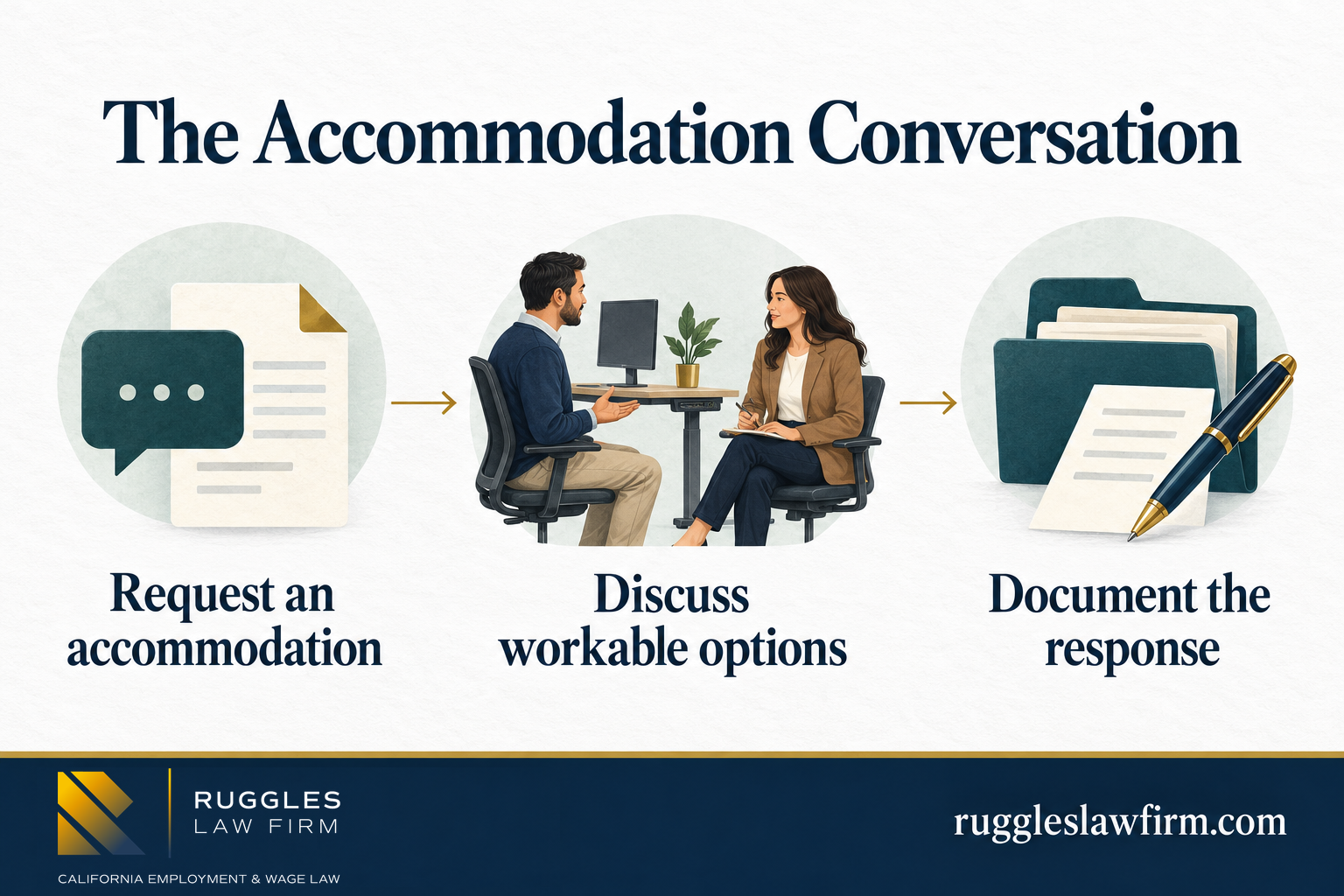
The employer and employee should exchange information about the limitations and workable options. In California, an employer must engage in a timely, good-faith interactive process when it knows of a possible need for accommodation. An employer’s awareness can arise from a request, an observation, or other information.
For a closer look at the information exchanged, see our guide to the interactive process and medical documentation.
Making a Clear Request
Explain that a medical condition is creating a work-related difficulty and describe the adjustment you need. A request can be made without legal terminology or a particular form. Following up in writing can help establish what was requested and how the employer responded. Keep participating in the discussion and responding to reasonable requests for information.
Important Help Articles For Disability Discrimination

Denied Medical Leave? What California Employees Can Learn from Head v. Costco
If you’re searching for a real-world disability discrimination case study, look no further than Head v. Costco Wholesale Corp. One former Costco employee was denied medical leave after exhausting his FMLA and CFRA time while caring for his wife with cancer and...

TWELVE ELEMENTS THAT MAKE A STRONG EMPLOYMENT LAWSUIT IN CALIFORNIA
By Matt Ruggles, California Employment Lawyer What makes a strong employment lawsuit in California? After more than 30 years litigating employment cases, I’ve seen the patterns that separate strong claims from weak ones. I’ve represented employees and employers...
How Do I Select a California Employment Lawyer?
Selecting a California Employment Lawyer: A Practical Guide for Employees Selecting the right California employment lawyer can be the key to a successful outcome when you’re facing a legal problem related to your employment in California. Because there is no formal...

Workplace Discrimination: 7 Things California Employees Get Wrong
Workplace discrimination occurs when an employer treats an employee unfairly based on a legally protected characteristic. In California, the Fair Employment and Housing Act (FEHA) is the primary law that defines and protects employees from unlawful discrimination and...

Indefinite Medical Leave: Can My Employer Terminate Me?
California’s Fair Employment and Housing Act (FEHA) requires employers to provide reasonable accommodations to help employees with disabilities perform their essential job duties, unless doing so would cause the employer an undue hardship. However, under California...

Wrongful Termination Lawsuits Under FEHA: A Costly Gamble for Employers
Wrongful termination lawsuits under California’s Fair Employment and Housing Act (FEHA) can be treacherous terrain for employers. One of the biggest dangers of taking a case to trial is the potential for substantial attorney’s fees awards to prevailing plaintiffs....

Is Getting Fired After Exhausting Leave Wrongful Termination?
If your employer terminates you immediately after you have exhausted leave including your 12 weeks of Family and Medical Leave Act (FMLA) or California Family Rights Act (CFRA) leave, it raises a significant red flag for potential wrongful termination in the form of...

Why Did an Employment Lawyer Reject My Case? Common Reasons Explained
If you’re asking, “Why did an employment lawyer reject my case?”, you’re not alone. Many people believe they were “wrongfully terminated” because they followed workplace rules, received good evaluations, and were never warned or disciplined. But the overwhelming...

What Do These Legal Words Mean? 42 Common Employment Lawsuit Terms
This guide explains 42 common employment lawsuit terms in plain language, from the Fair Employment and Housing Act (FEHA) to discovery, damages, and settlement. Matt Ruggles breaks down the language used in lawsuits alleging harassment, discrimination, and retaliation...

New 2025 Laws to Protect California Employees
New laws to protect California employees are set go into effect in 2025. These new laws include updates to existing laws in areas such as workers' compensation, whistleblower protection, family leave, and anti-discrimination measures. Here's an overview of how these...
How We Evaluate Your Case
We start with your job duties, the employer’s knowledge of your condition, and the accommodations discussed. We compare the employer’s explanation with the documents and timeline, including any performance concerns that predate your request.
Accommodation Requests and Responses
Keep the request, the employer’s response, follow-up messages, and any alternatives discussed. These records help establish what each side knew and when.
A Dated Timeline
Prepare a dated summary of important conversations and events, including the request for help, any performance concerns, leave, and employment decisions.
Job and Performance Records
Useful documents include the job description, performance reviews, disciplinary records, and pay records. Earlier performance feedback can help place later decisions in context.
The People Involved
Identify who received the request, who participated in the accommodation discussion, and who made the employment decision. Note what each person knew about your restrictions or request.
Work Restrictions, Leave and Separation Documents
Relevant materials include medical notes describing work restrictions or a need for leave, leave notices, return-to-work instructions, and termination or severance documents.
Preserving Records Lawfully
Preserve records you lawfully possess and avoid altering originals. Do not access accounts without permission or take confidential business information you are not entitled to keep. If you are unsure what to preserve, ask before collecting it.
Deadlines for Taking Action
Act promptly. For California employment claims handled by the Civil Rights Department, an intake form generally must be submitted within three years of the last harm. A CRD right-to-sue notice is required before pursuing FEHA claims in court, and separate lawsuit deadlines apply.
Federal deadlines are often much shorter. An EEOC charge in California generally must be filed within 300 days for ADA claims; federal employees generally have a different process that starts with contacting an EEO counselor within 45 days. Other claims and circumstances can carry different deadlines. Do not assume an internal complaint or ongoing discussions with your employer preserve a filing deadline.
Your Options and Potential Relief
We also discuss what you want to achieve. That may include keeping your job with a workable accommodation, addressing an unlawful termination, or evaluating a proposed separation. Depending on the facts and available claims, potential relief can include lost earnings, emotional distress damages, reinstatement, or other remedies. No particular result is guaranteed.
Lost Earnings
Pay records and the employment timeline help us evaluate claimed lost earnings. The available relief depends on the supported claims and the evidence, not simply the length of time since the employment decision.
Benefits and Compensation Records
Identify the compensation and benefits affected by the employment decision and preserve the records supporting those amounts. A clear accounting helps us evaluate the claimed loss.
The Employer’s Explanation
We compare the employer’s stated reasons with the timeline and documents, including any concerns that existed before the accommodation request. Unfavorable facts matter as well as favorable evidence.
The Effect on You
Describe how the events affected you and what outcome you want. Emotional distress damages may be available depending on the facts and supported claims; the effect must be evaluated individually.
Describing What Happened
A factual account of the events and their effects is more useful than assigning a label to the experience. Explain the changes you noticed and when they occurred.
Relevant Supporting Information
Tell us what information supports your account. Discuss an appropriate process with the firm before sharing sensitive medical records or other private material.
Practical Next Steps
Continuing Employment With an Accommodation
If you want to remain employed, we can evaluate the communications and the adjustments discussed, along with the practical objective of a workable accommodation.
Evaluating Termination or Separation
If employment has ended or a separation agreement is proposed, we can review the events, documents, and pending deadlines. Get advice before resigning or making a decision that may affect your options. See our Severance Agreements page.
Schedule Your initial case consultation
Discuss Your Situation With Ruggles Law Firm
If a disability or accommodation dispute is affecting your work, contact Ruggles Law Firm to discuss the relevant events and documents. Mention any pending deadline when you reach out.
Call (916) 758-8058.
The Ruggles Law Firm Serves Many Cities in Northern California and Beyond
Led by experienced attorney Matt Ruggles, the Ruggles Law Firm provides legal support to employees who have encountered disability discrimination at work. If you’ve experienced discrimination anywhere in California, Matt Ruggles can help guide you through your options.
Sacramento
- Roseville
- Folsom
- Yuba City
- Marysville
- Davis
- Stockton
- Modesto
- Fresno
- And more!
San Francisco
-
Walnut Creek
-
Berkeley
-
Oakland
-
Concord
- Burlingame
-
San Raphael
- And more!
San Jose
-
Palo Alto
-
Sunnyvale
-
Redwood City
-
Cupertino
-
San Mateo
-
Santa Clara
-
Mountain View
- And more!