
Can your employer put you on unpaid leave instead of accommodating your disability? If you can work with another reasonable accommodation, California's disability-accommodation regulation says the employer may not require leave. A new religious-accommodation decision, Smith v. Burbank Unified School District, does not erase that protection. [1–3]
For an employee who is ready to work, losing a paycheck while remaining technically employed can be devastating. The legal question is whether the employer actually evaluated a workable accommodation before taking the employee off the job.
The October 7, 2026 Smith decision deserves attention. It also deserves a careful reading. Here is what California employees should understand about forced unpaid leave, reasonable accommodation, and the evidence that can determine whether a claim succeeds.
What did the court decide in Smith v. Burbank Unified School District?
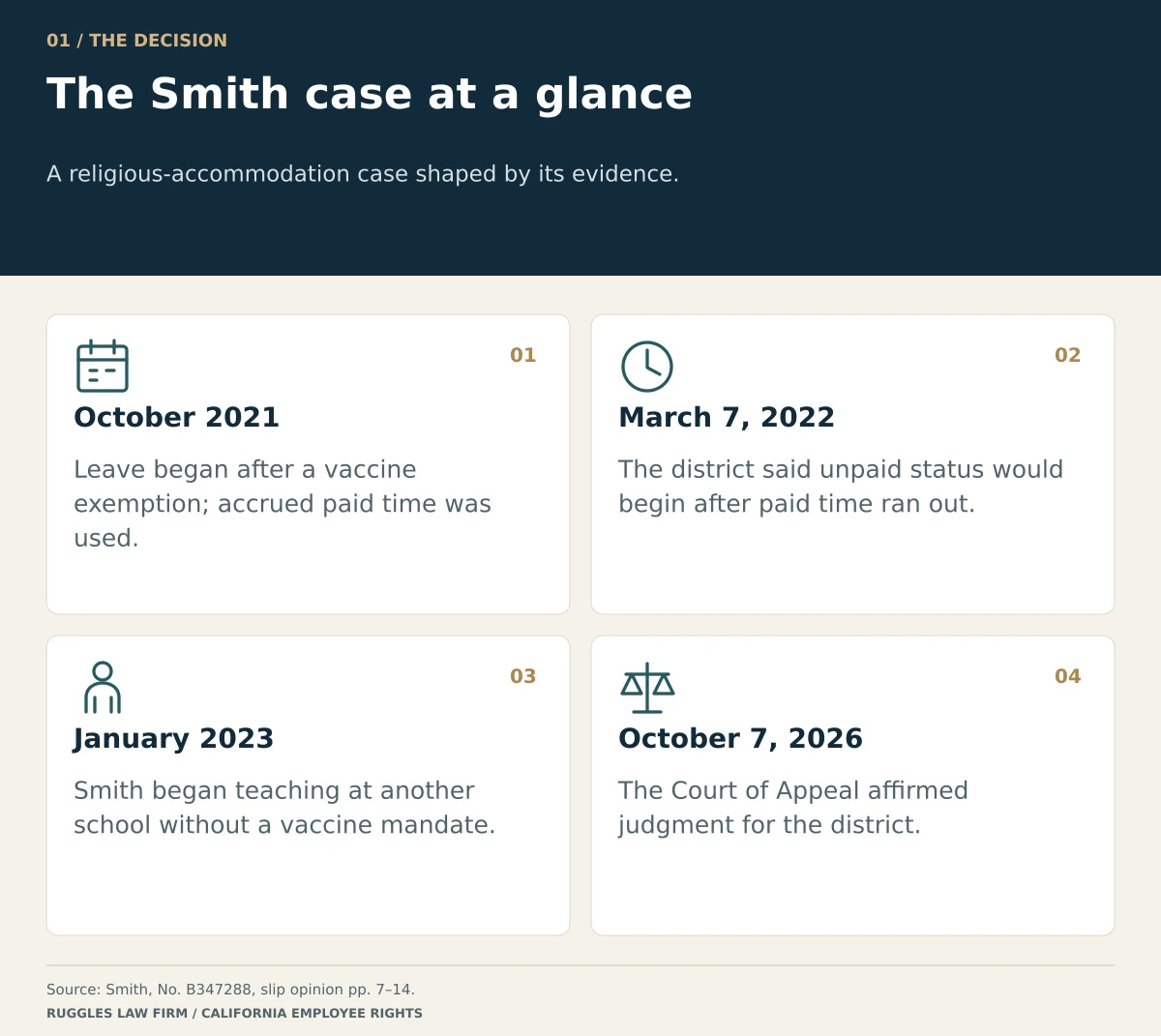
Smith involved a teacher who requested a religious exemption from his school district's COVID-19 vaccination requirement. The district granted the exemption but offered leave, concluding that alternatives would create undue hardship. The Court of Appeal affirmed summary judgment for the district. [1]
The court relied on unrebutted evidence about classroom contact, student supervision, staffing, infection risks, and earlier operational disruption. Smith did not produce evidence countering those burdens. The district had accommodated certain employees in isolated office jobs differently, but their duties differed from classroom teaching. The court also noted that Smith retained the ability to return when the mandate ended. [1, pp. 5, 10–14]
One timing detail matters: Smith began leave in October 2021, used accrued paid time, and was told his paid leave would run out on March 7, 2022, with unpaid leave afterward. He started teaching elsewhere in January 2023. [1, pp. 7–9]
The decision addressed religious discrimination and related claims. It did not decide a disability-accommodation claim under the separate forced-leave regulation. Its narrow lesson: unpaid leave is not automatically unlawful in every religious-accommodation case.
Religious accommodation and disability accommodation have different rules
Both duties arise under California's Fair Employment and Housing Act, commonly called FEHA. They address different problems.
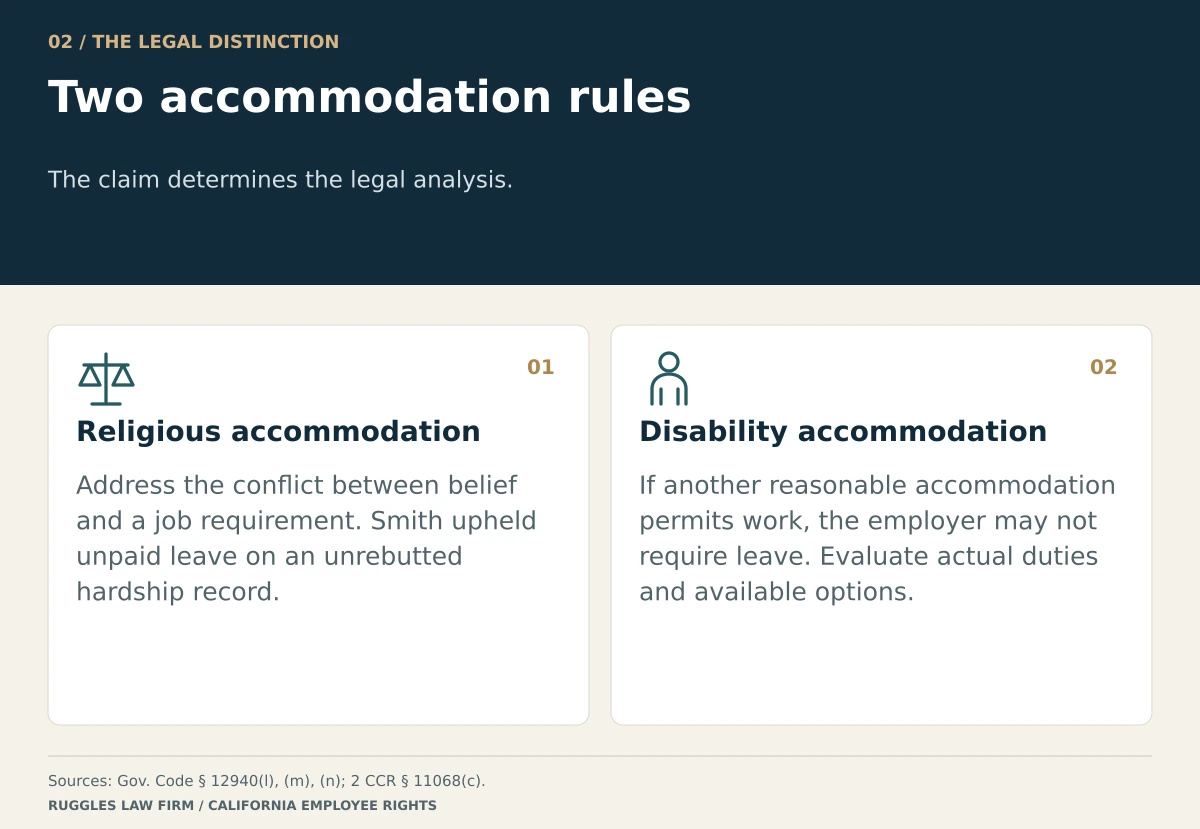
A religious accommodation resolves a conflict between a sincere religious practice or belief and a job requirement. A disability accommodation addresses a known disability and may enable the employee to perform the essential duties of the current position or a suitable vacant position. Disability law also provides a distinct duty to engage in a timely, good-faith interactive process. [2–4]
| Question | Religious accommodation | Disability accommodation |
|---|---|---|
| What must be addressed? | The conflict between religion and a work requirement. | The employee's limitations and an effective way to perform the job or a suitable vacant job. |
| Can unpaid leave qualify? | Sometimes, as Smith illustrates on its particular record. | Yes, when appropriate; but forced leave is prohibited if another reasonable accommodation permits work. |
| Must alternatives be considered? | FEHA requires exploration of available reasonable alternatives. | The employer must participate in the interactive process and assess effective options. |
| What does undue hardship mean? | Under FEHA, significant difficulty or expense, evaluated in context. | The same FEHA statutory definition applies; the employer must establish the defense. |
The distinction is not that religious accommodation requires only a trivial employer effort. California uses a significant-difficulty-or-expense standard. Federal Title VII law also rejects the old “more than de minimis” approach. The standards should be analyzed under their respective statutes. [2, 4, 5]
The California rule employers cannot skip: 2 CCR section 11068(c)
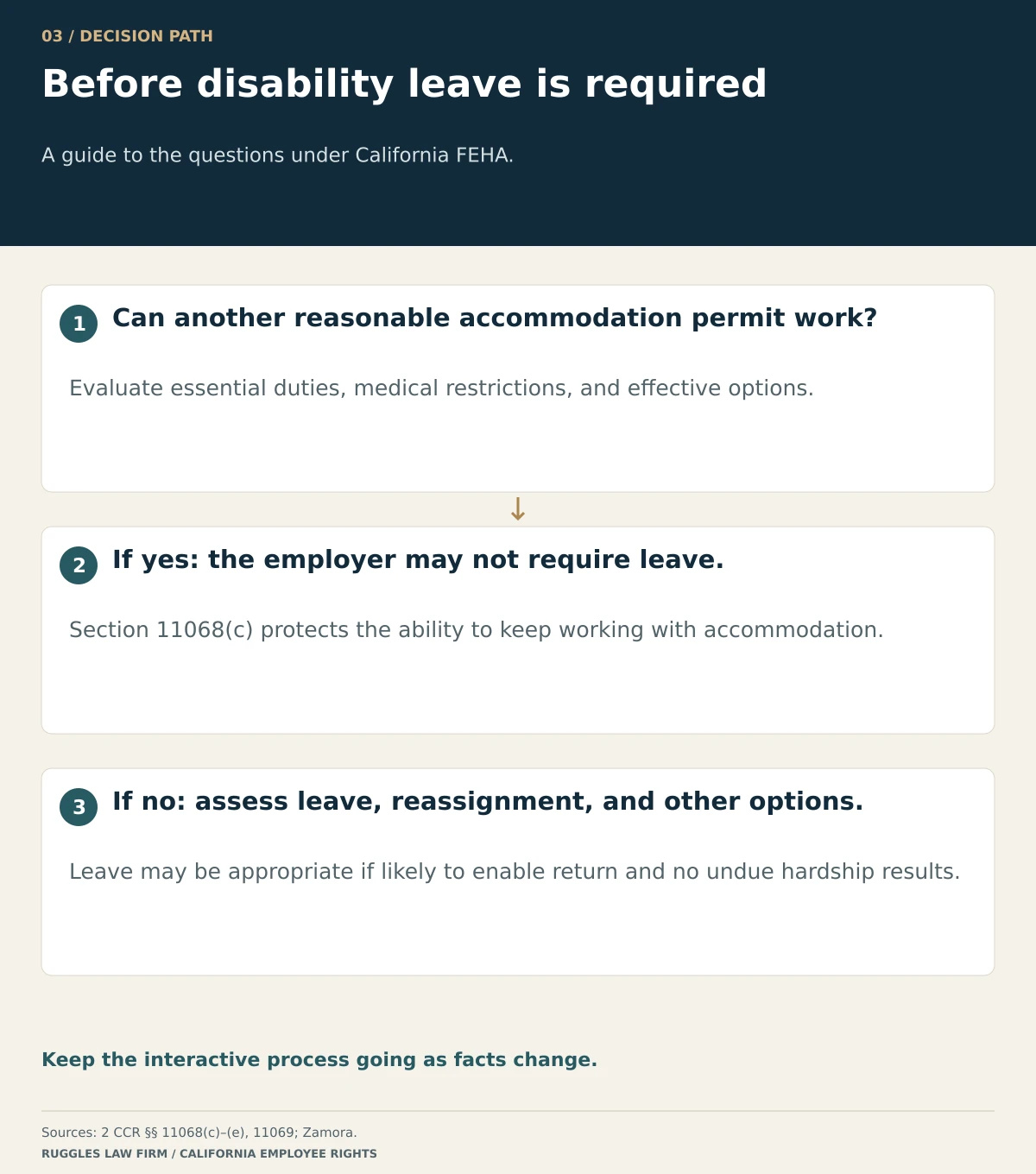
California Code of Regulations, title 2, section 11068(c) addresses both sides of the leave question.
Leave may be a reasonable accommodation when an employee cannot currently perform essential duties or needs treatment and recovery, the leave is likely to permit a return to work with or without further accommodation, and it does not impose undue hardship.
But when another reasonable accommodation permits the employee to work, the regulation expressly states that “an employer may not require that the employee take a leave of absence.” [3]
An employer therefore cannot resolve a disability request simply by saying, “We approved leave, so we accommodated you.” The analysis must address the available work accommodations. Nor is “come back when you have no restrictions” a substitute for an individualized assessment. [3, subds. (c), (i)]
For more background, see our California disability accommodation rights guide.
Wallace: good intentions do not make forced leave lawful
In Wallace v. County of Stanislaus (2016) 245 Cal.App.4th 109, a sheriff's deputy was removed from work because the county mistakenly believed he could not safely perform his duties. The jury found that he could perform the essential functions and rejected the county's safety defense. [6]
The published portion of the opinion applied section 11068(c) and rejected the county's characterization of leave as a lawful accommodation on those facts. The court also explained why an employee need not prove personal hostility when disability was a substantial motivating reason for the adverse action. [6, pp. 128–134]
For employees, the practical point is direct: an employer's belief that it was protecting you does not end the inquiry. What could you actually do, with reasonable accommodation, at the time the employer removed you?
Keeping your job open may not be enough
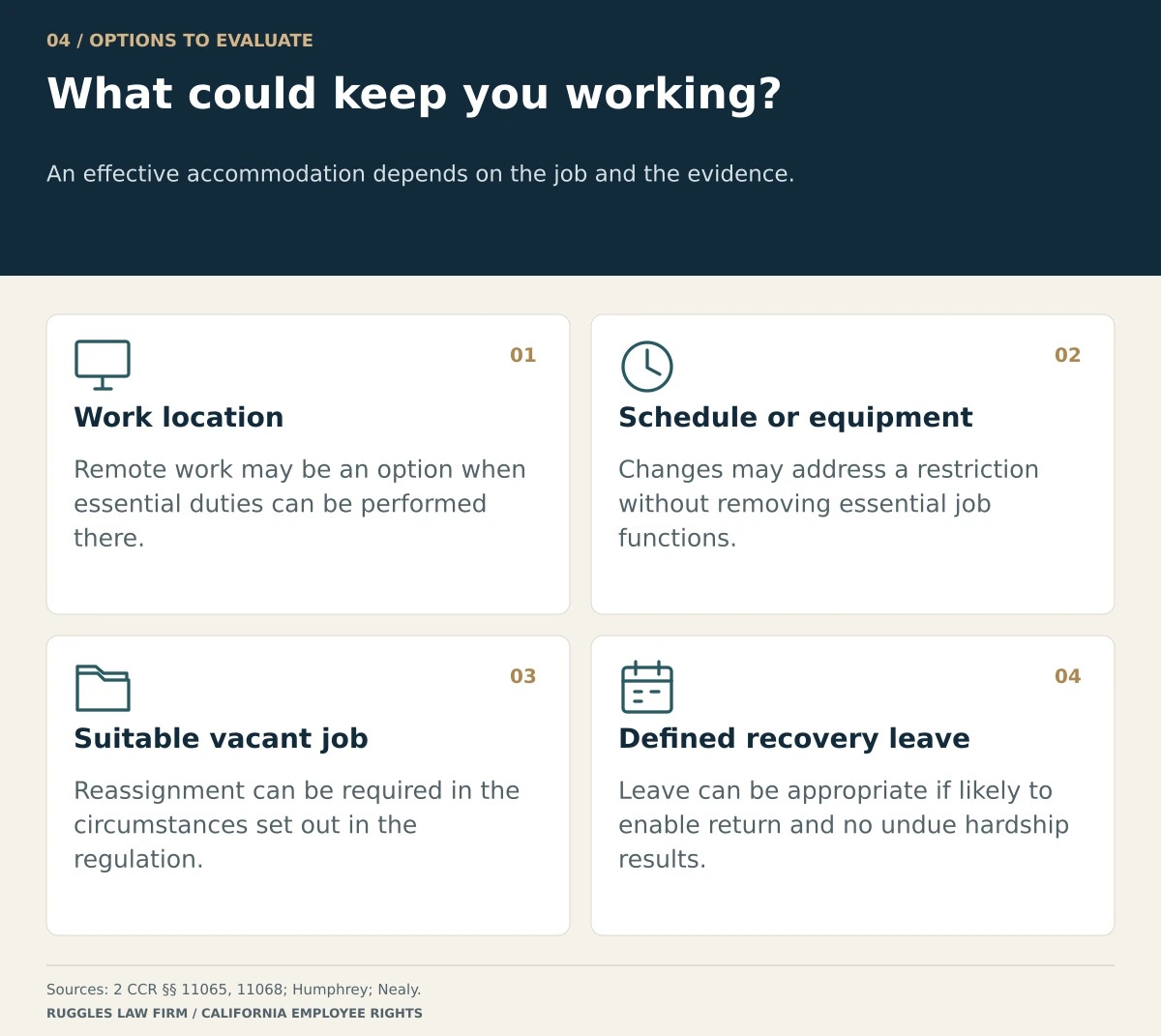
Zamora v. Security Industry Specialists, Inc. (2021) 71 Cal.App.5th 1 applies the forced-leave regulation and explains that an employer's duties can continue while an employee is on leave. Evidence of available modified work and the employer's failure to discuss it can matter. [7]
Reassignment also requires more than telling the employee to search the company's website. In Jensen v. Wells Fargo Bank (2000) 85 Cal.App.4th 245, 263–265, disputed evidence about suitable positions and the accommodation process defeated summary judgment. The current regulation requires the employer to identify and offer suitable vacancies in the circumstances it specifies, with preferential consideration subject to stated limits, including ordinarily applicable bona fide seniority rules. [3, subd. (d); 8]
The actual assignment matters. Cuiellette v. City of Los Angeles (2011) 194 Cal.App.4th 757, 769–772 involved existing permanent light-duty work. A workers' compensation disability rating did not establish that the employee could not perform that assignment. The decision does not require every employer to create a permanent light-duty job. [9]
When an employer may legitimately rely on Smith
Employers may cite Smith to reject the claim that unpaid leave is always unreasonable in a religious-accommodation case. They may also use it to emphasize the importance of the actual job, safety conditions, and operational evidence. Those are legitimate points.
An employer has a stronger defense when the record establishes essential duties that cannot be performed with the proposed adjustments, a meaningful safety or operational burden, and no effective alternative that avoids undue hardship. General disagreement with management will rarely answer detailed admissible evidence.
Disability law has real limits as well. Nealy v. City of Santa Monica (2015) 234 Cal.App.4th 359, 374–378 explains that FEHA does not require eliminating essential job functions, creating a position, promoting an employee, or providing indefinite leave to await a speculative opening. An employer may choose an effective accommodation other than the employee's preferred option. [3, subd. (e); 10]
Employees should therefore avoid the opposite overstatement: that every unwanted leave is illegal. A strong case identifies an accommodation that was actually available and reasonable.
When reliance on Smith would be misplaced
The following employer positions require careful scrutiny:
- “Leave is always reasonable because you are still employed.” The disability regulation expressly requires a different analysis when another accommodation would permit work.
- “We put everyone with restrictions on leave.” Uniform treatment does not replace the required assessment of an employee's abilities and available accommodations.
- “Our policy prohibits modified work.” A policy label does not establish that a job function is essential or that an adjustment creates undue hardship.
- “We were worried about safety.” The disability safety defenses require an assessment grounded in reasonable medical judgment and current medical knowledge or the best available objective evidence. They address an imminent and substantial risk that reasonable accommodation would not avoid. [11]
- “Your preferred accommodation was rejected, so the discussion is over.” The interactive process may require discussion of alternatives and renewed efforts when an arrangement is ineffective. [12–13]
The Ninth Circuit's ADA decision in Nunes v. Wal-Mart Stores, Inc. (1999) 164 F.3d 1243, 1247–1249 reinforces the need to evaluate potentially effective medical leave and actual safety evidence. Humphrey v. Memorial Hospitals Assn. (9th Cir. 2001) 239 F.3d 1128, 1135–1138 addresses continuing accommodation efforts and remote work where the duties permit it. These federal decisions are useful alongside California authority; they do not displace more specific FEHA protections. [13–14]
Even religious-accommodation cases turn on the evidence
A recent published Ninth Circuit decision supplies an important comparison. In Lewis-Williams v. San Francisco Bay Area Rapid Transit District (Sept. 11, 2026), Nos. 25-618, 25-619, and 25-740, the court affirmed a judgment for employees on religious-accommodation claims after trial. The majority explained that showing vaccination was the most effective precaution did not automatically establish that less-effective alternatives imposed undue hardship. Evidence about the employees' limited close contact and the employer's proof mattered. [15, pp. 10–13, 17–18]
That decision did not overrule Smith, and it arose in a different procedural posture. It shows why the conclusion “vaccination works best” and the conclusion “every alternative causes undue hardship” are not interchangeable. California state courts must apply California precedent; Ninth Circuit reasoning can be persuasive on related issues.
Three examples of how the distinction works
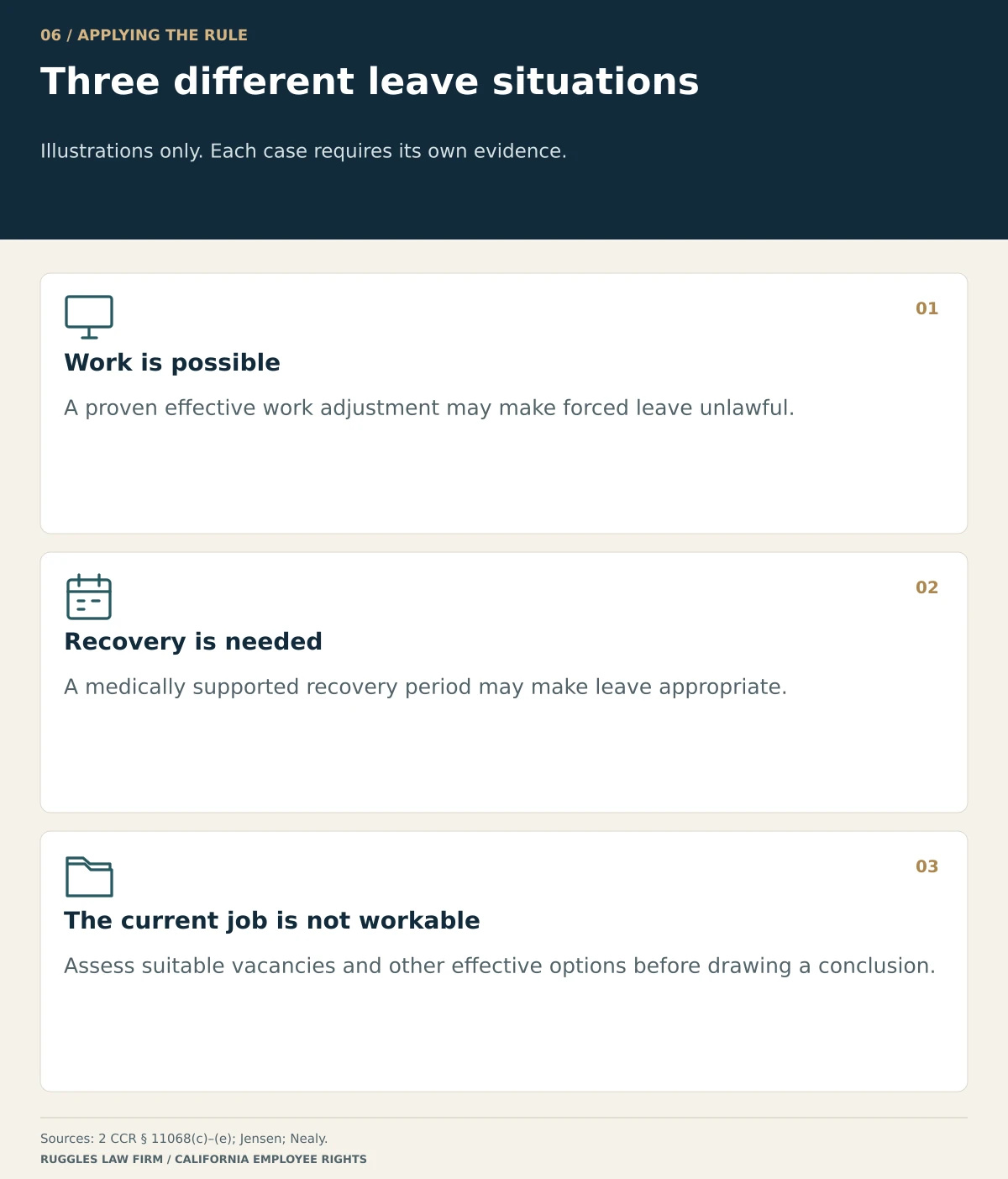
An analyst can continue working remotely. A medical restriction limits commuting, but the employee has successfully performed all essential duties from home. Sending the employee onto unpaid leave without addressing that evidence could support a disability-accommodation claim. Remote work is not automatic; the duties and employer's actual operational evidence still matter.
A worker needs a defined recovery period. An employee cannot perform essential duties during treatment, but medical information supports a return after a defined period. Leave may be an effective accommodation, even if the employee has used other protected leave. The employer must evaluate the request and hardship rather than apply an automatic cutoff. [3; 12; 14]
A worker cannot perform the current job, but an appropriate vacancy exists. The inquiry should include qualifications for that vacancy and whether reassignment is required. If there is no suitable vacancy and no effective accommodation for the existing position, the analysis changes. [3; 8; 10]
These examples are illustrations, not promises about any particular claim.
What to do if your employer forces you onto unpaid leave
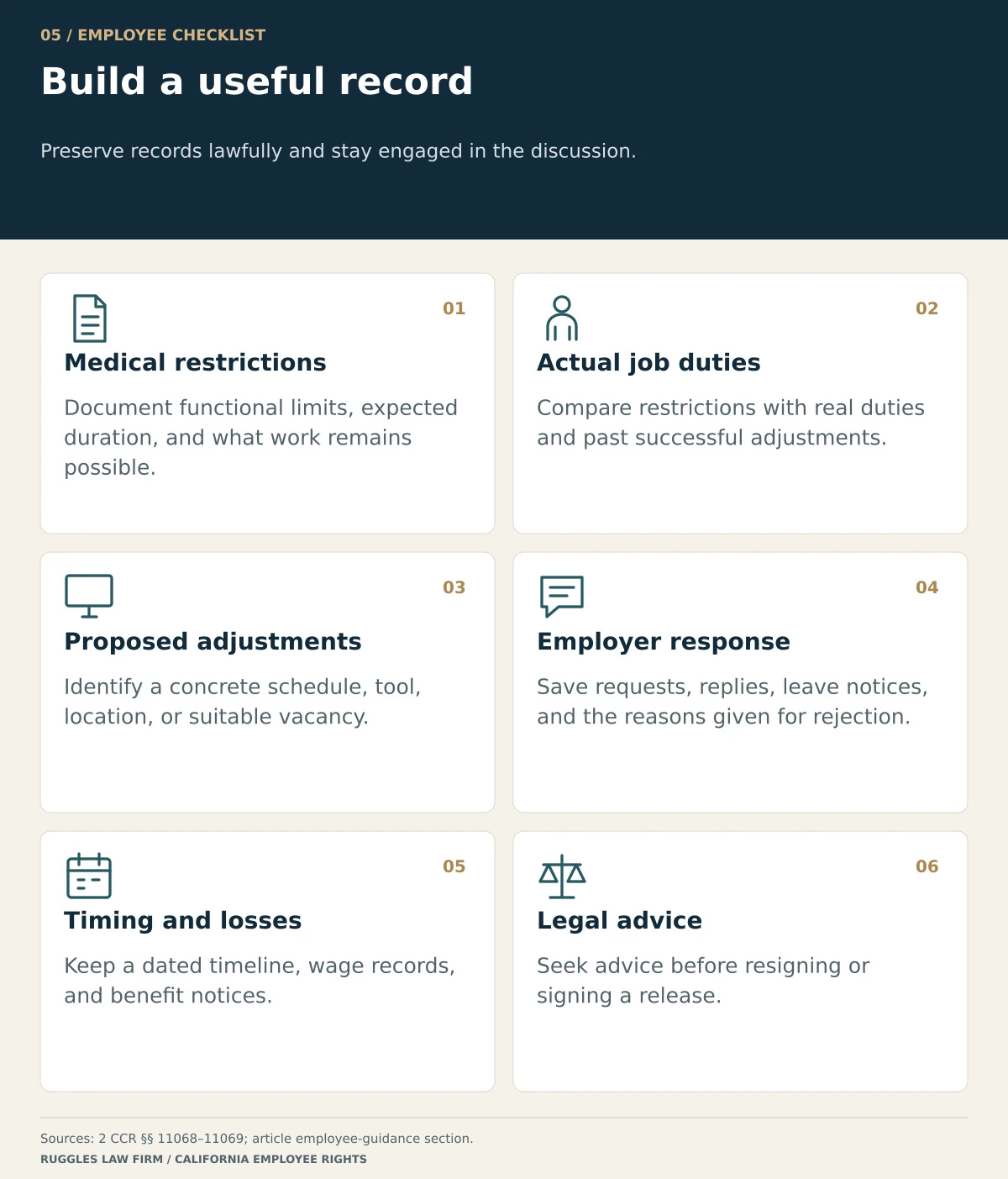
- Clarify what you can do. Ask your healthcare provider to describe functional restrictions, expected duration, and adjustments that would permit work. Avoid an unexplained “off work” note if it does not accurately describe your abilities.
- Make the proposed accommodation concrete. Identify the schedule, equipment, task adjustment, work location, or suitable vacancy you want considered.
- Ask for a written explanation. What essential duty cannot be performed? What alternatives were assessed? What specific hardship does the employer claim?
- Stay engaged. Respond to reasonable requests, discuss effective alternatives, and document meetings. Where clarification of medical information is needed, ask what is missing. [12]
- Preserve your records lawfully. Keep accommodation requests, restrictions, leave notices, pay records, relevant job postings, and performance reviews. Do not take protected employer or customer information you are not entitled to possess.
- Get advice before resigning or signing a release. The legal consequences of leave, resignation, termination, benefits applications, and a severance agreement can differ.
The most useful question is often: What evidence shows that you could have continued working with a reasonable accommodation?
How these cases are evaluated in litigation
A careful evaluation begins with the employee's restrictions, essential duties, employer knowledge, and the options available when the decision was made. A leave approval does not answer those questions.
For a summary judgment opposition, connect each proposed accommodation to evidence: a medical explanation, actual work history, a suitable vacancy, a supervisor's admission, or competent evidence addressing the claimed operational burden. Challenge unsupported conclusions, but also supply affirmative proof. The employee's qualification burden and the employer's undue-hardship defense are separate issues. [8; 10; 16]
Claims also require separate attention. Disability discrimination, failure to accommodate, failure to engage in the interactive process, and retaliation have distinct elements. A process violation should be tied to an accommodation that could have been available. Current FEHA expressly protects requests for disability and religious accommodation against retaliation, whether or not the request is granted. Older statements suggesting that a request alone is never protected should not be carried into a current case. [2, subds. (l)(4), (m)(2), (n); 17]
See our explanation of the interactive process under California law and our guide to medical leave and disability severance issues.
Frequently asked questions about forced unpaid leave in California
1. Can my employer force me onto unpaid leave because I have a disability?
Not when you can work with another reasonable accommodation. Section 11068(c) expressly prohibits requiring leave in that situation. Whether an effective accommodation exists depends on your restrictions, duties, and the employer's evidence. [3]
2. Does Smith allow employers to put every disabled employee on leave?
No. Smith addressed religious accommodation on a particular record. It did not interpret the disability regulation governing involuntary leave. [1; 3]
3. Is unpaid leave ever a reasonable disability accommodation?
Yes. Leave can permit treatment or recovery when it is likely to allow a return to work and does not create undue hardship. It can be appropriate even when further accommodation will be needed upon return. [3]
4. Does reasonable accommodation mean my employer must keep paying me during leave?
Not necessarily. FEHA recognizes both paid and unpaid leave. Wage replacement, accrued paid leave, and benefit rights depend on other applicable laws and policies; they require a separate review. [3]
5. Can my employer require me to be 100 percent healed?
An employer cannot impose a “fully healed” return-to-work rule without an individualized assessment of your ability to perform essential duties with or without reasonable accommodation. [3, subd. (i)]
6. Is my preferred accommodation guaranteed?
No. Your preference must be considered, but the employer may select another effective reasonable accommodation. Forced leave remains subject to the specific rule protecting employees who can work with another accommodation. [3, subds. (c), (e)]
7. Can working from home be a reasonable accommodation?
Yes, when essential duties can be performed there and the arrangement does not impose undue hardship. A job's actual demands and evidence of successful remote work matter. [13]
8. Must my employer remove an essential job duty?
Generally, no. Distinguish eliminating an essential function from changing how or when you perform it, or restructuring marginal duties. A job description is relevant but is not the entire analysis. [4; 10]
9. Does a lifting restriction mean I cannot work at all?
No. Determine which duties require lifting, whether an adjustment permits performance, and whether an appropriate vacant position exists. Restrictions must be compared with actual duties. [3–4]
10. Must my employer consider another job?
In the circumstances specified by section 11068(d), the employer must identify and offer suitable vacant positions for which you are qualified. This does not mean creating a new job or providing a promotion. [3; 8; 10]
11. Is telling me to check job postings enough?
Ordinarily, that alone does not discharge an existing employee's reassignment rights. The employer has an affirmative role in identifying appropriate vacancies and considering reassignment. [8]
12. Must a temporary light-duty assignment become permanent?
Not automatically. An existing permanent light-duty position and a temporary recovery assignment present different questions. Examine the employer's actual practices and available positions. [9–10]
13. What does undue hardship mean under FEHA?
It means significant difficulty or expense in context, considering factors such as the accommodation's cost, financial resources, workforce, and operations. A conclusory statement that an adjustment is inconvenient is not the statutory test. [4]
14. Who must prove undue hardship?
The employer bears that defense. The employee still must establish the applicable elements of the claim, including qualification and an available reasonable accommodation where required. [2–3; 16–17]
15. Does an employer have to wait for someone to be injured before raising safety concerns?
No. Objective evidence can establish a qualifying risk before an injury occurs. But a disability safety defense requires the regulatory assessment and consideration of reasonable accommodation, not generalized fear. [11; 14]
16. What is the interactive process?
It is a timely, good-faith exchange about limitations and effective accommodations. Both sides must provide necessary information and avoid obstructing the discussion. [12]
17. Does approving leave end the interactive process?
Not necessarily. New information, a possible return with restrictions, or an ineffective arrangement may require further discussion of available accommodations. [7; 12–13]
18. Do I have to use the phrase “reasonable accommodation”?
The duty is not limited to a particular phrase. The regulation addresses requests, information from third parties, observation, and certain circumstances following exhaustion of leave. Make your need clear and keep a written record. [12, subd. (b)]
19. Can my employer ask for medical documentation?
When the disability or need is not obvious, reasonable documentation may be requested. It should address the relevant limitations and accommodation need; an unrestricted demand for your entire medical history is different. [12]
20. What if my doctor's note is unclear?
Ask what needs clarification and obtain a more precise explanation of your restrictions. The regulation requires the employer to identify needed clarification and allow a reasonable opportunity to provide it. [12, subd. (c)(4)]
21. Does exhausting CFRA or FMLA leave end all accommodation rights?
No. FEHA can require a separate evaluation of additional leave or other accommodation. Eligibility for one leave law and entitlement to a disability accommodation are different inquiries. [3; 12]
22. Is an employer required to provide indefinite leave?
No. California's regulation expressly says indefinite leave is not required. An estimated recovery period supported by medical information should be assessed on its actual facts rather than treated automatically as indefinite. [3; 10]
23. Does receiving disability benefits automatically defeat my case?
No, but statements made in benefits applications can matter. The applicable benefit standard, medical restrictions, time period, and potential accommodations must be reconciled accurately. [9; 14]
24. Can unpaid leave be an adverse employment action?
Yes. A leave that removes pay or benefits can have serious employment consequences. Whether those consequences violate FEHA depends on the claim's elements and the employer's defenses. [6]
25. Can I have a claim if my employer says it was trying to protect me?
Potentially. Wallace illustrates why a mistaken safety belief does not necessarily excuse removing an employee who can safely perform the job. The actual ability to work and evidence supporting the decision matter. [6]
26. Can my employer retaliate because I requested accommodation?
No. FEHA expressly protects disability and religious accommodation requests, regardless of whether the request was granted. A retaliation claim still requires proof of the applicable elements. [2, subds. (l)(4), (m)(2)]
27. Does a religious objection itself establish a disability?
No. Religious belief and disability are separate protected grounds. A medical restriction accompanying a religious objection must be evaluated under the applicable disability standards. [2; 4]
28. What records are most useful to an employment lawyer?
The restrictions, accommodation requests, employer responses, job description, available-position information, leave notices, performance records, and wage or benefit losses usually provide the starting point. Preserve the timeline and identify witnesses with firsthand knowledge.
29. Should I resign if my employer refuses to let me work?
Get advice first. Resignation may affect legal theories, remedies, benefits, and the factual record. Document your willingness to work within accurate medical restrictions and discuss effective alternatives.
30. How can Ruggles Law Firm help?
We represent employees in California employment disputes. If you were placed on unpaid leave after disclosing a disability or requesting accommodation, submit an inquiry through our website so we can evaluate the facts and discuss next steps.
Speak with a California disability discrimination attorney
An employer's decision to label unpaid leave an “accommodation” does not make that decision lawful. If you could have continued working, the available accommodation and the employer's reasons deserve scrutiny.
Request an initial case consultation
We represent employees in Sacramento, Northern California, and throughout California. Tell us about your disability discrimination or accommodation concern so we can evaluate the facts and discuss next steps.
Request an initial case consultation
Or call (916) 758-8058.
About the author: Matt Ruggles is a California employment attorney at Ruggles Law Firm, APC. He represents employees and brings more than 30 years of employment litigation experience, including substantial prior experience representing employers. Learn more about Matt Ruggles.
This article provides general information based on the authorities discussed as of October 9, 2026. It is not legal advice for a particular situation. Contacting the firm does not by itself create an attorney-client relationship.