
Five California employment case studies about the questions HR failed to ask
An employer can have a polished handbook, a sophisticated payroll system and several layers of HR approval—and still make a decision its own records cannot comfortably explain.
Sometimes the problem is a pay rule that appears only after the employee has produced the result. Sometimes it is a leave decision made without asking the person who actually manages the work. Sometimes the company has an explanation, but the explanation gets less convincing as we examine how it was assembled.
These five California employment case studies come from actual matters Ruggles Law Firm litigated and resolved. They are not composites. Names are omitted, and nonessential details are omitted or generalized to reduce identification risk. We do not disclose settlement amounts or terms. The accounts describe our clients’ positions, the evidence we used and the problems we had to confront—not findings that every allegation was proved in court. Each matter ended in a negotiated resolution, not a trial verdict. A settlement is not an admission of wrongdoing or a promise of a similar result for someone else.
The employers were not all the same size. The common issue was not the number of people in HR. It was whether the decision survived a careful comparison with the facts.
The graphics are conceptual illustrations of the evidence and review process. They are not actual case documents, quotations, exhibits or reconstructions of a particular event.
1 The cap that was not in the plan
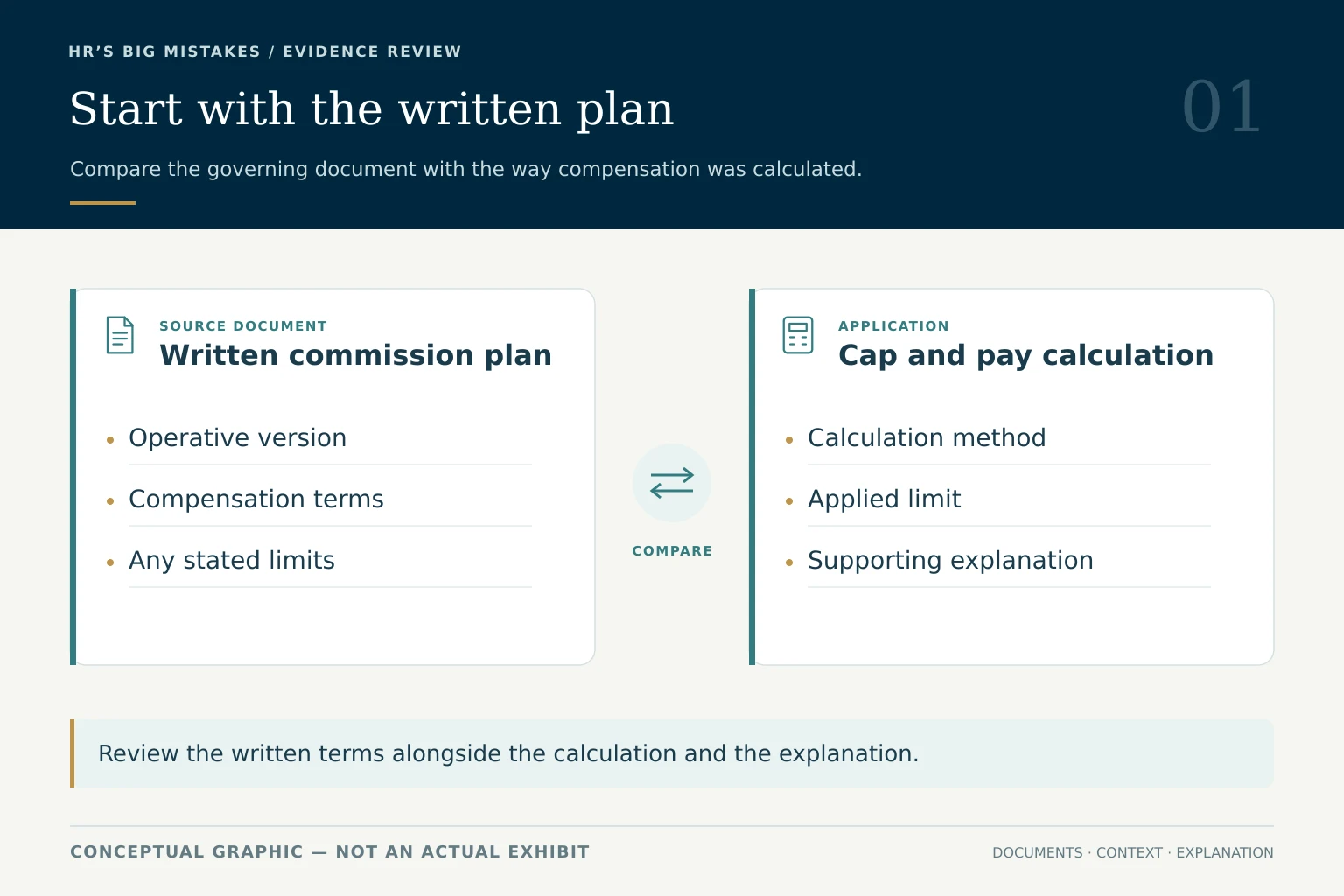
A salesperson helped bring in a major transaction. The written compensation documents described how to calculate commissions, including higher levels of performance. The employer’s own payroll records recognized the transaction and paid part of the commission. Then the employee encountered a limit that, in our reading, did not appear in the governing written formula.
The company treated the transaction as exceptional. The employee’s position was simpler: an unusually successful sale should not become a reason to replace the agreed calculation with a smaller number.
What we checked
We put the compensation plan, the employee-specific pay terms, the commission statement and the payroll record next to one another. We examined which rules applied to the transaction, how credit was allocated and what had already been paid. Our calculation credited the employer for documented payments rather than presenting the entire commission as unpaid.
That approach narrowed the dispute. The useful question was not whether management thought the result was generous. It was where the asserted limit came from, and whether that limit was part of the terms that governed the employee’s work.
The problem we had to address
This was not a file containing only favorable documents. There were performance and expense issues, and the plan contained language about management’s discretion. Those issues had to be examined rather than brushed aside. We also had to separate the employee’s compensation claim from disagreements about the employee’s overall employment history.
Our response was to identify the particular provisions and records that supported the commission claim. Our presentation addressed the plan’s management-discretion language while arguing that it did not authorize the disputed limit. It also compared older performance material with the later records in which the company credited and paid commission on this very transaction.
We did not need to pretend the employee had never been criticized. We needed to explain why those criticisms did not answer the specific payment question we were litigating.
What this case shows
A compensation dispute often becomes clearer when someone reconstructs the calculation using the employer’s documents. Save the plan that actually applied, not just the latest version. Keep the individual pay terms, commission statements and payment records together. A number on a spreadsheet is more persuasive when each input has a source.
Resolution: The lawsuit resolved through a negotiated settlement. That resolution was not a trial finding that the employer violated the law.
Related reading: California commission disputes and unpaid sales commissions.
2 The leave deadline that replaced the conversation
An employee remained away from work for medical treatment. The employer’s leave paperwork eventually pointed toward exhaustion of protected leave. Management then moved toward ending the employment relationship.
But the people inside the company were not all telling the same story. HR correspondence reflected an ongoing medical situation and an anticipated update. The employee’s direct manager described a team that had been covering the work. The manager did not welcome the termination decision and testified that coverage could have continued, although it would have been difficult.
That last qualification mattered. We did not turn “possible but difficult” into “effortless.” The employer had real work to get done, and the employee had been absent for a substantial period. The case called for a closer examination of the actual decision, not a slogan about being sympathetic to someone who was ill.
What we checked
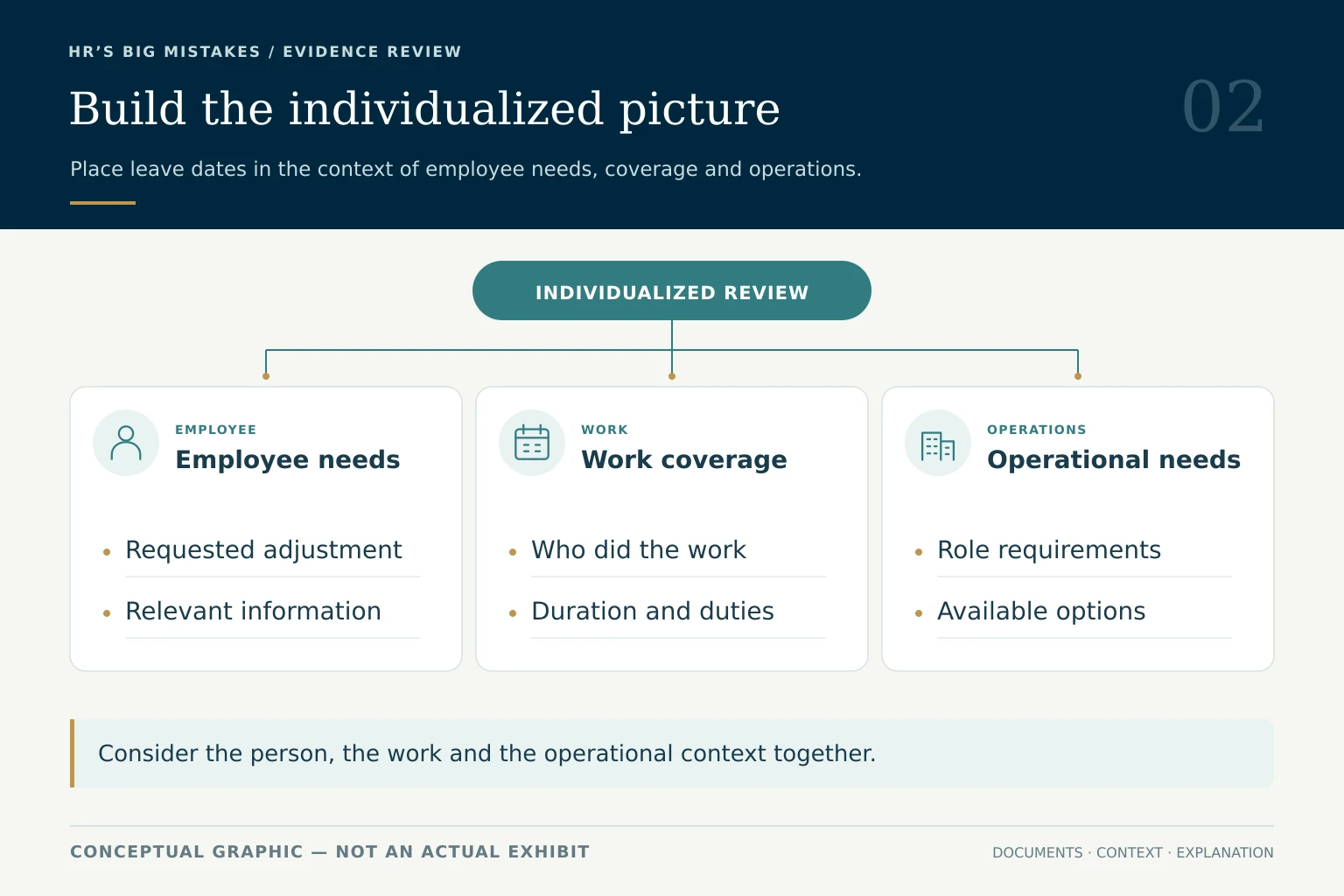
We compared the medical-leave correspondence, internal emails, termination documents and testimony from the people involved. We asked who understood the leave to be ongoing, who believed it was unauthorized, who was waiting for more information and who decided the relationship should end.
The comparison exposed a useful disagreement. The explanation offered by the manager pushing termination did not align neatly with the accounts of the employee’s supervisor and HR witnesses. The coverage evidence also gave us a concrete way to test generalized references to operational burden.
The problem we had to address
The employer characterized the requested leave as indefinite. The employee’s return-to-work outlook and the information available to the company were disputed. Those are serious issues in a leave case; a lawyer cannot simply assume that any additional absence is workable or that an employer must wait forever.
We addressed that problem by focusing on the medical-update chronology and what the decision-makers did with the information they actually had. Our litigation position was that uncertainty called for a real inquiry, and that the employer’s records did not show the individualized consideration its explanation suggested. We used testimony about actual coverage to challenge the factual basis of the decision, not to claim that staffing concerns can never matter.
What this case shows
A leave status is not the whole story of a workplace decision. The revealing evidence may be the difference between a form, a manager’s practical experience and HR’s own communications. Preserve the requests, responses, medical work-status information and termination explanation as a chronology. A date alone does not tell you who asked the next question—or whether anyone did.
Resolution: The matter resolved by settlement, not by a trial verdict. The outcome did not establish that every requested leave extension must be granted.
3 Earned pay renamed later
In another commission dispute, the employer was not merely declining to pay more. It asserted that previously paid commissions could be treated as advances and recovered from the employee. Different versions of the compensation plan became central to the dispute.
Our client’s position was that the relevant commissions had been earned under the earlier plan. The company relied on its understanding of advance payments and chargeback practices. It also pursued counterclaims. This was not a case in which we could win the argument simply by repeating that the employee had worked hard.
What we checked
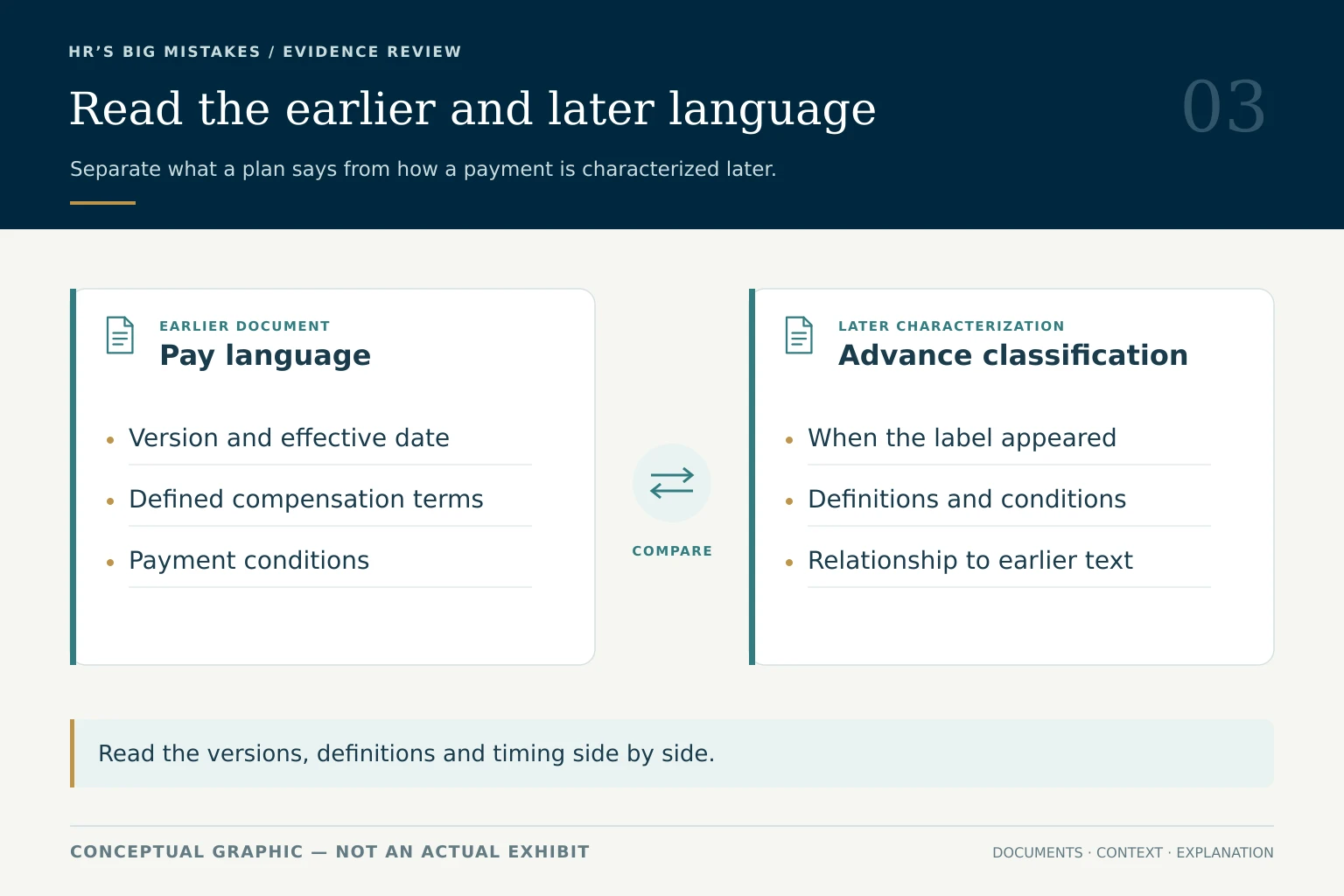
We compared the earlier and later plan language and examined which version governed the disputed commissions. The important issue was the condition for earning the payment—not just the label the company attached to it after the fact.
The earlier plan described commissions as paid when earned. Our litigation position was that the employer was attempting to apply later advance-and-chargeback terms to compensation governed by that earlier language. We questioned company witnesses about the text. The firm’s litigation record summarizes testimony acknowledging that the earlier plan did not describe the payments as advances, including testimony supporting our reading of that plan.
That made the dispute specific. Instead of arguing about a general company practice, we could ask which written provision made these particular payments recoverable.
The problem we had to address
The employer contended that the employee knew how its commission and chargeback practices worked. There were also disputes about project completion, billing and records controlled by the company. A commission case can turn on whether an earning condition was satisfied; assuming that every payment is final would have skipped the very issue we needed to prove.
We addressed those complications through plan comparison, written discovery and witness examination. Our presentation distinguished a payment subject to an agreed earning condition from the employer’s attempt, as we alleged it, to change the character of compensation after it had been earned. We also addressed the employment-separation dispute and the company’s counterclaims as part of the case, rather than treating the wage question as the only risk.
What this case shows
The newest compensation plan may not answer a dispute about older work. Preserve each version and the communications about when it took effect. Match the disputed payment to the governing terms and the underlying transaction records. Words such as “advance,” “earned” and “chargeback” should lead to precise questions about the agreement and the facts—not automatic conclusions for either side.
Resolution: The arbitration dispute resolved through settlement. It was not a trial verdict or a judicial declaration that every chargeback is unlawful.
4 An investigation pointed in one direction
An employee raised concerns about workplace safety and training. A serious misconduct accusation then became the employer’s stated reason for termination. The employee denied the accusation and maintained that the real problem was the safety complaint.
The timing invited scrutiny. It did not decide the case.
The employer said it had received a serious report that it needed to act on. It also pointed to earlier attendance, performance and insubordination concerns. There was a written witness statement, and there were HR notes. A fair account of this matter cannot pretend that the company had no documents or that the employee had an unblemished record.
What we checked
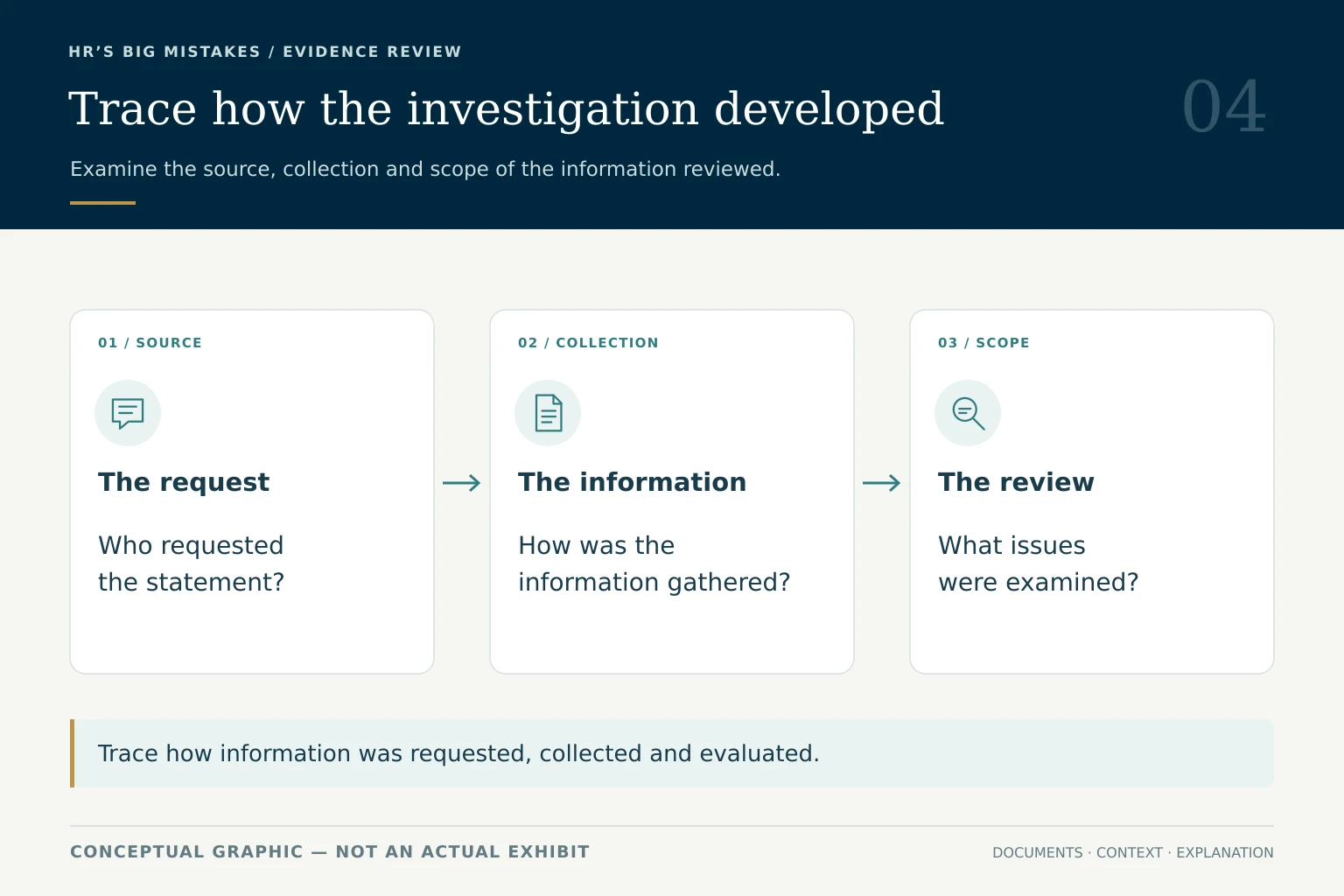
We examined the employee’s written safety concerns, the disciplinary chronology, communications about proposed training, and the documents supporting the termination explanation. We also questioned a management witness about how the accusation had been collected and investigated.
Our litigation record describes testimony that management requested a written statement and that HR helped with its preparation. It also identifies questions about the scope of the inquiry and whether other potentially relevant witnesses had been interviewed before the decision. Those were important matters to test because the existence of a statement does not, by itself, establish how reliable or independent the process was.
There was another piece of the chronology to examine: internal discussion of a response to the employee’s safety concerns. We compared that proposed response with the steps management actually took. The investigation was not just about what the termination letter said. It was also about what happened to the original complaint.
The problem we had to address
The employer strongly disputed retaliation. It maintained that the accusation was credible, that others could support it and that the employee’s conduct justified termination. We did not have a judgment declaring the allegation fabricated, and we do not present one here.
Our approach was to challenge the explanation with identified records and focused testimony. We examined who knew of the safety complaint, who helped create the later statement, what the decision-makers verified and which issues remained disputed. At the stage described in the reviewed litigation record, the parties had exchanged written discovery and taken a limited management deposition; additional depositions were still proposed.
What this case shows
An employer should take a serious misconduct report seriously. That does not make every resulting decision immune from examination. For an employee disputing an accusation, “that is false” is the beginning of the conversation. The useful next steps are identifying the records, witnesses, timing and inconsistencies that allow the explanation to be tested.
Resolution: The lawsuit ended in a negotiated settlement. There was no trial finding that the misconduct accusation was fabricated or that the employer admitted retaliation.
Related reading: False accusations at work in California.
5 The approval chain that skipped the next question
An employee needed time away from work for a medical reason. The employer had an outside benefits administrator, local HR, higher-level HR and managers involved in the decision. More participants should have meant better information. Our review raised a different question: was each person assuming someone else had done the necessary checking?
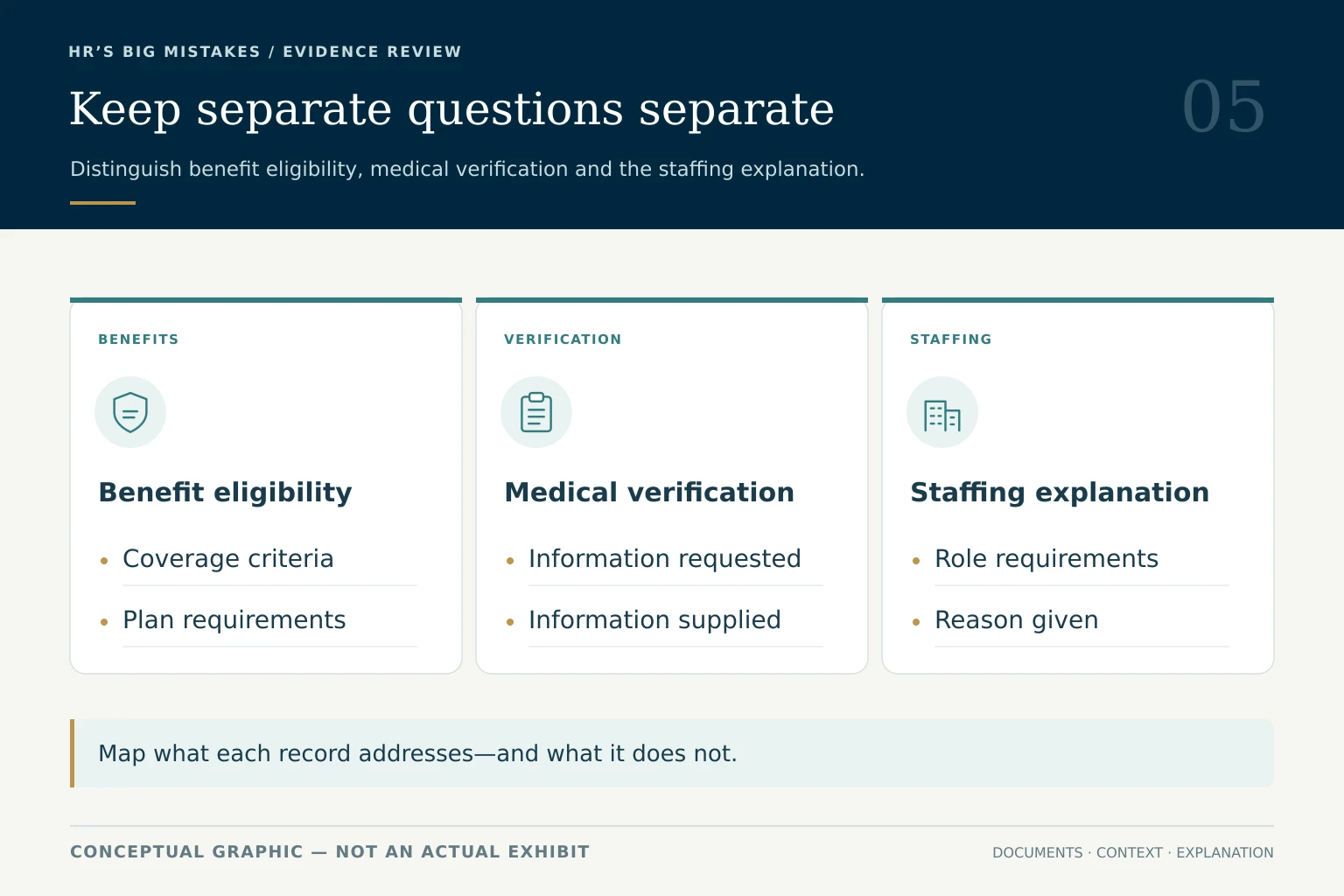
The employee did not qualify for certain leave or benefit programs. But that eligibility determination was not a medical finding that the employee did not need time away. The employer had allowed leave, and medical notes had been supplied. When HR asked the outside administrator to verify medical necessity, the administrator did not perform the requested verification in this case.
What we checked
We compared the correspondence, eligibility information, medical-note chronology and termination letter. In depositions, we asked HR witnesses what they personally knew, what they relied on and what they had asked the other decision-makers.
Describing an earlier consultation, one higher-level HR witness said she had not known the medical reason for the leave. She understood that the local facility needed the position filled, but the discussion had not gone into detail about why. She also testified that performance was not the basis for the release in the conversation she described. Other testimony confirmed that the outside administrator had not verified medical necessity. The manager who doubted the leave did not contend that the medical notes were fake.
The problem we had to address
Management had raised performance concerns before the leave. A manager viewed the timing with suspicion. The employee requested additional time, and the employer said it needed the role filled. These were genuine complications. A medical note did not erase the employment history or answer every staffing question.
We addressed those issues by separating different propositions. A concern about performance was not the same thing as the reason a particular decision-maker gave for ending employment. A benefits-eligibility decision was not a medical assessment. A general staffing assertion was not a detailed account of what the higher-level HR participant had investigated.
That distinction allowed us to confront the company’s explanation without claiming that every difficult fact had disappeared. The value of the depositions was in showing the limits of each witness’s knowledge and identifying the assumptions connecting one level of the approval chain to the next.
What this case shows
An approval chain can transmit an assumption as efficiently as it transmits a fact. For employees, the important record may be the gap between what an administrator decided, what local management reported and what the higher-level HR participant understood. Keep those communications separate enough to see the differences.
Resolution: The litigation ended in a negotiated resolution, not a trial victory or admission of wrongdoing.
The work behind the useful question
The graphics summarize a few evidence questions. The work that makes those questions useful usually happens earlier.
In these matters, that work included comparing versions of a compensation plan, reconciling payroll with the claim, building a leave chronology, reading the employer’s explanation fairly and asking witnesses about the limits of their own knowledge. Not every case needed the same tools. The commission-cap matter relied heavily on documents; other matters included depositions. The illustrations summarize methods of review rather than depicting actual documents or events.
We also had to account for inconvenient evidence. Performance criticisms, disputed medical timelines, operational demands, serious misconduct accusations and counterclaims can change the risk of a case. Ignoring them does not make an employee’s case stronger. Identifying them early lets us decide which assertions can be answered with evidence, which remain disputed and what a practical resolution should take into account.
That is the point of these case studies. The interesting moment is not simply that an employer made an assertion. It is the moment the assertion meets the record.
Questions employees often ask about these cases
Does a mistake by HR mean I have a lawsuit
Not necessarily. A poor decision, inaccurate assumption or unfair process is a reason to examine the situation, not a legal conclusion by itself. The relevant rights, evidence, employer knowledge, consequences and deadlines all need review. These examples illustrate how we investigated particular disputes; they are not a checklist that automatically proves a claim.
Can the employer still raise performance issues after I complain
A complaint does not make the rest of the employment record disappear. In several of these cases, performance or conduct concerns were part of the defense. We examined when those concerns arose, what supported them and whether they actually explained the decision being challenged. Preserve unfavorable documents too; a lawyer needs the whole record.
What should I bring to an initial case evaluation
Bring a concise chronology and lawful copies of the documents relevant to the problem: pay plans and statements, disciplinary records, complaints and responses, leave communications, work-status notes and termination papers. Identify possible witnesses and what each may know. Do not take trade secrets, privileged material or other employees’ confidential files, and do not access systems you are no longer authorized to use.
Did these employees win at trial
No. These are actual matters the firm litigated and resolved by agreement. A negotiated resolution can serve a client’s goals without a trial. It does not establish that a judge or jury accepted every allegation, and it does not predict what another case will be worth or how it will end.
Why leave out the employers and settlement figures
The educational point is the decision-making and evidence, not identifying the people or advertising confidential terms. Changing names alone does not necessarily protect confidentiality. We omit or generalize nonessential details, and publication requires review of the obligations that apply to each matter.
For a broader issue-by-issue overview, read Dear Employer: My Suggestions For Avoiding Liability. This article takes a different approach: five actual matters, the evidence we examined and the obstacles we had to address.
About the author: Matthew J. Ruggles is the founder of Ruggles Law Firm. His practice focuses on representing employees in California employment disputes.
General information only: This article is not legal advice and does not create an attorney-client relationship. Claims are fact-specific and subject to deadlines. Past results do not guarantee future outcomes. The parties’ disputed positions are not court findings, and settlements are not admissions of liability.