
CALIFORNIA EMPLOYEE RIGHTS • 2026 UPDATE
Your employer says you were trained. The records should tell a more specific story.
What SB 513 changed for California employees in 2026
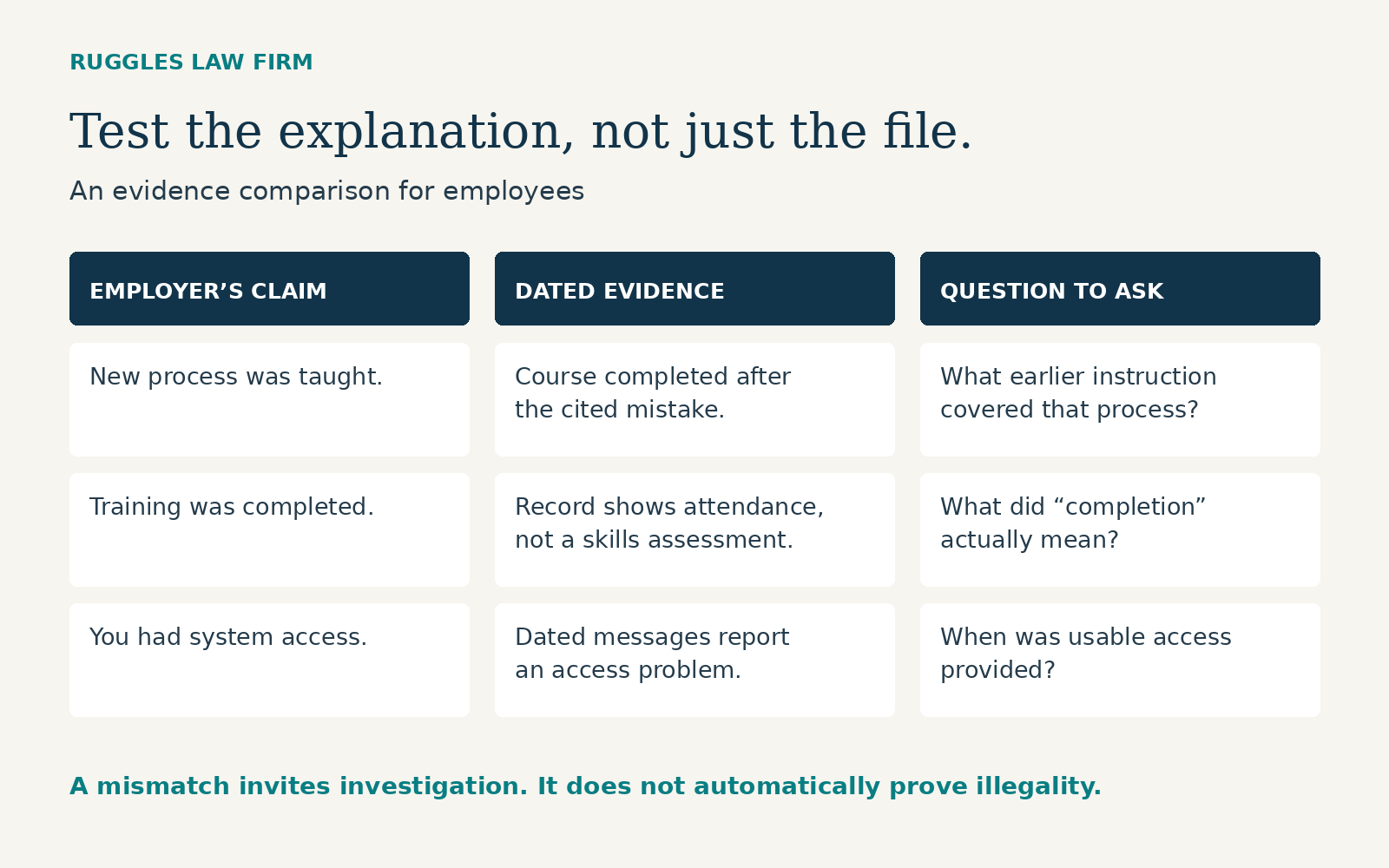
A performance dispute often begins with a broad assertion: you received the training, understood the procedure, and failed to follow it. Those are three different propositions. A course invitation may show that a class existed. An attendance log may show that someone joined. Neither necessarily establishes what the course covered or whether it addressed the task that later became the reason for discipline.
Senate Bill 513, chapter 654 of the Statutes of 2025, was approved and filed on October 11, 2025. Its amendment to Labor Code section 1198.5 took effect January 1, 2026. The amendment is an enacted California statute.
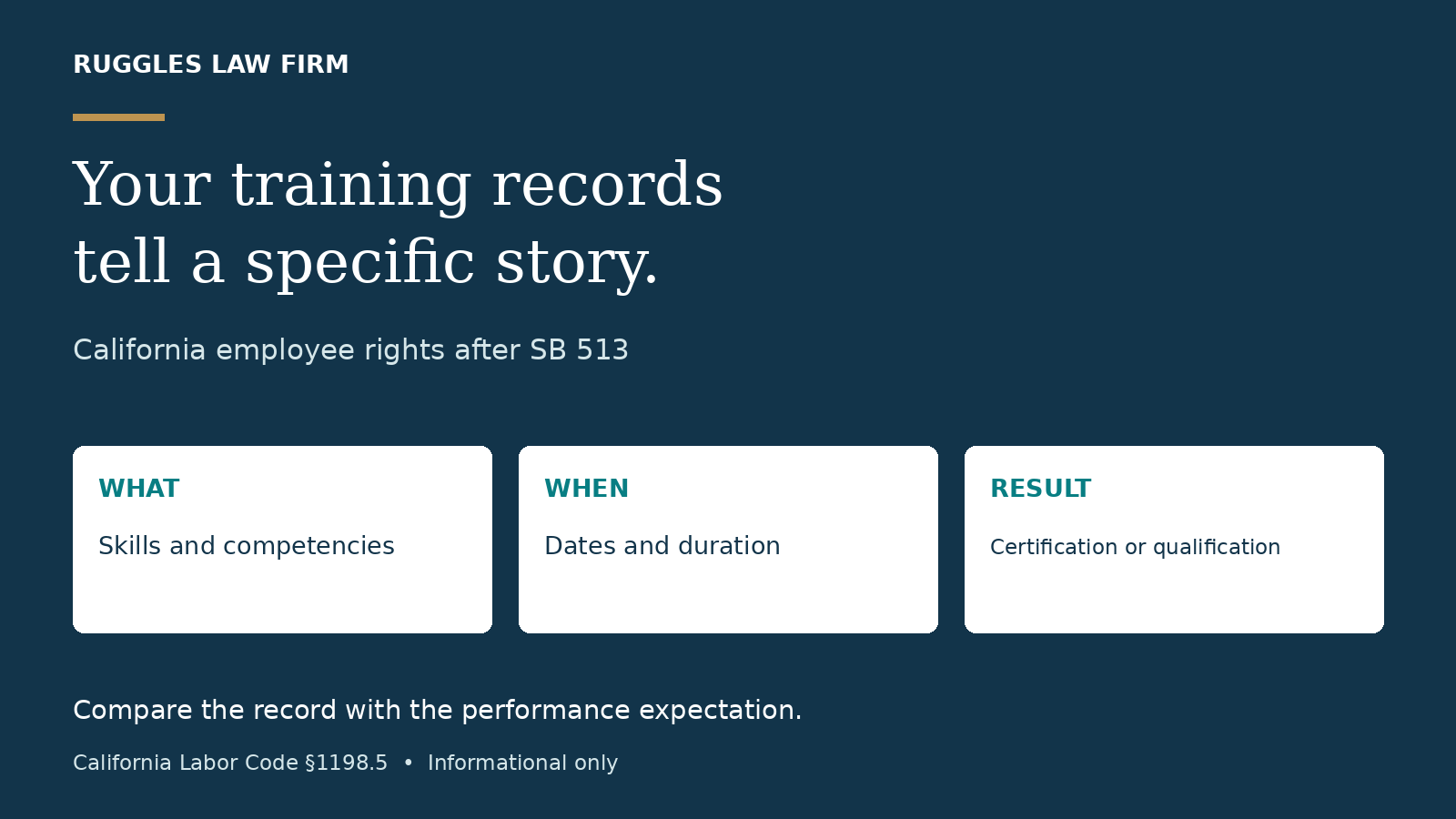
The amended law makes two points explicit. Personnel records relating to performance include education or training records. And an employer that maintains education or training records must ensure they identify the employee, training provider, date and duration, core competencies including equipment or software skills, and resulting certification or qualification. The wording matters: this is not a declaration that every informal workplace conversation must become a newly created training certificate.
The five categories to look for
- Employee: Is the record actually yours, rather than a generic course roster?
- Provider: Who supplied the training?
- Date and duration: Did it occur before the disputed assignment or after the alleged mistake?
- Competencies: Did the course cover the process, equipment or software at issue?
- Result: What certification or qualification resulted, if any? Do not equate an attendance entry with a professional license.
For the general request process, start with our California personnel-file guide. This article addresses the narrower question: how training records can clarify an employer’s performance explanation.
What training records can and cannot prove about a PIP or termination
Focus on whether the records support the actual reason for the employment decision. Identify the precise expectation first: operating a new system, meeting a safety protocol, using an updated sales process, or completing a qualification. Then compare that expectation with the training that was available to you at the relevant time.
Separate access, attendance, content and demonstrated skill
These concepts are related, but not interchangeable. A login created in your name does not establish that the system worked. A completion badge does not necessarily identify the version of the software taught. A passing score may support an employer’s account of training, yet still leave a question about whether later expectations changed. Read both helpful and unfavorable evidence before deciding what the records mean.
Consider a hypothetical employee disciplined in October for using an obsolete workflow. A record showing training on the new workflow in November would not explain what the employee knew in October. But the employer might have other evidence, such as an earlier demonstration or written instructions. The later date warrants a focused question about what instruction occurred before the discipline.
Look for a connection to a protected right
Inadequate training and unfair management are not automatically discrimination or retaliation. Government Code section 12940 prohibits specified discrimination, retaliation for protected opposition or participation, and failures to provide required disability accommodations or engage in the interactive process. A viable claim needs the applicable legal elements and evidence connecting the facts to them.
For example, compare whether employees in genuinely similar roles received training that you were denied, whether a disability-related access problem was raised, or whether criticism appeared after a protected complaint. Record names, dates and specific circumstances you lawfully know. Do not assume that every coworker is a valid comparator or that every complaint is protected under the same statute.
Read our guides to workplace retaliation and workplace investigations for the broader issues. Evaluate training records alongside the other evidence in the case.
How to request your training records without asking for everything on the server
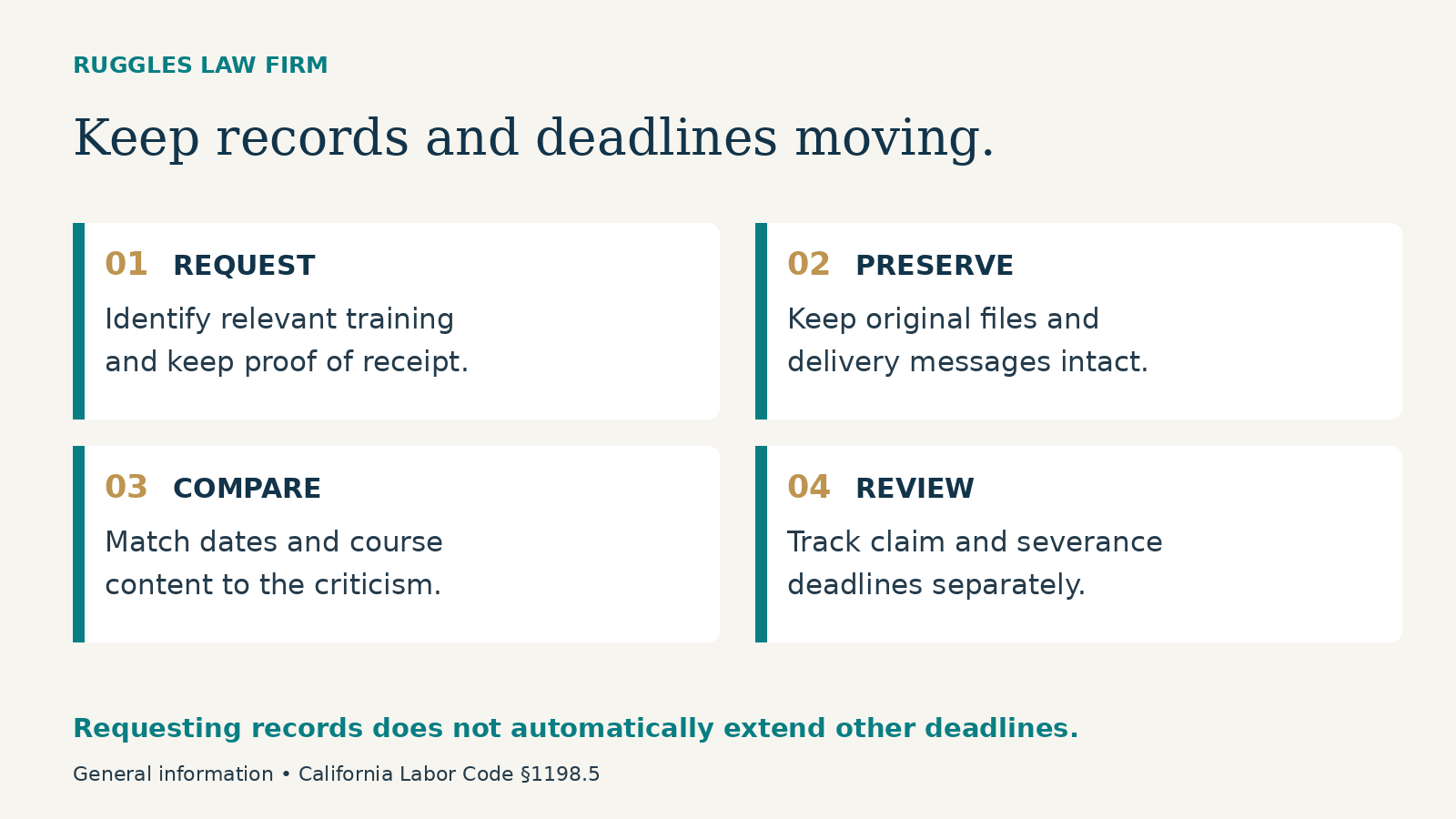
For section 1198.5, make a written request and keep proof of when the employer received it. You may submit your own written request or use an employer-provided form. Identify yourself, the relevant employment dates and the records sought. An authorized representative can act for you, but the authorization must be in writing. The employer may take reasonable steps to verify identity.
Ask for records relating to your performance or grievances, expressly including education and training records maintained by the employer. Identify useful course names, learning platforms, job roles or date ranges. A specific description can help HR find records held outside the main personnel folder; it does not convert the request into an unlimited right to confidential business files.
Sample request language to adapt
Please provide a copy of the personnel records you maintain relating to my performance or any grievance concerning me under California Labor Code section 1198.5, including my education and training records. For training records, please include the employee and provider names, dates and duration, core competencies, and resulting certification or qualification required by section 1198.5(a)(2). Relevant training includes [identify courses, systems or dates]. Please confirm receipt and let me know about any actual reproduction charge. I would prefer electronic copies if you agree to that delivery method.
This sample is not a demand to create nonexistent records or waive lawful exceptions. If you already have a lawyer, coordinate with counsel before sending it. A request should also be tailored if litigation is pending, a collective bargaining agreement applies, or you work for a public agency.
Calendar the right deadline for each type of record
The section 1198.5 deadline is ordinarily no later than 30 calendar days after receipt of the written request. A written agreement may extend the date, but not beyond 35 calendar days after receipt. Do not confuse that with the separate deadline under Labor Code section 226(c): covered payroll-record requests must be fulfilled as soon as practicable, and no later than 21 calendar days after the request.
Labor Code section 432 separately addresses copies of instruments an employee or applicant signed relating to obtaining or holding employment. It does not simply import the personnel-file deadline. Label separate requests clearly so the response can be checked against the correct rule.
A personnel-record request does not automatically extend a severance acceptance deadline, an agency filing deadline or a court deadline. If the offer expires first, seek advice and request additional review time rather than assume the records request pauses the clock.
Review the records and build an evidence timeline
Keep the original delivery email, files and attachments together. Make a separate working copy for notes. Record the number of files, their names, the period covered and any explanation for omissions. Do not edit original timestamps or annotate the only copy of a certificate.
Build a short comparison sheet
- Employer’s statement: Write the exact performance issue and identify the document or meeting where it appeared.
- Relevant training: List the course, date, duration, provider and actual subject matter shown in the response.
- Your contemporaneous evidence: Add course invitations, help requests, access-error messages, completed assessments or corrections you lawfully possess.
- Unresolved point: Ask a neutral question, such as whether training covered the revised process or whether an attendance entry reflects completion.
- Possible explanation: Note facts that support the employer too. An accurate review is more useful than a one-sided list.
When something appears missing, describe it precisely. “The response includes the introductory module but not the advanced module referenced in my September warning” is more useful than an accusation that HR concealed everything. Ask whether the record exists, whether it was searched for, and whether an exception is asserted. An incomplete production may reflect a search problem, a legal disagreement, poor recordkeeping or something more serious. Establish the facts before assigning motive.
Preserve evidence lawfully
Keep lawful copies of your own reviews, training confirmations, requests for help, PIP, termination notice and severance papers. Do not bypass access controls, use credentials after authorization ends, export coworkers’ private files, or take trade secrets or privileged material. If you think important evidence is about to disappear, ask counsel about a preservation request. Self-help collection can create a new problem while you are trying to document the old one.
Important exceptions, costs and enforcement limits
Section 1198.5 is not full civil discovery. It excludes specified records, including records relating to investigation of a possible criminal offense, reference letters and certain pre-employment or examination records. It permits redaction of nonsupervisory employee names. Special exclusions or procedures apply to specified public employees, certain qualifying collective bargaining agreements, and public agencies with an independent employee relations board or commission.
Employers generally must comply with only one former-employee request per year under this section. Current employees’ access is at reasonable times and intervals. The statute also limits the number of requests employers must fulfill from employee representatives in a calendar month. The existence of one restriction does not mean the employer can ignore every part of an otherwise valid request.
The statute requires retention of personnel records for at least three years after termination. Copy charges cannot exceed actual reproduction cost. Location rules differ for current and former employees; a former employee may obtain copies by mail by reimbursing actual postal expenses. Electronic delivery can be practical, but do not describe your preferred format as an unconditional statutory entitlement.
If a covered employer fails to allow timely inspection or copying, section 1198.5(k) provides for a $750 penalty recoverable by the current or former employee or Labor Commissioner. Section 1198.5(l) authorizes an action for injunctive relief with costs and reasonable attorney’s fees. These enforcement provisions do not guarantee a payout for every missing field or impose a daily $750 penalty. Applicability, defenses and the facts must be reviewed.
Once an employee files a lawsuit relating to a personnel matter against the employer, the inspection and copying right under section 1198.5 ceases during that lawsuit’s pendency in the court with original jurisdiction. Litigation discovery is a different process. Do not send a stock request without checking with your litigation lawyer.
Retaliation for asserting protected rights can raise a separate issue. Labor Code section 98.6 protects specified exercises of employee rights and related activities. Preserve any threats or adverse changes and seek an individualized assessment. The request itself does not make you immune from legitimate performance management.
What to do before your next performance meeting
- Identify the specific skill or process the employer says you failed to use.
- Save the relevant warning, job description and lawful training confirmations.
- Write down when expectations changed and when you asked for instruction or access.
- Send a tailored written records request and retain delivery evidence.
- Track the records deadline separately from any severance, grievance or claim deadline.
- Prepare a short factual correction if the record is inaccurate. Avoid speculation about motive.
- Get advice promptly if termination, a release, discrimination, retaliation or an expiring deadline is involved.
If you are considering a separation offer, the training record may help evaluate the employer’s explanation, but it does not establish a severance formula. Our California severance negotiation guide explains why compensation, claims, release terms and practical objectives should be considered together.
32 frequently asked questions about California training records
1. What is the main change made by SB 513?
It expressly includes education and training records in the performance-related personnel records covered by Labor Code section 1198.5. It also identifies required information for employers that maintain those records. It does not turn every workplace conversation into a course or guarantee that every employee has a training-related claim.
2. When did the training-record amendment take effect?
January 1, 2026. SB 513 was approved and filed on October 11, 2025, as chapter 654. The current official version of section 1198.5 identifies that effective date. This guide addresses the California statute as reviewed October 20, 2026, not a future proposal.
3. Can I ask while I still work for the company?
Yes, subject to the statute’s scope and exceptions. Current employees need not wait to be fired to request covered records. Put the request in writing, preserve proof of receipt and remain professional. A request is not a substitute for responding appropriately to current job duties or a performance deadline.
4. Can I request records after a layoff or resignation?
Yes. Former employees are included, although the employer generally must comply with only one request from a former employee per year under section 1198.5. Consider requesting the relevant personnel records together rather than sending a series of narrow requests without first planning what you need.
5. Does a learning-management-system record count?
Consider the record’s relationship to your performance, education or training, regardless of the software used to store it. Identify the platform and relevant courses in your request. Do not assume the right permits you to export the entire platform, other employees’ records or proprietary training materials.
6. What information should maintained training records include?
Section 1198.5(a)(2) lists the employee’s name, provider’s name, training date and duration, core competencies including equipment or software skills, and resulting certification or qualification. Review the response against those categories. If an item does not apply or is missing, ask for clarification rather than inventing a result.
7. Does the law require a certificate for every training session?
The statute requires specified information in education or training records the employer maintains. It does not say every training event must result in a professional certificate. A record may need to distinguish attendance, course completion and a resulting qualification. Those are not necessarily the same thing.
8. Can I make the request by email?
A clear email is a practical way to make and document a written request. Use the employer’s designated recipient if one exists and keep the sent message and acknowledgment. If receipt is disputed, the delivery evidence matters. Avoid putting unnecessary sensitive personal information into an unprotected message.
9. Do I have to use HR’s request form?
Section 1198.5 permits a written request submitted by the employee or representative, or completion of an employer-provided form. If using the form helps identify the right records, it may be sensible. Keep a copy and do not overlook releases, unrelated authorizations or inaccurate statements bundled into it.
10. Can my lawyer request the records for me?
Yes. A representative must be authorized in writing by the employee. The employer may reasonably verify identity and authorization. Coordinate with counsel about the scope, deadlines and delivery. Separate rules apply once a personnel-related lawsuit is pending, so representation does not eliminate the need to check the procedural posture.
11. How long does the employer have to respond?
Ordinarily no later than 30 calendar days after receipt of the written section 1198.5 request. The parties may agree in writing to a later date, but it cannot exceed 35 calendar days after receipt. Save the receipt date and any agreement; do not calculate from an unrelated email or an assumed processing date.
12. Can HR give itself another month because it is busy?
The statute does not provide an open-ended extension for workload. Its written-agreement rule is capped at 35 calendar days after receipt. Still, review the actual facts, applicable exceptions and any asserted defense with counsel before characterizing a delayed production as deliberate obstruction or promising a particular remedy.
13. Are payroll records due on the same date?
No. Labor Code section 226(c) generally requires compliance as soon as practicable and no later than 21 calendar days for covered payroll-record requests. It allows oral or written requests, although writing is easier to document. Identify the payroll request separately and check coverage, including the statute’s public-entity exclusion.
14. Can I obtain a document I signed during onboarding?
Labor Code section 432 provides a separate right to a copy, on request, of an instrument an employee or applicant signed relating to obtaining or holding employment. Name the signed document when possible. Do not assume all onboarding information falls within that provision or that it has section 1198.5’s 30-day deadline.
15. Can the company charge for copies?
For copies under section 1198.5, charges may not exceed actual reproduction cost. A former employee receiving copies by mail may reimburse actual postal expenses. Ask for an explanation of a proposed charge. A request for an electronic copy may reduce friction, but electronic delivery should not be described as guaranteed by this section.
16. Must I travel back to my old workplace?
Former-employee inspection generally occurs where the records are stored unless the parties agree in writing to another location. Mail copies are an option with actual postage reimbursed. Special alternatives apply to certain terminations involving harassment or workplace violence. Ask about delivery arrangements rather than appearing at a former workplace unannounced.
17. How long must personnel records be kept after termination?
Section 1198.5 requires retention for at least three years after termination. Other obligations may also apply, especially when a dispute is anticipated. The retention period is not permission to postpone your claim, and it is not the statute of limitations for every employment cause of action.
18. Can the employer redact other employees’ names?
Section 1198.5 allows redaction of nonsupervisory employee names. Other legal concerns can require analysis too. A redaction does not by itself establish concealment. If it prevents you from understanding the response, ask what was withheld and why, while respecting coworkers’ privacy and avoiding unauthorized efforts to identify them.
19. Will I receive every investigation document?
Not necessarily. The personnel-record right is limited and is not full litigation discovery. Records relating to investigation of a possible criminal offense are expressly excluded, and other scope or privilege issues may arise. Identify the missing category and obtain advice before assuming the employer must provide every witness interview or lawyer communication.
20. Do these rules apply to all public employees?
No single answer covers every public employee. Section 1198.5 contains exclusions for specified employees and agencies, and an initial board or commission process may apply. Public-safety, agency-specific and other rules may provide a different path. Identify the employer and your classification before relying on the private-sector request template.
21. What if I am covered by a union agreement?
A valid collective bargaining agreement can displace section 1198.5 only when the statutory conditions are met, including express provisions addressing records inspection and copying and specified compensation requirements. Union coverage alone is not the entire test. Review the agreement and consult your representative about any grievance deadline or separate access procedure.
22. Does a completion badge prove I mastered the job?
Not necessarily. Check what the badge represents: logging in, attending, passing a quiz or demonstrating a skill. It may be helpful evidence, but the assessment, task and date matter. It can also support the employer’s position, so evaluate it honestly rather than treating every certificate as conclusive proof in your favor.
23. What if the training occurred after the mistake cited in my PIP?
That sequence can be important, but it is not the entire story. Ask what earlier instruction the employer relied on and whether the task changed. Build a dated comparison using the warning, course record and relevant communications. A later course does not prove there was no prior instruction.
24. Can missing training records prove wrongful termination?
No automatic rule turns a missing record into an unlawful discharge. It may identify a weakness in the employer’s explanation or a separate records issue. A wrongful-termination, discrimination or retaliation claim still requires its own legal basis and supporting facts. Preserve the gap accurately without overstating what it proves.
25. What if younger coworkers received training that I did not?
Compare roles, duties, eligibility, decision-makers and timing before drawing a conclusion. If similarly situated employees received opportunities denied to you because of age, that may support a discrimination inquiry. A difference in course access alone does not prove motive. Document facts you lawfully know and avoid collecting coworkers’ confidential files.
26. What if a disability made the training inaccessible?
Explain the functional access problem and the assistance you need through an appropriate channel. FEHA can require reasonable accommodation and a timely good-faith interactive process, subject to its standards and limits. Preserve requests and responses. Do not assume a training completion notation resolves whether an accommodation was needed or actually provided.
27. Should I sign a record saying I completed training I never received?
Do not knowingly adopt an inaccurate factual statement. Read whether the signature acknowledges receipt, attendance, completion or agreement. Ask for clarification and provide a factual correction if needed. If refusal could affect your job or the document has legal consequences, obtain prompt advice rather than relying on a universal rule about signing.
28. Can I ask the employer to correct an inaccurate entry?
You can identify the error and request correction, supported by dates and documents. Preserve the original entry and your written objection. Section 1198.5’s access provisions are not a blanket guarantee that the employer must accept your version. A concise, accurate correction can still help establish what you disputed and when.
29. What should I do if records are missing from the response?
Compare the production with the request and list specific missing categories. Ask whether responsive records exist, whether relevant systems were searched and whether an exception is asserted. Preserve the delivery and follow-up. Escalation should depend on the scope, elapsed time, governing law and actual response, not merely the number of pages produced.
30. Does the records request pause my severance deadline?
No automatic extension follows from the request. Ask separately for more review time and do not assume it has been granted. A lawyer can assess whether the offer, release and missing evidence justify a particular response. Keep the acceptance date and any statutory consideration or revocation rules separate from the records calendar.
31. What changes if I already filed an employment lawsuit?
Under section 1198.5(n) and (o), the statutory inspection and copying right ceases during a qualifying personnel-related lawsuit’s pendency in the court with original jurisdiction. Counsel should use the appropriate discovery process and evaluate the specific posture. Coordinate further records requests with counsel when a case is pending.
32. When should I contact an employment lawyer about training records?
Seek advice when the records connect to threatened termination, a PIP, suspected discrimination or retaliation, a disability-access problem, a severance release, a missed production deadline or an approaching claim deadline. Bring the actual documents, a short chronology and the employer’s stated reason. A records gap can help guide an evaluation, but it does not establish the outcome of a case.
Get a California employment-law evaluation
If your employer’s training story does not match your experience, start with the documents and the dates. Ruggles Law Firm represents California employees in employment disputes and severance matters. A focused review can help distinguish a correctable records problem from evidence relevant to a legal claim.
Request an initial case consultation or call 916-758-8058. Sending an inquiry does not itself create an attorney-client relationship.
This article provides general information about California law as reviewed October 20, 2026. It is not legal advice and does not create an attorney-client relationship. Coverage, exceptions, deadlines and outcomes depend on the facts. Do not delay seeking advice about an expiring deadline while waiting for records.