
California Executive Severance Lawyer
Protect your compensation. Preserve your options. Leave with a plan.
An executive severance agreement can affect far more than your next paycheck. It can determine what happens to your bonus, commissions, restricted stock units, stock options, health coverage, professional reputation, and ability to move into your next role.
Call Matt Ruggles at (916) 758-8058 to discuss your executive severance agreement. Mention any signing deadline when you contact the firm.
Matthew J. Ruggles
30+ years of employment law experience. Former management-side employment lawyer. Now representing California employees.

Quick Links
California Executive Severance Review

Before you sign, you need to know what the company already owes you, what it is offering in exchange for a release, and whether the proposed terms protect your interests.
Ruggles Law Firm represents California executives and other highly compensated employees in severance agreement review, severance negotiation, and negotiated departures. Whether you have been laid off, removed from leadership, offered an early retirement package, or asked to discuss a transition, we help you evaluate the offer and decide what to do next.
Schedule Your Initial Case ConsultationExecutive Severance Requires More Than a Salary Calculation
A package described as "six months of severance" may sound substantial. But six months of base salary is not necessarily six months of your actual compensation. The offer may exclude a performance bonus, outstanding commissions, an upcoming equity vest, or benefits that were an important part of your employment package.
The restrictions matter, too. Payments might stop when you accept another job. An undefined cooperation requirement might follow you for years. A release might reach compensation disputes you have not yet identified.
We evaluate both sides of the transaction: what you receive and what you agree to give up.
Our executive severance work addresses the needs of CEOs, CFOs, COOs, CTOs, CMOs, presidents, vice presidents, senior directors, sales leaders, and other employees with substantial incentive compensation or equity. A particular title is not required. The complexity and value of the agreement are what matter.
Matt's Legal Perspective: The right question is not simply, "How many months can I get?" It is, "What is this agreement actually worth, and what could it cost me after I sign?"
Executive Severance Review, Negotiation, and Exit Planning
Review an offer before you sign
We examine the proposed agreement alongside the documents that govern your employment and compensation. The objective is a practical assessment: what the terms mean, what requires clarification, which rights need protection, and whether negotiating is worth the potential benefit, expense, and risk.
Negotiate compensation and contract terms
When negotiation makes sense, we develop a focused proposal supported by your contracts, compensation records, employment history, and the circumstances of your departure. Depending on the engagement, that may involve advising you behind the scenes or communicating with the employer's representatives directly.
More money is not the only possible objective. A shorter payment deadline, improved equity treatment, a workable reference agreement, or the removal of an unreasonable restriction can materially improve the exit.
Plan a departure before employment ends
You do not always have to wait for a termination notice to obtain advice. A reduction in responsibilities, leadership dispute, acquisition, compensation change, or proposed transition may justify reviewing your options early.
Do not assume that resigning first improves your position. A resignation can affect eligibility for contractual severance and other benefits. Some "good reason" provisions require specific notice and an opportunity for the employer to correct the problem before you leave.
Our guide to negotiated exits for executives explains why the sequence of events matters.
What Should an Executive Severance Package Include?
There is no single package that fits every executive. We start by separating compensation already owed, benefits available under existing agreements or plans, and additional consideration offered for the separation agreement.
| Component | Questions to address before signing |
|---|---|
| Cash severance | What compensation measure is used? When is payment due? Can payments be reduced or stopped? |
| Bonuses and commissions | What has been earned? Which plan applies? Are milestones, accounting, or chargebacks disputed? |
| RSUs and stock options | What vests, settles, expires, or becomes exercisable? What approvals would an improvement require? |
| Benefits | When does coverage end? Is a premium subsidy included? What happens to retirement or deferred benefits? |
| Release and ongoing obligations | Which claims are released? What restrictions, repayment duties, or cooperation requirements remain? |
| Professional reputation | What will the company say about the departure? Who may provide a reference? |
| Enforcement and payment security | What happens if the employer pays late, changes ownership, or alleges a breach? |
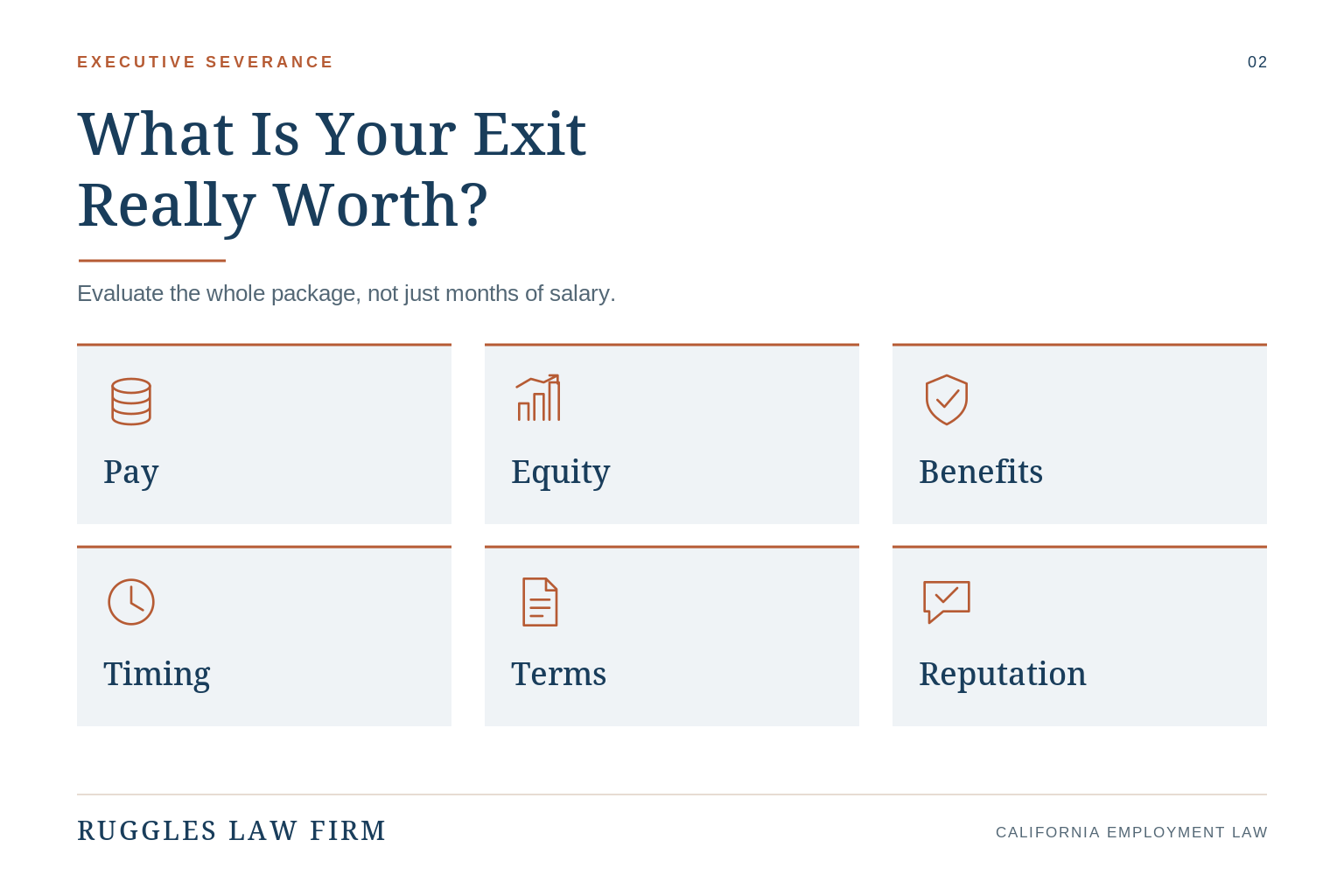
Cash severance: amount, timing, and conditions
The headline number is only the beginning. We examine whether severance is paid in a lump sum or installments, when payment begins, and whether the employer claims a right to stop payments, deduct another debt, or offset income from a new position.
A delayed payment can create a real cash-flow problem even when the agreement appears generous. The final document should state how the effective date is calculated and when each payment becomes due. Any release, revocation period, or approval condition should fit the payment schedule rather than leave it uncertain.
Bonuses, commissions, and earned incentive compensation
A termination does not, by itself, resolve whether an incentive payment has been earned. The answer depends on the compensation plan, applicable law, and the performance already completed.
For sales executives, we examine the plans applicable to particular transactions, relevant milestones, payment history, and the basis for any proposed chargeback. For other executives, we review annual and long-term incentive plans, performance measures, retention agreements, and any claimed continued-employment requirement.
A target bonus is not automatically an earned bonus. Likewise, calling a payment "discretionary" or an "advance" does not end the analysis. The actual terms and facts matter. See our discussion of severance negotiation for California sales executives.
Health coverage and other benefits
We identify when active coverage ends, what continuation rights apply under COBRA or applicable state law, and whether the employer will subsidize premiums. A useful benefits provision specifies the duration, covered dependents, payment method, and circumstances in which the subsidy ends.
Other potential subjects include executive outplacement, career coaching, retirement-plan rights, supplemental retirement benefits, and an employer contribution toward legal fees. These are possible negotiating points, not benefits every employer must provide.
Matt's Legal Perspective: Money already owed should not disappear into a severance number. Start with a clear accounting. Then evaluate the additional payment and protections being offered for your signature.
Protect Your RSUs, Stock Options, and Other Equity
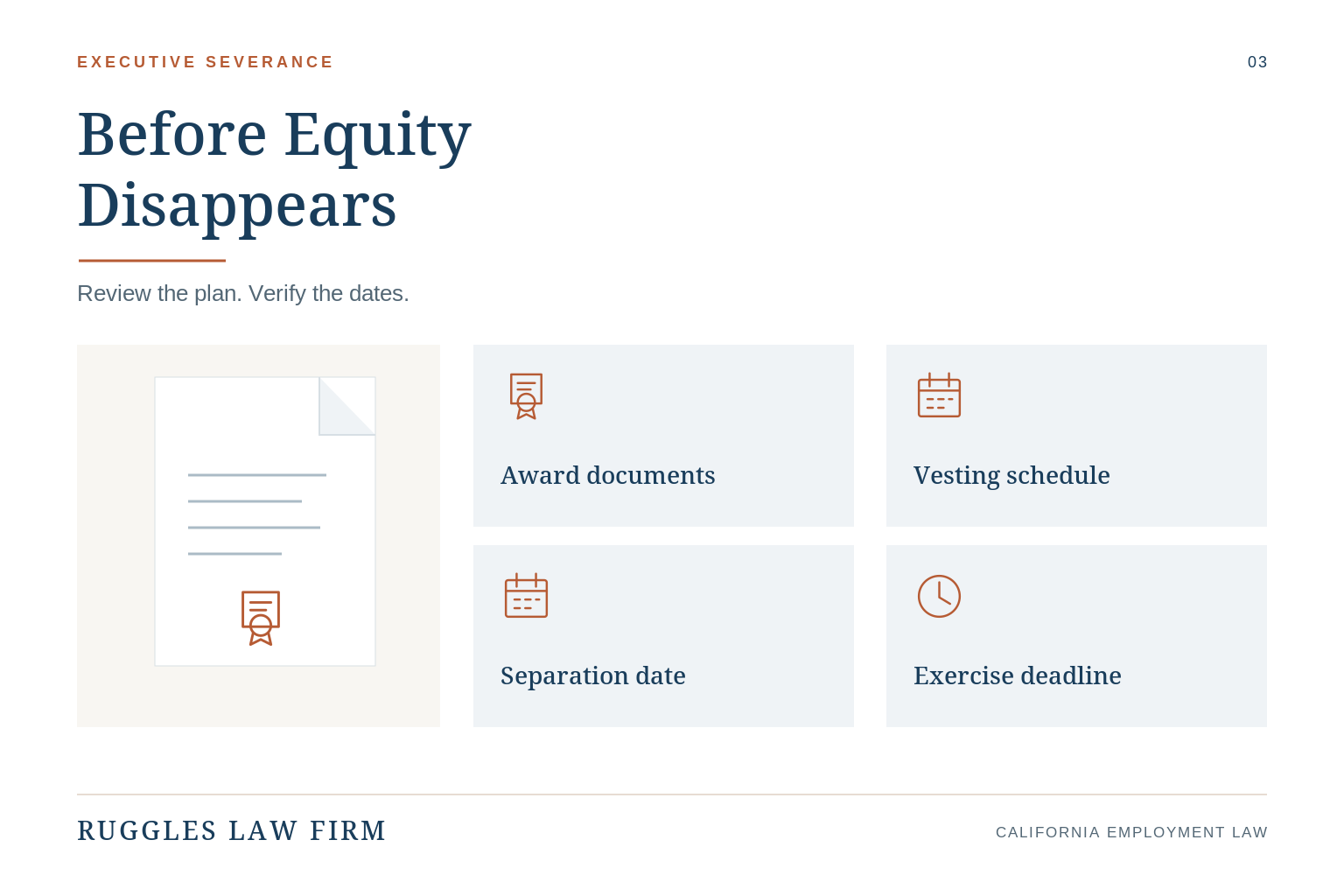
Equity deserves its own review. The severance agreement may say little about stock while incorporating an equity plan and award agreements that control what happens when employment ends.
Read the plan, the award, and the separation agreement together
We look at vesting schedules, performance conditions, termination definitions, settlement terms, repurchase rights, and post-termination exercise provisions. A stock-portal balance alone does not explain all of those rights.
RSUs and stock options are not interchangeable. Vesting, settlement, and exercise can be different events. Private-company awards may also involve liquidity conditions or other restrictions that change their practical value.
Identify possible improvements before rights expire
Depending on the documents and circumstances, a proposal may seek partial or full acceleration, continued vesting under an authorized transition arrangement, cash in place of forfeited awards, an extended exercise period, or clarification of existing rights.
These changes are not automatic. They may require approval under the equity plan, a written award amendment, and tax or securities-law review. A verbal assurance from a manager is not a substitute for the required documentation.
Our guides explain RSUs after a California layoff and negotiating RSU acceleration.
Do not assume a nearby vesting date proves a legal claim
Termination shortly before a vesting event warrants careful investigation. But timing alone does not establish wrongful termination or an automatic right to unvested equity. We evaluate the plan language, the stated reason for the decision, relevant evidence, and any independently supported legal claims.
Matt's Legal Perspective: "You lose the stock" is a conclusion, not an analysis. First determine what the documents actually provide. Then determine whether there is a credible basis to seek a different result.
What Creates Leverage in Executive Severance Negotiations?
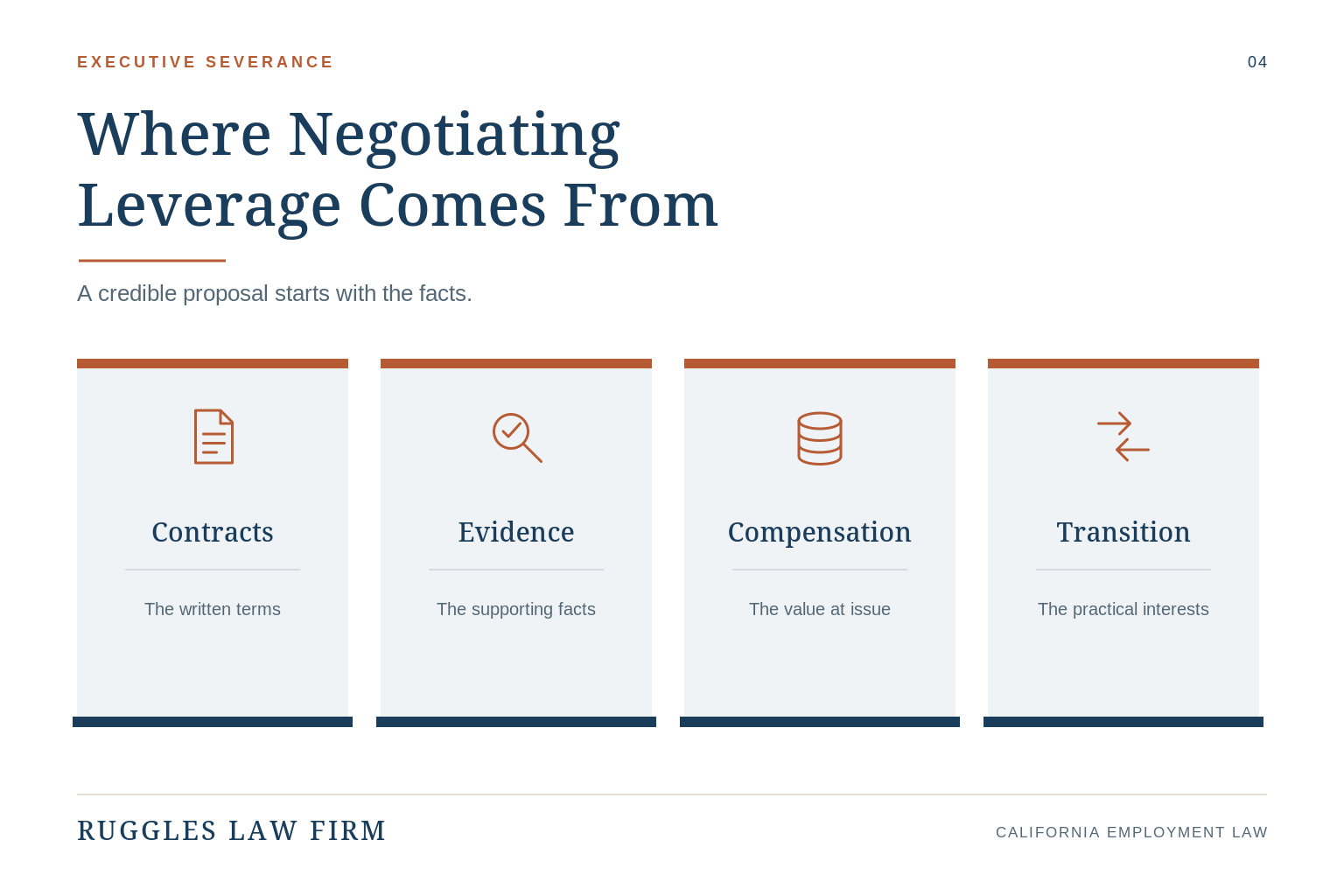
An effective counterproposal gives the employer a reason to reconsider. That reason should come from the facts, the governing documents, and a realistic understanding of the employer's interests, not an unsupported accusation or an inflated demand.
Existing contracts and promised benefits
An employment agreement, executive severance plan, retention agreement, or change-in-control arrangement may provide rights beyond the company's initial offer. Eligibility can turn on defined terms such as "cause," "good reason," or a qualifying termination following an acquisition.
Some plans also require timely claims or appeals. We review those procedures rather than assuming an informal negotiation preserves every contractual remedy.
Evidence supporting potential legal claims
Depending on the facts, a departure may raise questions involving discrimination, disability accommodation, protected leave, retaliation, whistleblowing, unpaid compensation, or breach of contract.
Different protections have different requirements. For example, retaliation for opposing discrimination is not the same legal claim as retaliation for reporting suspected unlawful business conduct. California Labor Code section 1102.5 addresses qualifying whistleblower activity; the Fair Employment and Housing Act addresses separate discrimination-related protections.
A harsh or unfair decision is not necessarily unlawful. We consider the employer's likely defenses and unfavorable facts as carefully as the evidence supporting your position.
The company's practical interests in an orderly transition
A company may value an orderly handoff, continuity for customers, cooperation with an authorized investigation, or a clearly documented departure. Those legitimate business interests can support a proposal even when litigation is not the right path.
Professional negotiation does not require threats to embarrass the employer or an assumption that every dispute belongs in court. It requires a credible explanation of why the proposed resolution makes sense. Our article on using leverage in severance negotiation discusses that distinction.
The Nonfinancial Terms Can Follow You for Years
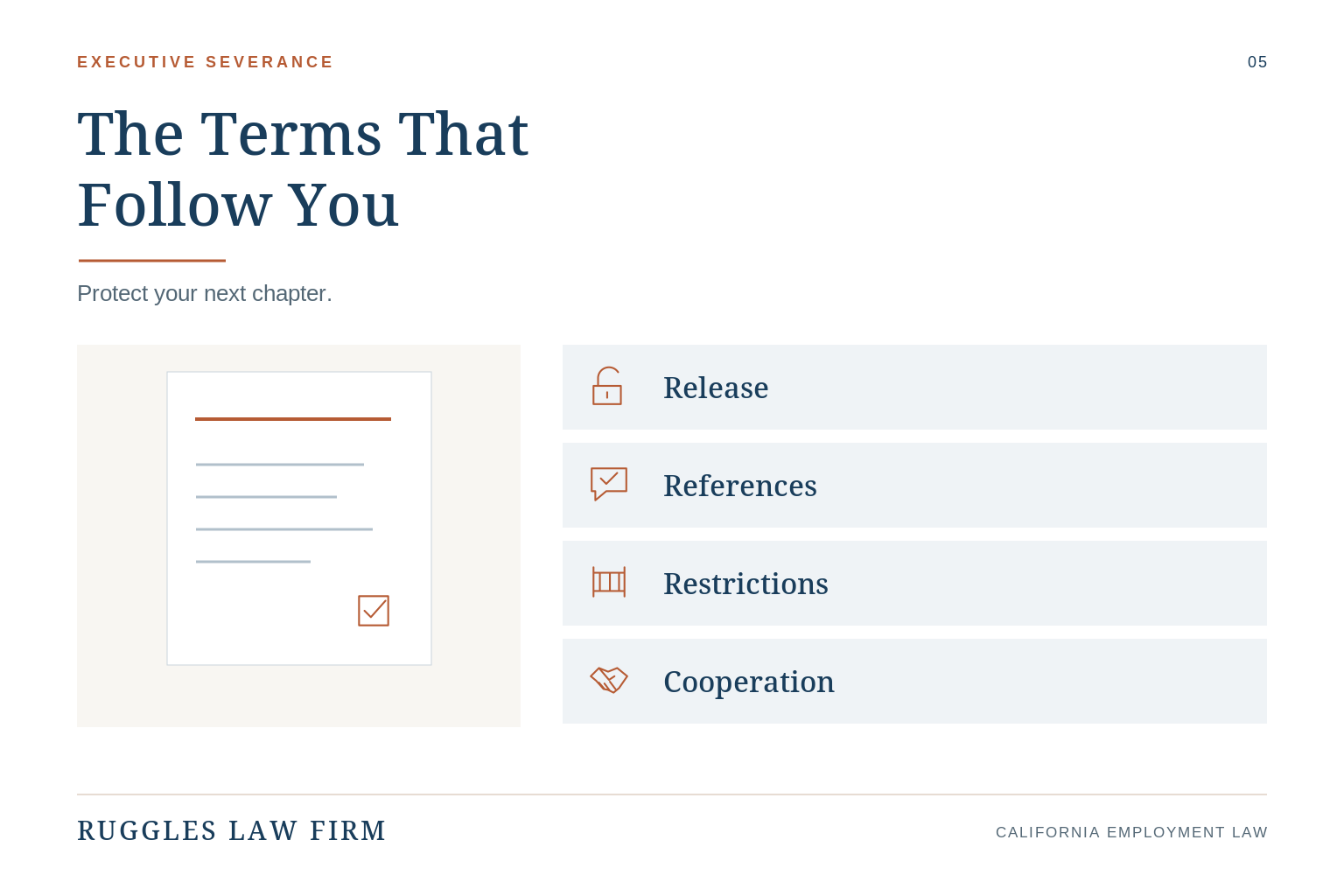
An executive's next opportunity may be affected by what the separation agreement says about the last one. We review the obligations that remain after the severance payment arrives.
Releases, unknown claims, and rights that should survive
A release can eliminate valuable existing claims, including unknown claims when an effective California Civil Code section 1542 waiver is included. Its reach should be understood before you sign.
We consider appropriate exclusions for enforcing the agreement, preserved compensation and benefit rights, indemnification rights, and claims that cannot lawfully be waived. The agreement should not purport to bar protected communications with government agencies or waive claims based on future conduct.
Confidentiality and nondisparagement
Confidentiality is not an all-or-nothing question. California law restricts separation provisions that prevent disclosure of unlawful workplace acts, while allowing protection for certain other information, including the amount paid and legitimate trade secrets.
We review required statutory protections and consider whether a mutual, workable nondisparagement provision is appropriate. The people actually bound by the company's commitment matter as much as the word "mutual."
Noncompetes, nonsolicitation provisions, and your next job
California generally prohibits employment noncompetes, subject to statutory exceptions. That does not make every confidentiality, nonsolicitation, ownership, or transaction-related restriction harmless.
We examine the actual language, applicable law, and any out-of-state provisions. The goal is to identify and address problems before your next employer, customer, or business opportunity becomes involved, rather than advise you to ignore the agreement.
References and departure announcements
A reference provision should answer practical questions: Who may respond? What will they say? Will an agreed letter be provided? What will employees, customers, recruiters, or the board be told?
Where appropriate, we seek consistent, accurate language for the reason for departure and internal or external announcements. A useful agreement protects reputation without requiring false statements.
Cooperation, repayment demands, and indemnification
A broad cooperation clause can create substantial unpaid obligations. We consider reasonable notice, subject matter, duration, scheduling, compensation where appropriate, expense reimbursement, and protection for privileged communications.
Executives should also examine existing indemnification rights, advancement of defense expenses, and relevant directors-and-officers insurance arrangements. Signing-bonus repayment, relocation reimbursement, alleged overpayments, and clawback provisions deserve separate review. Some statutory or regulatory obligations cannot simply be negotiated away.
Mergers, Acquisitions, Layoffs, and Negotiated Departures
A change in ownership can bring overlapping agreements into play: employment contracts, retention awards, change-in-control benefits, equity plans, and a new separation document.
Some benefits turn on the transaction itself. Others require an additional qualifying event, such as termination without cause or a properly documented good-reason resignation. The exact definitions, notice requirements, and dates can determine eligibility.
We also assess whether a larger workforce reduction raises separate notice or payment issues under applicable federal or California WARN requirements. A severance offer should not be assumed to resolve those issues automatically.
For senior executives, deferred compensation and transaction-related payments can present specialized tax issues, including Internal Revenue Code sections 409A, 280G, and 4999. We flag those issues for appropriate coordination with tax or benefits advisers rather than treating an after-tax result as a certainty.
Read our guide to executive severance after a merger or layoff.
California Severance Rules and Signing Deadlines
Severance and final wages are different
California generally does not require an employer to offer severance simply because employment ends. An agreement, policy, or benefit plan may nevertheless create enforceable rights.
Final-pay obligations are separate. Subject to applicable exceptions, discharged employees must receive wages due, including earned unused vacation, at termination. Undisputed wages already due cannot be held hostage to a release. A genuine dispute over whether compensation was earned requires its own analysis.
Five business days under California law
For covered separation agreements, Government Code section 12964.5 generally requires notice of the right to consult an attorney and at least five business days to do so. An employee may knowingly and voluntarily sign earlier under statutory conditions. The statute contains an exception for certain negotiated settlements of existing claims.
Federal age-discrimination waiver requirements
For employees age 40 or older, an agreement seeking a release of federal age-discrimination claims generally must satisfy the Older Workers Benefit Protection Act. The usual requirements include at least 21 days to consider an individual offer, or 45 days for a covered group program, plus seven days after signing to revoke. Additional requirements apply, including specified group disclosures when relevant. Different rules can apply to settlements of already-filed charges or lawsuits.
There is no universal seven-day cancellation right for every severance agreement. Have the actual agreement and circumstances reviewed. An offer deadline, a claim-filing deadline, and an equity deadline are different dates; do not assume negotiations extend any of them.
The EEOC's severance-waiver guidance and California Government Code section 12964.5 explain important requirements.
A Practical Process for Your Executive Severance Review
Start with the documents and the deadline
Tell us when the offer expires and whether you have already responded. Useful materials include the proposed agreement, employment and severance-plan documents, compensation plans, relevant equity awards, benefits information, and a concise chronology of the events leading to the offer.
Preserve relevant records lawfully. Do not remove company trade secrets, privileged materials, patient information, or other records you are not entitled to take. Do not delete relevant communications or create a new problem while preparing for a consultation.
Identify priorities and realistic alternatives
We consider the financial terms, legal issues, evidence, available negotiation points, and your personal objectives. Someone who needs a prompt, certain resolution may make a different decision from someone prepared to pursue a supported claim.
The evaluation should account for the existing offer, the potential improvement, the cost of obtaining it, and what happens if negotiations do not succeed.
Make a focused proposal and review the final agreement
A useful proposal explains the requested changes and why they are justified. It can address money, payment timing, equity, benefits, reputation, and continuing obligations together rather than settling each subject in isolation.
Any final document should be checked against the agreed terms. Confirm payment dates, signatures, required approvals, references, and surviving rights before deciding whether to accept. You remain the decision-maker.
Our complete California severance agreement guide provides additional background.
Executive Severance Issues by Industry
Technology and software. RSUs, options, performance awards, vesting dates, and long-term incentives may carry more value than base-salary severance. See our California tech layoff, RSU, and executive compensation guide.
Finance and fintech. Deferred compensation, retention awards, repayment provisions, regulatory obligations, and internal investigations can complicate an exit. Read about severance negotiation for finance and fintech employees.
Healthcare. Leadership transitions may involve incentive targets, board communications, reporting responsibilities, and sensitive business or patient information. Our healthcare executive severance guide addresses these concerns.
Entertainment and media. Executive contracts may combine fixed terms, incentive compensation, project-related benefits, and important public-facing departure language. See severance negotiation for entertainment executives.
Enterprise sales. Long sales cycles and changing commission plans can make a base-salary-only offer an incomplete measure of the exit. Identifying the governing plan and completed earning conditions is essential to evaluating the compensation dispute.
Examples From Ruggles Law Firm's Severance Negotiations
A CFO obtained a six-figure increase after a merger
In a matter described in our published case study, a CFO faced termination following a merger. Our evaluation included evidence concerning his earlier cooperation with a government investigation. Negotiations resulted in a six-figure increase over the original offer and improved nonfinancial terms without litigation. Read the executive merger case study.
An enterprise sales executive received more than triple the initial offer
In another published matter, we reconstructed the applicable commission plans and challenged the employer's repayment position. The final package exceeded three times the original severance offer and eliminated commission repayment demands. Read the enterprise sales severance case study.
Past results do not guarantee a similar outcome. Each matter depends on its own facts, documents, law, and negotiating circumstances. These examples are not a prediction of what any particular executive will receive.
Sacramento Executive Severance Counsel for California Employees
I am Matt Ruggles, founder of Ruggles Law Firm. I have practiced employment law for more than 30 years, including years representing corporate employers and serving as an equity partner at Littler Mendelson. Since founding this firm in 2016, my practice has focused on representing employees.
That background informs how I evaluate an employer's explanation, the supporting documents, and the risks its lawyers are likely to consider. The objective is not to make every departure a lawsuit. It is to help you understand your position and pursue a sensible result.
Based in Fair Oaks in the Sacramento area, Ruggles Law Firm represents California employees, including executives in Sacramento, Roseville, Folsom, the San Francisco Bay Area, Silicon Valley, and elsewhere in the state. Learn more about Matt Ruggles's employment law background.
Matt's Legal Perspective: Sometimes the best recommendation is to negotiate. Sometimes it is to improve a few important terms and move on. You deserve a candid assessment, not a promise that every offer can be doubled.
Executive Severance FAQs
What is a fair severance package for a California executive?
There is no universal number of weeks or months. A useful evaluation considers contractual rights, compensation structure, tenure, transition needs, legal risk, benefits, equity, and the obligations imposed by the agreement. Another executive's package is not a substitute for reviewing your documents.
Can I negotiate an offer labeled "standard" or "non-negotiable"?
Sometimes. Those labels do not establish that every provision is legally required or that no change is possible. But some employers hold firm, particularly under standardized programs. The question is whether your circumstances support a credible request and whether pursuing it is worthwhile.
Can my employer withdraw the offer if I ask for more?
That risk cannot be dismissed. The answer depends on the offer, applicable law, existing rights, and how the communication is framed. An inquiry, a request for more time, and a counteroffer are not necessarily the same. Obtain advice before rejecting the existing proposal or assuming it will remain available.
Do I need a wrongful termination claim to negotiate severance?
No. Contract rights, disputed compensation, and legitimate transition considerations may support negotiations even when a lawsuit is not appropriate. A supported legal claim may add leverage, but an accusation without evidence can undermine the discussion.
Can I keep severance after accepting a new job?
That depends on the agreement. Some packages contain reemployment offsets, mitigation requirements, or conditions that end payments. We review those provisions because a successful job search should not create an unexpected repayment or disclosure dispute.
Can I negotiate through a lawyer without filing a lawsuit?
Yes. Reviewing an agreement or negotiating a departure does not itself require litigation. The firm and client should define the scope of the engagement. Any later decision to pursue litigation or arbitration is a separate strategic decision.
Are severance payments taxable?
Severance is generally taxable. Payment timing, equity, deferred compensation, and transaction-related benefits can raise additional issues. Evaluate the net benefit with appropriate tax advice rather than treating the gross amount or payroll withholding as your final tax result.
Will severance affect unemployment benefits?
Do not assume the agreement guarantees eligibility or ineligibility. The EDD determines benefits under applicable rules, and the nature of the payment and separation can matter. Disclose severance and other payments accurately when required and follow the agency's reporting instructions.
What does executive severance representation cost?
The fee and scope depend on the proposed engagement. A document review is different from extended negotiations or litigation. Confirm the fee arrangement, included work, and any additional services before proceeding. The potential benefit of negotiation should be evaluated in light of its cost.
What should I do if I already signed?
Seek advice promptly. An available revocation period, the release's validity and scope, or an employer's failure to perform may affect your options. Do not assume the agreement can be undone simply because you later regret the amount, and do not rely on a cancellation period that does not apply.
Can you review an agreement from an employer headquartered outside California?
Yes, when the matter involves a California employee or a sufficient California connection and fits the firm's practice. Where you worked, the contract language, the employer's structure, and choice-of-law or forum provisions can affect the analysis. California residence alone does not answer every jurisdictional question.
What should I bring to a severance consultation?
Start with the offer, all attachments, the deadline, your employment agreement, applicable compensation and equity documents, and a brief timeline. Identify your priorities and disclose adverse facts as well as favorable ones. A clear account is more useful than an exaggerated one.
Before You Sign, Understand the Whole Exit

You do not have to decide whether an executive severance offer is fair by looking only at its first page. Understand the payment, the compensation at stake, the rights being released, and the obligations that will continue after your employment ends.
Schedule Your Initial Case Consultation
Call Matt Ruggles at (916) 758-8058 to discuss executive severance review or negotiation. Have the proposed agreement and response deadline available when you contact the firm.
Ruggles Law Firm
California employee representation
7940 California Ave, Fair Oaks, CA 95628
This page provides general information, not legal advice for a particular situation. Laws, deadlines, and contractual rights depend on the facts. Contacting the firm does not by itself create an attorney-client relationship. Representation requires the firm's agreement to accept the matter.