

Your employer calls the severance package "standard." The agreement calls it "generous." The deadline suggests you should not spend too much time thinking about either description.
My first question is different: What has the company left out?
A completed bonus period? Fifteen years of service before a merger? An uncomfortable termination timeline? A stock grant scheduled to vest days after your departure? A contractual protection that appears in an executive agreement but somehow disappears from the proposed exit package?
Those are the questions that turn a request for more money into a negotiation with a reason behind it.
Start with the facts that could change the offer. Identify compensation the employer may have overlooked, test its explanation for the termination, review bonus and equity terms, and present a documented counterproposal. Separate amounts already owed from additional consideration for signing a release.
Our California severance agreement review and negotiation services focus on the documents, the negotiating leverage, and the practical value of your exit package.
What Gives You Leverage in a California Severance Negotiation?
"I deserve more" may be understandable. Our task is to build a more useful argument: Here is the document you overlooked, the assumption that does not hold up, or the unresolved issue your proposed release is supposed to settle.
We also separate money already owed from additional consideration for a release. California law does not allow an employer simply to withhold wages due until the employee signs away claims. That is different from negotiating a genuine dispute about whether particular compensation was earned. (Labor Code section 206.5.)
Consider the five situations below. Each shows how we would analyze an offer, develop legal leverage for a bigger severance package, and structure a counterproposal. The package calculations range from $135,000 for a manufacturing manager to $3 million for a technology executive.
The strategy follows the documents and the facts, not a universal severance formula. Dollar amounts are gross, before taxes, attorney fees, and costs; each calculation identifies the forms of compensation included.
The Bonus Was "Discretionary." The Spreadsheet Had Other Ideas.
The Problem Behind the Paperwork
Suppose Nora, a finance manager at a manufacturing company, earns $210,000 a year and has spent fourteen years helping the business survive supply-chain problems, acquisitions, and a particularly ambitious accounting-system conversion.
Her position is eliminated. The company offers $25,000 and excludes her annual bonus, explaining that bonuses are discretionary and she will not be employed on the payment date.
Now suppose Nora has completed the performance year, and the company's own incentive spreadsheet shows that her division met the relevant targets. That is where we would start.
How Unpaid Bonus Terms Can Strengthen a Severance Counteroffer
We would begin with the bonus plan, offer letter, performance measures, prior payout records, and correspondence announcing the payment schedule. We would want to know what "discretionary" actually means in these documents. Does the employer retain discretion over whether to pay anything, over the amount, or only over final approval? What work and other conditions are required?
California's definition of wages includes compensation for labor performed. But that does not make every anticipated bonus automatically payable; the earning conditions and facts still need analysis. (Labor Code section 200.)
The point to investigate would be the mismatch between a completed, measurable performance period and a later payment-date condition invoked after a no-fault layoff. A reservation of final approval authority would be a weakness to address, not an unfavorable sentence to pretend does not exist.
Next, we would change the request from "reward my loyalty" to a defined transition proposal. Nora's specialized role, long tenure, and abrupt departure would support the business argument for six months of base salary. We would pair that request with a resolution of the bonus dispute and a fixed health-coverage contribution.
The demand would not be a twenty-page account of every disappointing conversation Nora has ever had. It would be a short chronology, the relevant compensation language, the spreadsheet, and a specific proposal.
If the company repeated that its offer followed policy, we would ask it to address the separate incentive-compensation issue and explain how its proposal accounted for the completed year. We would also make clear that Nora was seeking a professional resolution, not a prolonged fight over every paragraph.
Building the $135,000 Severance and Bonus Proposal
A proposal combining $105,000 in cash severance, $20,000 to resolve the disputed bonus, and a $10,000 health-coverage contribution would total $135,000. If accepted, that structure would add $110,000 to the starting offer.
Any undisputed wages owed at termination would remain separate and would not be counted as a negotiating success.
The bonus argument would not, by itself, establish an entitlement to six months of severance. Its purpose would be to identify a concrete dispute; the transition proposal would give the employer a commercially sensible way to resolve it.
Your Position Has Been Eliminated. Your Replacement Starts Monday.
The Explanation That Needed a Second Opinion
Suppose Marcus directs operations for a network of outpatient clinics. During medical leave following surgery, he receives notice that his position has been eliminated in a restructuring. The company offers three months of pay and wishes him a speedy recovery.
Then suppose the company advertises a position with a different title and remarkably familiar responsibilities.
Marcus might understandably focus on the advertisement. We would focus on what the advertisement could help prove when placed beside the other records.
Using Medical-Leave Records to Evaluate Severance Leverage
First, we would assemble the sequence: the accommodation request, the doctor's estimated return date, management's responses, the restructuring announcement, and the new job posting. We would compare actual duties, reporting relationships, budget responsibility, and required experience rather than assume two similar titles meant the jobs were identical.
Assume the records show that most of Marcus's responsibilities survive. His doctor has proposed a return in six weeks, with a temporary scheduling adjustment. Management has rejected further leave by referring to a company maximum, without documenting an individualized review. Those would be the specific facts to investigate.
That distinction matters. California's Civil Rights Department explains that covered employers must consider reasonable accommodation and engage in a timely, good-faith interactive process; exhausting a leave benefit can still leave accommodation questions to address.
That does not automatically establish a right to indefinite leave or prevent a genuine, nondiscriminatory restructuring.
My Complete Guide to Employee Leaves of Absence in California explains how the different leave and accommodation frameworks fit together.
We would not argue that the company could never reorganize while someone was ill. We would ask narrower questions: What work disappeared? Who will perform the remaining duties? Why is the proposed return date unworkable? What alternatives were discussed?
We would also test the defense. A contemporaneous plan to eliminate the function before the accommodation request would matter. So would evidence that the replacement role required materially different work. The proposal should acknowledge those possibilities and identify the gaps the records actually support.
Our proposal would connect those gaps to the economics: Marcus's compensation, the period of lost work, his continuing insurance needs, and the cost and uncertainty of resolving the dispute through litigation. We would propose a defined settlement rather than declare a jury verdict inevitable.
If the employer moved from a policy-based response to substantive negotiations, we would focus on the money and the health-coverage arrangement. We would not spend that momentum demanding cosmetic changes to every standard provision.
Building the $325,000 Healthcare Exit Proposal
A structure with $290,000 in cash severance and settlement consideration, a $25,000 health-coverage contribution, and $10,000 in funded career-transition services would total $325,000.
Acceptance would produce a $265,000 increase over the starting offer, without requiring the employer to admit liability.
The negotiating basis would be the documented problems with the termination explanation and accommodation process, not simply the assertion that the termination felt unfair.
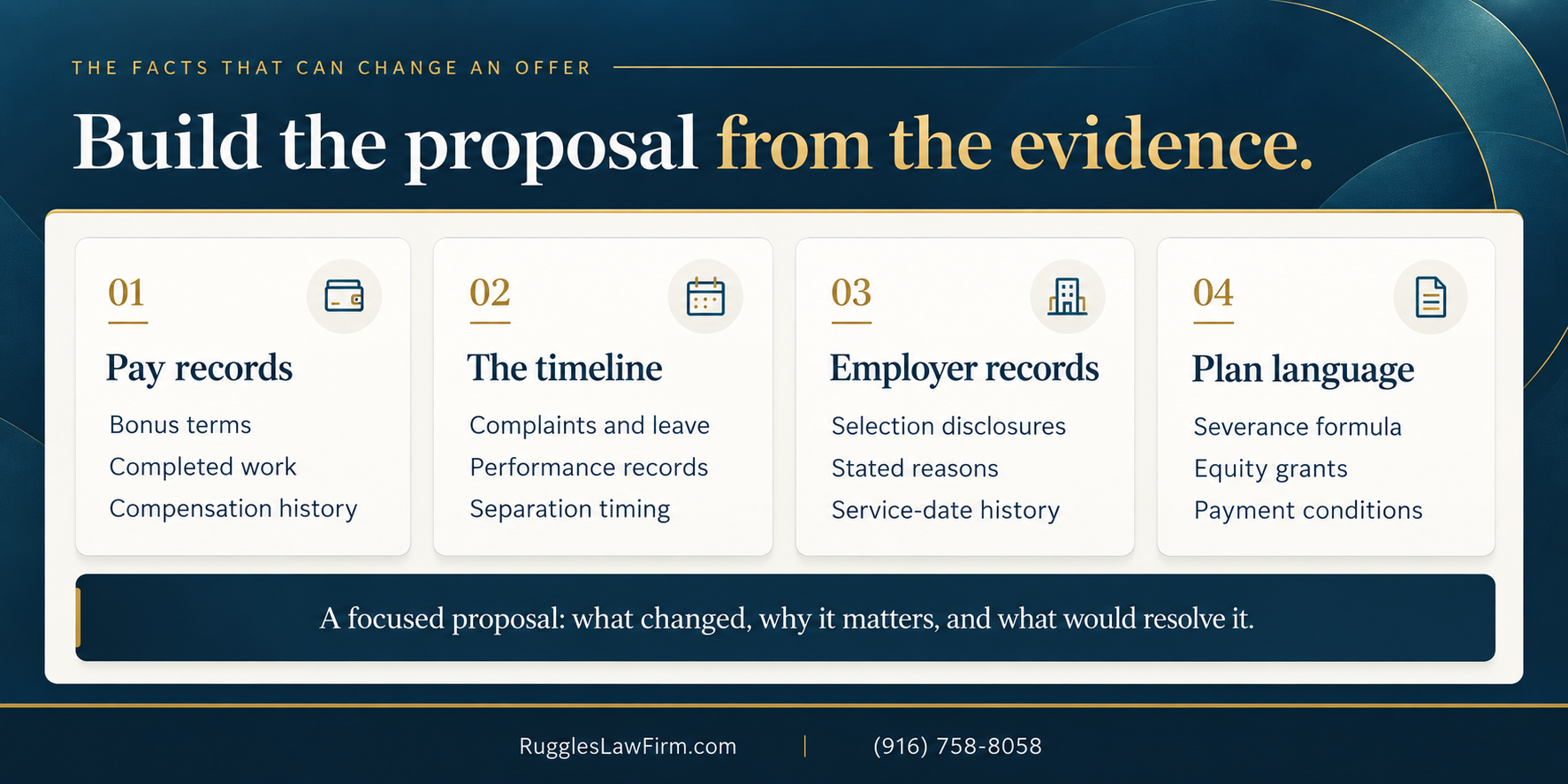
A focused counterproposal connects the documents, the chronology, and the value of the requested changes.
Eighteen Years of Service. Three Years According to Excel.
The Merger That Apparently Erased a Career
Suppose Elena has worked for a financial-services business and its predecessor for eighteen years. Following a merger, payroll gives her a new employee number. Three years later, the company eliminates her executive role and offers $90,000: three months of her $360,000 annual base salary.
The calculation may be mathematically correct. The question is whether the inputs are.
Calculating Severance Using the Right Service Credit and Compensation
We would ask for more than the latest severance agreement. The relevant documents would include Elena's original executive agreement, the signed merger-integration agreement, the preserved severance schedule, her compensation statements, and any retention award.
I discuss the wider compensation issues in Negotiating Severance for California Finance and Fintech Employees.
Assume the integration agreement expressly preserves predecessor service, and the severance schedule provides one month of eligible compensation for each credited year, capped at eighteen months. That would be a contractual benefit to analyze, not a formula automatically supplied by California law.
Now suppose another provision defines eligible compensation as base salary plus a specified average of annual incentives. With a qualifying incentive average of $60,000, Elena's eligible annual compensation would be $420,000, not $360,000.
We would prepare a side-by-side calculation showing the provision supporting each input. Eighteen months of $420,000 annual compensation would produce $630,000, compared with the employer's $90,000 calculation. No emotional appeal would explain that difference as efficiently as the contract and a correctly built worksheet.
If the company relied on its current personnel system and standard policy, we would redirect the discussion to the signed integration agreement: Which provision extinguished the preserved service credit? Where did Elena agree to replace the contractual compensation definition with base salary alone?
Suppose Elena also holds an $80,000 retention award that expressly protects payment when employment ends without cause during the protected period. If the company treated it as forfeited, we would identify that protection separately so it would not disappear inside a single undifferentiated demand.
Finally, we would translate the analysis into a proposal the employer's decision-makers could evaluate: the corrected severance calculation, the separately payable retention amount, and a health-coverage contribution. We would preserve the company's payment obligations in the release rather than inadvertently release the very rights being resolved.
Calculating the $725,000 Financial-Services Package
The proposed structure would combine $630,000 in cash severance, an $80,000 retention payment, and a $15,000 health-coverage contribution: $725,000 total.
Compared with the $90,000 opening offer, the difference would be $635,000.
The objective would not be to persuade an employer to give Elena a windfall. On these assumed terms, much of the additional value would come from recognizing disputed benefits that the earlier documents already promised.
Your RSUs Vest Tuesday. Naturally, You're Leaving Monday.
*At the stated equity valuation.
The Calendar Suddenly Becomes Very Expensive
Suppose Priya, a senior product leader at a cloud-software company, raises a written concern that customers are being billed for services they have not received. Several weeks later, the company terminates her for newly asserted performance problems.
Her departure falls immediately before a substantial RSU vesting date. Assume the proposed $150,000 package does nothing to preserve the affected grant.
The company might describe the timing as unfortunate. Priya might have a more expensive adjective in mind.
Negotiating RSU Vesting and Evaluating Retaliation Concerns
We would separate two questions that should not be confused: Is there evidence of unlawful retaliation? And what do the equity documents actually provide?
On retaliation, we would review what Priya reported, why she believed the billing was unlawful, who received the report, and who participated in the termination decision. We would compare her earlier evaluations and compensation approvals with the new performance explanation. We would also ask when the termination decision was actually authorized.
California Labor Code section 1102.5 can protect qualifying internal reports of reasonably suspected legal violations. It does not turn every workplace disagreement into whistleblowing.
Assume Priya made a specific report to a manager authorized to investigate it, her most recent review was favorable, and the newly documented criticism followed the report. Those facts would warrant investigating more than a coincidence involving a stock date.
My article on making a workplace complaint in California explains the value of a clear written record.
For equity, we would build a grant schedule identifying the number of units, vesting conditions, separation consequences, approval authority, and payment mechanics. Suppose the disputed tranche comprises 30,000 RSUs. At an assumed reference price of $25 per share, that would represent $750,000 in equity value.
We would not claim that proximity to vesting automatically entitled Priya to the shares. Instead, we would examine how the equity loss affected the financial stakes of the alleged retaliatory termination and propose a precise way to resolve that risk.
If the employer offered more cash but left the equity cancellation untouched, we would not let that cash increase obscure the larger issue. Our counterproposal would pair a defined cash payment with an approved amendment accelerating the identified tranche.
Closing would require more than a reassuring sentence about "favorable equity treatment." We would require the necessary approval, identify the award by grant number, specify the units and settlement date, and resolve inconsistencies with the original forfeiture language.
We would also reconcile the equity administrator's instructions with the signed agreement. My guide to negotiating RSU acceleration in California severance agreements expands on these grant-by-grant questions.
Valuing the $1.35 Million Cash-and-Equity Proposal
A proposal with $480,000 in cash severance and settlement consideration, $90,000 in incentive compensation, a $30,000 health-coverage contribution, and 30,000 accelerated RSUs valued at $750,000 would total $1.35 million.
Acceptance would mean $1.2 million in additional package value at the stated equity price.
That equity component would not be guaranteed cash proceeds; its value would depend on the share price. Any before-and-after comparison should use the same $25 reference value and exclude shares Priya already owns.
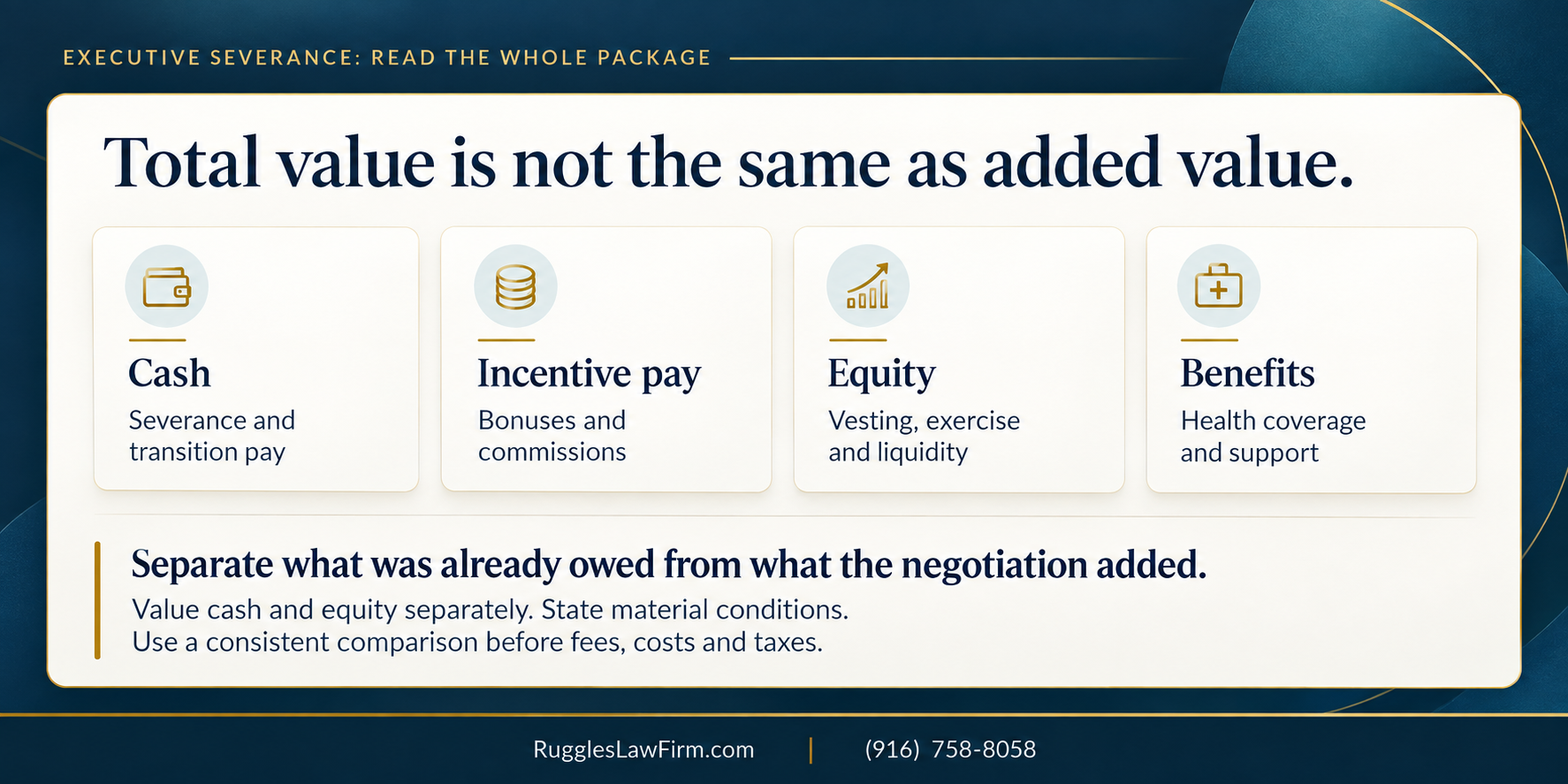
Compare the same categories at the beginning and end: total package value is not the same as the amount newly negotiated.
Congratulations on the Merger. Your Golden Parachute Is in Another PDF.
An Impressive Title, Minus the Actual Job
Suppose an acquisition leaves Julian with his executive title at a semiconductor company, but without his budget, his team, his decision-making authority, or his place in the reporting structure.
The buyer might call this "continuity." Julian might call it being a vice president of an empty calendar.
Assume the buyer offers $600,000 for a voluntary departure. For an executive earning $600,000 in annual base salary, a year's pay sounds substantial. But suppose the proposal does not apply protections in his change-in-control agreement or address several outstanding compensation rights.
Preserving Change-in-Control and Good-Reason Severance Rights
Our first move would be to prevent a premature resignation. Suppose Julian's agreement protects a departure for defined "good reason" after a qualifying acquisition, but requires timely notice and an opportunity for the employer to cure the problem.
We would compare the actual changes with the contractual definition. Losing authority and changing reporting lines would matter here because the agreement specifically addresses them, not because every demotion creates a right to executive severance.
We would then deliver the required notice, identify the relevant changes, and preserve the contractual sequence while continuing negotiations. If the buyer did not restore the role, Julian would not have inadvertently surrendered the protection by simply announcing that he quit.
Next would come the document map. We would read the executive agreement, change-in-control terms, incentive plan, individual equity awards, and acquisition documents together. A benefit that appears secure in one document can still be limited by a definition, exception, or payment condition elsewhere.
For a broader review of provisions that deserve attention, see How to Negotiate Executive Severance Agreement Terms.
Assume the agreements support eighteen months of base salary, a specified incentive payment, and favorable equity treatment upon a qualifying post-acquisition separation. We would turn those provisions into a component-by-component proposal rather than accept the buyer's base-salary-only framing.
The equity would require particular care. Suppose 40,000 units are affected and the transaction value is $40 per unit. We would seek a fixed equity-related cash payment of $1.6 million on that basis.
We would not use an optimistic future stock price, count already-owned shares, or assume a stock-portal estimate was itself an enforceable promise.
We would also identify the correct paying entities, obtain the required approvals, and align the release with the surviving payment obligations. Tax review would inform the payment schedule; we would not assume every component could simply be accelerated into an immediate check.
Throughout the negotiation, we would give the buyer a clear commercial choice: resolve the identified contractual issues in one coordinated agreement or continue defending an exit proposal that does not account for the documents. That would be a contractual discussion, not a threat to embarrass the company publicly.
Structuring the $3 Million Executive Package
| Package Component | Proposed Value |
|---|---|
| Cash severance: eighteen months of $600,000 base salary | $900,000 |
| Proposed annual incentive payment | $450,000 |
| Proposed fixed equity cash payment: 40,000 units at $40 | $1,600,000 |
| Health-coverage and funded executive-transition benefits | $50,000 |
| Total Proposed Package | $3,000,000 |
If the employer accepted this structure, the increase over its $600,000 proposal would be $2.4 million, not $3 million of additional severance.
The $3 million total would combine several different benefits; it would not be a $3 million salary-continuation payment.
A Practical Method for Negotiating a Better Severance Package
The useful lesson is not that every employee should demand six months, eighteen months, or a seven-figure package. It is that the opening offer should be tested against the actual facts and governing documents.
Our approach is to find the strongest one or two issues, investigate the employer's likely answer, quantify the disputed value, and propose a resolution the client would actually accept. We then make sure the agreed improvements survive into the final paperwork.
The importance of precise written terms is also addressed in Executive Severance Negotiation Mistakes and How to Avoid Them.
Sometimes the best strategy is a short employee-delivered request with legal guidance. Sometimes it is direct attorney negotiation. Sometimes the candid answer is that the existing offer is strong and further demands have limited prospects.
A useful severance review should distinguish those situations, not deliver the same sales pitch to everyone.
California Severance Negotiation FAQs
How much more severance should I request?
Begin with the strongest supportable basis for an increase, the value of any disputed compensation, and your transition needs. Do not choose a number merely because someone in a different job received it. The documents and facts of your own situation should drive the request.
Should I negotiate cash, bonuses, and equity together?
Evaluate them together, but identify them separately. Specify what is already owned or owed, what remains disputed, and what new consideration is offered for the release.
A larger cash number can still be a poor trade if it requires abandoning a more valuable compensation right.
For a broader checklist, see Executive Severance in California: 12 Questions Every Executive Should Ask.
What should I gather before a severance consultation?
Gather the proposed agreement, offer letter, amendments, bonus or commission plans, equity grants, relevant pay records, performance reviews, and a concise chronology.
Use documents you may lawfully retain or obtain; do not download unrelated confidential company material in an effort to build leverage.
California Severance Counsel Who Understands the Other Side of the Table
I have devoted more than thirty years to labor and employment law. My background includes service as an equity partner at Littler Mendelson, extensive management-side litigation, a law degree from UC Hastings, and an undergraduate degree from UC Berkeley, magna cum laude.
Read more about Matthew Ruggles's employment-law experience and training.
That experience informs how I evaluate a severance dispute: What will the employer's lawyer consider important? Which explanation needs testing? Which document changes the analysis? What proposal gives the company a reason to make a better deal?
Today, I bring that perspective to representing employees. My goal is not to manufacture outrage or promise that every offer can be transformed. It is to identify the strongest opportunity, explain it candidly, and pursue it with disciplined, determined advocacy.
You should be able to rely on your lawyer for more than a forceful letter. You should receive judgment, preparation, and a strategy focused on your financial future.
Review Your Severance Agreement Before You Sign
Before signing, request a California severance agreement review and consultation. We serve employees in Sacramento, the Bay Area, Silicon Valley, and throughout California.
Request a Severance Agreement ReviewCall (916) 758-8058 | RugglesLawFirm.com
The employer has already evaluated the agreement from its side. Make sure someone evaluates it from yours.