
Everything California Employees Need to Know About Disability Discrimination, the Interactive Process, Reasonable Accommodation, Medical Leave, and Wrongful Termination
Disability Discrimination Is Rarely About the Disability
Here’s one of the biggest misconceptions employees have.
They think disability discrimination cases are about the disability.
They’re usually not.
Most employers aren’t foolish enough to tell an employee,
“We’re firing you because you have cancer.”
Instead, they say things like:
“You’re just not performing.”
“We’ve decided to restructure.”
“You aren’t meeting expectations.”
“Your position has been eliminated.”
“This just isn’t working anymore.”
By itself, none of those explanations necessarily violates California law.
But what if those explanations suddenly appear two weeks after you requested medical leave?
Or immediately after your doctor submitted work restrictions?
Or right after you asked for a modified schedule because of chemotherapy?
That’s when experienced employment lawyers begin asking questions.
In my experience, disability cases are almost never about dramatic “gotcha” moments. Instead, they’re about timing, inconsistent explanations, ignored accommodation requests, shifting performance standards, and employers who become impatient with an employee whose medical condition suddenly makes them less convenient to manage.
And that impatience can become very expensive.
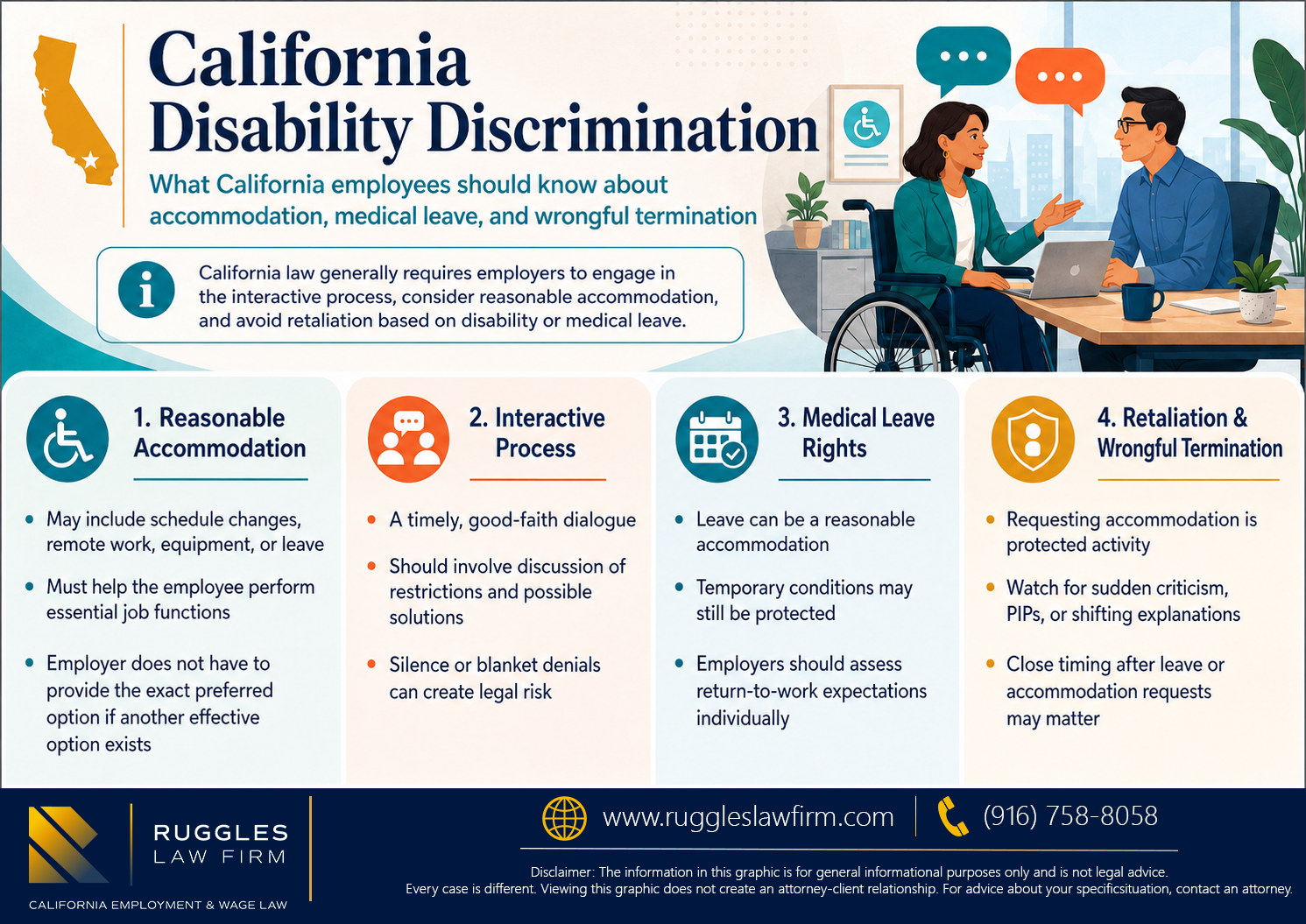
Why This Guide Exists
I’ve spent more than three decades practicing employment law.
For roughly twenty-five of those years, I defended employers.
Today, I represent California employees.
That perspective matters.
I’ve sat on both sides of the conference table.
I know how HR departments evaluate accommodation requests.
I know what managers say during internal meetings.
I know how lawyers evaluate litigation risk.
Perhaps most importantly, I know that many disability discrimination lawsuits begin with an employer making one avoidable mistake:
They stop talking to the employee.
Instead of solving the problem, they begin documenting the employee.
California law expects employers to do the opposite.
Call Us Before You Sign Anything
If you’ve recently been terminated after requesting an accommodation, taking medical leave, or disclosing a disability, don’t assume the employer’s explanation is the end of the story.
At Ruggles Law Firm, we help California employees evaluate whether their termination was lawful and negotiate severance agreements or pursue legal claims when appropriate.
Schedule a confidential consultation before signing a severance agreement.
Part One — Why California Disability Discrimination Cases Are Really About Timing, Communication, and Employer Excuses
California Law Is More Protective Than Federal Law
One of the biggest surprises for many employees is that California law often provides broader protection than the federal Americans with Disabilities Act (ADA).
Most employees have heard of the ADA.
Relatively few have heard of California’s Fair Employment and Housing Act (FEHA).
That’s unfortunate, because FEHA is often the more powerful statute.
California intentionally chose to provide broader workplace protections than federal law.
Among other things, FEHA generally recognizes a wider range of protected disabilities and places substantial obligations on employers to engage in an individualized assessment and interactive process before concluding that an employee cannot continue working.
This distinction matters because many online articles discuss only the ADA, leading employees to believe they have fewer rights than California law actually provides.
Matt’s Legal Perspective
California employers sometimes defend disability cases as though only the ADA applies. It doesn’t. FEHA frequently gives California employees broader rights, greater flexibility, and stronger legal remedies. Whenever I evaluate a disability case, I start with California law—not federal law.
For more information, read my previous blog: Fair Employment and Housing Act: How it Protects California Employees
What Actually Counts as a Disability?
Many employees assume disability discrimination laws apply only to catastrophic illnesses.
Not even close.
Under California law, protected disabilities can include conditions that affect a major life activity, even if the condition isn’t permanent.
Examples may include:
- Cancer
- Diabetes
- Epilepsy
- Heart disease
- Multiple sclerosis
- Parkinson’s disease
- Lupus
- Crohn’s disease
- Arthritis
- Fibromyalgia
- Migraine disorders
- Severe back injuries
- Pregnancy-related medical complications
- Anxiety disorders
- Depression
- PTSD
- ADHD (in appropriate circumstances)
- Long COVID
- Sleep disorders
- Vision impairments
- Hearing impairments
The analysis focuses less on the label and more on how the condition affects the individual’s ability to perform major life activities or work.
For more information, read my previous blog: California Disability Discrimination in Employment: A Guide to Your Rights Under the FEHA
This is one reason employees should avoid deciding, on their own, that their condition “isn’t serious enough.”
I’ve represented employees who initially believed they had no legal claim because they were “only” dealing with a temporary back injury or anxiety disorder.
California law may view those situations very differently.
Temporary Disabilities Can Be Protected
Here’s another common myth.
“If my disability isn’t permanent, I don’t have legal protection.”
False.
California law often protects temporary disabilities.
In fact, some of the strongest disability discrimination cases involve temporary medical conditions because employers assume the employee “will eventually recover” and simply don’t want to wait.
Consider examples like:
- Recovering from surgery.
- Broken bones.
- Cancer treatment.
- Pregnancy-related complications.
- Recovery after heart surgery.
- Temporary lifting restrictions.
- Rehabilitation following an accident.
Employers sometimes incorrectly assume they only need to accommodate permanent disabilities.
California law generally requires a much more individualized analysis.
Case Study #1 — “You’re Taking Too Long to Heal”
Sarah worked as a regional sales manager.
She underwent shoulder surgery after a serious skiing accident.
Her physician estimated recovery would take approximately four months.
The company initially approved leave.
Two months later, her supervisor began emailing HR.
“We need someone permanently in this role.”
Soon afterward, Sarah was informed her position had been “reorganized.”
Oddly enough, her replacement started the following Monday.
The employer insisted:
“This wasn’t because of your injury.”
Maybe.
Maybe not.
But a jury would likely want to know:
- Why the restructuring occurred during recovery.
- Why no alternative position was discussed.
- Why the company never revisited accommodation options.
- Why the replacement appeared before Sarah’s expected return.
Those questions often become the heart of disability litigation.
Matt’s Legal Perspective
Temporary disabilities don’t receive temporary legal protection—they receive real legal protection. Employers sometimes treat recovery periods as inconveniences rather than legal obligations. That’s precisely when liability often begins.
For more information, read my previous blog: Fired While on Medical Leave in California? What to Know About Return to Work Dates
The Interactive Process: The Most Important Phrase Most Employees Have Never Heard
If I had to identify one concept that determines more disability cases than almost any other, it would be this:
The interactive process.
Most employees have never heard the phrase until after they’ve been fired.
Ironically, employers hear it all the time.
That’s because California law requires employers to engage in a timely, good-faith interactive process with employees who may need workplace accommodations because of a disability.
Notice what the law does not require.
It does not require employers to immediately grant every accommodation request.
Likewise, it does not allow an employer simply to say:
“No.”
The employer must engage in a genuine dialogue.
That means discussing:
- the employee’s restrictions,
- the essential functions of the job,
- potential accommodations,
- available alternatives,
- and whether a reasonable accommodation would enable the employee to perform the position.
The process is intended to be collaborative—not adversarial.
Unfortunately, some employers treat it like a one-time meeting designed to create a paper trail.
A lawful interactive process is much more than checking a box.
For more information, read my previous blog: The Interactive Process: California Employers Must Comply
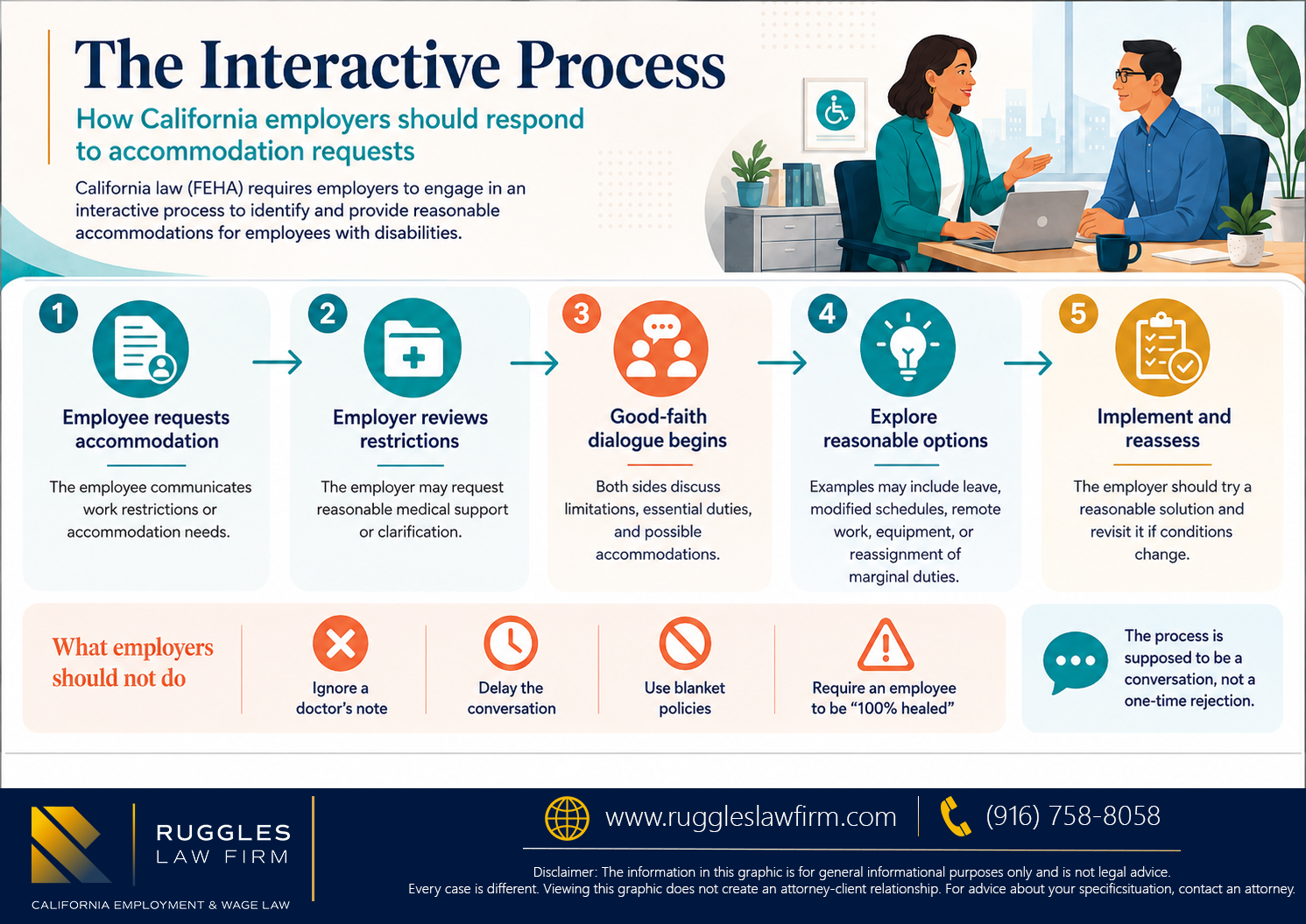
What the Interactive Process Is Not
It isn’t:
- A five-minute HR meeting.
- An email saying “accommodation denied.”
- Silence.
- Ignoring a doctor’s note.
- Waiting until termination to discuss restrictions.
- Telling the employee to “come back when you’re 100%.”
Those are some of the situations that frequently appear in disability discrimination lawsuits.
The Interactive Process Is a Conversation
Think of it like assembling furniture.
No one expects to dump all the pieces on the floor, glance at the instructions for ten seconds, and somehow end up with a functioning bookshelf.
Accommodation works the same way.
Sometimes the first solution isn’t the best one.
The employer and employee may need to exchange medical information, discuss alternatives, test temporary modifications, or revisit restrictions as treatment progresses.
California law generally expects that ongoing dialogue.
Matt’s Legal Perspective
One of the biggest mistakes employers make is treating the interactive process as an event instead of a conversation. When communication stops, lawsuits often begin.
For more information, read my previous blog: Did My Employer Follow the FEHA Interactive Process? A California Employee’s Guide
Don’t Wait Until You’re Fired
Many employees don’t contact an attorney until after they’ve been terminated.
Sometimes that’s unavoidable.
But if your employer is:
- refusing to discuss accommodations,
- ignoring your doctor’s restrictions,
- demanding you return without restrictions,
- suddenly criticizing your performance after years of positive reviews,
- or pressuring you to resign,
it may be worthwhile to obtain legal advice before making major employment decisions.
Sometimes a carefully timed letter from counsel changes the entire course of the discussion.
Sometimes it doesn’t.
But it’s usually easier to preserve your rights before the employment relationship completely breaks down.
Part Two — Understanding the Interactive Process and Reasonable Accommodation
What Is a “Reasonable Accommodation”?
This is where many disability cases go off the rails.
Employees sometimes believe that because they have a disability, the employer must automatically grant whatever accommodation they request.
Employers sometimes make the opposite mistake, assuming that because an employee’s first request isn’t feasible, the conversation is over.
California law generally supports neither position.
A reasonable accommodation is a workplace adjustment that enables a qualified employee with a disability to perform the essential functions of the job without imposing an undue hardship on the employer.
Notice what that definition does not say.
It doesn’t require the employee’s preferred accommodation.
It doesn’t require the employer’s cheapest accommodation.
Instead, it requires both sides to engage in a genuine effort to identify an accommodation that works.
Think of the interactive process as a negotiation rather than a contest. The goal is not for either side to “win.” The goal is to keep a qualified employee working whenever reasonably possible.
Common Examples of Reasonable Accommodations
Reasonable accommodations take many forms, including:
- Temporary medical leave
- Modified work schedules
- Flexible start and end times
- Remote or hybrid work (where appropriate)
- Additional unpaid leave
- Ergonomic equipment
- Voice-recognition software
- Modified workstations
- Reassignment of marginal job duties
- Temporary lifting restrictions
- Reassignment to a vacant position
- Assistive technology
- Permission to attend medical appointments
- Modified break schedules
Notice something interesting?
Many of these cost almost nothing.
Some accommodations require significant planning.
Others require little more than a willingness to be flexible.
Matt’s Legal Perspective
The best accommodation isn’t necessarily the one the employee asks for. It’s the one that allows the employee to continue performing the job while reasonably addressing the medical limitations. Good employers solve problems. Bad employers look for reasons why every solution supposedly won’t work.
For more information, read my previous blog: Disability Discrimination: How Employers Frequently Blow It With Accommodations
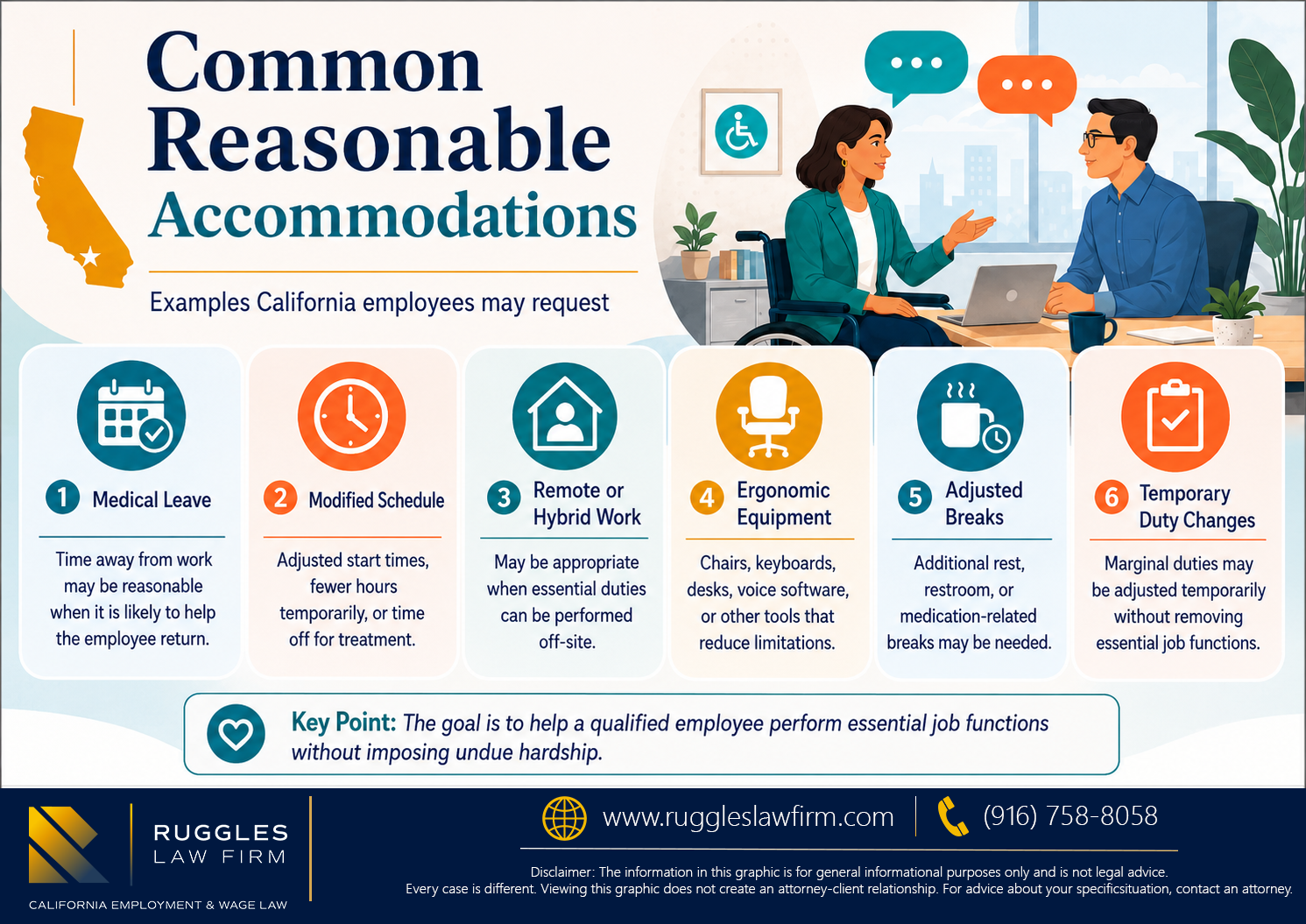
What Makes an Accommodation “Unreasonable”?
California law does not require employers to do the impossible.
Employers generally are not required to:
- Create an entirely new position
- Eliminate essential job duties
- Remove another employee from a job
- Lower legitimate production standards
- Excuse misconduct unrelated to the disability
- Provide accommodations that create an undue hardship
But employers sometimes stretch these principles far beyond what the law allows.
One of the most common phrases I hear during consultations is:
“HR told me they don’t have to accommodate me.”
Sometimes that’s true.
More often, what they mean is:
“We don’t want to.”
Those are very different statements.
The Words Every Employee Should Listen For
During consultations, I often ask clients:
“Exactly what did HR say?”
Certain phrases immediately catch my attention.
For example:
“We don’t do light duty.”
“Everyone has to be treated the same.”
“If we do it for you, we’d have to do it for everyone.”
“Come back when you’re fully healed.”
“There aren’t any accommodations available.”
“We’ve already made our decision.”
None of these statements automatically proves a legal violation.
But each raises important questions.
California law generally requires an individualized assessment—not blanket policies that ignore the employee’s specific circumstances.
Case Study #2 — “Company Policy”
David worked as a project manager.
After undergoing cardiac surgery, his physician temporarily restricted him from working more than eight hours per day.
David proposed a modified schedule for six weeks.
HR responded:
“Company policy requires all managers to work full-time.”
That was the end of the discussion.
No meeting.
No alternatives.
No follow-up.
No interactive process.
Instead, David was placed on a performance improvement plan because he could not work the required hours.
Could an employer ultimately determine that extended hours were an essential function?
Perhaps.
But California law generally expects the employer to analyze the issue—not simply point to a handbook and declare the conversation over.
Matt’s Legal Perspective
Policies are useful management tools. They’re not substitutes for the interactive process. California law generally requires employers to evaluate the individual employee—not simply recite the employee handbook.
For more information, read my previous blog: Workplace Discrimination: 7 Things California Employees Get Wrong
Medical Leave Is Often a Reasonable Accommodation
One of the biggest misconceptions in employment law is that medical leave is separate from disability accommodation.
It often isn’t.
A leave of absence may itself be a reasonable accommodation.
This is especially true when additional recovery time will likely allow the employee to return and perform the essential functions of the position.
Unfortunately, employers sometimes view leave as an inconvenience rather than an accommodation.
The timeline often looks like this:
Week One:
“Take all the time you need.”
Week Four:
“When are you coming back?”
Week Eight:
“We need certainty.”
Week Twelve:
“We’ve decided to move in another direction.”
Sound familiar?
Sometimes the employer’s decision is lawful.
Sometimes it isn’t.
The answer depends on many factors, including:
- the anticipated duration of the leave,
- the employee’s prognosis,
- the employer’s operational needs,
- whether additional leave would create an undue hardship,
- and whether meaningful dialogue occurred throughout the process.
Is Indefinite Leave Protected?
Generally, California law does not require employers to grant completely indefinite leave where there is no reasonably foreseeable return-to-work date.
That doesn’t mean employers can simply label every request as “indefinite.”
An employee whose physician anticipates returning them to work in six weeks presents a very different situation from someone with no anticipated recovery date at all.
Employers sometimes blur those distinctions.
Courts generally do not.
Matt’s Legal Perspective
Medical leave isn’t automatically reasonable, and it isn’t automatically unreasonable. The real question is whether additional leave would likely allow the employee to return to productive work within a reasonably foreseeable period.
For more information, read my previous blog: Indefinite Medical Leave: Can My Employer Terminate Me?
Remote Work Changed Disability Law Forever
If there is one topic that has evolved dramatically in the past several years, it’s remote work.
Before 2020, many employers insisted:
“This job simply cannot be performed remotely.”
Then came the pandemic.
Suddenly…
Entire companies operated from kitchen tables.
Conference rooms became Zoom meetings.
Commutes became coffee walks.
The impossible became ordinary.
Does that mean every employee now has the right to work from home?
No.
But employers who previously insisted remote work was impossible may now face more difficult questions if they deny similar requests without meaningful analysis.
Factors Employers Should Consider
When evaluating remote-work accommodations, employers should examine:
- Which job duties require physical presence?
- Which duties were previously performed remotely?
- Was the employee successful while working remotely?
- Are comparable employees working hybrid schedules?
- Would remote work genuinely prevent essential job performance?
Simply saying:
“We want everyone back.”
may not satisfy California’s obligation to engage in an individualized interactive process.
Case Study #3 — The Successful Remote Employee
Michelle worked for a software company.
She successfully performed her job remotely for nearly three years.
Following treatment for an autoimmune disorder, she requested to continue working remotely two days per week.
The company denied the request.
Its explanation?
“We believe collaboration is better in person.”
Perhaps.
But Michelle’s performance evaluations during three years of remote work were excellent.
No one identified any specific duties she failed to perform.
No one suggested alternatives.
No one explored hybrid scheduling.
Instead, HR denied the request within two days.
When employers ignore their own history, they sometimes undermine their own defense.
Matt’s Legal Perspective
The pandemic changed more than where people worked. It changed what employers can credibly argue about remote work. Past practice often becomes powerful evidence in accommodation cases.
For more information, read my previous blog: California Leave of Absence: Advice to Employees
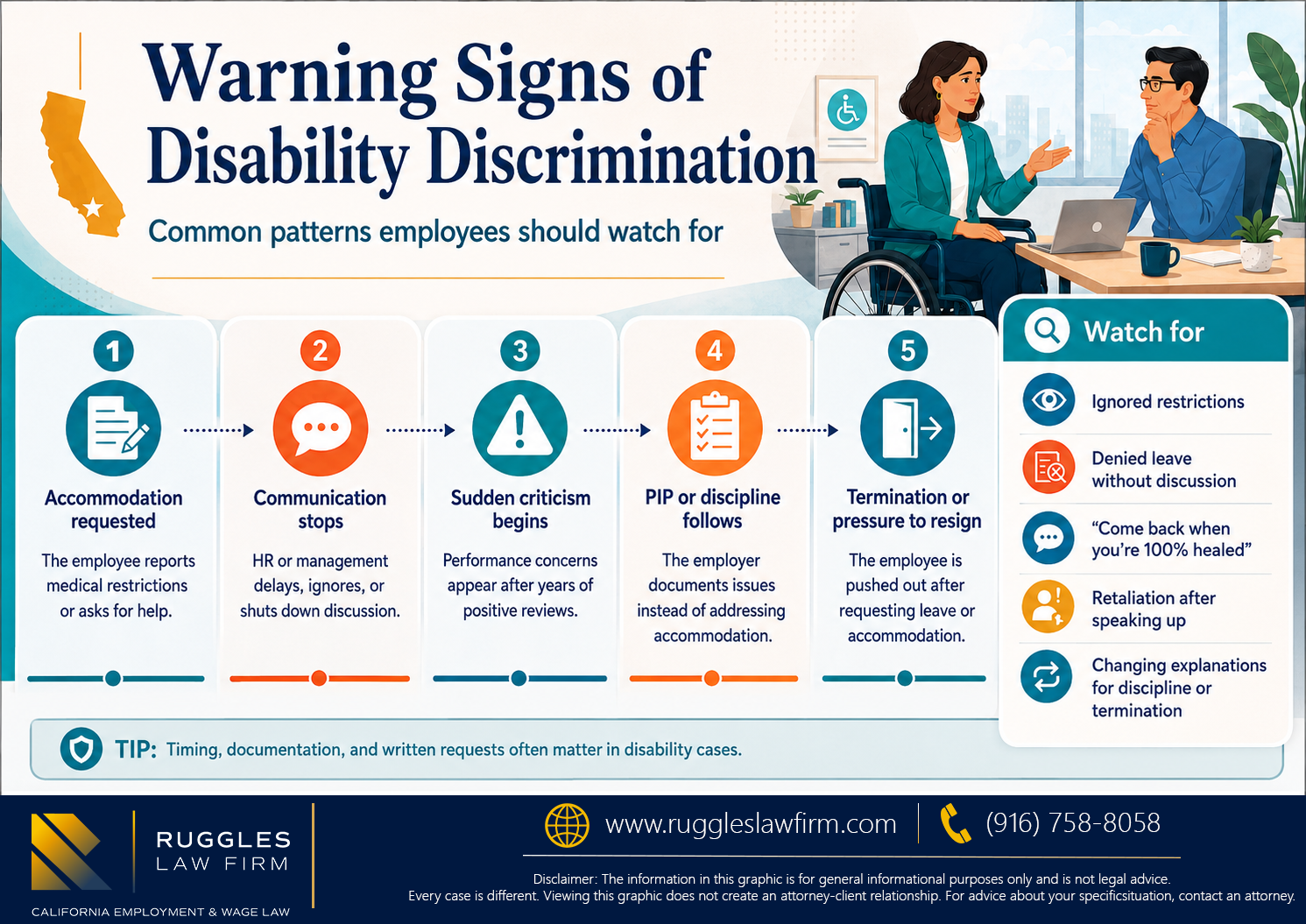
The “100% Healed” Myth
Few phrases concern employment lawyers more than this one:
“Come back when you’re 100%.”
Many supervisors believe this sounds perfectly reasonable.
Legally, it can create serious problems.
California law generally requires employers to determine whether an employee can perform the essential functions of the position with reasonable accommodation.
That is a very different question from asking whether the employee has completely recovered.
Many employees successfully perform their jobs while:
- using mobility devices,
- working modified schedules,
- receiving ongoing treatment,
- attending physical therapy,
- taking medication,
- or working with temporary restrictions.
If employers require employees to be completely symptom-free before returning to work, they may bypass the individualized assessment FEHA requires.
Matt’s Legal Perspective
California law protects qualified employees—not perfect employees. Employers should focus on whether the employee can perform the essential functions with reasonable accommodation, not whether every medical issue has completely disappeared.
For more information, read my previous blog: Reporting a Disability: Do I Need to Notify My Employer?
Call to Action
If your employer has:
- denied your accommodation request,
- ignored your doctor’s restrictions,
- refused to engage in the interactive process,
- required you to be “100% healed,”
- terminated you while on medical leave,
- or suddenly criticized your performance after you disclosed a disability,
you may have important rights under California law.
At Ruggles Law Firm, we represent California employees—not employers—in disability discrimination, failure-to-accommodate, and wrongful termination matters. If you’re unsure whether your employer complied with its legal obligations, a timely legal evaluation can make all the difference. Don’t wait until after you’ve signed a severance agreement or missed an important deadline to understand your options.
Part Three — Performance Improvement Plans, Retaliation, Wrongful Termination, Employer Defenses, and Practical Advice
“I Was Suddenly Put on a Performance Improvement Plan.”
One of the questions I hear most often during consultations is:
“I’ve worked here for twelve years. I’ve always had excellent reviews. Then I asked for an accommodation, and suddenly I’m on a Performance Improvement Plan. Is that legal?”
The answer, as with many legal questions, is:
It depends.
Performance Improvement Plans (“PIPs”) are not illegal.
Many employers use them appropriately.
Sometimes an employee truly is struggling, and the employer genuinely wants to help improve performance.
But here’s where things become interesting.
When the timing looks like this…
- Twelve years of strong evaluations.
- Positive bonuses.
- Promotions.
- Recognition awards.
- Employee requests a reasonable accommodation.
- Supervisor changes attitude.
- Weekly criticism begins.
- Employee is suddenly described as “not meeting expectations.”
- PIP follows shortly thereafter.
…an employment lawyer starts asking different questions.
The issue isn’t the existence of the PIP.
The issue is why it suddenly appeared.
Timing Matters More Than Most Employees Realize
One of the strongest pieces of evidence in many employment cases isn’t a dramatic email.
It’s a calendar.
Consider these two timelines.
Timeline A
- January – Employee begins missing deadlines.
- February – Counseling sessions.
- March – Written warning.
- April – PIP.
- June – Termination.
Nothing about this timeline necessarily suggests unlawful discrimination.
Now compare it with:
Timeline B
- Monday – Employee requests accommodation.
- Tuesday – HR requests medical documentation.
- Thursday – Supervisor begins documenting performance.
- Following Monday – Employee receives first negative review in ten years.
- Two weeks later – PIP.
- One month later – Termination.
Same outcome.
Very different story.
Courts and juries often evaluate these timelines carefully because timing sometimes reveals motivation more clearly than words.
Matt’s Legal Perspective
Most employers don’t announce discriminatory motives. They announce business decisions. That’s why timing frequently becomes one of the most persuasive pieces of evidence in disability discrimination cases. A calendar can sometimes tell a more compelling story than an email.
For more information, read my previous blog: Disability Discrimination and Retaliation in California
Can an Employer Discipline a Disabled Employee?
Absolutely.
This surprises many employees.
Having a disability does not create immunity from discipline.
Employees with disabilities must generally:
- perform the essential functions of the position,
- comply with legitimate workplace policies,
- meet reasonable production standards,
- avoid misconduct unrelated to the disability.
California law does not require employers to overlook legitimate performance problems simply because an employee has a medical condition.
But it also does not allow employers to:
- manufacture performance problems,
- ignore accommodations that would solve the performance issue,
- hold disabled employees to inconsistent standards,
- use a disability as an excuse to remove a valued employee who has become inconvenient.
That distinction is critical.
When Performance Problems Are Actually Accommodation Problems
One of the most common mistakes employers make is confusing performance deficiencies with accommodation needs.
Imagine this situation.
An accountant develops severe migraines.
Bright fluorescent lighting triggers debilitating headaches.
She begins making calculation errors late in the afternoon.
The employer concludes:
“Her performance has declined.”
Perhaps.
But suppose inexpensive task lighting, occasional remote work, or relocating her workstation dramatically reduces the migraines.
Now the issue isn’t simply poor performance.
The issue is whether reasonable accommodation could have corrected the problem before discipline occurred.
That’s precisely why California requires employers to engage in the interactive process.
Case Study #4 — “The Slow Sales Representative”
Kevin worked in medical device sales.
After chemotherapy began, fatigue affected his travel schedule.
He requested:
- fewer overnight trips for sixty days,
- additional video meetings,
- temporary assistance covering two distant territories.
Instead, management concluded:
“Your sales numbers are declining.”
Technically, they were correct.
But they never discussed accommodations.
Never analyzed alternatives.
Never evaluated whether temporary modifications could restore performance.
Instead, they terminated Kevin for poor production.
Sometimes declining performance is exactly what it appears to be.
Other times it’s the direct consequence of an employer refusing to accommodate the disability causing the decline.
Matt’s Legal Perspective
If an employer disciplines an employee for problems that reasonable accommodation might have prevented, the employer may be treating the symptom while ignoring the legal obligation to address the cause.
Retaliation Often Begins Before Termination
Many employees think retaliation means being fired.
Usually it isn’t that simple.
Termination is often the last chapter—not the first.
Retaliation frequently develops gradually.
For example:
Employee requests accommodation.
Supervisor becomes distant.
Meetings stop.
Responsibilities disappear.
Promotion opportunities vanish.
Negative evaluations begin.
Vacation requests are denied.
Coworkers are told the employee “can’t handle the workload.”
The employee is excluded from important projects.
Finally…
Termination.
None of those individual actions necessarily proves retaliation.
Collectively, however, they may tell a compelling story.
Protected Activity Includes Requesting Accommodation
One point employees frequently misunderstand is this:
You do not have to win your accommodation request to receive protection.
Requesting reasonable accommodation is itself protected activity.
Likewise:
- reporting disability discrimination,
- participating in an investigation,
- opposing unlawful discrimination,
- assisting another employee,
- requesting medical leave where protected,
may all implicate California’s anti-retaliation protections.
An employer cannot lawfully retaliate merely because an employee exercised rights protected by law.
Matt’s Legal Perspective
Employees sometimes believe they lose legal protection if their accommodation request is ultimately denied. That’s generally not how retaliation law works. Asking for your rights and proving your rights are two very different issues.
For more information, read my previous blog: Is Being Fired After Filing a Complaint Considered Wrongful Termination?
“We Eliminated Your Position.”
Perhaps.
Layoffs happen.
Businesses reorganize.
Positions disappear.
Sometimes that’s exactly what occurred.
Sometimes it isn’t.
The important question isn’t whether a restructuring happened.
The question is whether the restructuring explains your termination.
Employment lawyers often ask questions like:
- Was anyone hired afterward?
- Were your duties reassigned?
- Were similarly situated employees retained?
- Was your position recreated?
- Was the decision made before or after the accommodation request?
- Are internal documents consistent with the explanation?
Those questions often separate legitimate business decisions from pretext.
What Is “Pretext”?
Pretext simply means the stated reason isn’t the real reason.
That doesn’t necessarily mean the employer lied about everything.
It means the explanation may not fully explain the decision.
For example:
Employer says:
“Budget reductions.”
Evidence shows:
- budget increased,
- department expanded,
- replacement hired three weeks later.
Now a jury may begin questioning credibility.
Employment cases often turn less on whether the employer made a bad decision than whether the employer gave an honest explanation.
Matt’s Legal Perspective
Most employment lawsuits are credibility contests. If an employer’s explanation changes over time, juries naturally begin wondering what else changed.
Employer Defenses You Will Probably Hear
After representing employers for many years before representing employees, I’ve heard virtually every defense.
Some are entirely legitimate.
Some are considerably weaker.
Common defenses include:
“The employee couldn’t perform the essential functions.”
Sometimes true.
Sometimes reasonable accommodation would have solved the problem.
“We didn’t know about the disability.”
Knowledge matters.
Employers generally cannot accommodate disabilities they genuinely don’t know about.
However, employees don’t necessarily have to use legal buzzwords.
Sometimes simply communicating medical limitations is enough to trigger further inquiry.
“Accommodation would have created an undue hardship.”
Undue hardship is a real legal concept.
But employers generally need more than:
“It would have been inconvenient.”
Courts often examine:
- financial resources,
- workforce size,
- operational impact,
- duration,
- available alternatives.
“The decision had already been made.”
This defense sometimes succeeds.
Other times documents reveal the decision wasn’t finalized until after protected activity occurred.
Again…
Timing matters.
Documentation Wins Cases
One question I ask nearly every client is:
“Do you have the emails?”
Employees often answer:
“I don’t think so.”
Then, after searching carefully, they discover:
- accommodation requests,
- supervisor responses,
- calendar invitations,
- doctor’s notes,
- performance reviews,
- Teams messages,
- text messages.
Those documents frequently become the backbone of litigation.
Memory fades.
Documents usually don’t.
Practical Advice for Employees Still Working
If you’re still employed and navigating the interactive process, there are several practical steps that can help preserve your rights and improve communication with your employer.
Put Important Requests in Writing
Accommodation requests do not always have to be in writing, but written communication creates clarity.
Instead of saying:
“I’m having trouble because of my back.”
Consider writing:
“Because of my medical condition, I’d like to discuss reasonable accommodations that will allow me to continue performing my job.”
That simple email may become important evidence later.
For more information, read my previous blog: How to Make a Workplace Complaint in California: Verbal vs. Written
Be Cooperative
The interactive process is exactly that—a process.
Remain open to alternatives.
If your preferred accommodation isn’t feasible, another accommodation may achieve the same goal.
Reasonableness often matters to judges and juries.
Follow Medical Advice
Keep medical appointments.
Maintain current restrictions.
Provide updated medical information when reasonably requested.
Inconsistent medical documentation sometimes creates avoidable problems.
Don’t Assume HR Is Your Lawyer
HR has an important role.
Many HR professionals genuinely try to comply with California law.
But HR represents the employer—not the employee.
That doesn’t make HR your adversary.
It simply means your interests may not always be identical.
Case Study #5 — “Everything Was Verbal”
Angela requested accommodations for severe anxiety.
Every conversation occurred in person.
Nothing was documented.
Six months later, HR insisted:
“You never requested accommodation.”
Angela knew she had.
Her supervisor knew she had.
Unfortunately, proving verbal conversations months later became far more difficult than proving a short email would have been.
Sometimes the smallest documents become the most important evidence.
Matt’s Legal Perspective
You don’t need to write a legal brief to preserve your rights. Often, a thoughtful email confirming what was discussed is worth far more than relying on memory months or years later.
Don’t Resign Too Quickly
One of the saddest consultations I have involves employees who resigned believing they had no other option.
Sometimes resignation truly was unavoidable.
Sometimes it wasn’t.
If your employer appears to be refusing accommodations, retaliating against you, or pushing you toward the door, it is often worth obtaining legal advice before resigning.
Once the employment relationship ends, certain practical options—including negotiating accommodations or preserving the working relationship—may disappear.
Resignation can also complicate legal claims depending on the facts.
That doesn’t mean employees should remain in intolerable situations indefinitely.
It simply means major employment decisions deserve careful consideration.
Call to Action
If your employer has suddenly placed you on a Performance Improvement Plan after you disclosed a disability, requested medical leave, or asked for a reasonable accommodation, don’t assume the timing is merely a coincidence.
At Ruggles Law Firm, we regularly help California employees evaluate whether a PIP reflects legitimate performance concerns or whether it may be part of a broader pattern of disability discrimination, retaliation, or wrongful termination. Early legal advice can often identify issues before they become much harder to address.
Part 4 — Constructive Discharge, Damages, Litigation, Employee Checklist, Employer Mistakes, and Final Practical Advice
“I Wasn’t Fired. I Just Couldn’t Take It Anymore.”
One of the saddest conversations I have with prospective clients begins like this:
“I know I probably don’t have a case because I resigned.”
My first response is almost always:
“Tell me why.”
Many employees assume resignation automatically ends any legal claim.
It doesn’t.
Sometimes resignation is exactly what the employer intended.
Sometimes an employer makes working conditions so intolerable that a reasonable employee feels they have no meaningful choice except to resign.
California law refers to this concept as constructive discharge or constructive termination.
The employer doesn’t say:
“You’re fired.”
Instead, the employer says—or does—things that communicate the same message.
Examples may include:
- refusing to discuss accommodations,
- repeatedly ignoring medical restrictions,
- stripping away meaningful job duties,
- drastically reducing compensation,
- assigning impossible workloads despite known medical limitations,
- humiliating the employee because of the disability,
- insisting the employee return without restrictions,
- threatening termination every time accommodations are discussed.
Standing alone, none of these circumstances automatically creates a constructive discharge claim.
Together, however, they may paint a very different picture.
Matt’s Legal Perspective
Some employers discover that resignations create fewer questions than terminations. California law recognizes that reality. If an employer deliberately makes continued employment objectively intolerable because of a disability, changing the word from “terminated” to “resigned” may not change the legal analysis.
For more information, read my previous blog: California Wrongful Termination: How to Recognize It
“HR Told Me to Come Back When I Had No Restrictions.”
Few phrases concern me more than this one.
The so-called “100% healed” requirement continues to appear in workplaces despite years of litigation.
Imagine an employee recovering from spinal surgery.
The physician writes:
“May return to work.
No lifting over 20 pounds for six weeks.”
Instead of discussing possible accommodations, HR responds:
“Call us when your restrictions are gone.”
The problem is obvious.
The employer never asks the legally important question:
Can this employee perform the essential functions of the position with reasonable accommodation?
Instead, the employer asks a medically convenient question:
Is the employee completely healed?
Those are not the same inquiry.
California law generally requires employers to evaluate capabilities—not perfection.
Disability Is Not a Four-Letter Word
One of the unfortunate realities I see is that employees often hesitate to mention a disability.
They worry that:
- they’ll look weak,
- they’ll lose promotion opportunities,
- coworkers will judge them,
- they’ll be labeled “high maintenance.”
Ironically, delaying communication sometimes makes accommodation more difficult.
Employers cannot generally accommodate limitations they genuinely don’t know exist.
That doesn’t mean employees should disclose every medical detail.
Quite the opposite.
Most employers don’t need to know your diagnosis.
They usually need to understand your functional limitations.
There’s a difference.
Instead of saying:
“I have Crohn’s disease.”
The conversation often focuses on:
“My physician recommends more frequent restroom breaks.”
Or:
“My doctor has temporarily restricted prolonged standing.”
The focus should remain on work restrictions—not unnecessary medical history.
Matt’s Legal Perspective
You generally don’t owe your employer your entire medical autobiography. The discussion should focus on the limitations affecting your work and the accommodations that may allow you to continue performing your job.
What Compensation Can Employees Recover?
Every consultation eventually arrives at the same question.
“What is my case worth?”
The honest answer is:
No attorney can responsibly answer that during the first meeting.
Every case depends on its facts.
However, California law may allow recovery of several categories of damages when an employer unlawfully discriminates because of disability or fails to accommodate.
Potential remedies can include:
Lost Wages
The income the employee lost because of the unlawful conduct.
Future Lost Earnings
Sometimes called front pay.
Particularly important for executives and highly compensated employees who require substantial time to find comparable employment.
Lost Bonuses
Performance bonuses.
Retention bonuses.
Sales incentives.
Executive incentive compensation.
Lost Commissions
Particularly significant for commissioned employees whose income extends well beyond base salary.
Lost Equity Compensation
Restricted Stock Units.
Stock options.
Performance shares.
Deferred compensation.
Many employees overlook these substantial losses.
Lost Benefits
Health insurance.
Retirement contributions.
Vehicle allowances.
Expense reimbursements.
Other employment benefits.
Emotional Distress
Many disability cases involve significant emotional harm.
Being told you’re suddenly no longer valuable because your health changed can have profound personal consequences.
California law may permit recovery for emotional distress where supported by the evidence.
Attorney’s Fees
One reason disability discrimination cases differ from many ordinary business disputes is that prevailing employees may recover attorney’s fees under applicable law.
That provision exists for an important public policy reason.
Without fee-shifting, many employees could never afford to challenge unlawful discrimination.
Matt’s Legal Perspective
Employers sometimes calculate the cost of terminating an employee. They don’t always calculate the cost of violating California law. Those are two very different numbers.
The Five Biggest Employer Mistakes
After spending decades representing employers before switching to represent employees, I’ve noticed certain mistakes appear again and again.
Mistake #1 — Stopping the Interactive Process Too Soon
The conversation ends.
Emails stop.
Accommodation requests disappear into a black hole.
Silence becomes the employer’s strategy.
California law generally expects continued communication—not radio silence.
Mistake #2 — Deciding the Outcome Before Gathering Information
Sometimes managers reach a conclusion before reviewing medical documentation.
Then they simply look for evidence supporting the decision already made.
That’s backwards.
The law expects investigation before conclusion—not conclusion before investigation.
Mistake #3 — Letting Frustration Replace Judgment
Managers are human.
Repeated absences can create operational challenges.
Deadlines still exist.
Customers still expect service.
But frustration should never substitute for legal compliance.
Mistake #4 — Treating Every Employee Identically
I’ve heard managers proudly say:
“We treat everyone exactly the same.”
That sounds fair.
Sometimes it isn’t.
Disability accommodation exists precisely because identical treatment can produce unequal results.
Fairness and sameness are not always identical.
Mistake #5 — Forgetting That Jurors Have Families Too
Jurors have undergone surgeries.
They’ve cared for aging parents.
They’ve recovered from cancer.
They’ve struggled with depression.
They’ve requested time off.
When employers appear dismissive of legitimate medical issues, jurors often understand those situations on a deeply personal level.
Practical Checklist for Employees Still Working
If you’re currently employed and navigating a disability or accommodation issue, here are practical steps that can strengthen communication and help preserve important information.
✔ Notify Your Employer Promptly
Don’t assume your supervisor knows what’s happening.
Communication matters.
✔ Request Accommodation Clearly
You don’t need legal terminology.
Plain English works.
✔ Keep Copies
Save:
- doctor’s notes,
- accommodation requests,
- emails,
- performance reviews,
- text messages,
- Teams messages,
- disciplinary notices.
Use your personal email or personal device to retain copies only if doing so complies with your employer’s lawful policies and does not involve taking confidential or proprietary company information.
✔ Be Professional
Angry emails rarely improve legal claims.
Professional communication often does.
✔ Follow Medical Advice
Ignoring your physician’s restrictions may complicate both your health and your employment situation.
✔ Continue Performing Your Job
If accommodations are pending, continue performing your duties to the best of your ability unless your physician advises otherwise.
✔ Don’t Assume HR Has Reached the Correct Legal Conclusion
HR professionals work hard.
Many are excellent.
But they can make mistakes.
Employment lawyers and judges sometimes disagree with HR.
✔ Before Signing a Severance Agreement, Understand What You’re Releasing
Many severance agreements include broad releases of legal claims.
Once signed, those releases may prevent you from pursuing disability discrimination or failure-to-accommodate claims, even if you later learn your employer violated California law.
If you believe your disability played a role in your termination, consider obtaining legal advice before signing.
Matt’s Legal Perspective
The biggest mistake employees make isn’t requesting an accommodation. It’s assuming they have no rights when the employer says “no.” Sometimes “no” is a lawful answer. Sometimes it’s the beginning of a very different legal conversation.
Why Early Legal Advice Matters
One of the themes running through this guide is that timing matters.
Employees often contact me:
- after they’ve resigned,
- after they’ve signed a severance agreement,
- after key emails have been deleted,
- after deadlines have passed.
Sometimes we can still help.
Sometimes opportunities have already been lost.
You don’t need to hire an attorney every time HR asks for a doctor’s note.
But when the conversation shifts from solving the problem to documenting your “performance deficiencies,” or when accommodation discussions abruptly stop and termination seems imminent, obtaining legal advice early can help you understand your options before irreversible decisions are made.
Final Thoughts Before the FAQ
Living with a disability is challenging enough.
California law recognizes that qualified employees should not have to choose between protecting their health and protecting their careers.
Most employers want to do the right thing.
Many do.
But when an employer refuses to engage in the interactive process, ignores reasonable accommodations, or terminates an employee because of a disability rather than working toward a lawful solution, California law provides meaningful protections.
Understanding those protections is often the first step toward protecting your future.
Ready to Discuss Your Situation?
If you believe your employer failed to accommodate your disability, ignored your medical restrictions, retaliated after you requested an accommodation, or terminated your employment because of a disability, the attorneys at Ruggles Law Firm can evaluate your situation under California law.
Every case is different. An early evaluation can help you understand your rights, assess the strengths and challenges of your potential claims, and make informed decisions before signing a severance agreement or taking other significant steps.
Frequently Asked Questions About Disability Discrimination, Failure to Accommodate, and Wrongful Termination in California
These answers provide general information about California employment law. The outcome of any matter depends on the specific facts, applicable law, and procedural deadlines.
What is disability discrimination under California law?
Disability discrimination occurs when an employer takes adverse action against an employee because of a physical or mental disability, medical condition, or perceived disability. Common examples include terminating an employee because of a disability, refusing reasonable accommodations, failing to engage in the interactive process, denying promotions because of medical restrictions, or retaliating against an employee for requesting accommodations.
Does California law provide greater protection than the ADA?
Generally, yes. California’s Fair Employment and Housing Act (FEHA) often provides broader protections than the federal Americans with Disabilities Act (ADA), including a broader definition of disability and more robust obligations to engage in the interactive process.
What qualifies as a disability in California?
Many physical and mental conditions may qualify, including cancer, diabetes, depression, anxiety disorders, PTSD, multiple sclerosis, epilepsy, chronic pain conditions, long COVID, and many temporary medical conditions that substantially limit a major life activity.
Can temporary disabilities be protected?
Yes. Temporary disabilities may receive protection under California law. Recovery from surgery, broken bones, pregnancy-related medical complications, or other temporary impairments may trigger an employer’s obligation to consider reasonable accommodations.
What is the interactive process?
The interactive process is a timely, good-faith dialogue between the employer and employee to determine whether a reasonable accommodation would allow the employee to perform the essential functions of the job.
What is a reasonable accommodation?
A reasonable accommodation is a workplace adjustment that enables a qualified employee with a disability to perform the essential functions of the position, unless doing so would create an undue hardship.
Does my employer have to provide the accommodation I request?
Not necessarily. Employers generally are required to provide a reasonable accommodation, but not always the employee’s preferred accommodation if another effective accommodation is available.
What if my employer ignores my accommodation request?
Ignoring an accommodation request may violate California law. Employers generally should respond promptly and engage in the interactive process rather than simply remaining silent.
Can my employer require me to be “100% healed” before returning to work?
Generally, employers should evaluate whether you can perform the essential functions of your position with reasonable accommodation rather than requiring complete recovery.
Can medical leave be a reasonable accommodation?
Yes. Depending on the circumstances, a leave of absence may itself be a reasonable accommodation if it is reasonably likely to enable the employee to return to work.
Is indefinite leave protected?
Not always. While additional leave may be reasonable in many situations, employers generally are not required to grant leave with no reasonably foreseeable return-to-work date.
Can working from home be a reasonable accommodation?
Sometimes. Remote work may be reasonable depending on the employee’s job duties, past remote-work experience, and whether the essential functions can be effectively performed from home.
What are essential job functions?
Essential functions are the fundamental duties of a position—not every task listed in a job description. Determining what is “essential” often requires a fact-specific analysis.
Can my employer change my job because of my disability?
Employers may modify duties as part of a reasonable accommodation, but they generally should not remove essential functions or demote an employee simply because of a disability.
What if my employer says no accommodations are available?
That may be the correct answer—or it may not. California law generally expects employers to engage in an individualized assessment before concluding that no reasonable accommodation exists.
Can I be disciplined because of my disability?
Employees may be disciplined for legitimate performance or misconduct issues. However, employers generally should not discipline employees for problems that could have been addressed through reasonable accommodation.
What if my performance declined because my accommodation was denied?
That situation may raise important legal questions. If the decline resulted from the employer’s failure to reasonably accommodate your disability, the performance issues and the accommodation process may be closely related.
Can my employer terminate me while I’m on medical leave?
Sometimes. Being on leave does not create absolute job protection. However, the timing, reason for termination, and employer’s handling of the accommodation process are often critical factors.
What if I requested an accommodation and was fired shortly afterward?
Close timing between a protected request and a termination does not automatically establish a legal violation, but it may warrant careful legal evaluation.
Is requesting an accommodation protected activity?
Yes. Requesting a reasonable accommodation is generally protected activity, and employers may not retaliate against employees simply for making such a request.
Can anxiety or depression qualify as disabilities?
Often, yes. Many mental health conditions may qualify depending on how they affect major life activities and the employee’s ability to perform the job.
Can long COVID qualify as a disability?
Potentially, yes. Long COVID may qualify if it substantially limits one or more major life activities or otherwise meets the applicable legal standards.
Can pregnancy complications qualify as disabilities?
Certain pregnancy-related medical conditions may qualify for protection and may also implicate additional California laws governing pregnancy disability leave and accommodations.
Do I have to tell my employer my diagnosis?
Not necessarily. In many situations, employers primarily need information about your work-related limitations and any accommodations your healthcare provider recommends, rather than a detailed diagnosis.
Can my employer ask for a doctor’s note?
Yes. Employers may generally request reasonable medical documentation supporting an accommodation request when appropriate.
Can my employer ask for all of my medical records?
Not usually. Employers are generally entitled only to information reasonably necessary to evaluate the accommodation request, not unlimited access to an employee’s complete medical history.
What is undue hardship?
Undue hardship refers to significant difficulty or expense associated with a proposed accommodation, considering factors such as the employer’s resources, operations, and the nature of the accommodation.
Does a small employer have to provide accommodations?
The answer depends on several factors, including whether the employer is covered by the applicable statute and the specific circumstances involved.
Can I sue if my employer refuses to engage in the interactive process?
A failure to engage in the interactive process may itself support a legal claim under California law, depending on the facts.
What damages can I recover?
Potential remedies may include lost wages, lost future earnings, lost commissions, lost bonuses, emotional distress damages, attorney’s fees where authorized by law, and other appropriate relief.
What should I do if HR won’t return my calls?
Document your efforts in writing. A polite follow-up email confirming your accommodation request and asking to continue the interactive process may become important evidence later.
Should I keep copies of emails and doctor’s notes?
Yes. Keep copies of your own communications and medical documentation, but do not take confidential company documents or proprietary information that you are not authorized to retain.
Can my employer reduce my hours instead of accommodating me?
Possibly, but the reduction itself should not be used as a substitute for engaging in the interactive process or considering other reasonable accommodations.
What if my supervisor says accommodations aren’t “fair” to everyone else?
California law generally requires an individualized assessment. Treating every employee identically is not always the same as treating employees lawfully.
Can my employer force me to resign?
No employer should coerce an employee to resign because of a disability. In some circumstances, intolerable working conditions may support a constructive discharge claim.
What is constructive discharge?
Constructive discharge occurs when working conditions become so intolerable that a reasonable employee would feel compelled to resign.
What if I already signed a severance agreement?
Many severance agreements contain broad releases of legal claims. If you’ve already signed one, your legal options may be affected, which is why reviewing severance agreements before signing is often important.
How long do I have to bring a disability discrimination claim?
Time limits vary depending on the type of claim and procedural requirements. Because deadlines can be strict, employees should seek legal advice promptly rather than assuming they have plenty of time.
Can my employer retaliate because I requested leave?
Generally not. Requesting protected leave or accommodations should not, by itself, become the basis for retaliation.
Does every accommodation request become a lawsuit?
Absolutely not. Most accommodation issues are resolved through communication and good-faith participation in the interactive process.
Should I quit if my employer refuses to accommodate me?
Resignation can have significant legal consequences. Before resigning, it is often wise to understand your legal options and whether other alternatives exist.
Can I secretly record conversations with HR?
California has strict laws governing the recording of confidential communications. Employees should obtain legal advice before recording workplace conversations.
Should I communicate with HR by email?
When appropriate, written communication can create a clear record of accommodation requests, restrictions, and discussions.
What if my employer says my restrictions don’t make sense?
Employers may seek reasonable clarification or additional medical information, but they generally should not simply disregard medical restrictions without engaging in the interactive process.
What if I don’t know whether my employer violated the law?
Many employees don’t. An experienced employment attorney can evaluate the facts, explain your options, and help determine whether the employer complied with California law.
Does every unfair workplace decision violate California law?
No. California law does not prohibit all unfair or unkind management decisions. The issue is whether the employer’s conduct violated specific legal protections, including those relating to disability discrimination and accommodations.
Should I hire an attorney before signing a severance agreement?
If you believe your disability, medical leave, or accommodation request played any role in your separation from employment, consulting an attorney before signing a release is often prudent.
Why do employers sometimes offer severance after disability issues?
Employers may offer severance for many legitimate business reasons. In some situations, a severance offer also reflects an employer’s desire to resolve potential legal disputes without litigation.
Can I negotiate a severance agreement after a disability-related termination?
Often, yes. Many severance agreements are negotiable, particularly where there are legitimate legal issues surrounding the termination or accommodation process.
When should I contact an employment lawyer?
If you have been denied accommodations, terminated after requesting accommodations, placed on a sudden Performance Improvement Plan after disclosing a disability, forced to return to work without accommodations, or asked to sign a severance agreement after a disability-related separation, obtaining legal advice promptly can help you understand your rights before important deadlines pass.
Matt’s Final Legal Perspective
After more than 30 years practicing employment law, including approximately 25 years representing employers, I’ve learned something that surprises many people.
Most disability cases don’t begin with hostility.
They begin with uncertainty.
An employee isn’t sure whether to disclose a medical condition.
A supervisor isn’t sure how to respond.
HR isn’t sure what accommodations are required.
Those uncertainties are exactly why California law requires the interactive process.
When employers approach that process with curiosity, flexibility, and a genuine desire to solve problems, disputes often never develop.
When employers approach it with predetermined conclusions, silence, or impatience, they frequently create legal problems that were entirely avoidable.
I’ve represented enough employers to know that most do not wake up intending to violate the law.
I’ve also represented enough employees to know that good intentions do not excuse unlawful decisions.
If you’re reading this because you’ve recently requested an accommodation, taken medical leave, or been terminated after disclosing a disability, remember this:
You don’t need to know today whether you have a lawsuit.
You do need to understand your rights before making irreversible decisions—such as resigning, signing a severance agreement, or assuming that your employer’s explanation is the final word.
Sometimes the employer acted lawfully.
Sometimes it didn’t.
The key is making that determination based on the facts and the law—not fear, assumptions, or frustration.
Contact Ruggles Law Firm
If you believe your employer failed to accommodate your disability, refused to engage in the interactive process, retaliated against you for requesting accommodations, or terminated your employment because of a disability or medical condition, Ruggles Law Firm can evaluate your situation under California law.
Our practice is devoted to representing employees—not employers—and we regularly advise professionals, executives, sales employees, healthcare workers, engineers, and other California employees facing complex workplace issues.
Before you sign a severance agreement or decide to resign, understand your legal options. An informed decision today may protect opportunities you cannot recover tomorrow.
RLF Blog Post Disclaimer
Updated 07-01-2026
Contact the Ruggles Law Firm at 916-758-8058 to Evaluate Your Potential Lawsuit
Matt Ruggles has a thorough understanding of California employment laws and decades of practical experience litigating employment law claims in California state and federal courts. Using all of his knowledge and experience, Matt and his team can quickly evaluate your potential claim and give you realistic advice on what you can expect if you sue your former employer.
Contact the Ruggles Law Firm at 916-758-8058 for an initial case consultation.
Blog posts are not legal advice and are for information purposes only. Contact the Ruggles Law Firm for consideration of your individual circumstances.