
How to Evaluate, Negotiate, and Protect Your Pay, Equity, Benefits, and Career Before You Sign
By Matthew J. Ruggles
Top 12 Questions California Executives Ask About Severance
If you are a California executive holding a severance agreement, you probably have two reactions at once: you want a fast, practical answer, and you know the document could affect years of compensation and career momentum. That tension is why smart people make expensive mistakes. They focus on the headline payment while overlooking equity, bonus language, benefits, the termination narrative, future cooperation, references, restrictive clauses, and the claims they will release forever.
I am Matt Ruggles. I spent decades representing major employers before I began representing employees. These 12 questions come from issues executives repeatedly raise in real severance consultations.
Here is the first principle. A California severance agreement is a transaction. The employer is buying certainty, a release of claims, confidentiality, cooperation, and a controlled exit. You are deciding what those promises are worth. My complete guide to California severance agreements explains the full review process. This article gives the answers executives usually need first.
Nothing below is a substitute for advice about your documents and facts. California employment law is highly fact-specific, especially when compensation plans, protected leave, discrimination, retaliation, whistleblowing, or a group layoff are involved.
1. Do I have to sign the severance agreement?
Answer: No – but signing may be the only way to receive benefits you are not already entitled to.
A severance agreement is voluntary. Refuse it, and you generally keep claims you have not otherwise lost, but you may give up the offered severance. Sign it, and the release can be broad and enforceable. In Skrbina v. Fleming Companies, Inc. (1996) 45 Cal.App.4th 1353, a written severance release barred later employment claims. California Civil Code section 1542 ordinarily protects unknown claims, but most employer agreements ask you to waive that protection expressly.
Separate what the company already owes from what it offers for your signature. Final wages, earned compensation, vested benefits, and contractual entitlements are not automatically “severance.” California Labor Code section 206.5 prohibits requiring a release of wages due unless those wages have been paid. And Edwards v. Arthur Andersen LLP (2008) 44 Cal.4th 937 recognizes that a general release does not erase nonwaivable statutory protections.
Do not ask only, “How much will I receive?” Ask, “What am I selling, what do I already own, and what new value am I receiving?” For a clause-by-clause map, see All Common Severance Agreement Clauses Explained.
2. Is my employer required to pay severance in California?
Answer: Usually no; the right normally comes from a contract, plan, policy, or negotiation – not a general California severance statute.
California does not require every terminated employee to receive severance. A right may arise from an offer letter, executive plan, change-in-control provision, company policy, collective agreement, or binding promise. In Asmus v. Pacific Bell (2000) 23 Cal.4th 1, the California Supreme Court addressed ending an indefinite employment policy after reasonable time and notice without impairing vested benefits. Policy language, timing, and vesting matter.
Mass layoffs are different. California’s WARN Act, Labor Code sections 1400-1408, can require 60 days’ notice in covered situations, and section 1402 provides remedies for violations. WARN pay and negotiated severance are related but not identical; do not let an employer count money already owed as the entire price of a release without analyzing the components.
If HR calls the offer “standard,” that describes the employer’s starting policy, not necessarily your legal ceiling. Read California Severance Negotiation After Layoffs before assuming a formula ends the discussion.
3. How do I know whether the offer is fair?

Answer: There is no universal weeks-per-year rule; fairness is the total value compared with your contractual baseline, lost compensation, legal leverage, and transition risk.
Two executives with the same tenure can have radically different cases. One may have six months guaranteed by contract, a bonus payable next week, and equity vesting during a notice period. Another may have no contractual severance but strong retaliation evidence and a damaging termination process. A third may be in a tightly administered reduction in force with a fixed formula and limited individual flexibility.
Benchmark the whole package: cash, notice or garden leave, target or earned bonus, commissions, RSUs and options, COBRA premiums, retirement benefits, accrued vacation, outplacement, reference language, departure announcement, legal-fee contribution, and the restrictions imposed after employment. Then compare that value with the claims and business protections the company wants you to release.
Tenure and title help tell the fairness story, but neither automatically creates leverage. The better question is whether the package reasonably purchases the company’s requested peace. My article on calculating an effective severance demand explains why a principled demand usually beats an arbitrary number.
4. Can I negotiate if HR says the offer is final or non-negotiable?
Answer: Yes, you can ask; whether the company moves depends on leverage, process, and a credible proposal.
“Non-negotiable” often means HR lacks authority, a group formula is being protected, or the company sees no reason to make an exception. It does not make a counterproposal illegal. The real questions are whether the employer may withdraw the offer, how much relationship capital is at stake, and whether your ask gives legal or business decision-makers a defensible reason to improve the deal.
A good counterproposal identifies the contractual baseline, explains material risks, quantifies requested changes, and offers closure. Cash may be difficult while an extended termination date, COBRA subsidy, neutral reference, paid cooperation, or limited equity vesting is achievable.
Do not negotiate in a burst of anger or announce claims you cannot support. Read How to Negotiate Severance Like an Employment Lawyer and Seven Employee Mistakes That Ruin Severance Negotiations before sending your first email. Your opening position should create room to move without destroying credibility.
5. What gives an executive leverage for a larger severance package?
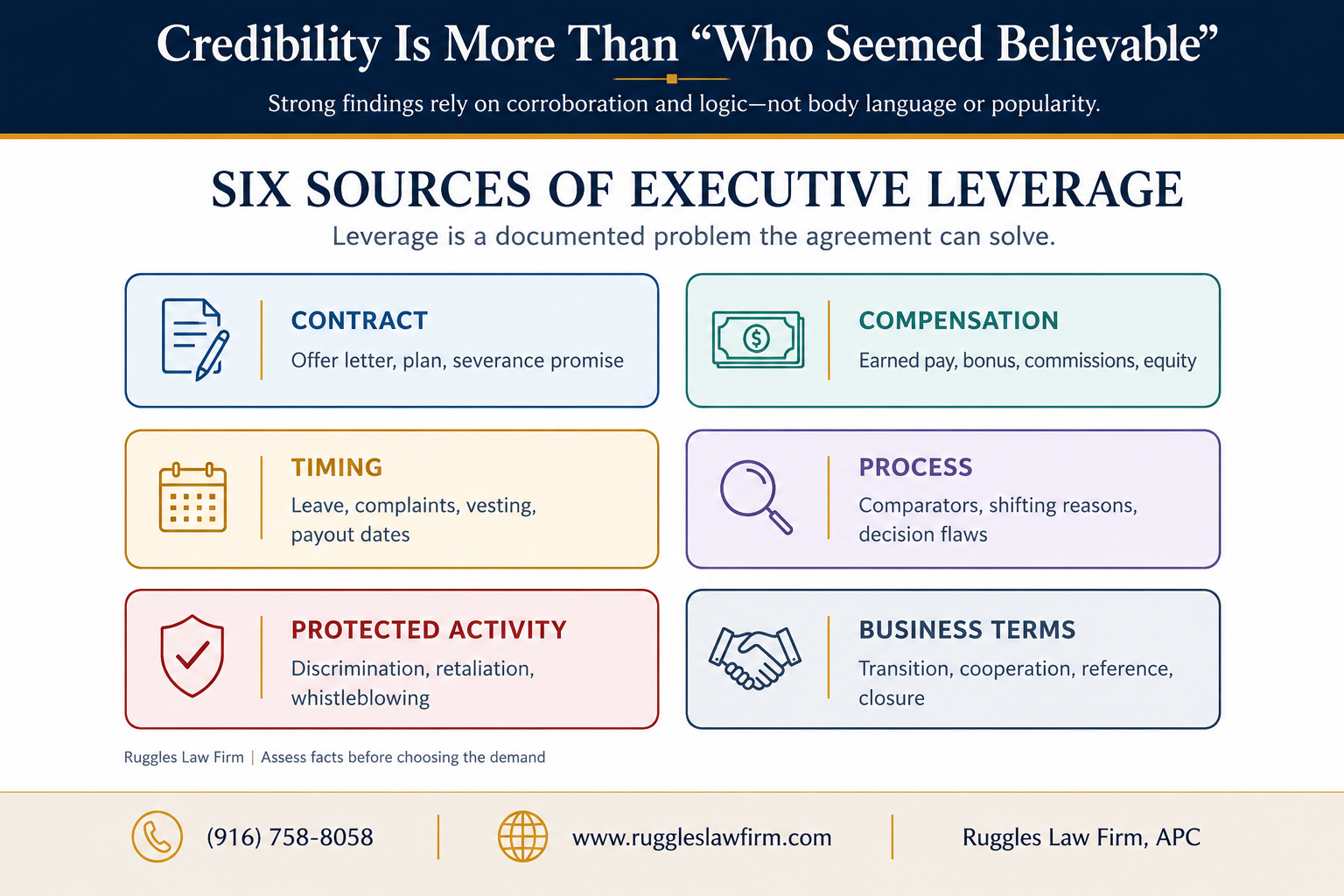
Answer: Leverage is a documented problem the employer can solve by improving the agreement.
The strongest leverage usually comes from contract rights, unpaid compensation, inconsistent explanations, suspicious timing, comparators, protected leave, discrimination, retaliation, whistleblowing, accommodation failures, or a flawed layoff. California’s at-will rule is broad but does not authorize an unlawful reason. Guz v. Bechtel National, Inc. (2000) 24 Cal.4th 317 recognizes separate statutory and contractual limits.
Executives also bring business leverage: the company may want a smooth transition, reasonable cooperation, protection of customer relationships, a controlled announcement, or help in pending litigation. Those interests can support value, but “I know embarrassing information” is not a sound threat and can backfire. Tie the ask to legitimate rights and mutual closure.
Document timing, performance history, compensation terms, complaints, leave, and changing explanations. Preserve lawful records, but do not take privileged or proprietary material. Use my legal leverage guide to distinguish a genuine claim from an injustice with little settlement value.
6. How much should I ask for?
Answer: Ask for a supportable package with a rational anchor, priorities, and a realistic settlement range.
Start with amounts already owed, contractual severance, vested equity, earned bonus or commissions, accrued vacation, and benefits. Then value the release using lost compensation, likely job-search time, claim strength, and employer practices.
An executive demand can include more than months of base salary. Sometimes the highest-value request is extending the termination date through a vesting event, paying target bonus, accelerating a limited equity tranche, covering COBRA, removing a no-rehire clause, confirming a neutral reference, or paying for burdensome future cooperation. A demand should identify which terms are essential and which are tradable.
Do not “shoot for the moon” simply to appear tough. An inflated ask can make legal conclude there is no settlement zone. On the other hand, asking only for what the company already offered wastes the release. See Examples of Successful Severance Negotiation in California and the case study on tripling a California sales executive’s severance for examples of fact-driven anchoring.
7. Can I keep or accelerate my RSUs, stock options, or other equity?
Answer: Unvested equity is often forfeited under the plan, but timing, contract language, and settlement leverage can make some of it negotiable.
Read the equity plan, grant notices, award agreements, offer letter, change-in-control provisions, and termination definitions together. Identify the exact termination date, vesting dates, exercise window, and who has authority to grant an exception. A short extension of employment can be worth more than several months of salary.
Do not overstate California wage law. In Schachter v. Citigroup, Inc. (2009) 47 Cal.4th 610, the California Supreme Court enforced a clear forfeiture condition in a voluntary restricted-stock arrangement when the employee resigned before vesting. That does not prevent a company from negotiating acceleration or an extended vesting date; it means plan terms are a critical starting point, not a substitute for leverage.
Also flag repurchase rights, clawbacks, “cause” definitions, exercise periods, taxes, and noncompete language. Read How to Negotiate RSU Acceleration, RSUs After a Layoff in California, and When Lost Equity Creates Severance Leverage.
8. What happens to my bonus, commissions, PTO, and final paycheck?
Answer: Earned compensation must be separated from discretionary or unvested compensation before you price the release.
California Labor Code section 201 generally requires earned, unpaid wages to be paid immediately when an employee is discharged; section 203 can impose waiting-time penalties for a willful failure. Vested vacation is treated differently from severance and usually must be paid out. Commission rights depend on the written plan, when the commission is earned, and what conditions remain.
Bonuses are intensely document-specific. A nondiscretionary bonus tied to completed work may present a wage issue, while a plan may lawfully condition an unearned bonus on continued employment. In Neisendorf v. Levi Strauss & Co. (2006) 143 Cal.App.4th 509, the court upheld plan terms where employment ended before bonus eligibility. Termination immediately before a payout date can still deserve scrutiny, especially if contract language, past practice, pretext, or bad-faith timing points the other way.
Demand an itemized accounting. Do not allow the employer to label earned wages or vested benefits as consideration for releasing claims. Read Wages Owed at Termination and, for complex compensation, Severance for California Finance and Fintech Employees.
9. How long do I have to review and revoke the agreement?
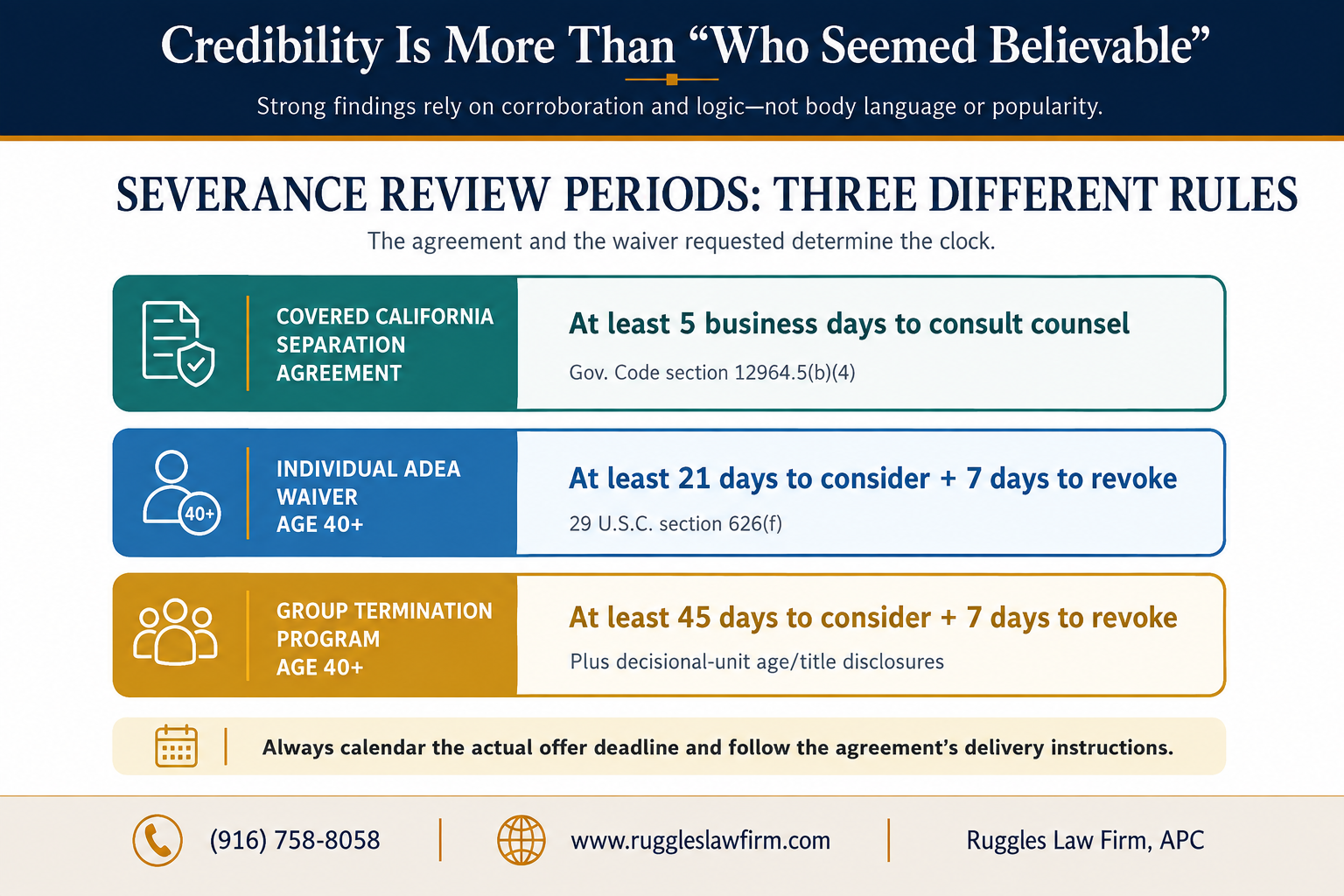
Answer: Read the actual deadline; age-40-plus waivers have special federal periods, and covered California separation agreements must provide time to consult counsel.
Under Government Code section 12964.5(b)(4), an employer offering a covered separation agreement must notify the employee of the right to consult an attorney and provide at least five business days, although the employee may choose to sign sooner. Other deadlines may be longer.
For a federal age-discrimination waiver, the Older Workers Benefit Protection Act, 29 U.S.C. section 626(f), generally requires at least 21 days for an individual exit, 45 days for a group program, and a nonwaivable seven-day revocation period after signing. Group programs also require age-and-job-title disclosures. A materially revised final offer can affect the review period, and the agreement’s instructions control how notice must be delivered.
Start negotiating promptly. Missing a deadline can destroy bargaining power even where the employer could extend it. Read Why You Must Act Fast on a California Severance Agreement and Top 10 Things to Watch Out for in a Severance Agreement.
10. What happens to COBRA, unemployment, and WARN rights?
Answer: Treat health coverage, unemployment, and layoff notice as separate workstreams; none should disappear into one vague severance number.
COBRA usually lets eligible employees continue group health coverage at their cost, but executives can negotiate paid premiums or a stipend. Confirm duration, dependents, reimbursement, and what happens when new coverage begins.
California severance pay generally does not itself disqualify a claimant from unemployment benefits. Powell v. California Department of Employment (1965) 63 Cal.2d 103 distinguished true severance from wages allocated to services or notice periods. Apply promptly, disclose payments accurately, and let EDD decide; salary continuation, pay in lieu of notice, vacation pay, and severance can be classified differently based on substance.
For a covered mass layoff, Cal-WARN may require 60 days’ notice, and Labor Code section 1402 provides back-pay and benefit remedies for violations. Ask what part of the package is WARN notice pay, what part is already earned, and what part is new consideration for the release.
11. Can a PIP or “performance” termination ruin my negotiation?
Answer: It can reduce leverage if unrebutted, but a label is not proof and a clean factual response may expose pretext.
California employers generally do not need a PIP before ending at-will employment. A short, subjective, or unfair PIP is not automatically illegal. The issue is what the evidence shows: sudden criticism after years of strong reviews, goals no peer could meet, shifting metrics, stripped resources, replacement by a favored comparator, timing after leave or complaints, or statements inconsistent with the stated performance reason.
Respond calmly. Correct errors, request measurable expectations, preserve performance history, and continue performing. Do not resign merely to escape embarrassment; resignation can change contract, unemployment, and claim analysis. See my PIP insights and guide to what to do after being fired.
In the agreement, negotiate the exit narrative separately from money: resignation versus layoff language, personnel-file notation, internal and external announcements, reference protocol, and whether the employer will contest unemployment. Those terms can protect an executive long after the cash is spent.
12. Which non-cash terms matter most to an executive?
Answer: The best executive deal protects money, mobility, reputation, and time.
Review confidentiality, non-disparagement, trade-secret language, non-solicitation, no-rehire, cooperation, indemnification, arbitration, venue, tax language, return of property, reference terms, and the departure announcement. Narrow definitions, add lawful-agency and truthful-testimony carveouts, make non-disparagement mutual where possible, identify permitted disclosures, and require reasonable notice and compensation for substantial cooperation.
California Business and Professions Code section 16600 broadly voids employment restraints outside statutory exceptions, and Edwards rejected a narrow-restraint exception for employee noncompetes. Government Code section 12964.5 restricts gag provisions concerning unlawful workplace acts and requires specified carveout language in covered agreements. Civil Procedure Code section 1001 separately restricts confidentiality of facts concerning specified discrimination, harassment, and retaliation claims. The exact statute and effective date matter.
For senior leaders, a neutral reference, agreed announcement, title confirmation, removal of a no-rehire provision, indemnification, D&O coverage confirmation, and paid cooperation can be worth more than another paycheck. Read How to Negotiate Executive Severance Agreement Terms and Executive Severance Negotiation Mistakes before treating boilerplate as harmless.
Matt’s Bottom Line for California Executives
A severance agreement is not simply a check. It is the final rewrite of your compensation, legal rights, exit story, and continuing obligations. Before you negotiate, build four lists: what the company already owes, what you will lose at separation, what claims or business risks the company wants resolved, and which career terms you need protected.
Move promptly. Save the agreement, calendar deadlines, gather compensation plans, preserve lawful evidence, avoid public comments, and understand the release. For a deeper roadmap, read How to Negotiate a Severance Package, Negotiated Exits for Executives, and my executive severance case study.
If you are a California executive, manager, or high-earning employee facing termination, a layoff, a PIP, or a proposed separation, contact the Ruggles Law Firm at (916) 758-8058 before you sign. I can evaluate the agreement, identify realistic leverage, and tell you which terms are worth negotiating.
Frequently Asked Questions About California Executive Severance
These answers provide general California employment-law information. Executive severance rights depend on the agreement, compensation plans, timing, claims, and the specific facts of the separation.
Is severance pay mandatory after a California layoff?
Usually not. Severance typically depends on a contract, plan, policy, collective agreement, or negotiated deal. Cal-WARN notice obligations may create separate rights in a covered mass layoff.
Do I have to sign a severance agreement to receive my final paycheck?
No. Earned wages cannot lawfully be conditioned on signing a release. Severance benefits above existing entitlements may be conditioned on a valid agreement.
Can my employer withdraw a severance offer if I negotiate?
Possibly, depending on the offer and circumstances. Most employers want the release, but assess withdrawal risk and deadlines before countering.
Is a "standard" severance package non-negotiable?
No. "Standard" describes a policy or opening position. Exceptions are more likely when an executive presents credible contractual, legal, or business reasons.
What is a fair severance package for a California executive?
There is no universal formula. Compare total value with contract rights, tenure, compensation loss, job-search horizon, legal leverage, and the release requested.
Is one or two weeks of severance per year of service required?
No. A weeks-per-year formula may be company practice, but California law generally does not impose that benchmark.
Can I negotiate more than cash severance?
Yes. Equity, bonus, COBRA, termination date, reference language, announcements, cooperation pay, no-rehire terms, and outplacement may all be negotiable.
When should an executive hire a severance lawyer?
As early as possible, especially before the first counteroffer. Timing matters when vesting dates, bonus payouts, short deadlines, or potential claims are involved.
Is it safer to negotiate myself before hiring counsel?
Not always. An unsupported first demand can lock in positions or reduce credibility. Get a leverage assessment before deciding who should communicate.
Does every employee get 21 days to review a severance agreement?
No. The 21-day federal rule generally concerns an individual ADEA waiver for someone age 40 or older. Other agreements may have different deadlines.
When does the 45-day severance review period apply?
It generally applies when an age-claim waiver is requested in an exit incentive or other termination program offered to a group or class of employees.
Can I revoke a severance agreement after signing?
An ADEA waiver must generally provide seven days to revoke. Other agreements may not provide a revocation right, so read the actual clause.
What OWBPA information must a group layoff disclosure contain?
It generally identifies the decisional unit, eligibility rules and deadlines, job titles and ages selected, and ages of comparable employees not selected.
What is a California Civil Code section 1542 waiver?
It is language waiving protection for unknown claims that could have materially affected the settlement. Understand its breadth before agreeing.
Can a severance release waive unpaid wage claims?
California restricts releases of wages due unless those wages have been paid. A bona fide disputed wage claim may be settled under different rules.
When are final wages due after termination in California?
Earned, unpaid wages are generally due immediately upon discharge under Labor Code section 201, subject to specific statutory exceptions.
Must accrued vacation or PTO be paid at termination?
Vested vacation generally must be paid. Combined PTO policies require review; separate sick leave usually follows different rules.
Am I entitled to a bonus if terminated before the payout date?
It depends on the plan, contract, discretion, earning conditions, and past practice. Continued-employment language can matter, but so can bad-faith timing.
What happens to commissions after termination?
The written commission plan and earning trigger control. Identify orders, revenue, contingencies, chargebacks, and post-termination payment rules before releasing claims.
Do unvested RSUs automatically disappear at termination?
Many plans provide forfeiture, but confirm the exact termination date, plan language, vesting schedule, and whether an exception or extension is negotiable.
How long do I have to exercise vested stock options?
The plan and grant control. Post-termination windows can be short, so obtain written dates and tax advice immediately.
Can I ask my employer to pay COBRA premiums?
Yes. Define duration, dependents, payment method, tax treatment, and what happens when new coverage becomes available.
Does severance pay prevent California unemployment benefits?
True severance generally does not automatically disqualify a claimant. Report all payments accurately and let EDD classify severance, wages, notice pay, and vacation.
Is WARN pay the same as severance?
No. WARN remedies may compensate for missing statutory notice, while severance is consideration created by contract, policy, or negotiation.
Are noncompete clauses enforceable against California employees?
Generally no, outside narrow statutory exceptions. Choice-of-law and out-of-state facts can complicate the analysis, so do not ignore the clause.
Are employee non-solicitation clauses enforceable in California?
They are often vulnerable when they restrain lawful work, but trade-secret and fact-specific issues matter. Seek advice before acting.
Can I negotiate a mutual non-disparagement clause?
Yes. Define covered speakers, require lawful carveouts, avoid one-sided remedies, and consider a mutual commitment by specified company leaders.
Can a severance agreement stop me from discussing unlawful workplace conduct?
California law restricts provisions that deny the right to disclose information about unlawful acts. The agreement should include required statutory carveouts.
Can I negotiate a neutral or positive reference?
Yes. Specify the contact, approved language, title, dates, rehire status, and whether the company will provide a signed reference letter.
Should I accept a no-rehire clause?
Not automatically. It can affect future roles with affiliates or an acquiring company. Narrow or remove it when it creates meaningful career risk.
Can an employer require future cooperation after I leave?
Yes, by agreement, but the clause can be narrowed. Negotiate reasonable notice, scope, scheduling, expenses, compensation, and preserved legal rights.
Is severance taxable?
Cash severance is generally treated as taxable wages. Allocation labels do not override tax law; obtain tax advice for equity, benefits, or disputed claims.
Is a lump sum better than salary continuation?
It depends on payment security, benefits, mitigation offsets, reemployment, taxes, and unemployment classification. Define what happens if the company fails or you find work.
Should I resign during a PIP to protect my reputation?
Usually not without advice. Resignation can affect leverage, unemployment, equity, severance rights, and the legal characterization of the separation.
Can a severance agreement stop me from filing with the EEOC, CRD, SEC, or another agency?
An agreement cannot lawfully bar protected agency reporting or truthful participation. Review carveouts for charges, investigations, testimony, and whistleblower awards.