
Your employer says your salary is in the right range. That may be true. It may also answer only part of your question.
What happened to the bonus? Who received the larger equity refresh? Which employees received a retention award, a more valuable benefits package, or better access to incentive compensation? A salary spreadsheet can look reassuring while leaving out the compensation that makes the biggest difference.
California's equal-pay law expressly reaches more than base salary. SB 642, enacted in 2025 and effective January 1, 2026, makes this year's compensation review a useful moment to examine the whole package. But a pay difference is not automatically an unlawful pay difference. You still need to compare the work and evaluate the employer's explanation.
The direct answer
For a California equal-pay review, compare compensation for substantially similar work performed by employees of another sex, race, or ethnicity, and test whether lawful factors explain the entire difference. Include bonuses, stock, stock options, and benefits in the inquiry. Do not assume a posted salary range answers the total-compensation question, or that an anticipated stock award is already earned and payable. Those are different legal issues. [1][2]
What changed and what did not
SB 642 amended Labor Code sections 432.3 and 1197.5. Among its changes, it expressly defines compensation broadly for the equal-pay statute, uses a comparison to employees of another sex, ties the meaning of sex to California's Fair Employment and Housing Act, and changes the wage-action filing and recovery provisions. It also refines the pay-scale definition to a good-faith estimate of the range expected upon hire. These rules are already effective in 2026; this is not a preview of a January 2027 law. [1][2][3]
The law did not erase the requirement to compare substantially similar work. It did not prohibit every difference in pay. It did not establish that every equity grant vests immediately, or turn every discretionary bonus into an unconditional debt. The broader compensation definition is expressly limited to section 1197.5. [1]
Start with the work rather than the title
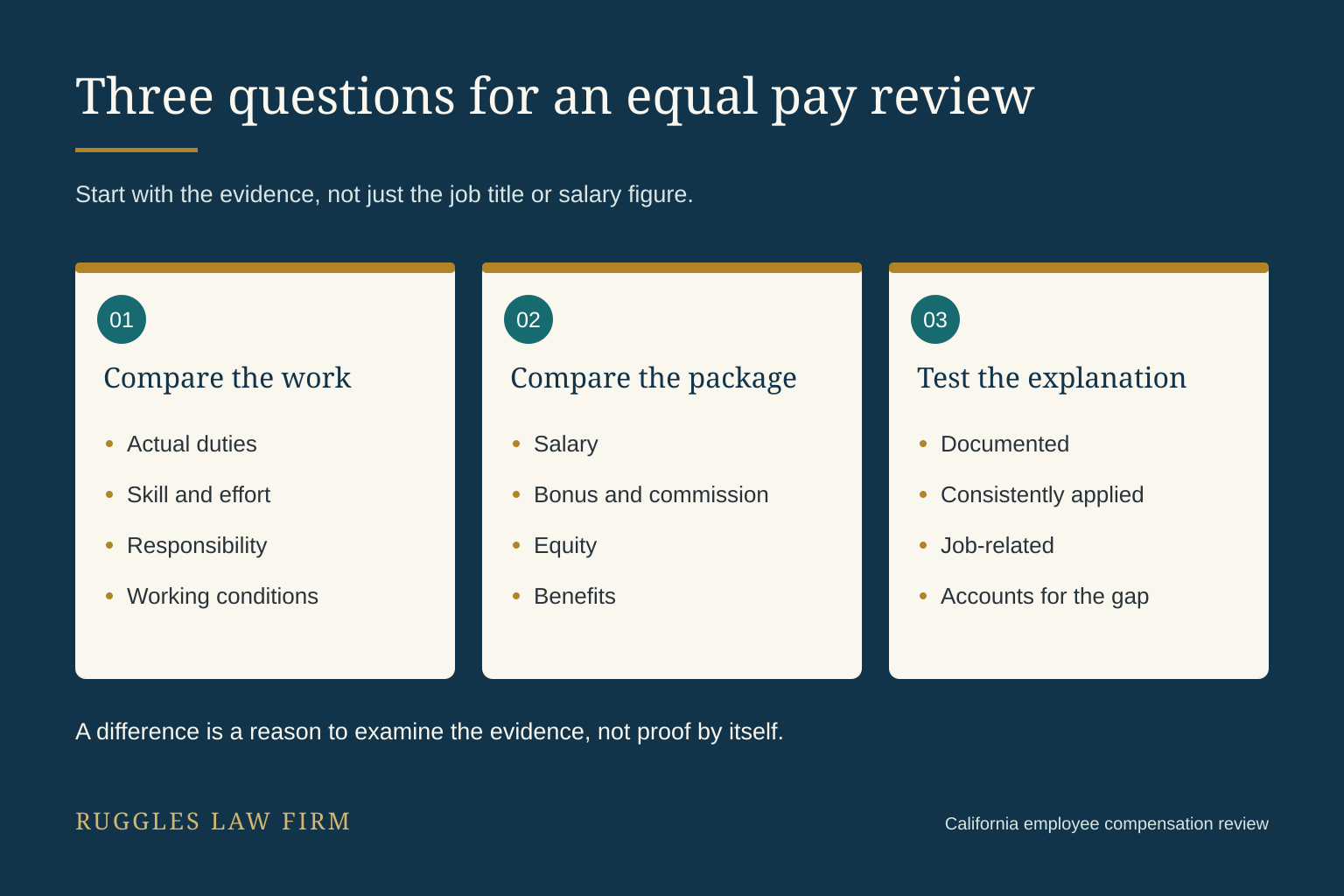
An equal-pay comparison asks about skill, effort, responsibility, and similar working conditions. Two employees need not carry the same title for their work to warrant comparison. Conversely, matching titles do not prove matching work. [1]
Build a short, factual comparison. Who owns the project? Who makes decisions? What expertise is required? How much supervision does each person receive? Who manages people, budgets, client accounts, or operational risk? Has the job changed since the formal description was written?
Separate what you know from what you suspect. “We both have director titles” is a starting observation. “We manage comparable teams, perform the same approval function, and report to the same executive” is more useful. A manager's real additional responsibility may also explain why the comparison is weaker than it first appeared.
A practical comparison file
- Your current and earlier job descriptions, with dates.
- A description of actual assignments and recurring duties.
- Reporting lines, team sizes, and decision-making authority.
- Relevant qualifications, experience, and training.
- Performance criteria, reviews, and measurable results.
- Lawfully available information about the proposed comparator's work.
Do not fill gaps with certainty you do not have. Mark them as questions for review. The purpose is to develop an accurate comparison, not to manufacture a perfect match.
Compare the package component by component
Section 1197.5 includes salary, overtime, bonuses, stock, stock options, profit sharing, specified allowances, and benefits within its compensation definition. A review that stops at base salary can therefore miss an important difference. [1]
Start with separate rows for base pay, bonus opportunity, actual bonus payout, commissions, equity grants, vesting events, retention awards, and benefits. Use the same comparison periods. Keep the plan documents beside the numbers so that a difference in opportunity is not confused with a difference in payment.
Bonuses require both the formula and the result
Save the target percentage, eligibility rules, performance period, goals, adjustment provisions, approval steps, and actual payout. A lower payment may reflect a documented difference in results. It may instead reflect different targets, access to accounts, or exceptions that deserve closer examination.
Ask when the employer selected the criteria and how they were applied. A convincing explanation should address the actual decision, not simply identify a factor that could theoretically explain it. A later summary is useful evidence, but it should be compared with the contemporaneous records.
Equity needs a careful comparison
An offer-letter estimate, a grant-date value, a vested award, and eventual sale proceeds are not interchangeable figures. Preserve the grant notice, award agreement, vesting schedule, number of shares or units, relevant valuation date, and any conditions or restrictions.
For example, comparing one employee's four-year award with another employee's one-year award can produce a misleading headline number. So can comparing grants made at very different stock prices without explaining the method. Record the difference first; do not label the entire difference recoverable damages before the legal and valuation analysis.
SB 642's treatment of stock and options in equal-pay analysis does not itself decide whether a particular grant is vested, earned, transferable, or payable after termination. Keep the equity-plan question and the equal-pay question separate. [1]
Benefits should not disappear from the file
Preserve compensation statements and descriptions of relevant benefits. Identify what the employer provided, to whom, during which period, and under which eligibility rules. Different elections or coverage needs can complicate a superficial comparison. Do not assume that every difference in the employer's cost demonstrates unequal treatment.
Test the explanation rather than stopping at the label
California permits qualifying differences based on a seniority system, a merit system, a system measuring production, or a bona fide factor other than sex, race, or ethnicity. The statutory conditions matter. The factors must be applied reasonably and collectively explain the entire pay differential. A bona fide factor must meet additional job-relatedness and business-necessity requirements; the statute also addresses an alternative business practice that serves the same purpose without the differential. Prior salary cannot justify the disparity. [1]
That framework produces more useful questions than “Is this fair?”
- Seniority: What system applies, and are the relevant service dates correct?
- Merit: Which criteria were used, and what do the underlying reviews show?
- Production: What period and measure were used? Were the inputs accurate?
- Experience or training: How does the cited qualification relate to this job and this decision?
- Completeness: Does the explanation account for the whole difference, or just one part?
“Market adjustment” may be an explanation to investigate. It is not a substitute for identifying the actual factor and testing it under the statute. Neither is “that is what the person negotiated.” The records and the applicable legal requirements still matter.
A hypothetical that shows the limits
Suppose two employees of different sexes perform substantially similar work and receive the same base salary. One receives a larger annual equity award. That is a reason to examine the award process, not a completed lawsuit.
If the larger grant follows a consistently applied, documented merit system that reasonably accounts for the difference, the employer may have a defense. If the explanation changes, the records contradict it, or the factor accounts for only part of the gap, the concern becomes more specific. These are hypothetical facts illustrating an inquiry, not a firm case result or a prediction.
A posted range is not a total-compensation audit
California's pay-transparency rule serves a different purpose. The pay scale is a good-faith estimate of the salary or hourly wage range the employer reasonably expects to pay upon hire. An employer with 15 or more employees generally must include the scale in job postings; applicants are entitled to the scale for the position upon reasonable request, and employees can request the scale for their current position. [1]
The Labor Commissioner's guidance distinguishes that required scale from additional compensation such as bonuses and benefits. It separately addresses commission- or piece-rate-based pay. A posting that lists a salary range is therefore not a representation that every element of the compensation package appears in that range. [2]
Save the complete posting with its date, URL, location, duties, and any incentive language. Compare it with the offer and your compensation documents. A posted range can be useful evidence, but it does not establish that everyone within the range is lawfully paid or that everyone below its top has a claim.
For the broader hiring rules, see our California salary-history and pay-transparency guide.
Ask focused questions and preserve records lawfully
You can request the pay scale for your current position. California also protects specified discussions and inquiries about pay, including disclosure of your own wages and asking about another employee's wages. That protection does not create a general obligation for a coworker or employer to disclose another person's compensation. [1]
A practical request can be short:
Please provide the pay scale for my current position. I would also appreciate a written explanation of the criteria used for my bonus and equity award, including the performance period and any adjustments applied.
The first request invokes a statutory disclosure right. The second seeks helpful information; do not assume the employer must produce every requested explanation or another employee's confidential file merely because you asked.
Preserve your own documents and communications you may lawfully retain. Do not access a payroll system without authorization, use another person's credentials, take trade secrets, or export unrelated personnel records. If your role gives you access to confidential compensation information, obtain advice before copying or using it outside your job responsibilities.
Your year-end evidence checklist
- Download your available pay statements and annual compensation summaries.
- Save bonus plans, targets, payout notices, equity grants, and vesting schedules.
- Preserve relevant job postings before they disappear.
- Record actual duties and any changes in scope or responsibility.
- Save performance reviews and the underlying goals or scorecards.
- Keep the exact questions you asked and the answers you received.
- Build a dated chronology of pay decisions, payments, complaints, and later employment actions.
- Note the source of comparator information and what remains unconfirmed.
Do not confuse three years to file with six years of recovery
Under the amended wage-action provision, a civil action generally must begin no later than three years after the last date the cause of action occurs. The statute addresses adoption of an unlawful compensation decision, becoming subject to it, and being affected by its application, including resulting payments. It separately permits relief for the period of violation, up to six years, and preserves specified doctrines for appropriate claims. [1]
Those are not interchangeable rules. “Up to six years of relief” is not permission to wait six years to file. It is also not a promise that every older payment is recoverable. Accrual, the applicable version of the law, earlier events, defenses, and the chosen claims need individual review.
Other claims can have different clocks. Section 1197.5's retaliation civil-action provision specifies one year. A pay-transparency complaint to the Labor Commissioner under section 432.3 has a one-year period measured from learning of the violation. Do not apply the wage-action period to every issue in the file. [1]
An internal complaint or compensation discussion should not be assumed to stop a filing deadline. Seek advice promptly, particularly before signing a release, resigning, or waiting for the next annual review.
Recordkeeping is a separate question too
Section 1197.5 requires covered compensation and classification records to be kept for three years. Section 432.3 requires job-title and wage-rate history for the duration of employment plus three years. Neither rule should be casually restated as a universal six-year retention requirement just because the wage-remedy provision mentions six years. Preserve available records now. [1]
Retaliation is not part of the price of asking
The equal-pay statute protects employees who invoke or assist its enforcement and specified pay discussions. It provides a rebuttable presumption for prohibited action within 90 days of protected activity. “Rebuttable” matters: timing does not automatically decide the case, and conduct outside that window is not automatically lawful. [1]
If your assignments, reviews, opportunities, or employment status change after you raise an equal-pay concern, record the sequence accurately. Preserve both favorable and unfavorable records. A preexisting performance concern can matter; so can a new explanation that does not match earlier documentation.
Our workplace-retaliation practice and equal-pay quick study guide explain related issues.
What to bring to an initial consultation
Bring a concise timeline, your compensation documents, the relevant job descriptions, the employer's explanation, and any pending agreement or deadline. Identify the comparison you think matters and be candid about what you do not know. A useful review separates a compensation disagreement from a supported legal claim and identifies the next evidence needed.
If separation is also being discussed, review compensation claims before signing a release. Our severance-negotiation guide addresses that separate process. Neither a pay discrepancy nor a statutory citation guarantees a particular settlement.
Frequently asked questions
Scope and comparisons
1. Is SB 642 a new law taking effect in 2027?
No. SB 642 was approved October 8, 2025, and took effect January 1, 2026. This article focuses on its relevance to the 2026 year-end compensation review, not an upcoming 2027 effective date. [1][3]
2. Does California equal-pay law cover more than salary?
Yes. Section 1197.5 expressly includes compensation such as bonuses, stock, stock options, and benefits. Gather the relevant plan terms and payment or grant records instead of comparing only annual base salaries. [1]
3. Is every unequal compensation package illegal?
No. The statutory comparison and the employer's defenses still matter. A difference may have a lawful explanation. The inquiry asks whether substantially similar work and a qualifying sex, race, or ethnicity comparison are present and whether lawful factors account for the difference. [1]
4. Must the comparator have the same title?
No. The statute focuses on substantially similar work, assessed through skill, effort, responsibility, and working conditions. Describe the actual work. Titles can help organize evidence, but they do not replace that comparison. [1]
5. Does the comparator have to work at my location?
The current statutory test is not limited to the same establishment. But comparing locations does not eliminate the need to evaluate the work, conditions, and asserted reasons for the difference. Document the relevant facts rather than assuming location either defeats or proves the claim. [1]
6. Does the law protect gender identity and gender expression?
The amended statute uses the FEHA definition of sex, which includes gender identity and gender expression. It is not confined to a comparison between a man and a woman. The remaining claim requirements still apply. [1][2]
7. Does this statute cover age-based differences too?
Section 1197.5 specifically addresses sex, race, and ethnicity. An age concern may involve a different legal framework. Do not force every discrimination issue into this statute or assume this article supplies the filing rules for another claim. [1]
8. Does the 15-employee threshold apply to equal-pay protection?
No. That threshold concerns the job-posting pay-scale requirement, not the general equal-pay rule. Coverage exceptions still require review; the Labor Commissioner identifies outside salespersons as excluded under section 1171. Do not decide coverage from a job title alone. [1][2]
Bonuses equity and benefits
9. Does the word discretionary end a bonus inquiry?
No. Keep the plan and identify what discretion it reserves and how it was used. The label does not replace an equal-pay analysis. Whether a particular bonus was earned is a related but separate question that also depends on the terms and facts.
10. Does SB 642 make my unvested stock immediately payable?
No. Including stock in equal-pay analysis does not itself accelerate vesting or override an award agreement. Preserve the grant and vesting terms, then assess the equal-pay issue separately from contractual entitlement. [1]
11. Should I compare equity at grant date or vesting date?
Do not select a date simply because it produces the largest difference. Preserve both the award terms and the relevant values, and explain the period and method. Different grant timing, vesting schedules, and market changes can make a superficial comparison unreliable.
12. What if our bonus targets match but payouts differ?
Compare the performance period, criteria, actual results, adjustments, and approval records. Matching targets do not establish matching outcomes, and different payouts do not by themselves establish a violation. Identify the decision that produced the difference.
13. What if one employee receives a retention award?
Preserve the award's stated purpose, eligibility rules, timing, and conditions. Ask how it fits the compensation comparison and the employer's asserted justification. Do not assume either that a special award is exempt from scrutiny or that it must be replicated for everyone.
14. Can different benefit elections distort the comparison?
Yes. Record what was offered and what each person selected, where that information is lawfully available. An employer's cost can differ for reasons unrelated to unequal treatment. Keep eligibility, opportunity, and actual use separate in your analysis.
15. Should I combine everything into one damages number?
Not at the beginning. Create a component-by-component record with consistent periods and stated assumptions. A working comparison is not a damages opinion. Avoid double counting grant values and later proceeds from the same award.
Explanations and transparency
16. Can seniority explain a difference?
A qualifying seniority system can be a defense. Check the service dates and how the system was applied. The employer's factors must be applied reasonably and collectively account for the entire difference. [1]
17. Can education or experience explain a difference?
Potentially, under the bona fide-factor defense and its conditions. Ask how the qualification relates to the job and pay decision. A credential listed on a résumé is not a complete legal analysis by itself. [1]
18. Can the employer rely on my lower previous salary?
Prior salary cannot justify a disparity under section 1197.5. The statute separately addresses decisions based on a current employee's existing salary, but resulting differences must still be justified by the listed lawful factors. [1]
19. Does being within the advertised range defeat my claim?
No. A range is not an equal-pay safe harbor. It does not establish whether substantially similar work is compensated lawfully, and it may not describe all components of the package. Preserve the posting as one part of the record. [1][2]
20. Must a posting list all bonuses and benefits?
The required pay scale concerns salary or hourly wages, not the entire compensation package. The Labor Commissioner's guidance says additional compensation such as bonuses and benefits need not be included, while addressing commission- or piece-rate-based pay separately. [1][2]
21. Can I request my current position's pay scale?
Yes. Section 432.3 requires an employer to provide an employee the scale for the employee's current position upon request. Keep a dated copy of the request and response. That right differs from demanding another employee's individual pay records. [1]
22. Can I require a coworker to reveal their compensation?
No general disclosure obligation arises from section 1197.5's pay-discussion protections. You may ask, but do not pressure a coworker or treat an unconfirmed rumor as an established fact. Record the source and limits of what you know. [1]
23. Does a larger negotiated offer automatically justify the gap?
Do not stop at the statement that someone negotiated better. Identify the actual factors behind the decision and assess whether the statutory requirements are met. The explanation must be evaluated, not merely repeated. [1]
24. What should I request besides the pay scale?
Ask for the criteria, performance period, and adjustments used for your own bonus or equity award. This is a practical information request, not a claim that every requested document must be disclosed informally. Preserve the response even if it is incomplete.
Records deadlines and next steps
25. Does the six-year recovery provision give me six years to sue?
No. The amended wage-action filing provision generally specifies three years after the last date the cause of action occurs. The up-to-six-year relief provision addresses a different question. Obtain an individualized deadline analysis rather than waiting. [1]
26. Does every paycheck matter for timing?
The statute includes being affected by an unlawful compensation decision through resulting payments among its accrual events. Whether a particular payment qualifies and what relief follows require analysis. Do not infer that every paycheck automatically revives every older claim. [1]
27. Are retaliation deadlines the same as wage-claim deadlines?
No. Section 1197.5 specifies one year for its retaliation civil action, while its wage-action provision uses a different period. Other claims and forums may have their own requirements. Treat adverse action as a prompt reason for advice. [1]
28. Does an HR complaint stop the clock?
Do not assume it does. Keep pursuing accurate information, but obtain advice about filing requirements while an internal review is pending. A promise to investigate should not be treated as an extension without a sound legal basis.
29. Must employers keep all compensation records for six years?
That is not the rule stated in these provisions. Section 1197.5 specifies three years for its covered records; section 432.3 specifies employment plus three years for job-title and wage-rate history. The recovery period is not a universal retention rule. [1]
30. What should I do if I suspect retaliation after asking about pay?
Preserve the request, response, and a dated account of later actions. Section 1197.5 includes a rebuttable 90-day presumption for prohibited action following protected activity. It is not automatic victory, and later retaliation is not automatically permissible. [1]
31. Can I copy confidential payroll files to prove my case?
Do not take unauthorized records or bypass access controls. Preserve your own documents and lawfully available evidence. If your job involves sensitive records, ask a lawyer about preservation before exporting or disclosing them.
32. What remedies does the equal-pay statute provide?
It provides for the compensation shortfall caused by the violation, interest, an equal amount as liquidated damages, and specified litigation costs and reasonable attorney fees. Liability and recovery are fact-dependent; this is not a promise that every difference produces an award. [1]
33. Do I have to complain to the Labor Commissioner before suing under this statute?
The Labor Commissioner states that an employee need not first file there before a court action under the Equal Pay Act. Choosing a forum and coordinating other claims still require care. Do not assume that the same rule governs every discrimination claim. [2]
34. Should I sign a severance release before investigating the pay issue?
Have the agreement, compensation records, and deadline reviewed before signing. A release may affect claims you are still evaluating. Requesting more time is not the same as obtaining it; preserve the actual deadline unless an extension is confirmed.
Sources and legal scope
[1] SB 642, Chapter 468, Statutes of 2025, sections 1–2, amending Labor Code sections 432.3 and 1197.5. Approved October 8, 2025. Official legislative record; chaptered statutory text mirror. This is statutory guidance, not an analysis of a new judicial decision.
[2] California Department of Industrial Relations, Labor Commissioner's Office, California Equal Pay Act and Pay Transparency Law FAQs, current page checked October 27, 2026. Agency guidance assists implementation; the enacted text controls.
[3] California Commission on the Status of Women and Girls, SB 642 signing announcement, including the January 1, 2026 effective date, checked October 27, 2026.
This article provides general information about California law, not legal advice for a particular situation. It does not create an attorney-client relationship. Coverage, deadlines, available claims, and remedies depend on the facts and applicable law. Consult an attorney about your circumstances before relying on this article to make a legal decision.