
Signing bonuses, training costs, and repayment demands after AB 1697
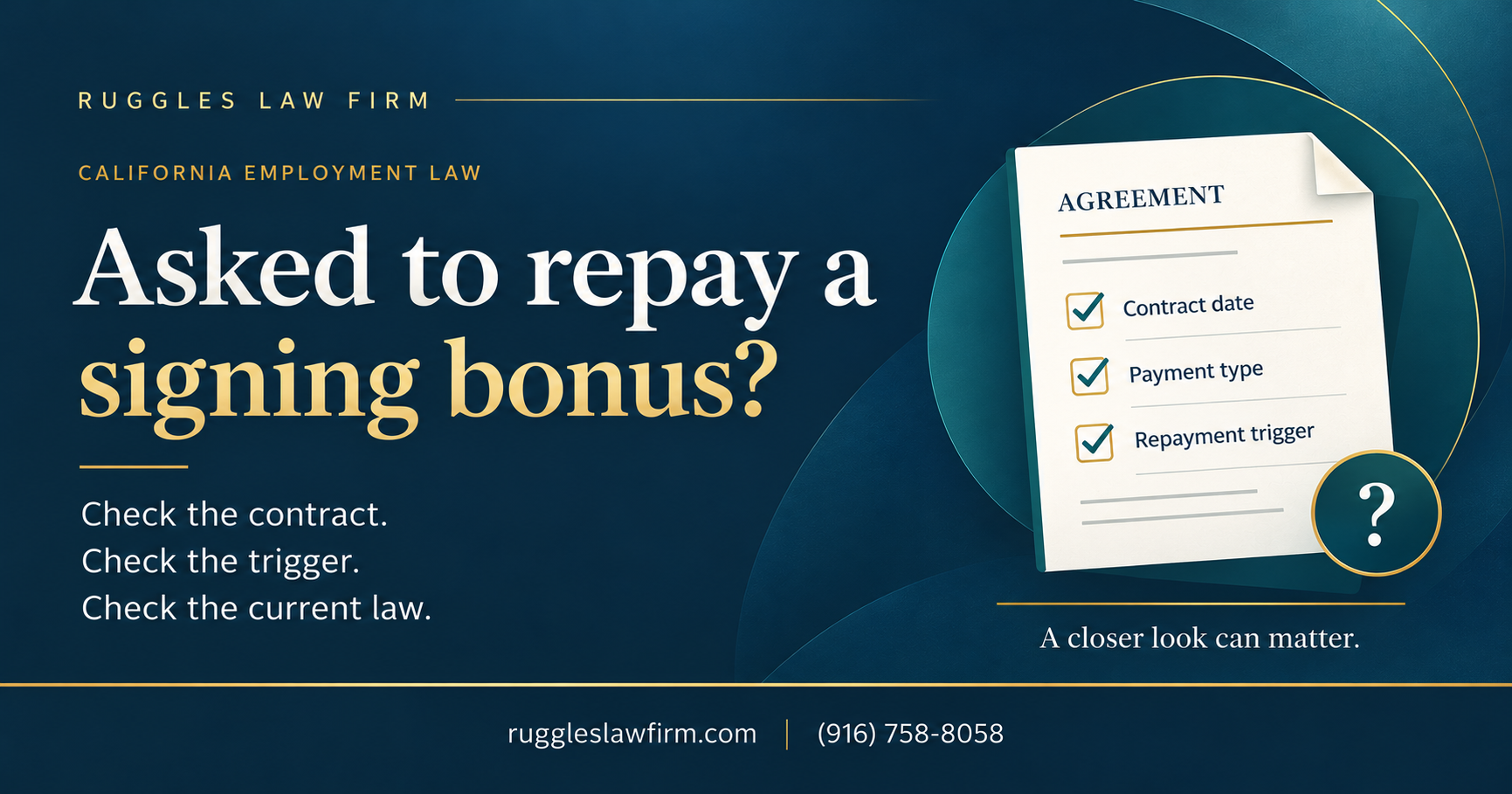
The September 30 change employees should know
A signing bonus can feel like a welcome gift when you join a company and an exit fee when you leave. The demand often arrives with the same message: You signed it, so you owe it. Before accepting that conclusion, read the actual agreement and check the current law. In California, the current-law part changed materially on September 30, 2026.
Governor Newsom signed AB 1697, an urgency measure that amended California’s stay-or-pay legislation. The new special restrictions now apply to contracts entered into on or after January 1, 2027. The legislation also makes the former 2026 versions of Business and Professions Code section 16608 and Labor Code section 926 inoperative for January 1 through December 31, 2026. Advice saying simply that every covered contract signed in 2026 is already prohibited is out of date.
That change does not establish that every earlier repayment clause is enforceable. The statute expressly preserves other laws. A demand can still raise questions about the contract’s actual trigger, wages, necessary business expenses, unlawful restraints, or other defenses. The useful answer comes from identifying which rule applies to which document, rather than announcing that every clawback is valid or every clawback is void.
This guide addresses California employment-related repayment demands as of October 6, 2026. It explains the enacted amendment, the revised exceptions, and the documents an employee should assemble before paying, resigning, or signing a severance agreement. It does not assume that California law governs every worker employed by a California-headquartered company.
Authority: AB 1697, Stats. 2026, ch. 889, §§1–4; Governor’s September 30 signing announcement. See the linked sources below.
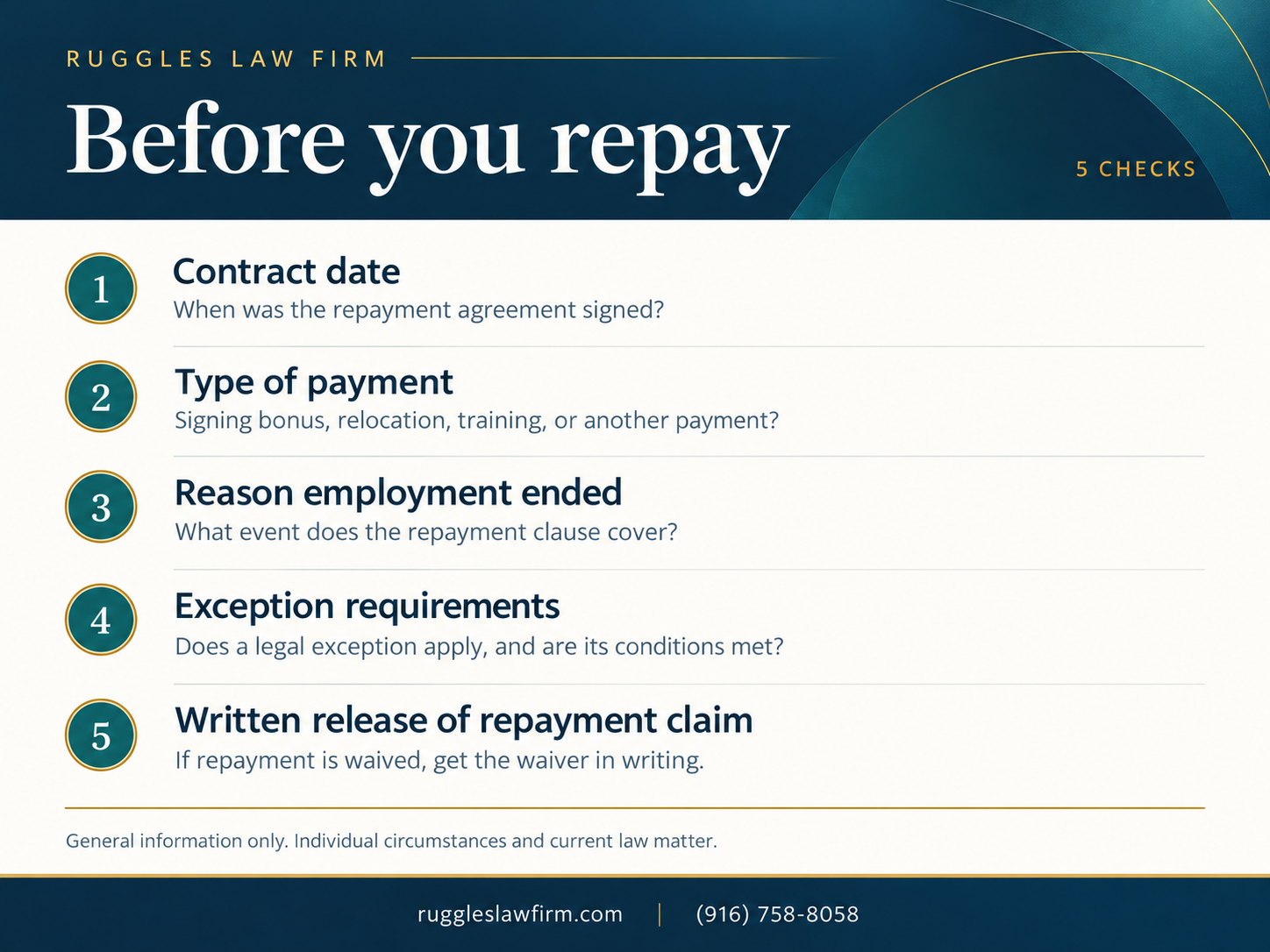
Start with the contract date, not just the departure date
Three dates can answer three different questions
- When was the repayment contract entered into? This is central to the January 1, 2027 application rule. Save signed versions, acceptance records, and amendments.
- When did you receive the payment? Under the general discretionary-payment exception, the permitted retention period runs no longer than two years from receipt of the payment.
- When and why did employment end? The exception analysis may distinguish the employee’s sole election to leave from employer-initiated separation for misconduct.
For a contract entered into before January 1, 2027, do not assume a departure in 2027 brings that contract within the new prohibition. The amended statute uses the date the contract was entered into. A later amendment, renewal, or replacement may require separate analysis; changing a date on a form does not resolve what the parties legally agreed to.
What happened to claims based on the earlier 2026 rule?
Section 1 of AB 1697 states that the amendments prevent accrual of liability for acts occurring between January 1, 2026 and the act’s effective date, and that pending claims based on violations during that period shall be moot. The amended code provisions separately make the former versions inoperative throughout calendar year 2026. Those are significant transition provisions. A lawyer handling an existing claim should review the enactment and the claim’s actual legal basis before taking another step.
An employee should not read that transition language as a declaration that an employer can recover any amount it requests. A claim based on a different law is a separate question. Likewise, an employer’s decision to withdraw a demand is different from a court determination that the contract was unenforceable.
Authority: AB 1697 §1; BPC §16608(b)(1), (c), (d); Labor Code §926(a), (d), (e). See the linked sources below.
What the revised stay-or-pay restriction covers
For contracts within its January 1, 2027 date range, section 16608 generally prohibits three kinds of separation-triggered terms, subject to exceptions: requiring a worker to pay a debt to an employer, training provider, or debt collector; allowing collection to begin or resume, or ending debt forbearance, when employment ends; and imposing a penalty, fee, or cost when the work relationship ends.
The statute uses broad definitions. A contract can include an oral or implied agreement. A claimed debt need not already be adjudicated or undisputed. The definition of worker extends beyond the simplest traditional employee relationship, and the employer definition includes specified affiliates, hiring parties, and agents. The label on the document is therefore only a starting point.
A training bill, recruiting charge, relocation obligation, or signing-bonus repayment clause deserves review when the charge is triggered by separation. But the fact that an employer calls something a bonus does not establish the bonus exception. Nor does calling an earned commission a loan automatically change the underlying earning terms.
This article focuses on exit-related repayment. For disputes over whether commissions were earned, use the firm’s commission guide rather than treating this law as a substitute for commission-plan analysis.
Authority: BPC §16608(a), (b). See the linked sources below.
The general bonus exception has five separate requirements
The revised general exception addresses a discretionary or unearned monetary payment, including a financial bonus, that is not tied to specific job performance. AB 1697 removed the earlier limitation to payments made at the outset of employment. That makes the updated wording important for retention arrangements as well as signing bonuses. All the following requirements must be met for this exception:
- Separate agreement. The repayment terms must be in an agreement separate from the primary employment contract.
- Counsel and review time. The employee must be told of the right to consult an attorney and given a reasonable period of at least five business days to obtain advice before signing.
- Proration, no interest, and a two-year maximum. Repayment for early separation must be prorated based on the remaining retention period, without interest. The retention period cannot exceed two years from receipt of payment.
- A genuine deferral option. The worker must have the option to receive the payment after fully serving the retention period, without a repayment obligation.
- Qualifying separation. Early separation must be at the employee’s sole election, or at the employer’s election for misconduct.
Do not blend these into one vague question about whether a repayment clause seems reasonable. A clause might provide proration but no deferral option. It might give five business days but require three years of service. Each term needs its own answer.
An illustration, not a client result
Assume a contract entered into in 2027 provides a $24,000 discretionary retention payment, a valid 24-month retention period measured from payment, and every other required feature. If the employee alone elects to leave halfway through that period, proportional repayment would be $12,000 on these simplified assumptions. An all-or-nothing $24,000 demand would require scrutiny. This example does not establish that a real contract qualifies, and a different statutory exception may have different requirements.
A no-fault layoff is materially different from an employee deciding to leave. The general exception does not simply permit repayment whenever the company terminates employment. It uses misconduct as defined by Unemployment Insurance Code section 1256. A contract’s broad definition of cause, an unfavorable review, or the employer’s preferred label does not by itself settle that statutory question.
Authority: BPC §16608(a)(6), (b)(2)(D). See the linked sources below.
Training repayment: a portable credential is a narrow category
The tuition exception is not a general license to charge employees for learning their jobs. The statute defines a transferable credential as a degree from a third-party institution that is accredited and authorized to operate in California, is not required for the worker’s current employment, and is transferable and useful beyond that employer.
For that exception, the tuition contract must be separate from the employment contract; obtaining the credential cannot be a condition of employment; the repayment amount must be specified in advance and cannot exceed the employer’s cost of the credential received; repayment must be proportional over the required employment period, without an accelerated payment schedule on separation; and employer-initiated termination cannot trigger repayment unless it is for misconduct.
Ask what the employer actually paid. An estimate of lost productivity, an internal training price, a recruiting expense, and third-party degree tuition are different things. Keep invoices, program descriptions, enrollment documents, and messages explaining whether the training was required. An impressive title such as professional development does not establish a statutory exception.
The statute separately exempts contracts related to enrollment in an apprenticeship program approved by the Division of Apprenticeship Standards. Do not assume an employer’s use of the word apprenticeship establishes that approval.
Authority: BPC §16608(a)(10), (b)(2)(B)–(C). See the linked sources below.
Other exceptions need their own analysis
Government programs and grant-funded bonuses
The revised law includes government-provided loan repayment or forgiveness programs. It also addresses recruitment or retention programs funded by federal, state, or local government grants when employee repayment obligations comply with grant requirements and do not exceed the grant’s required service obligations. Ask for the actual program and grant terms; a public-interest mission is not the same as a qualifying government program.
Certain licensed financial-services relationships
A distinct exception covers specified discretionary or unearned affiliation-inducement payments involving securities broker-dealers, insurance producers, investment advisers, their affiliates, and qualifying registered or licensed agents or representatives. It requires a separate repayment agreement, payment additional to compensation otherwise payable, notice of the right to counsel and at least five business days for advice, and a limit tied to the applicable federal rate if interest accrues on an outstanding obligation after separation.
The general bonus exception’s two-year/no-interest/proration features should not be copied into this separate exception as though the statutory tests were identical. Equally, working in finance does not automatically qualify someone. Identify the entity, relationship, license or registration, payment, and exact agreement.
Advanced paid time off
The amendment adds an exception for repayment arising from voluntary separation after an employer advances pay for time off beyond the worker’s accrual. The terms must be clearly disclosed separately from the primary employment contract when the worker requests the advance, the repayment obligation is limited to the statutory 40-hour amount, and interest is prohibited. Whether a debt fits this exception and whether it may be deducted from final wages remain different questions.
Residential property arrangements
Contracts related to leasing, financing, or purchasing residential property are separately excepted. An ordinary relocation reimbursement demand should not be assumed to fit simply because an employee moved. The actual transaction and contract matter.
Authority: BPC §16608(b)(2)(A), (E)–(G). See the linked sources below.
A repayment demand is not automatic permission to deduct wages
An employer can claim that you owe money without having the right to collect it by taking your final paycheck. California wage-deduction rules require a separate analysis. The Labor Commissioner’s deductions guidance explains, for example, why an employer cannot simply accelerate an entire loan balance into a final-paycheck deduction, even with a prior written authorization.
Section 16608 expressly preserves other protections, including Labor Code section 2802 concerning necessary work-related expenses. Labor Code section 2804 addresses agreements waiving that protection. A charge for necessary business expenses therefore calls for more than a stay-or-pay date check. Preserve the expense policy, directions requiring the expense, receipts, reimbursement submissions, and denial.
Keep separate columns for wages already earned, additional severance consideration, the amount the employer claims as a debt, and any proposed compromise. That prevents a severance offer from making an alleged debt appear established or quietly absorbing final wages into payment for a release.
Authority: BPC §16608(d); Labor Code §§221, 224, 2802, 2804; DLSE Deductions From Wages guidance. See the linked sources below.
The evidence checklist before you pay or leave
- The complete signed offer, employment agreement, repayment addendum, amendments, and e-signature completion records.
- Payment date, gross payment, amount actually received, payroll statement, and any separate promissory note.
- The written repayment demand, calculation, interest, deadline, collection notices, and proposed payroll deduction.
- The stated retention period, proration formula, deferral option, counsel notice, and time actually allowed to review.
- Training invoices, credential description, government grant or program terms, or licensing records if an exception is asserted.
- Termination notice, resignation communications, layoff announcement, misconduct allegations, and any opportunity to respond.
- Severance draft, release terms, offset language, surviving-obligations clauses, and agreements incorporated by reference.
- A concise timeline and lawful copies of relevant communications. Do not take trade secrets, privileged legal material, customer databases, or other employees’ private records.
Ask the employer to identify the exact provision, its calculation, and the basis for the claimed trigger. Keep your response factual. Avoid signing an acknowledgment that the debt is valid just to obtain a breakdown. Do not ignore a collection notice, lawsuit, arbitration demand, or deadline while waiting for informal clarification.
If you are considering resignation, obtain advice first when repayment is a major issue. A claim that the employer effectively forced you out can involve demanding legal standards and disputed evidence. A general article cannot safely determine that a particular resignation will count as something other than your sole election.
Authority: Practical document-review recommendations, not a statutory checklist. See the linked sources below.
Resolve the repayment issue expressly in the severance agreement
A better cash offer can still be a poor resolution if the agreement leaves an asserted repayment obligation alive. Look for language preserving every prior agreement, permitting offsets, assigning the debt, or allowing collection after the release takes effect.
When the parties agree to eliminate a repayment demand, the final writing should identify the obligation and the entities giving up the claim. It should address principal, interest, fees, collection, assignment, and offsets as appropriate to the facts. A promise that HR does not currently plan to collect is less definite than an enforceable resolution of the identified claim.
Do not automatically count the face value of a disputed or unenforceable demand as a cash recovery. Separate the legal assessment of the obligation from the practical value of closing the dispute. Any tax questions about repaid compensation, payroll adjustments, or forgiven amounts should be reviewed with a qualified tax adviser; this guide does not provide tax advice.
A focused negotiation asks the company to explain the clause, address the applicable law, and put the agreed outcome in writing. It does not depend on overstating the new statute. The firm’s severance negotiation guide explains the broader process for connecting a documented legal issue to a practical exit proposal.
Authority: Practical negotiation guidance; outcome depends on the agreement, governing law, and evidence. See the linked sources below.
Related: How to negotiate severance in California and sorting bonuses, commissions, and RSUs after termination. For the stay-or-pay date rule, use this October 6 update.
34 questions about California stay-or-pay agreements
1. What is a stay-or-pay agreement?
It is an arrangement requiring payment, repayment, a fee, or a debt-related consequence when a worker leaves a work relationship. The statutory wording covers several forms of separation-triggered debt, so the document’s title is less important than what it requires. The revised California prohibition also contains specific exceptions.
2. Did California ban all signing-bonus repayment in 2026?
No. AB 1697, signed September 30, 2026, changed the special statutory framework. The revised prohibition applies to contracts entered into on or after January 1, 2027, and the former 2026 provisions are made inoperative during 2026. Other laws can still affect enforceability.
3. Does a 2027 departure make my 2026 contract subject to the new prohibition?
Not merely because of the departure date. The revised statute uses the date the contract was entered into. Later amendments or replacement agreements require their own analysis. Save both the original and any later versions.
4. What if I signed before 2026?
The new special prohibition does not automatically invalidate that earlier contract. Have the agreement reviewed under the other laws and contract rules that apply. The signature is important evidence, but it does not answer every enforceability or collection question.
5. What if I already filed a claim under the earlier 2026 rule?
AB 1697 includes express language preventing accrual of liability for the specified pre-enactment period and making pending claims based on those violations moot. Counsel should promptly review the actual causes of action and procedural posture. Claims under independent laws need separate analysis.
6. Is a retention bonus treated differently from a signing bonus?
The revised general discretionary-payment exception no longer limits the covered payment to the outset of employment. A later retention payment may qualify if its nature and every required condition fit. A performance-earned bonus raises different questions.
7. Does calling the bonus discretionary settle the issue?
No. Review whether it is actually discretionary or unearned and not tied to specific job performance, as required by the general exception. Labels, earning conditions, payout communications, and the work performed may point in different directions.
8. Can the repayment terms be buried in the offer letter?
For the revised general discretionary-payment exception, repayment terms must be in a separate agreement from the primary employment contract. Whether particular documents satisfy that requirement depends on their content and structure. Do not assume a heading creates a separate agreement.
9. How long must I have to consult a lawyer?
The general bonus exception requires notice of the right to consult an attorney and a reasonable period of at least five business days to obtain advice before signing. That is a feature of this exception, not a universal deadline for every employment document.
10. Can a qualifying general bonus repayment term last three years?
The general exception limits its retention period to two years from receipt of payment. A three-year term therefore does not satisfy that feature. Confirm the contract date and whether a different exception is actually relevant before deciding what that means for enforceability.
11. Must the general bonus repayment amount decrease over time?
Yes, the general exception requires proration based on the remaining retention period. An all-or-nothing repayment requirement deserves close review. Do not apply this answer automatically to contracts outside the date range or to a different statutory exception.
12. Can the general bonus repayment obligation accrue interest?
The general discretionary-payment exception prohibits interest accrual on the early-separation repayment obligation. The separate financial-services affiliation exception has different language addressing post-separation interest. Identify the correct exception before comparing terms.
13. Do I have to be offered deferred payment instead?
The general exception requires an option to receive the payment after fully serving the retention period without a repayment obligation. Ask for the written option and how it was offered. Proration alone does not replace this requirement.
14. What if I am laid off rather than resign?
The general exception requires separation at the employee’s sole election or employer-initiated separation for misconduct. A no-fault layoff is different. Earlier contracts and other exceptions still require their own analysis, so do not rely only on this one condition.
15. Does a company definition of cause establish misconduct?
Not by itself. Section 16608 incorporates misconduct as defined by Unemployment Insurance Code section 1256. A company’s broad cause clause or performance criticism does not automatically answer that statutory question. Preserve the specific allegations and your response.
16. Can I resign and call it a forced departure?
That characterization can be disputed and may turn on legal standards and detailed facts. Get advice before making an irreversible decision when repayment is substantial. Do not assume workplace dissatisfaction automatically removes an employee-elected separation from the exception.
17. Does ordinary job training qualify as a transferable credential?
Not simply because the skills are useful. The statute defines a qualifying credential as a degree from an accredited third-party institution authorized to operate in the state, not required for the current job, and transferable and useful beyond the employer. Other exception requirements also apply.
18. Can the employer charge more than the degree cost?
The transferable-credential exception requires an advance-specified amount no greater than the employer’s cost of the credential received. Obtain invoices and identify what each charge represents. Internal estimates or unrelated recruiting costs should not be casually treated as tuition.
19. Can tuition repayment accelerate immediately when I leave?
The transferable-credential exception requires proportional proration during the required employment period and prohibits an accelerated payment schedule on separation. Compare the repayment schedule before and after departure. This is separate from the general bonus exception.
20. Are approved apprenticeships excepted?
The statute separately excepts contracts related to enrollment in apprenticeship programs approved by the Division of Apprenticeship Standards. Ask for the program identity and approval. An employer describing training as an apprenticeship does not itself establish the exception.
21. What changes for government-funded recruitment bonuses?
The amendment includes qualifying government-grant-funded recruitment and retention programs. Repayment obligations must comply with grant requirements and not exceed the grant’s required service obligations. Obtain the grant terms rather than relying on a general statement that public funding was involved.
22. Does everyone in banking or finance fall within a special exception?
No. The separate affiliation exception identifies particular broker-dealer, insurance, and investment-adviser relationships and qualifying registered or licensed agents or representatives. The agreement and payment must also meet additional conditions. A finance job title is insufficient.
23. Does the financial-services exception require the same two-year formula?
It has a different statutory test. Do not import the general exception’s entire two-year, no-interest, proration formula into it. Review its separate-agreement, additional-payment, counsel-review, licensing, and post-separation interest conditions directly.
24. Can advanced paid time off create a repayment obligation?
The amendment provides a limited exception for qualifying advances beyond accrued time off when separation is voluntary. Separate disclosure at the worker’s request, the 40-hour statutory limit, and no interest are required. Final-wage deduction rules remain a separate issue.
25. Can my employer simply deduct the debt from my final check?
Not automatically. A potentially valid debt does not establish a lawful final-wage deduction. California wage rules and Labor Commissioner guidance restrict employer self-help, including acceleration of a loan balance into final pay. Save the wage statement and any deduction authorization.
26. What if the charge is for necessary business expenses?
Section 16608 expressly preserves Labor Code section 2802 protections. Identify what the expense was, why it was required, and who directed it. A stay-or-pay exception does not eliminate the need to analyze reimbursement duties and other applicable law.
27. Can a relocation repayment clause use the residential-property exception?
Do not assume that it can. The exception covers contracts related to leasing, financing, or purchasing residential property. The actual contract and transaction need review; a generic relocation reimbursement is not automatically the same arrangement.
28. Does this law automatically vest my RSUs?
No. A repayment demand, an earning condition, and forfeiture of unvested equity are distinct issues. Review the grant and plan, the separation terms, and any applicable independent law. This article does not promise equity acceleration.
29. What remedies does the revised law provide?
For a qualifying violation, Labor Code section 926 authorizes a civil action and provides actual damages or $5,000 per worker, whichever is greater, plus injunctive relief and reasonable attorney fees and costs. Recovery is not automatic and depends on the applicable contract date, violation, and proceeding.
30. Does a California headquarters mean this law governs me?
Not necessarily. Work location, contract terms, the relationship, and applicable choice-of-law principles can matter. A multistate worker should obtain an individualized assessment. This guide is about California law, not a nationwide prohibition.
31. What should I ask for when the employer demands repayment?
Ask for the complete agreement, the precise triggering provision, the payment record, and a calculation showing principal, proration, interest, and fees. Preserve the response deadline. Requesting documents does not itself extend a deadline or stop a proceeding.
32. Should severance expressly resolve the alleged debt?
If eliminating repayment is part of the bargain, the final agreement should identify and resolve the obligation clearly. Review surviving-agreement and offset provisions and which entities release the claim. A verbal assurance can leave a substantial dispute unresolved.
33. Should I pay first and challenge the clause later?
That decision depends on the documents, deadlines, collection risks, and available defenses. Seek advice before paying or signing a debt acknowledgment when the amount is material. Also involve a qualified tax adviser where repayment affects previously taxed compensation.
34. What should I bring to a consultation?
Bring the signed contract and amendments, payment records, repayment demand, severance draft, and a short separation timeline. Include training, grant, or licensing documents if an exception is asserted. Tell the lawyer about every response, signing, collection, or litigation deadline.
Get the repayment demand reviewed before deciding
A useful review starts with the signed agreement, payment record, separation timeline, and the employer’s actual calculation. Ruggles Law Firm represents California employees in employment disputes and severance negotiations.
Learn about severance review and negotiation or contact Ruggles Law Firm. Call (916) 758-8058. Identify any signing or response deadline when requesting a consultation.
Primary law and official guidance
- AB 1697, Statutes of 2026, chapter 889, sections 1–4, amending Business and Professions Code section 16608 and Labor Code section 926. Accessible reproduction of the chaptered statutory text. The official bill-text endpoint was unavailable during review; the chaptered text was read in reproduction and signing independently confirmed below.
- Governor’s September 30, 2026 signing announcement, identifying AB 1697 among signed bills.
- Labor Code section 2802 and section 2804, necessary work expenses and waiver.
- California Labor Commissioner: Deductions From Wages, official agency guidance concerning Labor Code sections 221 and 224 and final-pay deductions.
This article discusses enacted California statutes, not a new court decision. Agency guidance is not itself binding judicial precedent. No litigation result or client example is presented.
Legal disclaimer: General information only, not legal or tax advice. Reading this article or contacting the firm does not create an attorney-client relationship. Laws, exceptions, governing-law issues, and deadlines require individual review. No result is promised.