
Your offer letter says “exempt.” Your calendar says fifty hours. Your paycheck says the same thing every two weeks. Before accepting the conclusion that overtime is simply part of the job, check what the exemption actually requires.
What is California’s 2027 exempt salary threshold?
Beginning January 1, 2027, California’s standard executive, administrative, and professional exemptions require a salary of at least $72,384 a year, or $6,032 a month. The employee must also satisfy the applicable duties and salary-basis requirements. A salaried employee who does not qualify for an exemption may be entitled to overtime.
This article addresses the standard California white-collar exemptions. Special rules apply to covered health care and fast-food employment, computer professionals, sales employees, and other categories.
The California Department of Industrial Relations has announced the 2027 increase. The statewide minimum wage will rise to $17.40 per hour. Because the standard salary test is tied to twice the state minimum wage for a forty-hour week, that change also moves the exemption threshold.
The useful question for an employee is what happens next. Will the company raise the guaranteed salary? Reclassify the position and begin paying overtime? Or leave the same label on a job that no longer meets the test?
Key takeaways for California employees
- The standard annual salary floor increases by $2,080 on January 1, 2027.
- A salary above the floor does not resolve the duties test. “Manager,” “analyst,” and “professional” are job titles, not complete legal analyses.
- A salary below the floor does not automatically require a raise. An employer may instead use a lawful nonexempt pay arrangement.
- A change in classification should come with accurate timekeeping, overtime treatment, and applicable break protections.
- A January correction does not answer whether earlier work was properly paid. Keep the old records as well as the new ones.
The salary floor moves on January 1
For the standard California white-collar exemptions, the annual calculation is the statewide minimum wage multiplied by two, multiplied by forty hours, multiplied by fifty-two weeks. Full-time employment for this purpose means forty hours per week. It is a statutory benchmark, not an estimate of how many hours a particular employee usually works.
| Effective period | State minimum wage | Annual salary floor | Weekly equivalent |
|---|---|---|---|
| 2026 | $16.90 per hour | $70,304 | $1,352 |
| January 1, 2027 | $17.40 per hour | $72,384 | $1,392 |
The 2027 monthly salary floor is $6,032. These are gross compensation figures. Sources: DIR minimum-wage guidance, 2027 announcement, and Labor Code section 515. Industry-specific rules can require more.
Consider a $72,000 annual salary. It clears the standard 2026 salary floor, but falls $384 short of the 2027 floor. The difference is small enough to disappear in a compensation spreadsheet. It is still a difference that matters to the exemption.
A higher city minimum wage generally does not replace the statewide wage in this standard salary calculation. It may, however, control the hourly minimum owed to a nonexempt employee working in that city. Keep those two questions separate when reviewing a pay change.
A valid exemption requires more than the number
Start by identifying the actual exemption the employer is relying on and the applicable wage order. Under Wage Order 4, for example, the executive, administrative, and professional categories each have specific requirements. The Labor Commissioner’s exemption overview also identifies categories that follow different rules.
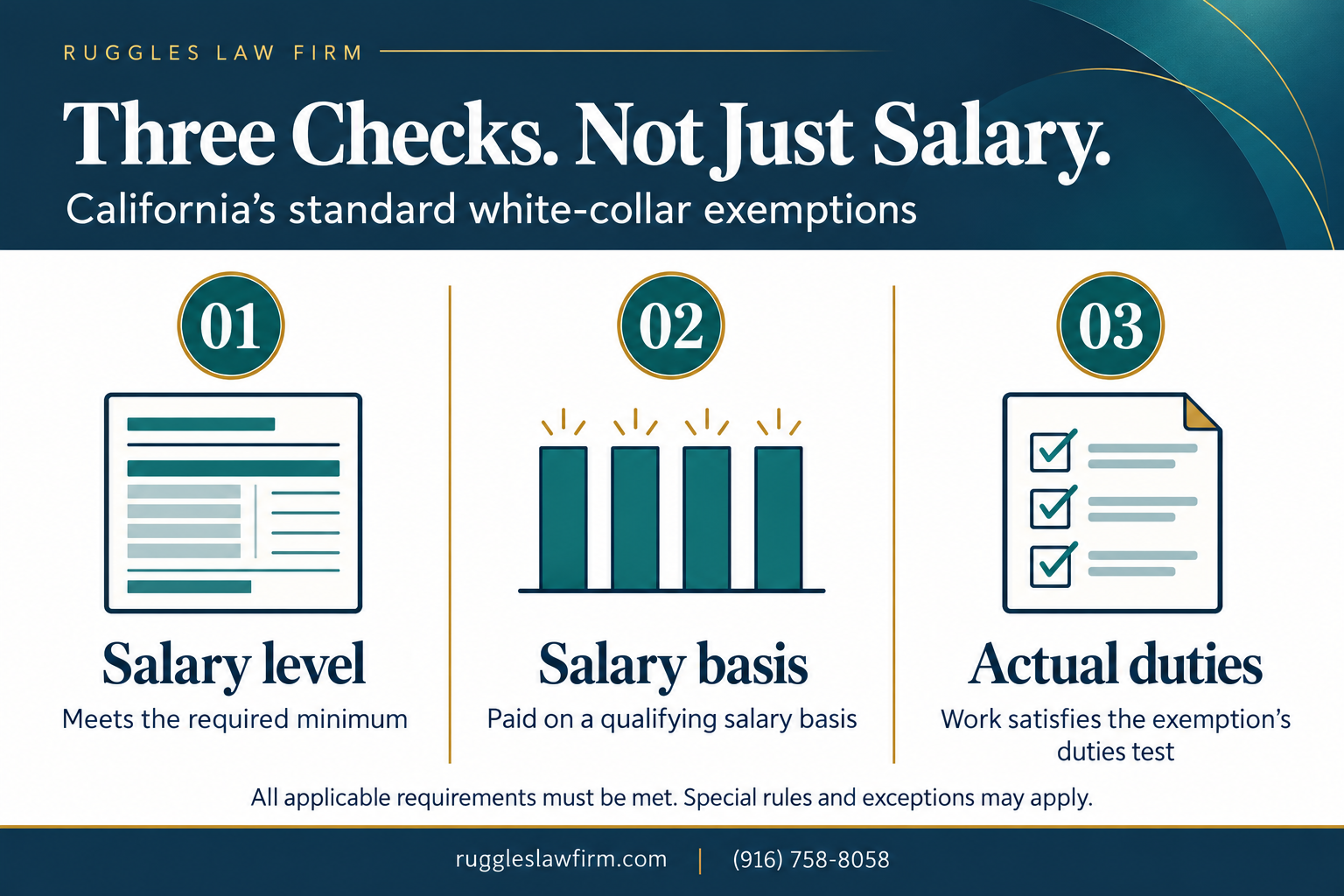
1. The required salary level
The guaranteed salary must meet the applicable minimum. A total-compensation presentation that combines base pay, a hoped-for bonus, commissions, benefits, and stock can obscure the issue. For the standard salary test, a nondiscretionary bonus does not fill a gap in the required salary. The DLSE addressed that distinction in its October 11, 2016 opinion letter.
2. A qualifying salary basis
The salary-basis inquiry concerns how the employee is actually paid, including whether the required salary is guaranteed and whether deductions are permissible. An annual figure in an offer letter is not the entire inquiry if payroll repeatedly reduces the employee’s cash salary because work is slow or the employee leaves early. Some deductions are allowed; reductions to a leave bank are not necessarily the same as reductions to salary. Review the pay statements and the reason for each deduction before reaching a conclusion.
3. The duties actually performed
California’s standard duties analysis generally requires the employee to spend more than half of working time on qualifying exempt work. Actual duties, the employer’s realistic expectations, and the realistic requirements of the job matter. A job description prepared for recruiting may be evidence. It is not a substitute for what happens on an ordinary Tuesday.
- Executive: Examine management responsibility, supervision of at least two employees, personnel authority or recommendations given particular weight, discretion, and the time spent on qualifying work.
- Administrative: Examine qualifying office or nonmanual work related to management policies or business operations, independent judgment, and the other requirements. Routine office work does not become exempt merely because it is performed at a desk.
- Professional: Examine the particular recognized, learned, or artistic profession and the required work and judgment. A degree alone does not establish the exemption.
Mixed duties require care. Work closely related to a genuinely exempt function can count toward that function. Conversely, a management title does not convert every routine task into management. A useful work log describes the task, its purpose, who made the decision, and how much time it took.
Matt’s legal perspective: The most useful question is often, “Show me a normal week.” Compare that week with the payroll records and the claimed exemption. If those records tell different stories, the label in the personnel system will not resolve the conflict.
Three examples that show where the review changes
These are hypothetical illustrations, not actual clients, case results, or predictions of recovery.
A $72,000 salary that crosses the line in January
Assume an employee performs qualifying administrative duties and properly receives a guaranteed $72,000 annual salary throughout 2026. Assume no industry-specific rule applies. The salary clears the 2026 standard floor. If it stays unchanged in January 2027, it no longer clears that floor.
The employer could raise the salary enough to satisfy the new requirement, while continuing to satisfy the other tests. It could also classify the employee as nonexempt and comply with the corresponding pay and working-condition rules. If the employee remains below the required salary and works overtime, continuing to call the position “exempt” does not answer the unpaid-wage question.
An $85,000 manager who mostly performs routine work
Assume a department lead earns $85,000, spends most working time processing the same routine transactions as the team, cannot meaningfully recommend personnel decisions, and follows detailed instructions for nearly every consequential choice. The salary is above the standard 2027 floor. The executive exemption still requires a close look at the work and authority.
Ask who actually runs the department, whether the lead’s recommendations carry weight, and whether particular activities genuinely serve a management function. A title change and a salary increase cannot fix missing duties. The evidence may support nonexempt status even before 2027.
A lawful move to nonexempt status that needs workable timekeeping
Assume a company reclassifies an employee as nonexempt on January 1 and says overtime must be approved. It also continues requiring the employee to review messages after dinner and prepare materials before logging in each morning.
The timekeeping system must capture compensable work. A rule requiring advance approval does not erase overtime the employer knew or should have known was being worked. The company may enforce a lawful scheduling rule, but it must still pay for compensable work. The practical issue is whether the new system reflects the actual workload.
What nonexempt status changes
Nonexempt employees can be paid a salary. They still must receive the wages and protections the law requires. Under Labor Code section 515(d), a nonexempt employee’s fixed salary is compensation only for regular, nonovertime hours, regardless of a private agreement to the contrary.
For employees subject to the ordinary California overtime rules, time-and-a-half generally applies after eight hours in a workday or forty hours in a workweek, with separate seventh-day rules. Double time generally applies after twelve hours in a workday and after eight hours on the seventh consecutive day worked in a workweek. Do not add overlapping premiums twice for the same hours. Valid alternative workweek schedules and statutory exceptions can change the analysis. The DIR overtime guide explains the basic framework.
The regular rate may include more than base pay. Certain bonuses and other compensation can affect the overtime calculation. A quick estimate that divides every payment by every hour can therefore be wrong in more than one direction.
Classification also affects applicable meal-period and rest-period protections. A review should examine the actual opportunity to take required breaks, interruptions, time records, and any premiums owed. An overtime exemption and a break exemption are not interchangeable across every special category.
If wages were underpaid, available relief depends on the claim and facts. Labor Code section 1194 authorizes recovery of unpaid overtime, interest, and reasonable attorney’s fees and costs in a civil action. Other remedies require their own elements. Do not assume every classification error produces every penalty.
Do not apply $72,384 to every job
The standard figure is useful because many employees encounter it. It becomes misleading when it is presented as the answer for the entire workforce.
- Covered health care employees: The salary test can depend on the applicable health care minimum wage. DIR describes a comparison between one and one-half times the applicable health care minimum wage and twice the statewide minimum wage, using the greater amount. Facility type, coverage, and effective dates matter. See the health care minimum-wage FAQ.
- Covered fast-food employees: Special wage rules affect the salary threshold for managers at covered establishments. Do not use the general statewide figure without checking the fast-food minimum-wage FAQ and the rate applicable to the period at issue.
- Computer professionals: California has a separate exemption with its own compensation and duties requirements. Using software, working for a technology company, or having “engineer” in a title is insufficient. Verify the applicable year’s rates on the DIR computer-software page.
- Sales employees: Outside sales and certain commissioned employees have separate tests. Not every salesperson qualifies, and not every exemption removes the same protections.
- Other special settings: Public employment, collective-bargaining agreements, and particular occupations can change which rules govern. Start with the employee’s work, employer, industry, and applicable wage order.
This article does not supply a 2027 fast-food, health care, or computer-professional dollar threshold. Each requires a separate, current coverage and rate check.
Build a record that answers the real questions
An employee does not need to turn a workplace concern into a legal brief. A clear factual record is more useful. Start with these categories:
- Salary history: Save offer letters, compensation notices, and pay statements showing when each salary took effect. Separate base salary from bonuses, commissions, and equity.
- Actual work: Record representative days, with approximate time spent on significant tasks. Describe approvals, discretion, supervision, and routine production work.
- Hours: Preserve lawful copies of schedules, calendars, relevant messages, and your own contemporaneous notes. Include required preparation, after-hours tasks, and interrupted breaks.
- Authority: Identify who made hiring, firing, budget, scheduling, and policy decisions, and what happened to your recommendations.
- Instructions: Keep relevant directions about time entry, overtime approval, salary deductions, and classification. Record dates and speakers accurately.
- The transition: Retain both the old arrangement and the January change. Compare stated hours, actual workload, pay, and benefits without assuming the change proves a past violation.
- Your chronology: List employment dates, role changes, pay changes, complaints, responses, and any adverse actions.
Preserve only records you may lawfully retain. Do not take trade secrets, privileged communications, customer files, or coworkers’ confidential records to build a wage claim. Do not alter records or secretly record confidential conversations without understanding California’s recording law.
If the employer never tracked your hours, that does not automatically end the inquiry. A careful reconstruction supported by calendars, messages, and witness information can be important. Distinguish what you know from what you estimate. “Usually about forty-five minutes after dinner” is more useful when you can identify the task and supporting messages.
What to ask before the first January paycheck
A focused written question can prevent an avoidable misunderstanding: What will my classification and guaranteed salary be effective January 1, 2027, and how should I record all work time if the position becomes nonexempt?
Then ask how the company will handle after-hours work, meal and rest periods, overtime approval, and the existing workload. Keep the answer. If the compensation notice arrives after January 1, identify the effective date and whether payroll addresses the intervening work.
A company’s decision to reclassify a job is not, by itself, an admission of earlier wrongdoing. It also does not settle an earlier claim. The earlier period must be evaluated under the salary floor, duties, pay practices, and laws that applied then.
Employees can raise wage concerns and seek advice. Labor Code section 98.6 protects specified wage-related complaints and activity from retaliation. Keep a factual record if pay, duties, scheduling, or treatment changes after a complaint. An unfavorable change is evidence to examine, not automatic proof of retaliation.
Do not wait for a promised payroll review to resolve filing deadlines. The Labor Commissioner generally identifies a three-year filing period for unpaid-overtime wage claims; other claims and procedures may involve different periods. An internal complaint or ongoing conversation should not be assumed to pause the clock.
For the broader classification framework, read the firm’s guide to resolving a California misclassification dispute. For a review of related pay problems, see common California wage violations.
35 frequently asked questions about California’s 2027 salary threshold
These answers address general California rules. The applicable exemption, industry, wage order, work location, and time period can change the result.
The new salary threshold
1. What is the standard California exempt salary threshold in 2027?
It is $72,384 annually, equivalent to $6,032 monthly, beginning January 1, 2027. This is the salary floor for the standard executive, administrative, and professional exemptions. Satisfying it does not establish the entire exemption, and special industries or other exemptions may use different rules.
2. How much does the threshold increase from 2026?
The standard annual floor rises from $70,304 to $72,384, an increase of $2,080. The weekly equivalent increases from $1,352 to $1,392. Compare the required salary with the guaranteed salary actually paid, rather than a total-compensation estimate that includes benefits or potential incentive compensation.
3. Does the new rule begin when my company runs its first January payroll?
The new threshold takes effect January 1, 2027. A payroll processing date does not postpone the legal change. If a pay period crosses January 1, the employer needs to account correctly for the effective date, classification, and work performed. Ask which date a compensation adjustment actually covers.
4. Are these gross salary figures or take-home pay?
They are gross salary figures, before ordinary payroll withholding. A net paycheck below the monthly figure does not itself show an exemption problem. Review gross salary, the pay-period length, and any deductions from salary separately from taxes and other properly authorized deductions.
5. Is a $72,000 salary enough in 2027?
Not for the standard salary test. It is $384 below the $72,384 annual floor. An employee might fall under a different exemption, but the employer cannot satisfy the standard white-collar salary requirement merely by describing that gap as minor. Duties and all other applicable requirements still need review.
6. Must my employer raise my salary to $72,384?
Not necessarily. The employer may use a lawful nonexempt arrangement instead of preserving an exemption. It must then comply with applicable minimum-wage, overtime, timekeeping, and break requirements. Whether a particular compensation change is otherwise lawful can also depend on notice, contract terms, and whether it is retaliatory or discriminatory.
7. Can the standard salary threshold be prorated for part-time work?
Generally, no. The standard test uses the full-time statutory benchmark even if the exempt employee has a reduced schedule. The DLSE enforcement manual addresses this in section 51.6.6. A part-time role can be nonexempt, with pay and overtime rights evaluated under the rules that apply to the actual work.
8. Does a higher city minimum wage increase this standard salary floor?
The standard white-collar salary test is tied to California’s statewide minimum wage. A higher local minimum wage generally does not replace that benchmark. The local rate can still matter to the minimum wages owed for nonexempt work in that jurisdiction. Industry-specific salary rules require a separate check.
9. Can a year-end bonus make up a salary shortfall?
Do not assume so. For the standard California test, nondiscretionary bonuses do not count toward the required salary under the DLSE’s October 2016 opinion letter. A promise that total annual compensation will exceed the floor is therefore not equivalent to paying the required qualifying salary.
10. Does a 2027 salary increase fix unpaid overtime from 2026?
No. A prospective salary change does not itself resolve an earlier underpayment. Review the earlier period using the salary requirement then in effect, the actual duties, the salary-basis rules, and the hours worked. A job could have been misclassified in 2026 because of its duties even if its salary exceeded the 2026 minimum.
Titles, duties, and pay practices
11. Does being salaried mean I am exempt from overtime?
No. Salary describes a way of paying an employee. Exempt status depends on a legal exemption. A salaried nonexempt employee remains entitled to applicable overtime. For the standard white-collar exemptions, check the required salary level, salary basis, and actual qualifying duties rather than relying on the payment label.
12. Does a manager title establish the executive exemption?
No. The executive test examines actual management, supervision, personnel authority or influential recommendations, discretion, and qualifying work time. A “manager” who mainly performs routine frontline work may not satisfy it. Some work connected to real management can qualify, so a task-by-task factual review is more useful than the title alone.
13. What does “primarily engaged” mean under the standard California duties test?
It generally means more than one-half of the employee’s work time is spent on qualifying exempt duties. The work actually performed, realistic employer expectations, and realistic job requirements matter. Simply listing five managerial responsibilities and four nonmanagerial responsibilities does not measure the time or character of the work.
14. Does supervising one person make me an exempt executive?
Supervising one person does not satisfy the executive requirement to customarily and regularly direct the work of two or more employees. The other executive requirements also must be met. A different exemption might apply on particular facts, but occasional oversight or a team-lead title is not a substitute for the relevant test.
15. Is every office employee administratively exempt?
No. Routine clerical, processing, and customer-service work does not become administratively exempt just because it is nonmanual. The test examines the work’s relationship to management policies or business operations, discretion and independent judgment, and the other regulatory requirements. Ask what decisions the employee actually makes and what approvals are required.
16. Does having a college degree make me a professional employee?
No. The professional exemption focuses on qualifying professional work and its other requirements. A degree may be relevant to a learned profession, but an employee who uses a degree to perform routine, standardized work does not automatically qualify. Particular occupations, including nursing and pharmacy, have additional rules that deserve specific review.
17. Can a job description prove that I am exempt?
It is evidence, but actual work matters. Compare the description with representative days, assigned tasks, approval requirements, staffing, and the employer’s realistic expectations. If the document describes strategy while the employee’s week consists largely of routine processing, that mismatch is worth investigating. Preserve the description and dated examples of the actual work.
18. What if payroll docks my salary when I leave early?
A deduction from cash salary can raise a salary-basis issue, but the reason and circumstances matter. Permissible deductions and adjustments to accrued leave require separate analysis. Keep the pay statement, the policy, the date, and the explanation. Do not assume every leave-bank deduction is an unlawful reduction in salary.
19. Does a six-figure salary automatically remove California overtime rights?
No. California’s standard exemptions still require qualifying duties and other elements. Do not substitute a federal highly compensated employee analysis for California’s requirements. A substantial salary can satisfy the salary level while leaving unresolved whether the employee exercises the required judgment and performs enough qualifying work.
20. Does working remotely change the exemption test?
Working from home does not itself make an employee exempt. For work governed by California law, the relevant duties and compensation requirements still apply. Work location and multistate arrangements can create additional coverage questions. Preserve the employer’s timekeeping instructions and a record of required calls, preparation, and after-hours tasks.
Overtime and special categories
21. Can a nonexempt employee still receive a salary?
Yes. Nonexempt status does not require every employee to be paid solely by the hour. But a fixed salary does not purchase unlimited overtime. California law treats a nonexempt employee’s fixed salary as compensation for regular, nonovertime hours, and the employer must separately satisfy applicable overtime and other wage obligations.
22. Do I need to work more than forty hours to earn California overtime?
Not always. Under the ordinary rules, working more than eight hours in a workday can trigger overtime even if the workweek totals forty hours or less. Separate seventh-day and double-time rules may apply. Valid alternative workweek schedules and specific exceptions can change the calculation, so identify the governing schedule and wage order.
23. Can my employer refuse overtime because I did not get advance approval?
A company generally must pay for overtime it knew or should have known was worked, even if a rule required advance approval. It may enforce a lawful policy through appropriate discipline. Employees should record all compensable work accurately and report workload problems rather than omit time to make the schedule appear compliant.
24. Does work email after hours count?
Required or permitted work outside the scheduled day can be compensable. The facts include what the employee did, how long it took, and what the employer knew or expected. A vague claim of being “always available” is different from a record of actual tasks. Track substantive calls, responses, and preparation accurately.
25. Can a bonus affect overtime even if it does not satisfy the exempt salary test?
Yes. These are different calculations. Certain bonuses must be considered when determining a nonexempt employee’s regular rate for overtime. Whether a payment counts, the period it covers, and how it is allocated require review. A compensation item can be irrelevant to satisfying the exempt salary floor yet relevant to overtime owed.
26. Do nonexempt employees receive meal and rest breaks?
Applicable California wage orders generally provide meal and rest-period protections for nonexempt employees, subject to specific rules and exceptions. Review shift length, timing, whether the employee was relieved of duty, interruptions, and any valid waiver. A salary does not itself eliminate breaks, and not every special overtime exemption also removes break rights.
27. Is $72,384 the correct threshold for covered health care employees?
Do not assume that. Covered health care employment can require a salary based on the greater of one and one-half times the applicable health care minimum wage or twice the statewide minimum wage. Coverage, facility category, and effective dates matter. Use the current DIR health care guidance rather than the general figure alone.
28. Is $72,384 enough for a manager at a covered fast-food restaurant?
The general statewide figure is not the complete answer. Covered fast-food establishments have special minimum-wage rules that affect the exempt-manager salary calculation. Confirm that the establishment and employee are covered, identify the rate effective for the work period, and review duties. Do not apply a prior year’s special rate without checking it.
29. Does every software employee use the standard salary threshold?
No. The computer-professional exemption has specific compensation, skill, and duties requirements, with periodically adjusted rates. A company’s industry or a software-related title does not establish that exemption. Identify which exemption is actually claimed and consult the official rate for the relevant year before deciding whether the salary is sufficient.
30. Are sales employees automatically exempt?
No. Outside sales has a distinct test based on actual selling activity away from the employer’s place of business. Certain commissioned employees covered by Wage Orders 4 and 7 can qualify for a separate overtime exemption if its earnings and commission requirements are met. A commission plan alone does not settle classification or break rights.
Records and next steps
31. Can I have a wage claim without perfect time records?
Potentially. Missing records do not automatically defeat a claim. Calendars, messages, schedules, system information, witness evidence, and a reasonable reconstruction can help establish the work performed. Be specific and candid about estimates. Preserve records lawfully and identify representative periods rather than inventing precision the evidence does not support.
32. Does reclassification prove that my employer violated the law before?
No. Employers may change classifications for different reasons, including a new threshold or a prospective business decision. The change also does not erase any earlier underpayment. Evaluate each earlier period on its own salary, duties, hours, and pay practices. Retain both versions of the compensation and classification documents.
33. Can my employer retaliate because I ask about unpaid overtime?
California law protects specified wage complaints and related activity from retaliation. Protection depends on the conduct and facts; it does not prevent legitimate action for an unrelated lawful reason. Record what you reported, to whom, when, and what changed afterward. Seek advice promptly if a complaint is followed by threats, reduced work, or termination.
34. How long do I have to pursue unpaid overtime?
The Labor Commissioner generally identifies a three-year period for unpaid-overtime wage claims. Different legal theories, forums, exceptions, and related claims can involve different deadlines. Do not treat that general period as a complete limitations analysis or assume discussions with HR suspend it. Obtain advice based on the actual dates and potential claims.
35. What should I bring to an initial case consultation?
Bring your employment dates, salary history, pay statements, offer letter, job descriptions, a practical account of your actual duties, representative hours, and relevant classification or wage communications. Identify where you worked and whether a union agreement or public employer is involved. A concise timeline makes it easier to assess coverage, evidence, potential wages, and deadlines.
Request an initial case consultation
If your salary, duties, and working hours do not match your employer’s exemption label, a focused review can identify the issues that matter. Ruggles Law Firm represents California employees in unpaid-wage and overtime matters.
Call (916) 758-8058 or Request an initial case consultation
Be ready to describe your salary history, actual duties, typical overtime, employment dates, and available pay records.
Primary sources and further reading
Source check date: October 3, 2026. Consult the current law and the wage order that applies to the employment.
- DIR 2027 minimum-wage and exempt-salary announcement
- California Labor Code section 515 and Wage Order 4, including sections 1, 2, and 3
- DLSE Enforcement Policies and Interpretations Manual, including salary-basis guidance and section 51.6.6 (read with current law; historical dollar examples are outdated)
- DLSE October 11, 2016 bonus opinion
- DIR overtime questions and answers and exemption overview
- Labor Commissioner wage-claim guidance
This article provides general information about California employment law as of October 3, 2026. It is not legal advice and does not create an attorney-client relationship. The applicable law, exemption, remedies, and deadlines depend on the facts. Hypothetical examples are illustrations only and do not promise a result.
